Posts Tagged ‘ Karachi ’

How to Succeed in Business in Pakistan

By Naween Mangi for Bloomberg Businessweek
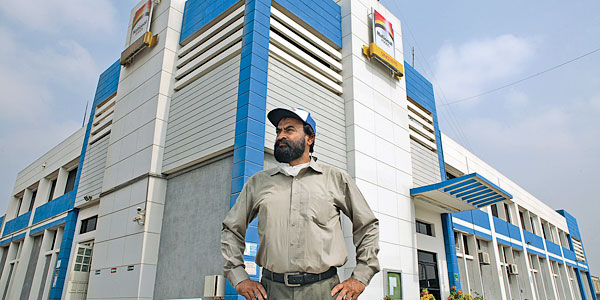
Muhammad Azhar Ali, factory manager for National Foods in Karachi, Pakistan, has a set work routine. At dawn he calls his production managers, who live in different parts of this sprawling city of 18 million on the Arabian Sea, to find out whether outbreaks of violence have rendered any areas dangerous.

If conditions seem especially risky, Ali slips two wallets into his pocket—one real and the other filled with expired credit cards and loose change, ready to hand over if bandits hold him up. He’s been held up once. He checks to make sure he isn’t riding in the same car as the day before, usually shunning his company-provided Toyota Corolla (a favorite vehicle for Pakistan’s upper-middle class) for his own less conspicuous Suzuki Cultus hatchback.

Finally, Ali and his driver head out to meet the 15 buses that have picked up employees at different collection points. Once all the buses have assembled at the rendezvous, Ali leads the convoy 50 kilometers from the city center to National Foods’ main plant. When the convoy arrives at 7:45 a.m. after a 90-minute drive, the workers line up outside a boundary wall topped with barbed wire and go through a body search as guards armed with shotguns look on. Ali monitors the security check on closed-circuit television from his office. The workday is about to begin. He has been up for more than three hours.

“Anyone else in my position in another country would have half the work I do,” says Ali, 49, who has worked at the company, Pakistan’s largest maker of spices and pickles, for over 25 years. “If I didn’t have to spend so much time figuring all this out, I would be looking at ways to enhance productivity.”

Companies across Pakistan’s industrial heartland are struggling to cope with rising insecurity, incessant power outages, and government corruption and inefficiency. Pakistan has lost 35,000 civilians in terrorist attacks since 2006. The war on the Taliban has cost $68 billion in destroyed infrastructure, higher security costs, lost foreign investment, and more.

Karachi has suffered retaliatory attacks from the Taliban such as the 16-hour siege at a naval air base in May that left 10 guards dead. Firefights erupt almost daily between the followers of Pakistan’s numerous political parties. Gunmen killed 664 people in the city between Jan. 1 and June 30, according to the Edhi Foundation, a charitable operator of ambulances. A Karachi resident is almost three times more likely to be killed by a bullet than in a road accident.

Gun battles lead to factory shutdowns in the city almost every month. The government hopes to boost economic growth from 2.4 percent in the last fiscal year to 4.2 percent this year. Growth needs to be 7 percent or more to accommodate all the young people joining the workforce. Large-scale manufacturing contracted 2.3 percent in May, vs. a year ago. Only 1.5 million of 180 million people pay taxes. Many of National Foods’ rivals pay no taxes as they sell unbranded spices bulked up with brick dust. “Working in Pakistan is like always being in a nightmare,” says Abid Muhammad Ganatra, director of finance for the nation’s biggest cement maker, Lucky Cement, in Karachi. “We have to work constantly to mitigate the pressures, to develop strategies to ensure growth. That’s why top management usually has sleeplessness.”

Some companies still manage to grow. At publicly traded National Foods, sales rose 23 percent to 7.4 billion rupees ($81 million) in the fiscal year ended June 30. In the company’s first year, in 1970, revenue was only 5,000 rupees. “Back then, it was a one-room operation where red chili, coriander, and turmeric were manually ground,” says Shakaib Arif, chief operating officer. “Now we make 60 million packets a year with 2,000 employees.”

Political violence is not National Foods’ worst problem. “The biggest challenge by far is energy,” says Arif, 38. Demand for electricity in Pakistan is three times supply. President Asif Ali Zardari is trying to attract independent power producers to Pakistan and has big plans to build hydroelectric plants.

Companies cannot wait. “We have created a mix of power we get from the grid, and what we can generate using our gas and diesel generators,” Ali says. “It costs three times as much to produce the power through generators.” Many factory floor, office, and bathroom lights are kept off to compensate. Ali often visits the powerhouse, a room at the plant that contains huge German-made diesel generators. Scarcity of fuel is a frequent worry. Bigger companies like Lucky Cement don’t rely on the national grid at all. It started generating its own power in 1996 and can produce 150 megawatts from its plants.

Karachi’s residents have taken to the streets this summer, burning tires and disrupting traffic to protest outages lasting days at a time. “In the morning I assess my workers,” says Sajjad Farooqi, who supervises National Foods’ weighing department. “If I find someone is stressed out because he hasn’t slept all night without electricity or that inflationary pressures are causing strain in his family, I have to change his shift and give him easier work.” Inflation averaged 15.5 percent over the last three years because of rising food and energy prices as well as record government borrowing.

National Foods tries to attend to the cultural and economic needs of its workers. A subsidized canteen sells a meal of curry and flatbread for as little as 25 rupees, while a prayer room accommodates 200. Separate working areas exist for women, an unusual perk in a Pakistani factory. Adult literacy classes are available. “We have to provide workers with incentives because they are facing a lot of pressures,” says Khalid Mahmud, who oversees 175 workers in the pickling operation. “Every month I give my most productive worker two T-shirts, 1,000 rupees, and take them to dinner. These prize winners are then keen to help us out when less workers show up and we need to meet production targets.”

The company joined 13 other factories earlier this year to hire a security patrol. A driver, a supervisor, and three armed agents patrol the streets from 7 p.m. to 7 a.m. in an open jeep, stopping at each factory to ensure the guards are not asleep. “We have to plan knowing we are in a war zone,’’ says National Foods Chairman Abdul Majeed. Last year the company was warned by the Karachi police that Taliban fighters had entered the city and were looking for factory jobs to support themselves and their families until they returned to battle. National Foods stepped up its screening and referral process.

The country’s lack of security takes its toll. “Every time I stop at a light, I look around me and think a gunman is about to come,” says Arif, who drives in a small car when visiting the Karachi factory. “I’ve already been held up three or four times.” Ali, the factory manager, has his own way of handling the tension. “When I get into the car in the morning, I close my eyes and rest. I don’t want to know if any gunman is coming. I let my driver take all the stress.”

The bottom line: Violence and energy shortages strain Pakistan’s economy, which is expected to grow 4 percent this year, well below India’s 8 percent rate.
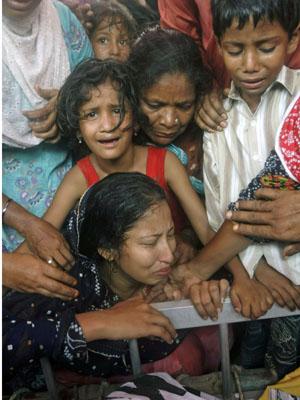
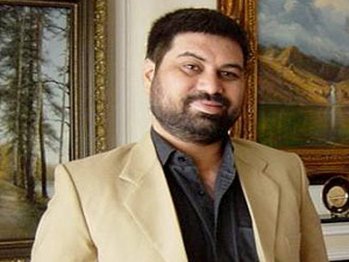
Killing of infants on the rise in Pakistan

By Raza Sayah for CNN

At a morgue in Pakistan’s largest city, five linen pouches — each the size of a loaf of bread — line the shelf of a walk-in freezer.
Wrapped inside each small sack is the corpse of an infant.

The babies are victims of what one relief agency calls Pakistan’s worst unfolding tragedy: the killing and dumping of newborns.
“Sometimes they hang them, and sometimes they kill by the knife, and sometimes we find bodies which have been burned,” said Anwar Kazmi, a manager at Edhi Foundation, Pakistan’s largest privately run social service and relief agency.

Records at Edhi Foundation show that more than 1,200 newborns were killed and dumped in Pakistan last year, an increase of about 200 from the previous year.

Families view many of these children as illegitimate in a culture that condemns those born outside of marriage.
Statistics show that roughly nine out of 10 are baby girls, which families may consider too costly to keep in a country where women frequently are not allowed to work.

The babies are usually just days old. Their corpses are often dumped in Karachi’s sprawling garbage dumps, where they’re sometimes mutilated by street animals, Kazmi said. He estimates that hundreds of baby corpses are never found.

The head of Edhi Foundation, 83-year-old Abdul Sattar Edhi, blames Pakistan’s crippling poverty and a government that, for decades, has failed to educate the masses, generate jobs and provide citizens with the most basic needs.

“The distribution of resources by the government is wrong,” Edhi said. “Many people don’t pay taxes; there’s no charity, and what you get from the government is all based on your wealth.”

The Pakistani government has said it’s improving education, but 55 million Pakistanis remain illiterate, according to the United Nations. And the government is billions of dollars in debt while entangled in a costly fight against the Taliban and other Islamic militant groups. The killing of newborns gets little attention in Pakistan, and rarely are they investigated by a police force that’s often poorly trained, lacks resources and stays focused on what’s perceived to be more important crimes.

In many parts of the world, female infanticide is still practiced through direct violence but also by intentional neglect, according to the World Health Organization.

In some Asian countries, infanticide of girls is enough to skew the population figures in favor of males. The United Nations found, for example, that there are 130 boys to 100 girls in parts of Asia, especially in countries with extreme poverty and overpopulation such as China and India.
“Girls are seen as a burden, seen as a property which belongs to somebody else so people see that as a waste of money and the wasting of an education of a girl,” said Bhagyashri Dengle, executive director of Plan India, a nonprofit for children. “Then when the girl gets married, the families have a big, heavy dowry. So that is one of the reasons here.”

Dengle said awareness and education at the grass-roots level are ways to combat this practice. “I think we really need to reach out to young people (to) create an awareness, to change attitudes and dispel the notion that having a boy is better than a girl,” she said. “We launched this program ‘Let Girls Be Born’ — that campaign is reaching out to masses using televisions, through newspapers and through (the) Internet. What we are trying to do is positive messaging on the girls. That girls aren’t a sect; they are as good as boys.”

In Pakistan, until things improve, the Edhi Foundation said, it will keep more than 300 cradles in front of its offices throughout Pakistan where families can drop off unwanted newborns. The foundation cares for them and puts them up for adoption, no questions asked.
“It’s for awareness — that please don’t kill your innocent babies,” Kazmi said.

Pakistan Issues Shoot-On-Sight Order as Karachi Violence Escalates

As Reported by The Voice of America

Pakistani security forces have been ordered to shoot on sight when confronting disorders in Karachi, where days of political and ethnic violence have left up to 85 people dead.

About 1,000 additional police and paramilitary forces were deployed in Karachi on Friday with new orders to shoot any armed “miscreants” they encounter.

Interior Minister Rehman Malik told reporters that dozens of suspects have been detained in connection with a series of targeted killings since Monday. At least 34 people died on Thursday alone when gunmen opened fire on buses.

Police say the killings are part of clashes between political groups in Sindh province, including the Muttahida Qaumi Movement and its rival, the Awami National Party (ANP).

The MQM largely represents the Urdu-speaking community, and until last month was part of the ruling coalition in Sindh. ANP represents ethnic Pashtuns. Both those groups and the ruling Pakistan People’s Party are believed to have links to armed groups in Karachi.

Shops were closed and streets were deserted in the southern port city Friday after the MQM called for a day of mourning and protest rallies.

MQM leader Raza Haroon has said his movement’s supporters are being targeted because the party quit the coalition.

The Human Rights Commission of Pakistan says 490 people were victims of targeted killings in Karachi in the first half of this year.

On Friday, Pakistani Prime Minister Yousuf Raza Gilani appealed for peace and security in Karachi, saying it was important for the economic development of the country.

U.S. Ambassador to Pakistan Cameron Munter called on all parties to refrain from further violence and work toward a “peaceful resolution of differences.”

Amnesty International criticized the government’s order for security forces to “shoot on sight” armed men involved in the violence. The rights group said Friday that by giving troops such power the government is effectively declaring Karachi “a war zone” and encouraging further lawlessness and violence, citing what it said was the army’s record of human rights violations.

About 18 million people live in Karachi, the country’s economic hub. The city also has been the scene of sectarian violence between Sunni and Shi’ite Muslims and militant attacks.

Meanwhile, in Pakistan’s northwest, military officials say troops backed by jets have killed 11 militants in the Kurram tribal region along the Afghan border. Officials say nearly 50 militants have been killed in Kurram since a military operation began there this week.

Did Pakistan Have Reporter Killed?

By Jennifer Epstein for Politico

In another possible blow to U.S.-Pakistan relations after the killing of Osama bin Laden, Obama administration officials believe that the country’s intelligence service ordered the “barbaric and unacceptable” killing of a journalist who had written about ties between the country’s military and Al Qaeda militants, according to a report Tuesday.

Intelligence surrounding the late May killing of Pakistani reporter Saleem Shahzad, 40, suggests that senior officials at Pakistan’s Directorate for Inter-Services Intelligence ordered the murder to silence his criticism, The New York Times reported Tuesday, citing two senior US administration officials.

American officials consider the intelligence to be “reliable and conclusive,” the Times said, with one official describing the actions of the spy agency, known as the ISI, as “barbaric and unacceptable.” Shahzad suffered 17 lacerated wounds, a ruptured liver and two broken ribs in the deadly attack.

Relations between the United States and Pakistan have become increasingly frayed since the early May killing of bin Laden in a Pakistani town with a heavy military presence, where he’d been holed up for several years. U.S. officials suspect that some members of the military and the ISI helped harbor him there, even if top Pakistani officials truly were kept in the dark about bin Laden’s presence there.

The Times’s report comes after journalists and others within Pakistan accused the ISI of being behind Shahzad’s death, and since the Pakistani government – under pressure — launched an investigation of the killing.

A Pakistani official, meanwhile, shot down the Times’s report.

“There is an international conspiracy to malign the law enforcement agencies and security forces,” Pakistani information minister Firdous Ashiq Awan said Tuesday, the Hindustan Times reported.

The allegations made by the Obama administration “are part of that conspiracy,” she said.

Awan also said that “good relations are in the interest of both” the United States and Pakistan, though “everybody safeguards their own interests” in a conflict and there have been some “ups and downs.”

In Pakistan, Truck Decoration a High-Octane Art Movement

By James Parchman for The New York Times

MURIDKE, Pakistan — Here on the historic Grand Trunk Road, some 40 miles north of Lahore and a few hours south of the former bin Laden hideout of Abbottabad, a mosque’s call to Friday afternoon prayers was overwhelmed by Pakistani pop music spilling from open-air markets. The barks of bus conductors calling out destinations added to the din.

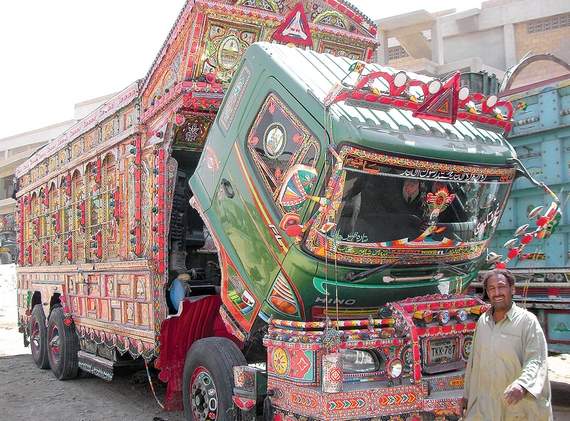
The passing parade of motorized rickshaws, farm tractors, buses and highway cargo trucks looked as if a re-enactment of ’60s peaceniks making the pilgrimage to Woodstock might be under way. A panorama of red, yellow and green, mixed with plastic whirligigs, polished mahogany doors and gleaming stainless steel cover plates, was a magical sight for a visitor with a love for anything on wheels.

It was not only the variety of vehicles — all are common across South Asia — that elicited this reaction, or even their Partridge-Family-meets-Ken-Kesey color schemes. Rather, it was the fascinating quantity and surrealistic detail of their decoration, unlike anything I’d seen in my travels around the world.

A deeper understanding of the origins and meanings of the decoration craft was gained over days of mingling with the truck drivers and the owners of decorating shops in Karachi, Lahore and Peshawar.

Karachi, situated on the Arabian Sea, is Pakistan’s major seaport. It is also the cargo hub of the country, and with 13 million people has a great many local and intercity buses. As such, the city supports a considerable customizing industry: When Saudi Aramco World magazine published an article about the trade in 2005, more than 50,000 people in Karachi were said to be employed decorating buses and trucks.

What I found at the Pakistani workshops was a pride of design and a willingness to answer questions — and to show off their creations to a former long-haul trucker.

Sparing no expense

At a driver’s cafe near Karachi’s 3-mile-long International Truck Yard (where I turned down an offer of boiled camel meat and cow-leg soup) workers took me by the hand to the shop of Masallah the truck decorator. My Dockers and Rockports were as out of place as their long-shirted, working-class shalwar kameez outfits and leather sandals, called chappals, would have been in one of New York City’s outer boroughs.

But my full beard may have helped in gaining their confidence and a look inside their truck cabs. Government safety agencies equivalent to OSHA were nowhere to be seen in the truck yards, and workers, many of whom were children of the owners, were being showered with sparks from their grinders and cutting torches.

Many of the trucks being outfitted at Masallah’s carried identification plates from Balochistan province. Their owners were prospering thanks to a steady demand for hauling loaded sea containers from Karachi’s port to landlocked Afghanistan. Their cargo, typically including supplies for U.S. and NATO military operations, make a trip of 500 miles by the southern route to Kandahar or 1,200 miles by a northern route to Kabul.

Pakistani truck owners can easily spend more on their trucks than on their homes. One driver from the Gwadar area of Balochistan told me he had just bought a Hino truck chassis for the equivalent of $35,000 and brought it straight to Masallah’s workshop. There he might spend another $25,000 for its body, paint and decoration. During the several weeks required to complete the work, he would sleep inside or under the truck, on his bedroll.

Adding decorative touches like ribbons, spinners, flags and polished steel cutouts in the shape of animals to a small bus costs an owner at least $800. This is considered an advertising expense; a highly decorated bus is usually the first choice of customers when there are several options.

Nissan and Hino tandem-axle trucks of the flat-front cabover design, many assembled in Pakistan, are the popular choices for cargo-haulers today, replacing the revered Vauxhall Bedford, a British model with a traditional cab. The Bedford was the mainstay of Pakistan’s cargo network since the early days of Pakistan’s independence.

The Bedford is still prized for its sturdy chassis and ability to continuously haul outsize loads. Many have bodywork with a high-crowned front prow, which lends itself to decoration and gives the truck the look of a sailing ship.

As is the case in the United States, offering a sharply decorated truck can be a powerful incentive for recruiting drivers. Pakistani bus and truck owners usually allow their drivers, whose average wages are about $75 a month, to work out their own designs in conjunction with the owner of the decoration shop.

Big business

Predictably, mass production has changed the business over the years. Adornments are no longer exclusively handmade.

“Pakistani buses were originally decorated using carved woodwork and individual paintings,” said Kurram Awan, the owner of a small shop of truck-decorating supplies in Lahore.

“Now, my shop sells over 1,000 different items, including braids, reflectors, flashing lights and antennas,” he said.

He added that the Pashtun drivers (Pashto speakers from the border region between Afghanistan and Pakistan) spent the most on decorations.

Durriya Kazi, an artist and teacher in Karachi, has long been a proponent of Pakistan’s folk art. She sees bus and truck decorating as an integral part of that tradition, noting the importance of distinguishing between sculpture as defined by the art gallery and the rich activity of actually making things that exists all over Pakistan.

In 2006, Kazi was instrumental in a program intended to spread Pakistan’s bus decoration skills to Melbourne, Australia, where a tram was transformed into a replica of a minibus used on Karachi’s W-11 route, resplendent in all its finery.

Another Pakistani with expertise in the subject is Jamal Elias of the University of Pennsylvania, a professor and the author of “On Wings of Diesel: Trucks, Identity and Culture in Pakistan” (Oneworld, 2011). His book explores the tradition of Pakistani truck decoration, and looks deeper into the “nature of response to religious imagery in popular Islamic culture.”

In an e-mail, Elias said that the creative inputs of decorators included several major themes, which could be combined across the cab and body of the truck or bus. These include Islamic religious images like the horse of Muhammad and depictions of the mosques at Mecca.

Other possibilities include images of a fish, representing good fortune, or the elegant eyes of a woman, representing beauty.

The End of AfPak

By Scott Malcomson for The New York Times

Remember how after 9/11, Osama bin Laden’s attacks on us could be linked to almost anything, from shopping habits to the rediscovery of Western values to carbon-pricing schemes? Something similar appears to be happening with Bin Laden’s death. Jihadism sure isn’t what it used to be. After 10 years, it seems, the time has come to go home. Troops are and will be coming back to the United States from Iraq and Afghanistan. The military budget will be cut. The outgoing secretary of defense feels able to openly mock NATO because, presumably, he thinks he can afford to — because it doesn’t matter all that much. The global war on terror is being downgraded from Armageddon to something more out of Leviticus: a tricked-out police action, just as John Kerry, in this magazine, always said it should be. On Sunday, Helene Cooper and Mark Landler reported that “American success in the counterterrorism campaign would seem to bolster arguments for a swift withdrawal from Afghanistan.” By Tuesday morning, they were reporting that President Obama would announce his withdrawal plans on Wednesday. Meanwhile, a Harris poll revealed that 51 percent of Americans and 54 percent of Britons believed “the death of Bin Laden meant it was time to bring troops from their countries home.”

That isn’t quite how it looked when I was in Washington a few weeks ago and spoke with about a dozen current and former American officials and with Pakistanis. The impression they each gave was that American withdrawal would be speeded not because of Bin Laden’s death but because of Pakistan’s reaction to it. After the initial shock, Pakistan’s (government-influenced) press latched onto a narrative of “national humiliation” as a result of the American raid, rather than, say, one of jubilation at the demise of a killer whose fantasies have brought Pakistan nothing but misery. A younger generation of military officers — Pakistan is dominated by its military — seemed at times about to revolt in reaction to the insult to Pakistan’s sovereignty. And the Inter Services Intelligence (I.S.I.), Pakistan’s ubiquitous military intelligence outfit, reacted, as was subsequently reported, by scouring the neighborhood around Bin Laden’s house for 
 evidence of how the C.I.A. found out he was there, and to determine who had been helping the Americans.

Finally, the Pakistan government did not respond to the Bin Laden raid by pressing its new advantage and rolling up terrorist networks across the land. No, it did not do that at all. So Secretary of State Hillary Rodham Clinton and Admiral Mike Mullen, chairman of the joint chiefs of staff, went to Islamabad and on May 27 presented a list of demands. These included the arrest or elimination of Ayman al-Zawahiri (of Al Qaeda), Ilyas Kashmiri (a long-sought semi-free-agent and former Pakistani military man), Sirajuddin Haqqani (of the AfPak-border based Haqqani network) and Atiya Abdur Rahman (Al Qaeda), and the shutting down of bomb factories in Pakistan.

By June 3, Kashmiri was dead. But this promising start now seems isolated. The other wanted men are still at large. The bomb-makers might well be getting tipped off. The revolt by younger Pakistani officers seemed only to get worse.

In short, the U.S. and Pakistan are really not getting along. Among members of Congress, beating up Pakistan has become ritualized; Senators McCain and Rogers were doing it again on the Sunday programs. I wondered: How many times can Pakistan be abandoned? As Bruce Riedel, a former C.I.A. officer and the head of President Obama’s first major AfPak review, shows in his excellent new book, “Deadly Embrace: Pakistan, America and the Future of Islamist Jihad,” embrace and abandonment have formed the pattern of American-Pakistani relations since the majority-Muslim nation was formed out of the breakup of British India in 1947. Harry Truman’s lack of interest yielded to Dwight Eisenhower’s enthusiasm for Pakistan as an anti-Communist bulwark and a base for spying on the Soviets. The relationship was and remained built around security and intelligence. Lyndon Johnson reversed course when India and Pakistan went to war in 1965; he cut off both, but Pakistan had, unlike India, been a strong ally, and it felt betrayed. This set the pattern: ultimately, Pakistan was tactical and India was strategic.

Now, after almost 10 years of intense engagement, Pakistan and the U.S. appear set for another split; at least that was the consensus among the officials I spoke with. There was a pervasive sadness in these conversations. It was due in part to the sheer human effort that has gone into the U.S.-Pakistan relationship. A lot of spies and soldiers and diplomats and politicians have put years of their lives into making “AfPak” work, which requires making Pak work. A lot (not all) of that effort seems to be going down the drain, along with much of the billions of taxpayer dollars that financed it.

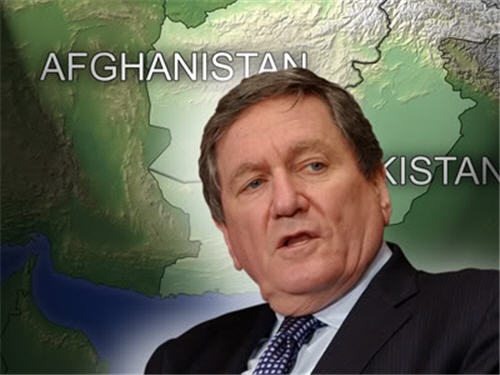
There is also personal sadness in that the AfPak effort was associated toward the end with Richard Holbrooke, whose death late last year brought the foreign-policy world up short. Holbrooke did not take great care of himself, so objectively his death could not be entirely a surprise, and among people over 70 the reactions I heard were more of the well-what-did-you-expect variety. But in the 35-to-65 range it was different. Holbrooke represented, very attractively, the assertion of youth and hope against experience. Even at 69 he had a distinct eagerness, even boyishness, alongside the baritone gravitas. He attracted bright young people. He could be young and old at the same time. Once he was gone, that sort of generational bridging disappeared. (Older figures are few in this administration.) The sense of continuity (as well as of optimism) is weakening. There’s something missing now.

There was also a sense of ideological loss of direction. For all their differences, Bill Clinton and George W. Bush shared a tangible optimism about American governmental involvement abroad. President Obama is different, and even if he weren’t the national mood is. The people’s representatives in Congress are vying to bring troops home faster, and if there is an internationalist remaining in the House he or she is keeping quiet. The Republican candidates for president seem to have settled on anti-war isolationism as a winning position. Obama’s great strength in foreign policy — his ability to repackage, and optimize, American power in a multipolar world — is the strategy that dare not speak its name, or it will bring accusations of “declinism.”

Finally, there is the tremendous sadness of Pakistan itself. The country doesn’t have enough water. It lacks the electricity to develop its industries. Literacy, by some reckonings, is actually declining. Democracy has been restored but the government is hardly stable. The one truly semi-stable institution, the military, is struggling against itself, just as Pakistanis are dividing, and attacking each other on an increasing scale (which is saying something).

But, in a way, the saddest thing of all, from a foreign-policy point of view — Pakistani or American — is that the one great card Pakistan has to play is to make itself a problem. Pakistan formed itself into a regional player through building its army, running terrorist proxies in Kashmir and Afghanistan, indulging in enough Islamist millenarianism to make itself frightening, and developing nuclear weapons. None of these strategies have a good future. But in the absence of a long-term committed relationship — what Holbrooke promoted as a “strategic partnership” — with the United States or, perhaps, with China, Pakistan is left with fear as its most successful export.

There was some discussion in Washington as to whether Mullah Omar’s name was on that list that Clinton and Mullen presented in Islamabad. It almost doesn’t matter. The doubt itself is the message: Pakistan stays valuable because it has terrorist “ties” or “links” or “proxies” or whatever. As national existential dilemmas go, Pakistan’s is particularly nightmarish. The U.S. will leave them to it — abandonment again — and choose the happier relationship with India. Secretary Clinton will be at the regional forum of the Association of Southeast Asian Nations in late July, helping to take her longtime initiative of eastward Indian engagement, and the integration of the United States into East Asian political structures, to a new level. This is part of a long-term strategy of accommodating the rise of China and of India.

And Pakistan, after 10 years, will be left behind; as the line in Washington goes, “There is no good solution.”

Pak Sailors Thank India, On Way Home

Mateen Hafeez for The Times of India

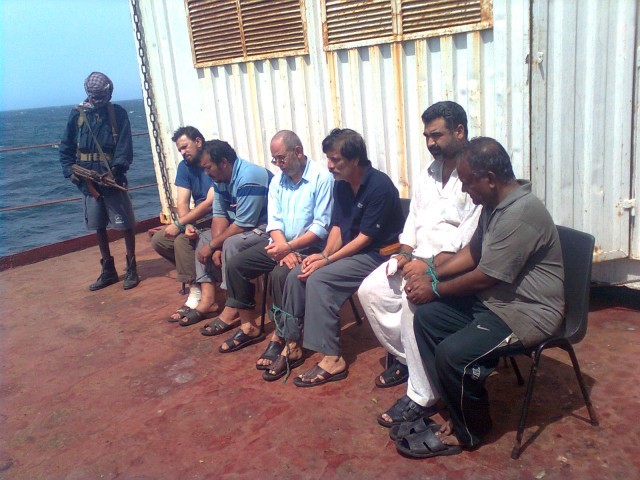
Five Pakistani hostages, who were held captive by Somali pirates for five months and rescued by the Indian Navy, will finally leave for Pakistan on Monday. The hostages had been languishing at Yellow Gate police station after their ‘consular access’ process got stuck in diplomatic channels of the two countries.

TOI was the first to report about the hostages’ plight and the problems in the consular access programmme. A team from the Pakistani High Commission then landed up at the Yellow Gate police station and completed the formalities. Earlier, this was scheduled to be done at Tihar jail in Delhi as the hostages were wrongly labeled ‘prisoners’. The men are Aurangzeb Balloch, his brother Sajjad, Farhad Aalam Khan, Mohammed Umair and Lal Bakhsh.

“We are excited to go home. There were some problems in our travel to Pakistan but the Yellow Gate police took care of us properly. We have no words to thank the Indian police and those who helped make our journey to Pakistan easy,” said Aurangzeb, a resident of Karachi. The other hostages were also jubilant when asked about their return to Pakistan. “In the last three months we saw the lanes and bylanes of this city. It’s very similar to Karachi. The people, places, food and roads here are similar to Karachi. Initially, we were afraid that we may be kept in India, but now we have a positive feeling about this country and its people who loved us,” said Sajjad, another hostage. “We watched the World Cup matches between India and Pakistan in the police station. When India won the final against Sri Lanka, we were happy. We never faced any discrimination here,” added Lal Bakhsh.

The hostages were part of an Iranian fishing trawler, Al-Murtuza. The ship was hijacked by AK-47 borne Somali pirates from the Ballochistan sea in November. “We would get insufficient food after we were captured by the pirates,” added Farhad.

The five men were provided food, chai and clothes. Sometimes they managed to get cigarettes. The policemen even gave their phones to the hostages so they could speak to their families in Pakistan. To speed up the process to send them home, Ansar Burny, former human rights minister in Pakistan, filmmaker Mahesh Bhatt and Abraham Mathai, state minorities commission vice-chairperson, worked together. “We spoke to Gurudas Kamat, the Union minister of state for home and he arranged consular access. The process was speeded up due to his efforts,” said Bhatt.

Aman ki Asha’s Gift of Life to Six-Year Old Muzaffar

By Lubna J. Naqvi for The News International

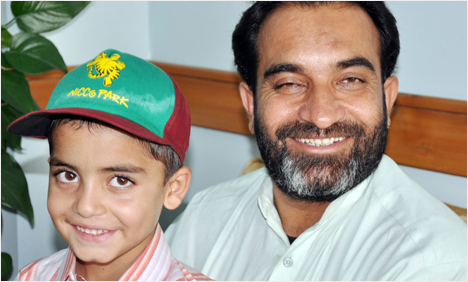
He has the cutest smile. One that was nearly wiped out forever by a congenital heart disease that his parents had no means of getting treated in Pakistan.

Muzaffar Ahmed Khan was only three years old he developed a seemingly never-ending severe chest congestion and cold. His father Rozay Khan, a teacher at a private school in Loralai, took the boy to a medical specialist the nearest big city in Quetta, 260 km away – a long road trip by any standards, and more so for a sick child. The trip led to a doctor diagnosing the boy as having a congenital heart condition. The treatment – risky and expensive heart surgery – was way beyond the reach of his father.

The boy lived on with the help of various medications, but without the required surgery, he was not expected to live much longer. The despair and pain of the family, and the discomfort of the sick child, can only be imagined.

It was a news report in the daily Jang of October 2, 2010 that set them on a path they will forever be grateful for. The paper had a report about a nine-year old Pakistani boy Muhammad Sufiyan, who also had a congenital heart problem. The report said that Rotary International and Aman ki Asha had taken Sufiyan to India where he underwent a successful operation at Manipal Hospital, Bangalore. Suddenly there was hope.

Rozay Khan contacted the Rotary Club representatives in Quetta, and provided them with Muzaffar’s medical documents. Things began to move. The Rotary officials contacted their counterparts in India and sent them the documents. Within a week the family was asked to make arrangements to travel.

Muzaffar was to be accompanied by his father and uncle Qaisar Khan. The Indian High Commission granted their visas within three days. Aziz Memon (President King Group) former governor of Rotary Club helped expedite the travel and other logistics.

They flew to Mumbai on May 5, 2011, and the next day, to Kolkata. There was some difficulty at the immigration, says Rozay Khan, but Rotary representatives in India helped smooth their way.

On May 7 Muzaffar was admitted to Kolkata’s Rabindranath Tagore International Institute of Cardiac Sciences. He underwent a two-and-a-half hour operation on May 11. He was discharged on May 19, with a month’s medication and a directive to avoid lifting heavy items for some time.

The doctors said that Muzaffar should get a medical examination after six months to be on the safe side, but that he was now perfectly healthy. It was like a miracle.

Barely a month later, Muzaffar and his father and uncle visited Aman ki Asha in Karachi on June 4, a day after they returned from India. If one had not been told, there were no signs that this smiling boy had so recently undergone a serious operation. He sat there beaming at us, shyly looking out from underneath long lashes that fringed his mischievous eyes. He would have pranced around the room like any other seven-year old, but was restrained by his father, who held him in his lap throughout the visit. Muzaffar was restless, and probably bored, but seemed to enjoy the attention.

Rozay Khan glowed with happiness at his son’s rapid recovery. A huge weight had been lifted off him, and his wife, who had been worried sick about their son, as his condition didn’t look too good before leaving for India. The first thing he did after Muzaffar’s successful operation was to call his wife over the phone. “It was an emotional time for all of us, but it has passed – all because of Aman ki Asha and Rotary Club.”

Rozay Khan was all praise for India. “I was given so much love and warmth in India that I didn’t even feel I was away from home,” he said.

“The Indians were very hospitable. They treated us just like brothers; they did so much for us that at times we were embarrassed. The hospital staff gave Muzaffar so much love and affection also. It was like we were still in Pakistan. Except for some of the people who didn’t speak Urdu or Hindi in Kolkata, I wouldn’t have known I wasn’t in Pakistan.”

Muzaffar’s uncle added that the Indians were amazed to hear them speaking Urdu – which they thought was Hindi. “They would ask us where we learnt to speak Hindi, and I would laugh and say we were not speaking Hindi we were speaking Urdu.”

He found the Indian people to be very interested in Pakistan. “They asked us so many questions and said they would love to come visit. However they lamented that they knew it would be impossible because of the visa issues. I told them that they should come, and be my family’s guests and see Pakistan.”

“So many people told us to convey their message through the media and Aman ki Asha to Pakistani authorities to ease travel to Pakistan,” said Rozay Khan. “They should do away with the obstacles that travellers have to face if they want to travel from India to Pakistan and vice versa.”

He said that in the nearly two months they spent in India they did not encounter any hostility – only got love and hospitability. “When people got to know that we had come for Muzaffar’s operation they were extra nice, even friendlier, more helpful and hospitable.”

Muzaffar gained health, love and friends across the border. His family wishes that the people of both countries were allowed to interact and visit each other more. They are grateful to Aman ki Asha and Rotary club for helping give Muzaffar a new life.

“We wish,” said Rozay Khan, “that the path of peace continues between the two countries through Aman ki Asha’s efforts. And we pray that we see peace between our two countries so we can visit our new friends again, and have them visit us.”

— Lubna J. Naqvi

Help Muzaffar’s dream come true

When total strangers from India and Pakistan joined hands to help Muzaffar, they did more than help save a life. They sparked off a determination in his family to get a good education for Muzaffar. They want him to be able to enter medical college and become a doctor himself. If anyone would like to contribute and help sponsor Muzaffar’s education to enable him to one day help others, please contact Aman ki Asha – amankiasha@ janggroup.com.pk

Dying to Tell the Story

By Umar Cheema for The New York Times

WE have buried another journalist. Syed Saleem Shahzad, an investigative reporter for Asia Times Online, has paid the ultimate price for telling truths that the authorities didn’t want people to hear. He disappeared a few days after writing an article alleging that Al Qaeda elements had penetrated Pakistan’s navy and that a military crackdown on them had precipitated the May 22 terrorist attack on a Karachi naval base. His death has left Pakistani journalists shaken and filled with despair.

I couldn’t sleep the night that Saleem’s death was confirmed. The fact that he was tortured sent me back to a chilly night last September, when I was abducted by government agents. During Saleem’s funeral service, a thought kept haunting me: “It could have been me.”

Mourning journalists lined up after the service to console me, saying I was lucky to get a lease on life that Saleem was denied. But luck is a relative term.

Adil, my 2-year-old son, was the first person in my thoughts after I was abducted. Journalists in Pakistan don’t have any institutionalized social security system; those killed in the line of duty leave their families at the mercy of a weak economy.

When my attackers came, impersonating policemen arresting me on a fabricated charge of murder, I felt helpless. My mouth muzzled and hands cuffed, I couldn’t inform anybody of my whereabouts, not even the friends I’d dropped off just 15 minutes before. My cellphone was taken away and switched off. Despite the many threats I’d received, I never expected this to happen to me.

Sure, I had written many stories exposing the corrupt practices of high-ranking officials and pieces criticizing the army and the intelligence agencies. After they were published, Inter-Services Intelligence, Pakistan’s prime security agency, always contacted me. I was first advised not to write too much about them and later sent messages laced with subtle threats. But I never imagined action was imminent.

On Sept. 4, I was driven to an abandoned house instead of a police station, where I was stripped naked and tortured with a whip and a wooden rod. While a man flogged me, I asked what crime had brought me this punishment. Another man told me: “Your reporting has upset the government.” It was not a crime, and therefore I did not apologize.

Instead, I kept praying, “Oh God, why am I being punished?” The answer came from the ringleader: “If you can’t avoid rape, enjoy it.” He would employ abusive language whenever he addressed me.

“Have you ever been tortured before?” he asked.

“No,” I said.

“These marks will stay with you forever, offering you a reminder never to defy the authorities,” he replied.

They tortured me for 25 minutes, shaved my head, eyebrows and moustache and then filmed and photographed my naked body. I was dumped nearly 100 miles outside Islamabad with a warning not to speak up or face the consequences.

The following months were dreadful. I suffered from a sleep disorder. I would wake up fearing that someone was beating my back. I wouldn’t go jogging, afraid that somebody would pick me up again and I’d never return. Self-imposed house arrest is the life I live today; I don’t go outside unless I have serious business. I have been chased a number of times after the incident. Now my son asks me questions about my attackers that I don’t answer. I don’t want to sow the seeds of hatred in his heart.

When Saleem disappeared, I wondered if he had been thinking about his children, as I had. He had left Karachi, his hometown, after receiving death threats, and settled with his wife and three children in Islamabad. From there, he often went on reporting trips to the tribal areas along the Afghan border. Tahir Ali, a mutual friend, would ask him: “Don’t you feel scared in the tribal areas?” Saleem would smile and say: “Death could come even in Islamabad.” His words were chilling, and prescient.

The killing of Syed Saleem Shahzad is yet another terrifying reminder to Pakistani journalists. He is the fifth to die in the first five months of 2011. Journalists are shot like stray dogs in Pakistan — easily killed because their assassins sit at the pinnacle of power.

When Daniel Pearl was brutally murdered by militants in Karachi in 2002, his case was prosecuted and four accomplices to the crime were sentenced. This happened only because Mr. Pearl was an American journalist. Had he been a Pakistani, there would have been no justice.

Today, impunity reigns and no organization is powerful enough to pressure the government to bring Saleem’s killers to justice. Journalists have shown resilience, but it is hard to persevere when the state itself becomes complicit in the crime. Now those speaking up for Saleem are doing so at a price: they are being intimidated and harassed.

Pakistan is at a crossroads and so is its news media. In a situation of doom and gloom, Pakistani journalists offer a ray of hope to their fellow citizens and they have earned the people’s trust. Even the former prime minister Chaudhry Shujaat Hussain has admitted that people who once went to the police with complaints now go to the press.

But this trust will be eroded if journalists continue to be bullied into walking away from the truth. News organizations throughout the world must join hands in seeking justice for Saleem and ending the intelligence agencies’ culture of impunity. An award for investigative journalists should be created in his honor, as was done for Daniel Pearl. No stronger message could be delivered to his killers than making him immortal.

Umar Cheema is an investigative reporter at The News International, Pakistan’s largest English-language daily. He was a Daniel Pearl Fellow at The Times in 2008.

Pakistan Troops Caught on Film Shooting Unarmed Teenager Dead

By Barry Neild for The Guardian

Pakistan’s security forces are facing criticism after paramilitary troops were caught on camera apparently shooting dead a teenager at point-blank range.

The footage, broadcast repeatedly on local television, is likely to further undermine faith in the country’s powerful security establishment, which is already facing allegations it helped conceal Osama bin Laden.

The video, captured by a cameraman from Pakistan’s Awaz television channel, shows a youth, identified as Sarfaraz Shah, arguing with paramilitary rangers in Karachi. The 18-year-old appears to plead for mercy before being shot at close quarters. He then falls to the ground and screams in pain as blood pools beneath his legs.

Zohra Yusuf, head of Pakistan’s independent Human Rights Commission, condemned the killing as “another indication of law enforcement personnel becoming increasingly trigger happy.”

She said the violence depicted in the video was a trend seen across Pakistan that reflected the impunity of the country’s law enforcers.

Pakistan’s prime minister, Yousuf Raza Gilani, said an inquiry would be launched and the culprits punished. Six members of the paramilitary Rangers, who are controlled by the interior ministry, have since been arrested.

Major general Aijaz Chaudhry, who commands the force, described the incident as “deplorable”. “The Rangers have no authority to kill any unarmed individual and they can fire only in self-defence,” he said. “On completion of the inquiry, all those found responsible will be given strict punishment.”

The incident is likely to further dent public faith in the government’s ability to control its security forces at a time when the US ally is facing questions about how bin Laden could have hidden for so long without the complicity of intelligence officials.

“What we saw on television shows that now there is the law of the jungle in this country and no one is accountable for his action or deeds. This is pathetic,” Mohammad Sultan, a retired soldier, told Reuters.

“What we are seeing is visual records of what we have long documented, which is the culture of impunity in the Pakistani law enforcement agencies,” said Ali Dayan Hasan, a researcher for Human Rights Watch. “What is becoming clear is that the free for all, the culture of wanton abuse and killing, is becoming untenable in the age of new media and cell phone cameras.”

In one media interview, a man identified as Salik Shah, the victim’s brother, said: “My brother was a victim of barbarism, brutality and aggression and everyone has seen it. The innocent young man was begging for his life regardless of whether he had done anything wrong. He was asking to be pardoned by the rangers; despite his repeated requests they did not listen to him, they did not arrest him, instead they were adamant about killing him and in the end they did.”

Hundreds of people showed up at Shah’s funeral a day after his death and denounced the Rangers. Some shouted “Rangers, murderers!” and others carried signs that said “Down with the Karachi Rangers.”

The video’s broadcast comes a few days after a prominent journalist was tortured to death after reporting claims about al-Qaida. Military intelligence officials have rejected claims they played a role in the killing.

Pakistan’s Daily Times newspaper said the military, paramilitary forces, police and intelligence agencies “who confidently violate human rights” should be held accountable for their actions.

“The security and law enforcement forces that do not respect the law themselves are inviting anarchy, which arguably is already under way,” it said in an editorial.

Last year, a video emerged of two teenage brothers being beaten to death before being strung up on a metal pole in broad daylight as police personnel looked on.

Pakistan Orders an Inquiry After Troops Kill a Teenager

By Salman Masood for The New York Times

President Asif Ali Zardari of Pakistan ordered an investigation on Thursday into the shooting death of an apparently unarmed teenager by paramilitary troops in the southern port city of Karachi. The shooting, which was captured on video and broadcast on national television, has led to protests and has been condemned by political parties and human rights groups.

It was the second time in recent weeks that a video has shown paramilitary troops using extreme force against civilians. Last month, five Chechens were gunned down in Quetta, Pakistan.

The shootings are sure to feed complaints that Pakistan’s security forces are too aggressive and sometimes bypass the sluggish and corrupt judicial system. Pakistan’s military leaders are also still embarrassed by the American raid on Osama bin Laden’s compound in Abbottabad, which the armed forces did not detect.

The victim of the Karachi shooting, Sarfraz Shah, whose age was given as 18 or 19, was stopped by paramilitary troops on Wednesday and accused of being involved in an attempted robbery in a nearby park.

A spokesman for the troops said a gun had been taken from him, but in the video, Mr. Shah does not appear to be armed when he is shot.

The recording shows the young man begging for mercy before being led toward a group of troops. One points his gun at Mr. Shah before firing several shots. Mr. Shah crouches, asking forgiveness while bleeding profusely.

“My hand is gone,” Mr. Shah shouts. “Take me to the hospital.” The troops step back, out of the video frame. A government official said five of the troops had been arrested.

Mr. Shah was buried on Thursday in Karachi, accompanied by protests from family members.

The shootings in Quetta last month were also recorded. The police and paramilitary troops initially reported that the victims, three women and two men, were suicide bombers. They were killed near a checkpoint on the outskirts of Quetta, the capital of Baluchistan Province in southwestern Pakistan, in a volley of fire as police officers stood by.

Video from local television networks showed one young woman raising her arm, as if to try to stop the gunfire. No weapons were recovered on the victims. An investigation of that shooting is under way.

The Pakistani security forces have repeatedly been accused of misusing their power. The army was accused of extrajudicial killings during a military operation to drive out militants that began in the Swat Valley in 2009. The army denied the allegations.

The country’s powerful intelligence agencies have also been accused of illegally detaining hundreds of terrorism suspects. And military intelligence has been accused of gross human rights violations in Baluchistan, where a separatist insurgency by Baluch nationalists has long simmered.

Pakistani Rangers, the group involved in Mr. Shah’s death, are controlled by the Interior Ministry. Rehman Malik, the country’s interior minister, announced the arrests in the case on Thursday evening, but he also accused Mr. Shah of being part of a gang involved in robberies, according to the local news media.

Mr. Malik said Mr. Shah had tried to steal a woman’s purse and was caught by guards in the park before being handed over to the Rangers.

The Rangers have been deployed in Karachi for several years and help the local law enforcement authorities in maintaining peace in the city, which is riven by political, ethnic and sectarian tensions.

Pakistan Leaders Must Make Choice After Clinton’s Warning

By The Bloomberg News Editorial Board

When U.S. Secretary of State Hillary Clinton visited Pakistan last week, she noted that U.S.- Pakistani relations were at a turning point after the killing of Osama bin Laden. It was up to the Pakistanis, she said, to decide “what kind of country they wish to live in.”

The brutalized body of investigative journalist Syed Saleem Shahzad, which turned up outside of Islamabad on May 31, may provide a clue to the answer.
Shahzad disappeared after publishing the first of two promised articles linking elements of the Pakistan navy to al- Qaeda following a deadly May 22 attack on a Karachi naval station. Last fall, after being questioned about a different story by Pakistan’s Directorate for Inter-Services Intelligence (ISI), Shahzad wrote that he was threatened by the spy agency.

Alternatively, it could be that foul play like Shahzad’s murder will become a thing of the past in Pakistan. While in Islamabad May 27, Clinton and Chairman of the Joint Chiefs of Staff Admiral Mike Mullen demanded authorities take “decisive steps” to crush the violent extremists the government has long supported, which would end the need to intimidate journalists who expose that support. Whichever way the Pakistan government goes, the May warnings by the U.S. ought to be the last.

The U.S. administration has continued to insist, as President Barack Obama did in a May 22 interview with the BBC, that the Pakistanis have “generally been significant and serious partners against the terrorist threat to the West.” This simply isn’t the case.

Victim, Sponsor

For much of the past decade, Pakistan has been both a victim and a sponsor of Islamic militants. Its soldiers are fighting bravely against homegrown terrorists seeking to install an Islamic government. In 20 attacks in May, these radicals killed some 150 people.

At the same time, the Pakistani army, led by General Ashfaq Parvez Kayani, is a longstanding patron of violent groups targeting Afghanistan and India.
Guided by excessive fear bordering on paranoia about India, Pakistan’s military and intelligence services believe that nurturing those extremists is an effective way to frustrate India’s regional ambitions. The ISI largely created and continues to support the Taliban and the Haqqani Network, the principal groups battling U.S. forces in Afghanistan and the fledgling government in Kabul. It also backs Lashkar-e-Taiba, the group responsible for the 2008 attacks in Mumbai that killed more than 160 people.

Double-Dealing

President George W. Bush’s administration tried to end this double-dealing by giving Pakistan billions in economic and military assistance. Yet Bush didn’t make the aid contingent on a crackdown on extremists. The Pakistanis cooperated somewhat with U.S. efforts to dismantle al-Qaeda but refused to act against other groups, including the Afghan Taliban, which was given refuge inside Pakistan’s borders.

The Obama administration accelerated the failed Bush policy, substantially increasing military and economic assistance, again without imposing rigorous conditions. And Pakistan continued to ignore administration warnings about continued support for extremists.
In one incident reported by the Washington Post, Obama’s first national security adviser, James Jones, warned officials in Islamabad that there would be “consequences” if a terrorist attack directed at the U.S. was traced to Pakistan. Yet when a man who had trained at a terrorist camp in that country attempted to detonate a car bomb in Times Square in May 2010, the U.S. administration did nothing. Shortly thereafter, Obama watered down Jones’s words, telling Kayani that a “successful” attack would have consequences.

Meaning Business

So when U.S. authorities learned that Osama bin Laden might be housed in a villa in a Pakistani garrison town, they dispatched Navy Seals to capture or kill him without so much as notifying the Pakistanis in advance. The raid provoked great outrage from officials in Pakistan. Since then, emotions have cooled. Clinton and Mullen have delivered their warnings, public and private. And this time, the Americans may mean business.

Will the Pakistanis respond?

Shahzad’s murder is a bad sign. On the other hand, reports from Pakistani tribal leaders suggest that the Pakistani army may be preparing a serious campaign in North Waziristan, where the leaders of the Haqqani Network and other extremist groups live.
It will soon be clear whether Clinton’s latest message got through. If not, the administration must consider new ways to persuade Pakistan to change course, recognizing that the country is behaving more like an adversary than a partner.

Gunmen Storm Pakistan’s Naval Aviation Base

By Faisal Aziz for Reuters

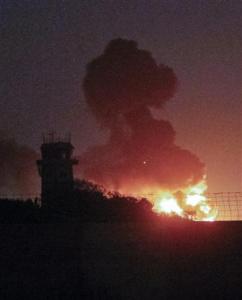
Gunmen attacked Pakistan’s naval aviation base on Sunday, starting fires, setting off explosions and fighting pitched gunbattles inside one of the country’s most heavily guarded military installations.

Officials said at least four people had been killed in the attack on PNS Mehran in the southern city of Karachi. Between 15 to 20 gunmen were inside and had attacked hangars housing aircraft, officials said. Witnesses said they could hear gunshots and see smoke rising from the base.

“They were equipped with sophisticated weapons,” navy spokesman Commodore Irfan ul-Haq told Reuters. Another spokesman said that one P-3C Orion, a maritime partrol aircraft, had been destroyed. “The attackers are still inside and intermittent firing is continuing.”

Interior Minister Rehman Malik said the militants had attacked from the rear of the base. “We have been able to confine them to one building and an operation is underway either to kill or capture them.” The Karachi attack evoked memories of an assault on Pakistan’s army headquarters in the town of Rawalpindi in 2009, and revived concerns that even the most well-guarded installations in the country remain vulnerable to militants.

Taliban militants, who have vowed to avenge the killing of al Qaeda leader Osama bin Laden by U.S. special forces, have carried out several attacks since his death on May 2.

Officials said the gunmen had attacked three hangars housing aircraft. Nine explosions were reported from the base, with jet fuel tanks possibly catching fire and exploding. Almost three hours after the start of the attack, gunbattles between presumed militants and commandos continued.

A least a dozen ambulances were parked outside the base, waiting to take wounded to hospital. Pakistani military and paramilitary reinforcements were pouring in, with four vehicles carrying about 10 troops each moving into the base. An intelligence official said four people had been killed and five wounded in the Karachi raid.

Prime Minister Yusuf Raza Gilani condemned the “terrorist” attack. “Such a cowardly act of terror could not deter the commitment of the government and people of Pakistan to fight terrorism,” Gilani said in statement.

Pakistan has faced a wave of bombings and gun assaults over the last few years, some of them claimed by the Tehrik-e-Taliban Pakistan (TTP), or Pakistani Taliban. Others have been blamed on al Qaeda-linked militant groups once nurtured by the Pakistani military which have since slipped out of control.

The discovery that bin Laden was living in the Pakistani garrison town of Abbottabad, not far from the Pakistan Military Academy, has also revived suspicions that militants may be receiving help from some people within the security establishment.

Pakistan and the United States say the senior leadership in the country did not know bin Laden was in Abbottabad.

On April 28, suspected militants detonated a roadside bomb in Karachi, killing four members of the navy, the third attack on the navy in a week. The attack came two days after two bombs hit buses carrying navy personnel, killing four people and wounding 56. Taliban insurgents took responsibility for the twin attacks.

Why Pakistan’s Taliban Target the Muslim Majority

By Omar Waraich for Time

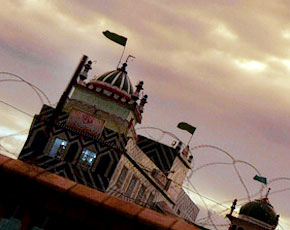
Although Pakistan’s headlines are dominated by the violent excesses of Taliban extremists, the majority of Pakistanis subscribe to the more mystical Sufi tradition of the country’s Barelvi school of Islam. And attacks on their places of worship are becoming depressingly familiar. Last Sunday, two bombers attacked the 13th Century Sakhi Sarwar shrine, near the southern Punjabi town of Dera Ghazi Khan, slaughtering 50 people and injuring twice as many. Mercifully, two other bombers failed to detonate their devices, preventing even higher casualties. Still, it was the deadliest assault yet on a Sufi shrine in Pakistan — and the sixteenth in the last two years.

The Pakistani Taliban swiftly claimed responsibility for the attack, as they have done for each previous one. Pakistan’s Taliban claims the mantle of the hardline Deobandi tradition, with many beliefs in common with the austere Wahabism of Saudi Arabia. They regard the Barelvi, who comprise more than three quarters of Pakistan’s Sunni Muslims, as irredeemable heretics. The Barelvis favor a more tolerant approach to Islam, promoting a cult of the Prophet and incorporate folkloric traditions such as seeking intercession from rural saints. Sakhi Sarwar, a mystic who is also revered by some Hindus and Sikhs, is said to grant women a son — a local legend that rouses anger among Islam’s more literalist adherents, who ascribe such powers only to Allah.

Tensions between Deobandis and Barelvis have punctuated most of Pakistan’s history. But with the arrival of al-Qaeda in the country a decade ago, local militants forged links with the global jihadists, their sectarianism sharpened to accept al-Qaeda’s “takfiri” worldview that deems adherents of other strains of Islam as deviant apostates worthy of death.

One reason for the uptick in sectarian-based terror attacks may be that the militants’ ability to strike the high profile urban targets that once grabbed global headlines has been diminished by Pakistani military offensives in their strongholds over the past two years. “It has become harder for the militants to strike hard targets,” says security analyst Ejaz Haider. “Some lessons have been learned from the previous attacks.”

So, the militants have, over the past two years, more keenly focused on sectarian attacks. Traditional Shi’ite processions are now routinely targeted by suicide bombers. In May 2010, two mosques of the minority Ahmedi sect were targeted in Lahore, killing 93 people. And there’s been an escalation of bombings directed against the majority Barelvis. After attacks on two of their most prominent shrines, Data Darbar in Lahore’s old city and Abdullah Shah Ghazi in Karachi, Barelvis came out on to the streets, wielding weapons and vowing revenge against the Taliban. They did not extend blame to the broader spectrum of Deobandis, perhaps wisely evading the beginnings of a more gruesome sectarian conflict that Pakistan can ill-afford.

Not all Barelvis are the models of peace and tolerance that some have portrayed them to be. It was a Barelvi, Mumtaz Qadri, that assassinated Punjab Governor Salmaan Taseer in January, for his opposition to Pakistan’s prejudicial blasphemy laws. The assassination was applauded by 500 Barelvi scholars in a joint statement. And the Sunni Tehreek, a Barelvi militant outfit, rewarded Qadri’s family and threatened Taseer’s daughter. While they may favor a more permissive vision of Islam, certain Barelvis are quite capable of violence where they feel the Prophet has been dishonored.

The campaign to defend Pakistan’s blasphemy laws from reform has, in fact, united Barelvis and Deobandis since last November. Barelvi anti-Taliban rhetoric was also put on pause. “We had seen the Barelvis getting ready to organize a campaign against the Taliban,” observes analyst Nasim Zehra, “but they got sidetracked by the blasphemy issue and this was forgotten.” Until last month’s assassination of Minorities Minister Shahbaz Bhatti, the religious right was able to frequently draw tens of thousands on to the streets.

Sectarian hatred aside, rural shrines are a far easier terror target than the more heavily guarded state and economic targets in the cities. Suicide bombers, especially the teenage boys favored by militants, can often evade notice before they reach the target. A crowded space helps secure the militants’ aim of causing high casualties. In the case of the Sakhi Sarwar bombers, they only had travel to a relatively short and unimpeded distance from North Waziristan to the edge of Punjab.

The bombings may also be an attempt to relieve pressure from sporadic Army actions against militants in the northern tip of the tribal areas. “Just to remain alive there, the militants have to try and force the government’s hand into diminishing pressure,” says analyst Haider. “To counter that pressure, they mount attacks in the mainland in the hope of securing some deal back in the tribal areas.” By targeting shrines across the country, the militants are able to demonstrate their enduring geographical reach and expose the state’s vulnerabilities.

The bad news is that the state is in a poor position to respond. After the latest bombings, Barelvi leaders denounced the Punjab provincial government for failing to provide security at shrines. The Punjab government dismisses the charge. “It’s happening all over,” says Ahsan Iqbal, a leading politician from the Pakistan Muslim League-N, the ruling party in Punjab. “This is not something that is province-specific.” Iqbal casts blame on the federal government for failing to share intelligence. The federal government reverses the charge, and argues that the law and order is a provincial responsibility. What no one seems to be focusing on is the desperate need to enhance the police’s capacity, with better equipment, counterterrorism training and an intelligence gathering network that reaches deep into Pakistan’s remote areas.

Sindh Saves the Day

By Nadeem F Paracha for Dawn

Plans are afoot to build the world’s first ever international Sufi university near Bhit Shah in Sindh. The main purpose of the institution would be to promote interfaith and intercultural education to tackle extremism in the country.

Such a thought and project could only have come about in Sindh. Especially in the context of what Pakistan has beengoing through in the last many years.

Not only have the country’s other provinces – especially the Punjab and Khyber Pakhtunkhwa (KP) – become central targets of horrid terrorist attacks by extremist organisations, the Punjab in particular has also been witnessing a steady growth of faith-based conservatism within its urban middle and lower middle-classes.

When extremists (calling themselves ‘Punjabi Taliban’) attacked the famous Sufi shrine, Data Darbar in Lahore late last year, economist and political analyst, Asad Sayeed, made a rather insightful observation.

He said that had such an attack on the Darbar taken place twenty years ago, thousands of Lahorites would have poured out to protest.

But not anymore. The attack on one of Punjab’s most popular Sufi shrines was simply treated as just another terrorist attack.

Though it is now clear that the Wahabi/Deobandi extremists have been going around blowing up Sufi shrines frequented by the majority Barelvi Muslims, the Barelvi leadership has looked elsewhere, putting the blame on the ever-elusive ‘foreign hands.’

Journalist and intellectual Khaled Ahmed once wrote a telling tongue-in-cheek article about the annual gathering of the Dawat-i-Islami in Multan.

The Dawat is the Barelvi equivalent of the Deobandi Tableeghi Jamat. Both these outfits are considered to be non-political organisations who are more interested in evangelizing their respective versions of Islam and its rituals. One should also mention that both these (sub-continental) strains of Islam accuse one another of being ‘flawed Muslims.’

Ahmed wrote how after Dawat’s huge congregation in Multan, when police found some bullet-riddled bodies of Dawat members, the outfit’s main leadership simply refused to acknowledge the glaring evidence that pointed towards the involvement of an opposing Sunni sect’s organisation in the murders.

Ahmed adds that Dawat leaders began babbling about ‘outside forces (RAW, CIA, Mossad)’ who wanted to create disharmony between Pakistan’s Barelvi majority and the Deobandi and Wahabi sects.

Barelvis: From moderate to militant

One can understand the above-mentioned episode as an example of the confusion Barelvi spiritual leadership has gone through since the 1980s.

From its inception in the 18th century and until about the mid-1980s, the Barelvi sect was largely apolitical in orientation, non-Jihadist and followers of some of the most relaxed dictates of the Hanafi madhab – the first of the four main Islamic schools of law that is also considered to be the most moderate.

‘Barelvi Islam’ (as it is sometimes called) is purely a sub-continental phenomenon that fuses elements of Indian Sufism with the folk and populist strains of various cultures that exist in the sub-continent.

It is also called the ‘folk Islam’ of the region in which a high degree of tolerance exists between various faiths, sects, classes and ethnicities and in which the puritanical aspects of other Islamic sects are eschewed and even rejected.

The Sufi shrine and an intense reverence of the Prophet (PBUH) play a central role in Barelvi Islam. Its populist and moderate make-up helped it become the majority Sunni sect amongst the Muslims of the sub-continent.

Two of its leading opponents have been the Sunni Deobandi sect (also a product of the subcontinent) and the Saudi-inspired Wahabism.

Both have accused Barelvis of ‘adopting Hindu rituals and practices’ and assorted ‘heresies.’

In spite of being the majority sect amongst Sunni Muslims in Pakistan, ‘Barelvi Islam’ hardly ever had a coherent political expression in shape of a mass-based political party or organisation.

Its spiritual leadership remained pro-Jinnah (unlike Deobandi organizations of undivided India), and various Pakistani political leaders have continued to appeal to the symbolism and lingo associated with various populist aspects of Barelvi-ism.

Zulfikar Ali Bhutto and his Pakistan Peoples Party (PPP) was the most successful in this respect.

Bhutto was also one of the first leading Pakistani political figures to undertake the act of regularly visiting various famous Sufi shrines in Sindh and Punjab.

Barelvis are in the majority in Sindh and the Punjab, whereas Deobandis are largely centred in Khyber Pakthunkhwa and in the Pushtun-dominated areas of Balochistan.

Until the 1970s Barelvi-ism also prevailed among many of Sindh and Punjab’s urban middle-classes, especially those who considered themselves to be progressive and likely supporters of secular politics.

However, the arrangement in this context was suddenly disturbed with the arrival of the Ziaul Haq dictatorship in 1977.

Dipped in the political Islam of scholar and Jamat-i-Islami (JI) chief Abul Ala Mauddudi, Zia soon moved towards infiltrating the spiritual and political nerve centres of Barelvi-ism in an attempt to ‘reform’ them.

Barelvi dominance across the country’s religious landscape reminded him of Z A. Bhutto’s populism (which he, like JI, considered to be ‘vulgar’ and ‘un-Islamic’), and from 1979 onwards Pakistan under Zia also became one of the leading client states of Saudi-generated Wahabi propaganda and aid.

Stunned by the ‘Islamic revolution’ in the Shia-dominated Iran in 1979, Saudi Arabian monarchy and its Wahabi Sunni religious elite began seeing Pakistan’s Barelvi-dominated make-up as venerable to Shia-ism’s revolutionary symbolism and also of socialist propaganda, especially with the arrival of Soviet forces in Afghanistan.

At least that was one of the reasons used by Zia and his Saudi allies to draw the United States into giving Pakistan billions of dollars worth of aid and arms.

With the aid also came Wahabi propaganda literature and preachers who along with Pakistani Deobandi and Wahabi spiritual and political groups began setting up madressas and mosques.

These madressas operated as institutions that would indoctrinate young Pakistanis – most of whom were immersed in the non-Jihadi traditions of Barelvi-ism – and prepare them for Jihad against Soviet forces in Afghanistan.

Bralevi tradition had also not been very kind to the ulema and the clergy.

To address this, Zia also began describing famous Sufi saints as ulema and banned (in the media) all criticism and humour aimed at the clergy.

The Afghan war, Saudi propaganda, the mushrooming of Deobandi and Wahabi madressas and televangelists, and a concentrated campaign by the Zia regime to equate the dictatorship’s capitalist-Islamist makeup as something in accordance with the Shariah and with ‘Jinnah and Iqbal’s vision,’ had a telling impact on Pakistan’s religious sociology.

In the Khyber-Pakhtunkhwa many moderate and progressive Deobandi strains that had prevailed in the province began sliding into the sect’s more radical dictates, coming closer to the puritanical Wahabi and Salafi ideas about faith.

This slide was celebrated by the Punjab-dominated military as a successful blow to the secular and ‘treacherous’ Pukhtun separatist tendencies.

In the Punjab, the province benefited the most from Zia’s Punjab-centric capitalist maneuvers. This coupled with unprecedented remittances coming from Pakistanis who had begun going to Arab Gulf states to work from the 1970s onwards, gave birth to new moneyed classes.

Many from the petty-bourgeoisie and bourgeoisie sections began moving away from their Barelvi heritage and towards more puritanical strains of faith.

Their Barelvi past now reminded them of their lower status and economic modesty, whereas they began relating their enhanced economic standing with the adoption of the more puritanical strains of Islam.

That’s why the growth of puritanical Islamist and sectarian organizations that Punjab saw under Zia, a lot of their local funding came from Punjab’s nouveau-riche and petty-bourgeois trader classes.

Interestingly, it was also the same classes that also pushed the Barelvi leadership to become more conservative and radical. Those sections of the Punjabi petty-bourgeoisie that stuck to Barelvi-ism encouraged their spiritual leadership to compete with the Puritanism and radicalism of the growing number of Deobandi and Wahabi groups.

This trend saw the first ever emergence of radical Barelvi groups. In the early 1980s, the Dawat-i-Islami was formed to counterbalance the growth of the Deobandi Tableeghi Jamaat that had begun making deep inroads into Punjab’s bourgeoisie and the military.

The Dawat discouraged the Barelvis from indulging in antics associated with the region’s folk Islam, emphasising an increased reverence of holy personalities and encouraging holding of recitals of naats and milads instead of quwalis and dhamals. The last two became associated with the practices of the lower-class Barelvis.

In 1992, emerged the Sunni Thereek (ST). A Barelvi outfit that emerged from the splintering of the oldest Barelvi Islamic political party, the Jamiat Ulema Pakistan (JUP).

Such occurrences did not really help the Barelvi sect defend its traditions in the face of the state-sponsored Deobandi and Wahabi onslaught –  rather, these organisations began turning Barelvi-ism into an equally anti-pluralistic and militant political phenomenon.

Sindh saves the day?

By the 1990s, Zia’s manoeuvres and Saudi involvement in reshaping Pakistan’s religious tradition had seen Khyber Pakhtunkhwa and Punjab become hostage to various violent Deobandi/Wahabi outfits and new-born Barelvi reactionary-ism.

The Punjab also saw a rise in the use of reactionary political and religious narratives within its lower-middle and middle-classes, whereas in Balochistan attempts were being made (by intelligence agencies) to neutralize secular Baloch nationalist militancy with the help of puritanical evangelical outfits. The agencies had already done this successfullyin Khyber Pakhtunkhwa in the 1980s.

But what happened in Sindh? Barelvi-ism in Sindh (outside Karachi) has always been a lot more secular and pluralistic than the Bareilvi-ism in the Punjab.

Its  sociology  in Sindh heavily revolves around the staunchly secular historicity that the province’s famous scholar, GM Syed’s literary work generated.

He described a highly pluralistic and secular reading of Sufism as being the cultural and religious make-up of the Sindhis and it is this narrative that still rules the roost in the province’s social and religious psyche.

This is one of the reasons why Zia completely failed to impose his version of Islam here. Also, just like the majority of the Baloch who equate puritanical Islam with the ‘Punjabi civil-military elite,’ so does the socio-political discourse in Sindh.

On the other hand, in Karachi, though Zia-backed Deobandi and Wahabi radical outfits did manage to find a foothold, two things have always worked against these outfits here.

The first is the fact that the sprawling ethnic, sectarian and religious diversity found in Karachi actually absorbs and neutralizes any attempt by an outfit to impose its version of Islam.

Secondly, MQM, a party that first emerged as a mohajir nationalist group, adopted almost the same populist Barelvi symbolism and lingo as Bhutto did in the 1970s.

Also, the other two big political parties in the city too are secular: the PPP and ANP.

Though the Sunni Thereek (ST) has managed to infiltrate some sections of MQM’s support, ST is Barelvi and anti-Taliban (albeit reactionary).

In spite of the rampant crime and ethnic tensions that are a constant in Karachi, it will not be an overstatement to claim that Karachi along with the rest of Sindh today stands to be perhaps the only (ragged) sanctuaries in present-day Pakistan that are (comparatively-speaking) largely free of the factors that have created opportunities in the Punjab and KP for violent extremist activity as well as for reactionary conservatism to now become a mainstay in Punjab’s bourgeois psyche.