Posts Tagged ‘ Karachi ’

India and Pakistan Officials Discuss Bilateral Water Treaty

As reported by Daily India

India and Pakistan officials attended a high-level meeting of the Indus Water Treaty Commission in Jammu to discuss a proposal by India to erect a dam on the river Indus.

A three-member delegation from Pakistan led by Sheraj Jameel, Commissioner, Indus Water Treaty, visited the Nikki Tawi area to examine the site and the design of the proposed artificial lake. The lake is being constructed at a cost of rupees 1.1 billion.

“We are here to inspect the project. We will see whether it is within the limitation of the treaty or not and after the visit we will talk to our counterpart,” said Jameel.
The Indian counterpart S.Ranganathan, Commissioner, Indus Water Treaty, said that the lake project is still in conception.

“In our opinion it does not violate the treaty. When we will get the information from the project authorities, we will analyse it and if it doesn’t violate the provisions, then we will give the go ahead for the project” said Ranganathan.

The team of delegates would be in the region for three days to examine all the records and plans vis-à-vis water distribution for the lake project.

The World Bank had brokered the Indus Water Treaty between India and Pakistan and was signed by the then Indian Prime Minister Jawaharlal Nehru and the then Pakistan President Mohammad Ayub Khan in Karachi in 1960 giving powers to the latter for monitoring the usage of three rivers-Indus, Jehlum and Chenab from Jammu and Kashmir to Pakistan.

India and Pakistan Are United by Language and History, Divided by Commerce

By Karin Brulliard for The Washington Post

In India, where it is made, Fair and Handsome men’s skin lightening cream sells for $1.25 a tube.

But by the time it hits the shelf at Sajid Khan’s shop in this city’s old marketplace, it has traversed 2,000 miles of sea and land, been smuggled over the Hindu Kush and marked up 25 percent.

Pakistan and India share language, culture, history and an 1,800-mile border; they are South Asia’s largest economies. What they barely share is trade – officially at least, because of a quasi-blockade that dates from partition in 1947, and all but chokes off commerce under a dizzying web of rules.

The hurdles have spurred off-the-books trade, much of it shipped through third parties in such places as Dubai, where products are re-labeled as imports from other lands – journeys that result in 40-to-70-percent markups. Only recently did Pakistan make its first export to India by truck: a load of gypsum rock.

But economists, business groups and U.S. officials are pushing to loosen at least the most maddening restrictions, and they are hopeful that the two nations’ decision two weeks ago to resume peace talks might help. Free trade, they say, would benefit both India and Pakistan and might help to ease tensions whose gravity is reflected in rival nuclear arsenals.

“Economics 101 dictates that countries’ major trading partners should be their neighbors,” said Shuja Nawaz, director of the South Asia Center at the Washington-based Atlantic Council. “To change the dialogue from a zero-sum game to a positive, win-win outcome for both India and Pakistan, you need to start with the low-hanging fruit of opening trade and tourism.”

For a Pakistani economy in tatters, experts say, a freer flow of goods from India would allow cheaper access to products and raw materials, and could open up India, with its enormous population, to exports of Pakistan products such as cement.

Some research indicates that bilateral trade – currently at about $2 billion a year, less than 1 percent of each country’s total trade – could swell 20 to 50 times under more liberal policies. Estimates of illicit trade range from $2 billion to $10 billion a year.

But for now, progress creeps. India admits all Pakistani products, but Pakistani firms complain that stringent standards and paperwork make many exports unviable. Pakistan, for its part, allows a slowly expanding list of Indian products that now includes artificial kidneys, camphor, parachutes and 1,931 other items – but not Fair and Handsome cream, which is instead legally exported from Kolkata to landlocked Afghanistan, via the Pakistani port of Karachi, then smuggled back into Pakistan.

Travel restrictions are another barrier. Businessmen in both countries say they wait months for visas that allow travel only within major cities in the other country – preventing visits to rural factories or farms – where they are often tailed by intelligence agents.

Then there is the logistic muddle of land trade at the one border crossing, midway between Lahore and the Indian city of Amritsar. The twice daily cargo train involves an engine switch: A train carrying Pakistani exports, for example, can enter mere miles into India, at which point the Pakistani engine and conductors are replaced by an Indian ones before continuing inland. With so few trains, exporters wait months for cargo space.

Trucks have only eight hours each day to cross, because each afternoon the two-lane road is overtaken by Indian and Pakistani border guards’ theatrical gate-closing ceremony. Even then, trucks must stop just past the frontier, where porters transfer the goods to local trucks. That is an advancement: Before 2007, trucks were barred from crossing at all, and laborers lugged all cargo across the boundary on their heads.

The little existing trade often falls victim to what look like political whims. In December, cargo trains sat idle for three weeks while Indian conductors awaited the visas that allow them to park just inside Pakistan.

That same month, spiraling onion prices prompted India to drop import tariffs and standards for the staple, triggering a surge in Pakistani onion exports. But Pakistan abruptly halted overland sales amid concerns about a domestic shortage.

“I had 400 trucks stuck on the other side,” said Rajdeep Uppal, a trader who is vice president of the Amritsar Exporters Council. “For a week these onions were standing there, and eventually they had to be sold within Pakistan for half the price. Who loses? Both the countries.”

Tensions aside, scenes of goodwill abound along the border. Pakistani and Indian train conductors sip tea and gripe about red tape together. Satanam Singh, a turbaned Indian driver – wearing a regulation yellow vest stamped “Indian Driver” – beamed as laborers unloaded his ginger on the Pakistani side. Coming to Pakistan, he gushed, was delightful compared with Mumbai, where the language is different and people hostile.

“It is a strange feeling, like I am going to a strange land,” said a smiling Mohammed Zafar, a Pakistani whose vibrantly painted truck, brimming with dates, was about to make its virgin voyage across the Indian frontier. “I am very happy.”

Here in Lahore, just 20 miles from the Indian border, Khan’s shop was the pioneer in a winding lane of stores now crammed with Indian silk and cosmetics – all smuggled into Pakistan illegally.

He said he would welcome friendlier business relations, even if they lessened the luxury value of his stock. Even his Afghan smuggler, who stopped by on a recent evening, agreed, on grounds that it would lessen the need to bribe border officials.

Among some merchants, skepticism about trade prospects remains, with Pakistanis fearing that open trade would lead to a glut of cheap Indian imports. S.M. Akhter, a top Indian customs official at the border, said national security concerns must trump market demands.

But despite the tangle of rules, some trade is quietly rising. Tahir Habib Cheema, the top Pakistani customs official at the border, said he realized last year that truck exports from Pakistan were allowed, but that “status quo” and “fear” had prevented them. He decided to change that – without notifying his bosses.

A comedy of errors ensued. By Oct. 7, Cheema had found one willing exporter and one importer. After hiccups on each side, a meeting at the frontline was arranged.

All parties agreed, Cheema said – and then the truck would not start. Someone proposed pushing it into India, an idea that was nixed by border guards who said the pushers would need visas. Finally, another vehicle nudged the truck over the line.

“This was something for the national cause,” Cheema said proudly. Since then, he added, Pakistani trucks have exported $2.5 million worth of products to India. He expects that to escalate this spring, when the two nations open a dedicated truck passage.

Correspondent Rama Lakshmi contributed to this article from New Delhi.


Books Not Bombs at Pakistan Literature Festival

As Reported by The AFP

Pakistan is hosting one of the world’s youngest and fastest-growing literary festivals, a showcase of new talent where writers urge citizens to reverse the tide of Islamist extremism and global isolation.

Now into a second year and determined to become an annual fixture on the international circuit, the Karachi Literature Festival portrays the softer face of a country more often associated with terrorism than award-winning prose.

Students, authors, budding writers and avid readers have descended on a hotel in an exclusive neighbourhood near the Arabian Sea for two days of book launches, workshops, dance, music and theatrical exhibits ending Sunday.

“It’s to promote our authors, who are underrated and do not get the credit they’re due, and also to interest people in reading and buying books,” organiser and Oxford University Press managing director Ameena Saiyid told AFP.

Women in T-shirts and skinny jeans rub shoulders with religious girls cloaked in Islamic veils at events with standing room only, as pensioners on crutches fold themselves into chairs and children race up the aisles.

Gathering nearly 100 authors and moderators, a handful from Britain, France, Germany and the United States give the event a veneer of the cosmopolitan, but the government denied visas to three of six Indians invited, organisers said.

Peace efforts between nuclear rivals India and Pakistan have been stagnant since Islamist gunmen killed 166 people in Mumbai in 2008. India and the United States blamed the attack on Pakistani militants.

Pakistan denies it is not doing enough to shut down Islamist terror groups, in a country where more than 4,000 people have been killed in Taliban-related bomb attacks in three years.

At the festival, where up to 5,000 people devoted their weekend to listen to their favourite authors — about twice the number of visitors compared with last year — some felt there was a duty to confront growing extremism.

“It’s the most fabulous development for Karachi,” said Aliya Naqvi, a doctorate student in Islamic history and wife of author H.M. Naqvi, whose debut novel “Home Boy” recently won an Indian prize for South Asian literature.

“Life goes on. You take a risk every time you step outside… But to ignore the rise of extremism would be disingenuous. It has to be acknowledged,” she told AFP between sessions.

The September 11, 2001 attacks put Pakistani writers on the international map as inquisitive Westerners searched for insight into the Taliban and Islam, at the same time as throwing the country into war and chaos.

Ahmed Rashid, whose book “Taliban” became a US bestseller, delivered a thundering address, saying it was time Pakistan faced up to its own mistakes rather than blame the United States.

“We have to do something to save ourselves,” he said, accusing Pakistan of meddling in Afghanistan, obsessing about India at the expense of national interest, failing the economy, sheltering Al-Qaeda and sponsoring the Taliban.

Nuclear physicist and social activist Pervez Hoodbhoy went further, warning a packed session on “Taking Stock: Where is Pakistan Now?” that the country is on “a knife-edge” and at risk of being overrun by a “clerical tsunami”.

Mohsin Hamid, best-selling author of novels “Moth Smoke” and “The Reluctant Fundamentalist”, said he did his best to look for the positive but conceded: “Fear is fundamental to what it’s like to live in Pakistan right now.”

The revolts in Egypt and Tunisia have resonated widely in Pakistan and were touched upon in questions from the audience. In response to one man, Hamid said it was not for him to lead a social movement onto the streets.

Inevitably in a country where mastery of English remains the preserve of the elite, who often live more luxuriously than the middle classes in the West and where the poor struggle on less than a dollar a day, there were cries of elitism.

While the event was free to all, sponsored by the British Council, Oxford University Press and USAID, some complained it was not on the public bus route.

US-educated novelist Bina Shah, whose new book “Slum Child” was snapped up like hotcakes, was asked how difficult she found it to write about a slum when she herself did not use public transport or go out to work.

“I’ve been in a rickshaw!” she hit back.

“My experience of a slum is obviously going to be different. It should convince you enough that a slum person could have told the story,” she said.

Bombers target Shiites in Pakistan, killing 12

As reported by The Associated Press

Suicide bombers attacked police protecting marches by minority Shiite Muslims in Pakistan’s two largest cities Tuesday, killing 12 people and wounding dozens, officials said.

The first and most deadly attack occurred in the eastern city of Lahore, where the bomber detonated his explosives as police tried to search him, killing 10 people. About an hour later, a second bomber struck in the southern port city of Karachi, killing at least two people.

The attacks laid bare the challenges facing Pakistani officials trying to secure cities far from the northwest, where militants fighting Pakistan’s U.S.-allied government and American forces in neighboring Afghanistan have long thrived. Many recent attacks have targeted minority Muslim and other religious groups.

The Taliban claimed responsibility for the attack in Lahore, where thousands of Shiite worshippers were marking the end of a 40-day mourning period for the Islamic sect’s most beloved saint when the blast hit their procession early Tuesday evening.

The bomber is believed to have been a young teenage boy who was wearing a suicide bomb jacket and also carrying a bag full of explosives, said senior police official Aslam Tareen. He detonated his explosives when police tried to search him, he said.

“It is a great sacrifice by the police officers who laid down their lives to protect innocent people,” said Tareen.

Footage from the scene showed ambulances racing to the area and men carrying away victims. One young man whose arm was apparently hurt screamed as he was placed on a stretcher. A white car caught up in the explosion was largely destroyed, its hood twisted upward. A man lay wounded on the ground with two women and a child weeping beside him.

Dr. Zahid Pervaiz at the city’s Mayo Hospital told reporters that 10 dead bodies had come in, while another 52 people were wounded.

Shakirullah Shakir, a spokesman for the Fidayeen-e-Islam wing of the Pakistani Taliban, told The Associated Press in a phone call that the militant group had dispatched the bomber and warned of more bombings.

Later Tuesday evening, a suicide bomber struck police protecting a group of people returning from a Shiite march in the Malir neighborhood of Karachi, Pakistan’s largest city.

Three people were killed and three wounded in the attack, said Hamid Paryar, a doctor at Karachi’s largest hospital. Two of those killed and one wounded were policemen, he said.

The third person killed is believed to be the suicide bomber, who was riding a motorcycle and carrying his explosives in a bag, said senior police official Shaukat Shah.

The blast occurred near a police van protecting the Shiite marchers, said Akbar Jaffry, who witnessed the bombing.

Attacks roughly tripled last year in Lahore and Karachi, according to a recent report by the Islamabad-based Pak Institute for Peace Studies.

The trend is a sign that militants are having greater success exporting the fight far from their northwest heartland along the Afghan border. The Pakistani army, under U.S. pressure, has carried out several offensives against militants in its northwest, but violence persists.

Killings of Newborn Babies on the Rise in Pakistan

By Hasan Mansoor for The Associated Press

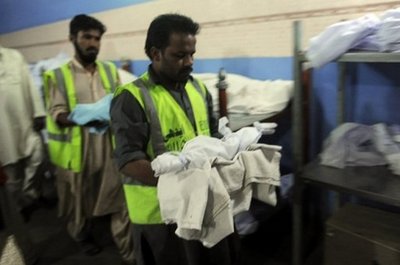
The lifeless bodies of two tiny babies are being given their final bath before burial in Karachi, after they were left to die in the southern Pakistani city’s garbage dumps.

“They can only have been one or two days old,” says volunteer worker Mohammad Saleem, pointing at the two small corpses being gently washed by his colleagues at a charity’s morgue.

In the conservative Muslim nation, where the birth of children outside of marriage is condemned and adultery is a crime punishable by death under strict interpretations of Islamic law, infanticide is a crime on the rise.

More than 1,000 infants — most of them girls — were killed or abandoned to die in Pakistan last year according to conservative estimates by the Edhi Foundation, a charity working to reverse the grim trend.

The infanticide figures are collected only from Pakistan’s main cities, leaving out huge swathes of the largely rural nation, and the charity says that in December alone it found 40 dead babies left in garbage dumps and sewers.

The number of dead infants found last year — 1,210 — was up from 890 in 2008 and 999 in 2009, says the Edhi Foundation manager in Karachi, Anwar Kazmi.

Tragic tales abound.

Kazmi recounts the discovery of the burnt body of a six-day-old infant who had been strangled. Another child was found on the steps of a mosque having been stoned to death on the orders of an extremist imam who has since disappeared, he says.

“Do not murder, lay them here,” reads a sign hanging outside the charity’s Karachi base where it has left cradles in the hope that parents will abandon their unwanted children there, instead of leaving them to die.

“People leave these children mostly because they think they are illegitimate, but they are as innocent and loveable as all human beings,” says the charity’s founder, well-known humanitarian Abdul Sattar Edhi.

Most children found are less than a week old. Khair Mohammad, 65, works as a watchman in the charity’s vast graveyard in the city outskirts. It is dotted with tiny unnamed graves.

“We acquired this land to bury children after another plot was filled with hundreds of bodies,” he says. The death toll is far worse among girls, says manager Kazmi, with nine out of ten dead babies the charity finds being female.

“The number of infanticides of girls has substantially increased,” Kazmi says, a rise attributed to increased poverty across the country.

Girls are seen by many Pakistanis as a greater economic burden as most women are not permitted to work and are considered to be the financial responsibilty of their fathers, and later their husbands.

A Pakistani family can be forced to raise more than one million rupees (11,700 dollars) to marry their daughter off. Edhi says that up to 200 babies are left in its 400 cradles nationwide each year and that it handles thousands of requests for adoption by childless couples.

Abortion is prohibited in Pakistan, except when the mother’s life is at risk from her pregnancy, but advocates say that legalisation would reduce infanticide and save mothers from potentially fatal back-street terminations.

According to Pakistani law, anyone found to have abandoned an infant can be jailed for seven years, while anyone guilty of secretly burying a child can be imprisoned for two years. Murder is punishable with life imprisonment.

But crimes of infanticide are rarely prosecuted. “The majority of police stations do not register cases of infanticide, let alone launch investigations into them,” said lawyer Abdul Rasheed.

Pakistanis for Peace Editor’s Note– The killing of innocent babies is utterly reprehensible in conservative Pakistan. If one does not want the baby, we urge the parents to drop off the unwanted babies at any Edhi Foundation center to be raised as an orphan. Islam does not condone killing of any life at any age under any circumstances. We are saddened by these stories and hope that this trend comes to an end soon.

Pakistan Elite Silent After Taseer Assassination

By Mosharraf Zaidi for CNN

The assassination of Punjab Gov. Salman Taseer by his bodyguard last week seems to confirm the prejudices about Pakistan as a country where moderate voices face danger, where violent extremism is widespread and where investors aren’t very safe.

Taseer, ever the entrepreneur, the tycoon and the irrepressible Pakistani patriot would resist vociferously. If he could tweet his thoughts from heaven, the prejudiced would have hell to pay. His plain-spoken manner and blunt were often a political liability. But for all his political faults, Taseer’s was a rare courageous voice.

He was murdered for speaking out in defense of a poor, defenseless Christian woman in a village — something few dared to do. It was Taseer’s unambiguous morality in his speaking out for the weak that captured imaginations of those neutral Pakistanis keen to see reason as a dominant force in their country.

Taseer was unique in life and stands virtually alone in death. The deafening silence among the pygmies that make up the rank-and-file of the Pakistani elite is the sound of fear and moral confusion.

The fear is genuine and real. More than the assassination itself, the mainstream reaction to Taseer’s murder exposes the cancerous immunity to reason in Pakistan’s Islamic discourse. Without expressing anything resembling blasphemy, educated and articulate Pakistanis chided Taseer, even in death, for writing his own death warrant. His crime? Asking for changes to the Pakistan Penal Code, whose blasphemy clauses have been regularly abused for social, political and economic gain.

The irrational right-wing Pakistani “Tea Party” is really no party at all. It is a lynch mob. And it isn’t tea that fanatics in Pakistan have been drinking for years. Instead, the Pakistani establishment has fed them a steady diet of nationalism, pan-Islamism and Takfirism [accusing a Muslim of apostasy.]

Unable to win elections, or compel social transformation on its own, the Pakistani right has always required the patronage of secret services and their financiers; American, Saudi or otherwise. It simply cannot survive without this patronage. The Machiavellian establishment, fueled by the clumsy intellect of military men and the dangerous cunning of civilian bureaucratic and political hatchet men, knows this. It is the only power base in the country that can truly respond to Taseer’s assassination.

In the heart of the most dynamic and exciting economic region in the world, Pakistan can still be a force for good. To do so, the Pakistani establishment has to take two sets of actions. The first and immediate is to mobilize the state machinery, swiftly and firmly, against those that openly call for violence.

This isn’t unprecedented. The Pakistani state has a long record of using busloads of cash, the British legacy administrative system of magisterial power, and a police force not entirely familiar with Miranda rights to obliterate dissent.

The second, the more complex and much longer-term task is the deradicalization of Pakistani Muslims. The religiously illiterate fanatic is a dangerous creature.

His blind rage is expressed in all kinds of wars that go far beyond religion. Pakistan’s class and caste wars are as old as the Indus River. Religious authority is merely an instrument of social mobility. Slaying members of the elite, even if it is not openly acknowledged, is seen as striking a blow for one’s oppressed class and caste sensibilities.

The 24-hour news media also feeds the rage, airing long and tortuous narratives that stimulate the indignities of being Pakistani in the 21st century. The U.S. war in Afghanistan and in Pakistan’s tribal areas is at the top of the list of these indignities.

Deradicalizing Pakistani fanatics is not going to be easy, but it may not be as impossible as it seems. In essence, it needs to be seen as rerationalism. Too often, critics view deradicalization as an attempt to strip Muslims of their identity or as an attack on the fundamentals of a Muslim’s faith. On the contrary, fundamental Islamic values of reason, knowledge and mercy need to be included in the mainstream Islamic narrative. These qualities are facets of Islam that have become subservient to blind rage.

Luckily, there are glimmers of light. Civil voices across the country demonstrate the establishment will not be batting alone if it begins to take steps to fix its own mess. More than 60 organizations have signed up to a call for resistance by the Citizens for Democracy.

Recently, activists in Karachi, including one of Taseer’s six children, registered criminal charges against a mosque leader who was openly inciting violence against Sherry Rehman, a former journalist and now member of Parliament who has submitted a bill for an amendment to the blasphemy laws. These are reasonable people asking for reasonable actions.

Bringing reason into Pakistan’s public discourse is a critical prerequisite for a society based on the rule of law and a political process that enhances the dignity of people, rather than undermines it.

Pakistan is teetering on the brink of economic collapse and political failure. For decades, Pakistanis have rightly spoken with pride of their society’s strength and resilience. Now is the time for Pakistan to prove its resilience once more.

Civil society can take the brave first few steps, but this struggle is one that requires the assets and resources of the state. Taseer’s assassination is a test of the Pakistani state.

Mosharraf Zaidi has advised governments and international organizations, including the U.N. and the EU, on international aid and development. He writes a weekly column for Pakistan’s The News, and other publications.

Islamists Rally for Pakistan’s Blasphemy Laws

By Zahid Hussain for The Washington Post

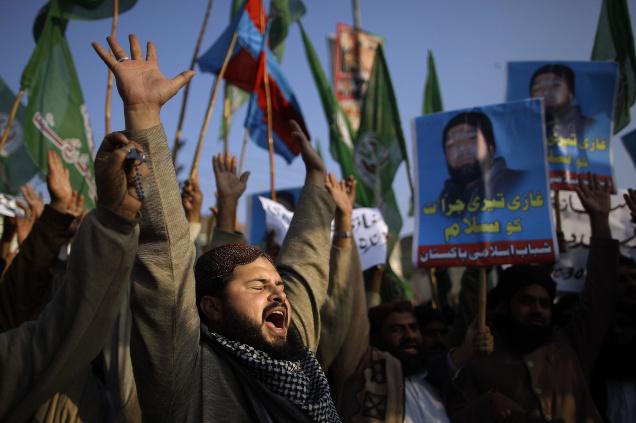
Tens of thousands of Islamists rallied Sunday in Pakistan’s southern port city of Karachi in support of the nation’s controversial blasphemy laws, and clerics threatened to kill anyone who challenged them.

Security was tightened around the house of Sherry Rehman, a former federal minister, who was threatened with death by radical clerics for moving a bill in the parliament last month to amend the blasphemy laws, which currently sentence to death anyone found guilty of insulting Islam.

The blasphemy laws have been in the spotlight since the murder last week of Salmaan Taseer, governor of Punjab province and a critic of the laws, who was shot by a member of his security detail. The shooter, Mumtaz Qadri, later said he killed Mr. Taseer because of the politician’s opposition to the laws. Mr. Taseer was a member of the Pakistan People’s Party, which runs the governing coalition, and was close to President Asif Ali Zardari.

The killing highlighted the extent to which extremist Islam has permeated Pakistan’s middle class and those close to the political elite even as the country grapples with an insurgency from the Pakistan Taliban and other violent Islamist groups. And it has deepened the polarization between moderate and radical Muslims throughout Pakistan. Radical clerics have seized the opportunity to whip up a campaign against moderate and progressive politicians, intellectuals and journalists.

Speakers at the Karachi rally sought to justify Mr. Taseer’s assassination, saying the killer fulfilled his obligation as a Muslim. “We will defend the assassin in the court,” declared Fazalur Rehman, the leader of Jamiat-e-Ulema Islam, a radical Islamic group that recently quit the coalition government after one of its ministers was sacked after publicly accusing a cabinet colleague of corruption.

The rally was organized by an alliance of hard-line Islamic groups including Jamaat-ud-Dawa, which the United Nations has said acts as a front for the outlawed terror group Lashkar-e-Taiba. Lashkar-e-Taiba is accused of masterminding the November 2008 terrorist attacks on Mumbai, which left more than 160 dead. Many demonstrators Sunday carried portraits of Mr. Qadri, who killed Mr. Taseer in a fashionable shopping district of Islamabad. Mr. Qadri has been hailed by Islamists as a great Islamic warrior.

Mr. Taseer had provoked the ire of radical clerics for publicly supporting a Christian woman who has been sentenced to death by a Pakistani court for allegedly making derogatory remarks against Islam’s prophet. The controversial laws have often been used against Christians and other non-Muslim communities, something that Ms. Rehman is seeking to prevent with a private bill she introduced last month.

A cleric of the Sultan Mosque in Karachi in his sermon on Friday called Ms. Rehman an “infidel” for suggesting changes in the blasphemy laws. A pamphlet signed by several Islamic clerics named her for supporting blasphemy. And some hard-line clerics have issued a “fatwa” demanding death to Ms. Rehman, a senior member of parliament of the Pakistan People’s Party.

Ms. Rehman said she is under pressure from the administration to leave the country until the situation calms down. “I am not going anywhere and [will] face the threat,” she said in a telephone interview.

A Prayer for Peace

Reported by Ghazi Salahuddin for The News International

We, in Pakistan, have rang out 2010 with a general strike and noisy rallies by religious elements in defence of the blasphemy law. We also rang out the year with a massive increase in petroleum products. And these spiritually and economically debilitating influences were certainly a distraction in our celebration of the biggest night of the year.

Today, on Sunday, the New Year is more than a day old. After spending the last few days of the departed year in taking stock of 2010, we are more inclined to look ahead and wonder what the coming year is going to be like. The general mood, certainly, is depressing. The past year was the year of floods, and Wikileaks, and drone attacks and social as well as political disarray. At the same time, it was also a year of hope – of Aman ki Asha – and of some intimations of how we, as a nation, still possess a conspicuous potential for survival.

In a sense, the attempt that so many ordinary citizens desperately made to celebrate the New Year in a communal spirit of joy was a genuine reflection of the life-force of a society that yearns for peace and happiness. In Karachi, the authorities made a concerted effort to subvert the inherent desire of the people to have a good time, as they always do. Roads leading to the Sea View promenade were blocked and eating places in the area were not allowed to do business.

It is besides the point that the young were still able to put up their show and the New Year was greeted with song and dance. Yes, the more privileged were able to celebrate the occasion in their private premises. But the point here is that public expression of any social or cultural vitality is increasingly being suppressed at the same time that the obscurantist elements are openly able to project their narrow outlook. What makes this dereliction more ominous is the government’s policy of appeasement and, even, surrender when it comes to dealing with the rise of intolerance and prejudice in our society.

It would be instructive to compare the rallies that were taken out in the late afternoon on Friday and the celebrations that were held a few hours later. I had an occasion to see the main procession that was taken out in Karachi and let me confess that it left me in a depressed state of mind. I simply could not identify with that crowd and the slogans it was raising. When I returned home at six, Sydney was greeting the New Year with its spectacular fireworks.

So, where do we, as a nation, belong in this world that is forever changing and embracing new technologies and new ideas? And it is in this context that I would like to return to the inspiration that we may draw from Aman ki Asha, the campaign launched by The Times of India Group and the Jang Group one year ago to promote peace between India and Pakistan.

Since yesterday was the first anniversary of this remarkable initiative, this newspaper has already underlined its main features and the success that it has achieved in the face of the raw winds of suspicion and animosity that have for long been blowing across this region. There was an editorial on this subject and a special edition. It was very encouraging to see the piece especially written for Aman ki Asha by Karen Armstrong, the celebrated religious historian.

Hence, I would not want to replicate the points that have been made. Still, I think that the public opinion poll conducted on the first anniversary of the project deserves to be carefully analysed. Here is a message that should not be overlooked when we interpret the social and political character of our society. It is true that the results of the survey are not at all surprising for those of us who have always believed in the overwhelming imperative of peace in not just our relations with India but also in a domestic context.

Now, the survey that was independently conducted by credible professionals, has certified that 70 per cent of Pakistanis and 74 per cent of Indians want peaceful relations between the two countries. What is crucial and meaningful here is that there has been a marked increase in the popular support for peace during the year that the largest media groups in India and Pakistan had conducted their varied and well-designed programmes under the umbrella of Aman ki Asha.

At a time when there is so much confusion about the role and the impact of the media, particularly the broadcast media, here is evidence that it can make a positive difference in shaping popular opinion when its message is in harmony with the natural aspirations of the people. This should make us realise that the media also has the power to sabotage the interests of the people when it is allowed to be manipulated by vested interests and when its expression is suppressed through intolerance and mindless chauvinism.

In many ways, the rise of extremism and militancy can be attributed to conflicts that are allowed to fester, distracting the attention and the resources of the nation from attending to the economic, social, and cultural needs of the people. Nothing undermines our national security more than rampant poverty and injustice and other deprivations of our people.

Indeed, the logic for normalisation of relations between India and Pakistan is rooted in the immortal desire of the people of both countries for social justice and for progress. In fact, Aman ki Asha should be seen in a larger context. Our need for peace transcends the otherwise fundamental issue of how our national security policies have remained India-centric.

Take, for instance, the official response to the rise of religious extremism in the country. Even when there is growing awareness that the threats we confront internally are very severe and could even jeopardise the very survival of the nation, the rulers do not seem to have the time or the intellectual ability to rethink and revise their national security formulations.

Meanwhile, of course, the people are ready and eager for what may be described as a paradigm shift. Initiatives like Aman ki Asha are necessary to set the stage for change and promote an environment in which an honorable and durable peace is possible.

When Aman ki Asha was launched one year ago, it affirmed that “peace between Pakistan and India is an idea whose time has come”. It also said that “it is daybreak for the people of the two countries who have languished in the twilight of mutual animosity and distrust for over six decades”. How long would it take for the rulers in the two countries to accept this self-evident truth?

The writer is a staff member. Email: ghazi_salahuddin@hotmail .com

Obama and the Pakistan Dilemma

By Matthew Kaminski for The Wall Street Journal

Islamabad, Pakistan– America can’t win in Afghanistan as long as assorted Taliban insurgents find safe haven in Pakistan. That’s the no-brainer dressed up as revelation in leaks this week about the latest U.S. National Intelligence Estimate regarding both countries.

The proposed solution is tidy, too: Lean on Pakistan to cut links to extremists in the tribal regions along Afghanistan’s eastern border and in southern Baluchistan, even as the CIA ramps up the number of covert drone strikes on those groups.

The assumption is that Pakistan can bring the extremists to heel at its pleasure. After all, the Pakistani military began nurturing Afghan and other jihadists in the 1980s and has kept them on as “strategic assets” throughout the American long war brought about by 9/11. So, we think, if Islamabad cuts its support and makes life difficult for the jihadists, this unfortunate genie can be put back in the bottle. President Obama might even meet his self-imposed deadlines for drawing down the 98,000 American troops in Afghanistan.

This is all a useful fiction, maybe even a necessary one. American bribes, threats and pleas have prompted Pakistan into its own troop surge in the tribal regions. Over the past 18 months the Pakistanis have more than quadrupled their presence there, to 140,000, and have taken heavy casualties. Last year the Pakistani army cleared Swat Valley and South Waziristan, which had been overrun by militants.

Today’s White House review of the war, which comes a year into the Obama surge, will likely highlight such progress. The president can consider his administration’s spirited engagement with Pakistan a foreign policy success. Credit is also due to “bulldozer” diplomat Richard Holbrooke, who developed close relations with the Pakistani civilian leadership before his untimely death Monday evening.

But Pakistan hasn’t turned. The insurgents who kill American troops in Afghanistan—principally the Taliban, whose leadership is in Baluchistan, and the militants loyal to the legendary fighter Jalaluddin Haqqani in the tribal regions—operate all too freely from Pakistan. President Obama should note that, too, today.

The year ends sourly for U.S.-Pakistani military relations. American frustration with Pakistan’s army chief, Gen. Ashfaq Kayani, has grown over broken Pakistani promises and a perceived lack of urgency. Summer floods diverted Pakistani troops away from the tribal areas, but the military doesn’t have that excuse now. The Pakistanis have also denied American requests to expand drone coverage to the area around Quetta, the city in Baluchistan that is the heaquarters-in-exile of the Taliban.

Pakistani officials say that Gen. Kayani will move his forces into North Waziristan, the tribal region that hosts the Haqqani network, in his own time. Some 50,000 troops are said to be ready to go in. No one wants them to lose, but they could against Haqqani’s respected force. A U.S. official says, “We don’t want them to do it if they’re not ready, but we don’t want them to think it’s not important.”

The Pakistanis may have found a way out. Analysts here say that the military is giving Haqqani time to relocate to a neighboring tribal region, Kurram, before soldiers go in to “clear” North Waziristan. A U.S. defense official here says that he’s seen no evidence to back the claim. But in the past most insurgents have simply melted away in the face of Pakistani advances.

Haqqani also figures as a trusted ally in Islamabad’s plans for a postwar Afghanistan. Afghan President Hamid Karzai and some American officials are open to talks with the Taliban, if they bring peace in exchange for power sharing. Also, who knows, America may get fed up and pull out before it wins. With all that in mind, Pakistani leaders may protect Haqqani, their favorite “asset,” thinking he and his Taliban allies may get power in Kabul one way or another.
Instead of sending drones over Quetta, the CIA this summer was allowed to set up shop on the ground. Across Pakistan, several such “fusion cells” pair CIA operatives with officials from Pakistan’s intelligence agency, the Inter-Services Intelligence. A Pakistani official says that this takes courage, as “ISI officers are murdered for helping Americans.”

Many circles here welcome U.S. pressure on the military and state to act. Islamic extremists are putting down deep roots in society, to the consternation of educated and moderate Pakistanis. This goes well beyond the mountainous regions that are the traditional home to religious warrior tribes. The state is losing its grip on Baluchistan. The country’s largest city, Karachi, is a militant hotbed. Parts of all Pakistani provinces have been radicalized, including the most populous, Punjab. Terrorism now touches all Pakistanis.

Pakistan is becoming more like Afghanistan—only with a more advanced economy and nuclear weapons. The people who cross the porous border between them, an arbitrary line drawn up by the British in the 1890s—already consider them the same country. Pakistan’s military has yet to show that it wants to—or that it can—control the Islamist wave. Many groups have slipped their leash and look at their old patron, the ISI, with distrust.
Gen. David Petraeus, the American commander in Afghanistan, certainly has contingency plans for Pakistan that go beyond extra doses of drones or diplomacy. Putting American boots in Waziristan is an obvious idea. But, like so many options, it is unappealing. The fallout in Pakistan would be hard to predict.

So for the moment, America gets to pretend that Pakistan can do this on its own. A successful terrorist attack on the U.S. with a Pakistani return address might quickly change that.

Pakistanis for Peace Editor’s Note
– As we have noted on several occasions before, Pakistan must do a lot more to hunt down the Taliban, its leaders and other militants on its side of the border. Already the violence and acts of terrorism within Pakistan are at an all time high as noted in this article and have touched every Pakistani and every corner of the country. Not eliminating the Taliban completely only allows them to get stronger.

Pakistan needs to stop playing a double game and stop thinking of the Taliban as a strategic asset as they never were nor ever will be an asset in any way. Pakistan must eliminate the safe havens for the Taliban within its territory, otherwise the United States will be compelled to act, with or without Pakistan’s blessings, and shall be correct in doing so to prevent attacks on its homeland emanating from Pakistan based militants.

A Silver Lining in Pakistan’s Floods

By Maha Hosain Aziz for Bloomberg Businessweek

With the devastating floods that began in July, Mother Nature has left an indelible imprint on Pakistan—its geography, its people, its national psyche. But it has also created an opportunity to change the destiny of millions of flood victims who traumatically lost their loved ones, homes, and livelihoods in mere days. This natural disaster may have given the country an opportunity to tackle a recurring point of contention in Pakistan—feudalism.

Academics, journalists, and analysts have frequently pointed to feudalism as a reason for the huge inequalities in Pakistan, claiming that many landlords treat their tenants and peasants like slaves. According to a 2009 estimate by campaigner Anti-Slavery International, debt has forced more than 1.8 million people to work for their landlords with no pay. If there is truth to this today, in even a few cases, perhaps the floods have delivered Pakistan an opportunity to empower those trapped in decades of feudalism and poverty.

The question is how to capitalize on this potential opportunity. Land reforms in 1959, 1972, and 1977 failed to redistribute land more equitably and are not expected ever to be legitimately carried out by any government, due to political constraints. What is possible today, in a post-flood scenario, is a collaborative effort among the private sector, entrepreneurs, NGOs, and foreign donors to be creative about job creation, even if only on a small scale. If successful, at least some of these landless flood victims could be given an opportunity to rebuild their lives outside the feudal context.

Laboring for the Owners

As many flood victims return to their homes to figure out how to rehabilitate their lives, others have already declared they will never go back. They appear to feel the floods have given them an opportunity to break away from the hold of their landlords. They did not own the land they were tilling and had to give large portions of their produce to their landlords while never coming close to paying off their debts.

Recent media coverage has captured the anger of many flood victims, particularly in rural Sindh. Some residents of Dari, near Kandhkhot, for instance, reportedly said they were literally left on the side of the road and abandoned by their landlords when the floods began. Unable to find shelter, they took refuge under some trees for a few weeks before making their way to overpopulated relief camps. Others with health problems made their way to camps but were turned away for medical treatment because they were not registered and have yet to be contacted by their landlords. Those who had small plots of land fear they will never retrieve what they owned because all the paperwork has been washed away.

There have also been reports of some influential landlords having had floodwaters diverted to save their own lands and instead engulf the villages of the poor. Others have said food rations and other forms of aid given to these landlords have only been passed on to their relatives and voters, while some apparently have kept the aid in storage for their own use in the coming months. While this has been difficult to prove, the perception of such acts has likely added to the resentment of some tenants and peasants toward their landlords that could derail feudal relations in the long term. As flood relief efforts increasingly focus on rehabilitation, we have to consider what these flood victims will do now. If they are not in a position to return to work on the land of their feudal lords, how will they make a living?

Earning Money in Aid Projects

Beyond finding housing for these landless flood victims, there is a real need to focus on job-creation strategies. Some aid agencies, such as Oxfam and the UNDP, have already teamed up with local NGOs to offer cash-for-work programs. In the Charsada and Nowshera districts of Khyber Pakhtunkhwa province, for instance, 1,500 flood victims from relief camps are being paid to pick up and dispose of rubble from the streets and build drains and roads,
working five days per week and receiving 400 to 600 Pakistani rupees ($4.7 to $7) for six hours of labor in a UNDP-sponsored project.

So while they earn money, these flood victims are rebuilding their homes.

But these jobs are short-term and do not cater to those who feel they cannot return home to work for their landlords. It would thus be prudent to think about long-term employment strategies, such as bottom-up programs, specifically for this cadre of flood victims. Perhaps foreign aid and NGO workers could work together with a local microfinance bank to introduce a combination of vocational training and loans for these flood victims so they can create their own employment and gain self-sufficiency. Or maybe social entrepreneurs can ally with the private sector to consider training flood victims for rural outsourcing in a particular area. There should also be a psychological component to any rehabilitation efforts, not only to help the flood-afflicted cope with the ongoing trauma of the floods, but also to introduce them to the idea of economic independence through these job creation projects.

This is the time to be creative for those flood victims who are not in a position to go home and work for their landlords anymore. It would be worthwhile for a local university, such as Lahore University of Management Sciences or Karachi’s Institute of Business Administration, to organize a job-creation conference, drawing on the perspectives of local businessmen, entrepreneurs, academics, NGO workers, and the flood victims themselves. These participants could start by “adopting” one flood-afflicted community of landless tenants and peasants, and brainstorming creative strategies specifically for their long-term employment and self-sufficiency.

We have already witnessed how quickly Pakistanis all over the world and in the country have rallied together to raise money aggressively for flood relief in the past few months. As the floods recede and recovery effects have turned to rehabilitation, perhaps these individuals would now be willing to offer “patient capital” to invest in their own job-creation project targeting those flood victims who will no longer go back to their feudal setup. It may not turn a profit for investors immediately, but if this works, it could provide at least one landless tenant or peasant with economic freedom—for the first time in his life

Maha Hosain Aziz is the senior teaching fellow in South Asian Politics at London’s School of Oriental & African Studies.

Pakistani Women Break Taboos in Winning Asiad Gold

As reported by Reuters

Sana Mir, captain of the Pakistan women’s cricket team that won a gold medal at the Asian Games in Guangzhou, had other ideas.

“I belong to Abbotabad where girls are not encouraged to take up sports leave alone cricket but my family was supportive and made it possible for me to play cricket and study as well,” Mir said after a triumphant return home on Sunday.

“I hope our victory will serve as a catalyst for women’s sports in Pakistan.”

The women’s team, wearing their green team blazers, were garlanded and showered with rose petals in a rousing welcome at Karachi airport after winning the gold medal in a one-sided final against Bangladesh on Saturday.

“This welcome is like icing on the cake after our victory,” Mir said.

Pakistani media greeted the gold medal as a victory for women in the country.  “Looking for positive faces to show the world, Pakistan need go no further than its sportswomen,” the Dawn English daily newspaper said in an editorial.

“Despite the many restrictions they face, Pakistani women have done well in the field of sports from time to time.”  “Unfortunately too little has been done to encourage these brave young women,” the News daily paper said.

“We never dreamt one day women’s cricket would be acknowledged this way,” said Mir. “The day we won the medal I called up my family to thank them for their support.”

In a country where cricket remains a passion despite the spot-fixing allegations surrounding the men’s team, the Pakistan Cricket Board (PCB) has been giving steady exposure to the women’s team.

“The fact that we have played regularly since last year in International Cricket Council (ICC) tournaments and against better opposition has helped these girls gain confidence,” said Bushra Aitzaz who heads the women’s wing in the PCB.

‘Pak Must Acknowledge Terrorism is “Home Grown”, Not Indian, Jewish or US conspiracy’

As Reported by ANI

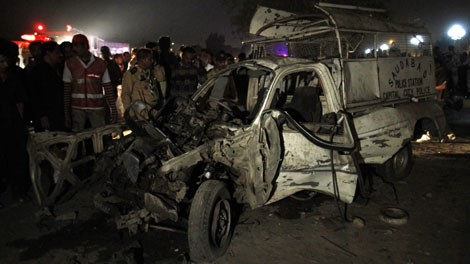
The Tehrik-e-Taliban Pakistan (TTP) attack on Karachi’s Crime Investigation Department compound should serve as an ultimate wake up call for Pakistan to swiftly act against home grown terrorism rather than blaming some Indian or US conspiracy for terror strikes on its soil.

“The assault on the CID centre must be seen for truly what it tells us in plain words: that home grown terrorism is no Indian, Jewish or American conspiracy against Pakistan or Islam,” Pakistan’s leading newspaper Dawn said.

“It also tells us that there are many misguided Pakistanis in our midst, who may even have sympathy for these zealots targeting largely Muslims that would not endorse their narrow minded view of the faith under whose banner they kill and maim innocent citizens,” it noted.

“How else does one explain the transportation of a van full of explosives along with a firing squad armed with latest weapons that came to attack the CID building during the evening rush hour no less?” the paper questioned.

It is high time that Pakistan woke up to the increasing threat posed by terror organisations and took stringent steps to tackle it.

“Much of Islam as we know it in this country today, isn’t exactly in very safe hands; it’s time we woke up to the threat and did something about it instead of issuing token mere condemnations that follow such ghastly acts of sheer murder and mayhem, from Islamabad to the provincial capitals and the other Pakistani capital of sorts, in exile, the faraway London,” the paper said.

It argued over a possibility that Thursday’s bombing took place “because no concrete action was taken after last month’s bombing at the Abdullah Shah Ghazi shrine; nor indeed the ghastly attacks before that on two Muharram processions in December and February.”

Ruing the state of Pakistan’s preparedness in combating terrorism, it expressed the hope that the latest bombing incident- at CID building in Karachi- “given its precision and intensity as well as the target hit, should serve as a final wake up call to law enforcement agencies and the authorities concerned in Karachi.”

Pakistan Bomb Shows Militant Reach

By Shakil Adil for The Associated Press

A coordinated assault on a police compound far from Taliban and al-Qaida heartlands along the Afghan border showed the ability of militants to strike back despite being hit by U.S. drone strikes and Pakistani army operations.

The Pakistani Taliban claimed responsibility for Thursday night’s attack in downtown Karachi, the country’s largest city and commercial hub, according to media reports. Fifteen people were killed and more than 100 were injured in one of the first coordinated strikes against a state target in the city.

The Pakistani Taliban is allied with al-Qaida and has emerged as the most potent threat to the stability of the nuclear-armed country since 2007. Its suicide squads have killed thousands of people in attacks on government, security force and Western targets, most of them civilians, shaking faith in the civilian government.

“These attacks which are happening around the country, they are carried out by enemies of the nation,” said Faisal Mehmood, a resident of Karachi, said Friday. “It is not in Islam that you kill your brothers.”

The gang of around six gunmen managed to penetrate a high-security area of Karachi that is home to the U.S Consulate, two luxury hotels and the offices of regional leaders. They opened fire on the offices of the Crime Investigation Department before detonating a huge car bomb that leveled the building and others nearby.

The police offices housed a detention facility that was believed to be holding criminals. There were conflicting accounts over whether militants were also being held there.

The CID takes the lead in hunting down terrorists in Karachi. Earlier this week, the agency arrested six members of Lashkar-e-Jhangvi, an al-Qaida linked group blamed for several high profile attacks in recent years. The suspects were presented before a court earlier Thursday.

Islamist militants are known to have found shelter among Karachi’s 14 million people, and their have been occasional attacks on Shiite Muslims, whom al-Qaida and the Taliban believe to be infidels, as well a blast last month at a Sufi shrines.

But it had largely escaped a wave of violence last year that saw many attacks in Lahore, Pesahwar and other cities.

The government has declared war on the militants, and the army has moved into several areas in the northwest close to Afghanistan. The United States has increased the tempo of missile strikes in the region over the last two months, with close to 100 this year alone.

But the Pakistani state still distinguishes between militants who attack inside Pakistan and those who focus on fighting U.S. troops in Afghanistan or Indian rule in the disputed Kashmir region, believing the latter to be “good” militants. Critics say this policy is shortsighted, noting that groups are increasingly coalescing and support each other.

Pakistan Looks Ahead to End of Afghan War

By Olivia Ward for The Toronto Star

As NATO forces prepare to pull out of Afghanistan, worries about the country falling back to Taliban control are paramount. But in neighbouring Pakistan, where suicide bombings and brazen attacks on security forces have become regular occurrences, the stakes are also high.

“What happens in Afghanistan affects us and vice-versa,” says Akbar Zeb, Pakistan’s High Commissioner to Canada. “We have four million Afghan refugees still living in Pakistan, and it’s in our interest to have a stable country where we can send them back. A Taliban takeover won’t be just detrimental to Afghanistan. It would harm Pakistan and the whole region.”

Zeb said that under the civilian government of President Asif Ali Zardari, relations have improved with Afghanistan, and contrary to reports of friction, there are “frequent contacts” between the two countries that would be helpful in creating stability.

But he added that Canada, and other Western countries, should not repeat the mistakes of the post-Soviet era, when the West lost interest in Afghanistan and Pakistan as soon as the Soviet troops withdrew.

During the rule of Pakistan’s military leader, President Pervez Musharraf, groups of Taliban-linked militants got a foothold in Pakistan, but were not seen as a danger to the country until internal attacks began to spread. Former prime minister Benazir Bhutto was assassinated, and suicide bombings took the lives of hundreds of civilians. Under pressure from the U.S., the Pakistani military began a massive campaign against the Taliban along the Afghan border.

“We have managed to clear a lot of areas from the Taliban,” said Zeb. “Military campaigns are the only language they understand. But they alone won’t help to win the war. We have border regions with a lot of poverty, and backward elements that have been ignored for a long time.”

Canada has announced support for road and rail projects linking Afghanistan and Pakistan to speed trade between the two countries.

“It’s a very good initiative, but scope is limited,” said Zeb.”We wish the projects were larger and not just (confined to) those that involve both Afghanistan and Pakistan.”

Talks with Islamabad are also ongoing on the use of ports in Karachi for shipping out Canadian troops and military supplies from Afghanistan.

But as the war continues, Pakistan has also been urged to be tougher on the Taliban. In the past two years it has carried out attacks against the militants in its border regions with some success, while American-launched drone strikes have killed high-ranking Taliban. The catastrophic floods that wiped out some of the most important agricultural areas of Pakistan brought a temporary truce, but militant attacks have resumed since the waters receded.

Last week, talk of a peace deal between the notorious Taliban-linked Haqqani network, and an opposing tribe in the remote northwest raised fears that it could open the way for Taliban access to strategic border areas. But the U.S. has also urged a Pakistani offensive against the network in North Waziristan, a volatile region where 400,000 civilians are vulnerable to displacement.

According to Pakistani officials, the country has lost some 7,000 security forces in a decade of fighting the militants — more than three times the coalition deaths in Afghanistan. Meanwhile 30,000 Pakistani civilians have died. The border region, a tangle of mutually hostile tribes, remains a haven for militants.

“It’s a difficult balance for Pakistan,” said Zeb. “Foreign troops may leave, and for them Afghanistan is a distant land. We’re Afghanistan’s neighbours. We helped with the fighting in the decade-long war against the Soviets. And we have to live with the outcome of this war.”

Sectarianism Infects Hospital Wards

As Reported by IrinNews.org

Religious, political and ethnic divisions have claimed hundreds of lives in Karachi, Pakistan’s largest city, but also influence the chances of survival for the injured.

A doctor in the emergency ward of Civil Hospital Karachi, one of the city’s largest public hospitals, told IRIN: “After a terrorism incident, we are under intense pressure. Earlier, we had the activists of various political parties threatening us in the emergency department to not treat the patients of their rival groups. They use all sorts of delay tactics, be it blocking the entrance to pounding on the doors and abusing the staff. Now, we also get calls [from the militants].”

The doctor, who asked not to be identified, added: “One ethnic-based party is so strong that it makes sure that the duty doctors are unable to carry out their work once the injured start arriving. We have doctors and other staff who are from that party within the premises. Time and again we have been told not to treat Pushtun injured, who are very easy to identify due to their language and beards. We already face a shortage of staff, medicines and medical equipment… It’s just a mess here. [But] all professionalism and ethics aside, how can you expect me to save someone when my life is in danger?”

According to a Human Rights Commission of Pakistan report released in July, 260 people have been killed in targeted killings since January 2010. The number continues to rise with 50 people killed so far in the latest wave of violence following a shooting rampage in Shershah Market on 19 October.

Turf war

The nub of the problem in Karachi is the ongoing turf war between the Muttahida Quami Movement (MQM) and the Awami National Party (ANP) for control of the coastal city. Both parties draw support from rival ethnic groups; the MQM’s vote bank is among largely Urdu speakers who migrated to Karachi after partition from India in 1947, while the ANP mainly represents Pushtuns.

Habib ur Rehman Soomro, secretary-general of the Pakistan Medical Association, acknowledged that sectarianism was rife in the health services. “I will not deny this occurrence. I live in this city and I know how things work. Refusing and delaying treatment in cases of emergency, especially after incidents of ethnic violence and terrorism, is a crime but all this is happening… Now the situation is such that all public hospitals in the city have the offices of MQM, PPP [the ruling Pakistan Peoples Party] and if it’s a Pashtun-dominated area, ANP.”

Shams Khan was injured on 3 August in the violence that erupted after the killing of MQM leader Raza Haider, which claimed 45 lives.

“I was shot in the leg by these boys near Lalo Khait. I made my way to Abassi Shaheed Hospital but they refused to treat me. I was practically thrown out of the facility by my beard as one of the doctors called me a Taliban. Bleeding, I made my way to JPMC [Jinnah Postgraduate Medical Centre]. I lost so much blood by the time the doctors attended to me. I now limp around and need a crutch to walk. The doctor told me that had I been treated earlier, it would not have happened.”

Soomro told IRIN that doctors were under constant threat. “Since the 1990s, there have been plenty of incidents of targeted killings of doctors killed on the basis of sect and ethnicity. Over 85 doctors have been murdered. First it was the Shia-Sunni issue, then the Pushtun-Mohajir issue, now it’s about sects. It’s just insane. Political affiliations need to be removed.”

A doctor at the JPMC, who asked not to be named, said: “We have seen days where doctors were beaten by angry political activists as well as the family members of the victims after a bomb blast… This cycle of madness will not end.”

Pakistanis for Peace Editor’s Note– We are unsure which is sadder, the inability of doctors in Pakistan’s biggest city to save lives without threat and or intimidation and violence against them, or that the very people giving these threats to the doctors are in fact linked to members of the two ruling political parties, who have been charged with being “leaders” of the country.