Posts Tagged ‘ Pakistanis ’

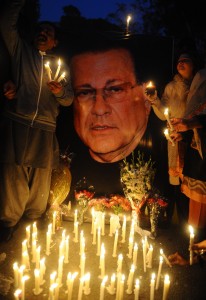
Shahbaz Bhatti, Modern Day Martyr in Pakistan

By Terry Mattingly for The Pocono Record

In the early days of Christianity, martyrs often gave their final testimonies of faith to Roman leaders before they were crucified, burned or fed to lions.

Times being what they are, Shahbaz Bhatti turned to Al-Jazeera and YouTube. The only Christian in Pakistan’s Cabinet knew it was only a matter of time before his work as minister for minority affairs got him killed. Threats by the Taliban and al-Qaida kept increasing.

“I want to share that I believe in Jesus Christ, who has given his own life for us. I know what is the meaning of the cross and I follow him on the cross,” said Bhatti, in a startlingly calm video recorded several weeks before his assassination on March 2.

“When I’m leading this campaign against the sharia laws for the abolishment of blasphemy law, and speaking for the oppressed and marginalized persecuted Christian and other minorities, these Taliban threaten me. … I’m living for my community and suffering people and I will die to defend their rights. So these threats and these warnings cannot change my opinion and principles.”

The last straw was almost certainly the Catholic statesman’s defense of Asia Bibi, a Christian mother of five who was sentenced to death last November for the crime of blasphemy after she publicly defended her faith in a village argument. The verdict — which must be upheld by a higher court — further polarized a tense nation and sparked a global firestorm.

Then again, in 2009 Bhatti received the U.S. Commission on International Religious Freedom’s first medallion for the promotion of religious freedom. A year later, he met with Pope Benedict XVI to discuss interfaith work and religious liberty in Pakistan. Bhatti was not hiding his convictions.

The blasphemy laws in question went into effect in 1986, during the dictatorship of Gen. Muhammad Zia-ul-Haq. They ban, among other actions, the use of “derogatory remarks, etc; in respect of the Holy Prophet. Whoever by words, either spoken or written or by visible representation, or by any imputation, innuendo or insinuation, directly or indirectly, defiles the sacred name of the Holy Prophet Mohammed (PBUH) shall be punished with death, or imprisonment for life, and shall also be liable to fine.”

These blasphemy laws have been used against hundreds of Muslim dissenters and Ahmadi sect members, whose approach to Islam is specifically attacked in the laws. In practice, conversion from Islam to another faith is considered blasphemy, as are attempts to advocate or defend minority faiths, such as Christianity or Hinduism.

Vigilantes often kill those formally or informally accused of blasphemy — making trials irrelevant.

This was the case with Bhatti’s death in a wave of machine-gun fire into his unarmored car. Pakistani officials had denied his request for an armored car, despite the constant threat of drive-by shootings.

Formalities were also irrelevant on Jan. 4, when Salmaan Taseer, the governor of Pakistan’s Punjab Province, was assassinated by one of his bodyguards. This outspoken Muslim also defended Bibi and called for reform in the use of blasphemy laws.

Adoring crowds showered Taseer’s assassin with rose petals and garlands as he arrived to face a magistrate, while moderate Muslim leaders remained silent. Pakistan’s legislators observed a moment of silence for Bhatti, since it probably would have been fatal for anyone to offer a prayer in his honor.

After all, pamphlets left by those who killed Bhatti warned that they would keep fighting “all the world’s infidels, crusaders, Jews and their operatives within the Muslim brotherhood. … This is the fate of that cursed man. And now, with the grace of Allah, the warriors of Islam will pick you out one by one and send you to hell, God willing.”

Apparently, many radicals in Pakistan have concluded — a perfect Catch-22 — that it is blasphemy to oppose the blasphemy laws.

Meanwhile, the Pakistani conference of Catholic bishops is preparing to render a judgment of its own. Later this month the bishops will review a proposal to ask the Vatican to designate Bhatti as a martyr.

“Bhatti is a man who gave his life for his crystalline faith in Jesus Christ,” Bishop Andrew Francis of Multan told a Vatican news agency. “It is up to us, the bishops, to tell his story and experience to the church in Rome, to call for official recognition of his martyrdom.”

-Terry Mattingly is director of the Journalism Center at the Council for Christian Colleges and Universities.

Islamophobia and Radicalization

By James Zogby for Counter Punch

Let me state quite directly: Islamophobia and those who promote it are a greater threat to the United States than Anwar Al-Awlaqi and his rag-tag team of terrorists.

On one level, Al-Awlaqi, from his cave hide out in Yemen, can only prey off alienation where it exists. Adopting the persona of a latter-day Malcolm X (though he seems not to have read the last chapters of the “Autobiography” or learned the lessons of Malcolm’s ultimate conversion), he appears street-smart, brash, self- assured and assertive — all of the assets needed to attract lost or wounded souls looking for certainty and an outlet for their rage. Like some parasites, Al-Awlaqi cannot create his own prey. He must wait for others to create his opportunities, which until now have been isolated and limited: a disturbed young man here, an increasingly deranged soldier there.

Islamophobia, on the other hand, if left unchecked, may serve to erect barriers to Muslim inclusion in America, increasing alienation, especially among young Muslims. Not only would such a situation do grave damage to one of the fundamental cornerstones of America’s unique democracy, it would simultaneously and rapidly expand the pool of recruits for future radicalisation.

I have often remarked that America is different, in concept and reality, from our European allies. Third generation Kurds in Germany, Pakistanis in the UK, or Algerians in France, for example, may succeed and obtain citizenship, but they do not become German, British or French. Last year, I debated a German government official on this issue. She kept referring to “migrants” — a term she used to describe all those of Turkish descent living in her country — regardless of the number of generations they had been there. Similarly, following their last election, a leading British newspaper commented on the “number of immigrants” who won seats, without noting that many of those “immigrants” were third generation citizens.

America has prided itself on being different. Being “American” is not the possession of a single ethnic group, nor does any group define “America”. Not only do new immigrants become citizens, they also secure a new identity. More than that, as new groups become American and are transformed, the idea of “America” itself has also changed to embrace these new cultures.

Within a generation, diverse ethnic and religious groups from every corner or the globe have become Americans, dramatically changing America in the process. Problems remain and intolerant bigots, in every age, have reared up against new groups, but history demonstrates that, in the end, the newcomers have been accepted, incorporated and absorbed into the American mainstream.

This defines not only our national experience, but our defining narrative as well. When immigrant school children in Europe learn French, German or British history, they are learning their host’s history. In the US, from the outset, we are taught that this is “our new story” — that it includes all of us, and has included us all, from the beginning.

It is because new immigrants and diverse ethnic and religious communities have found their place and acceptance in the American mainstream that the country, during the last century, survived and prospered despite being sorely tested with world wars, economic upheaval and bouts with internal strife. During this time we had to contend with anti-black, anti-Asian, anti-Catholic, anti-Jewish, anti-immigrant, and anti-Japanese movements. In the end, after creating their moment of pain, these efforts have always lost.

They lose, but they don’t always go away. The Islamophobia we are witnessing today is the latest campaign by bigots to tear apart the very fabric of America. We know the groups promoting it. First, there is the well-funded “cottage industry”, on the right, of groups and individuals with a long history of anti-Arab or anti-Muslim activity. Some of the individuals associated with these efforts have been given legitimacy as commentators on “terrorism”, “radicalisation” or “national security concerns”, despite their obvious bias and even obsession with all things Arab or Muslim (in this, they remind me of good old-fashioned anti-Semites who never tired of warning of Jewish threats or conspiracies or who while always claiming to like individual Jews rallied against any and all Jewish organisations).

If these “professional bigots” have provided the grist, the mill itself was run by the vast network of right-wing talk radio and TV shows and websites, and prominent preachers who have combined to amplify the anti-Muslim message nationwide. Their efforts have done real damage. They have tormented decent public servants, created protests that have shuttered legitimate institutions, fomented hate crimes, and produced fear in the Muslim community.

In just the past two years, we have seen a dramatic upsurge in the activity of these bigots. More ominously, their cause has been embraced by national political leaders and by elements in the Republican Party, who appear to have decided, in 2010, to use “fear of Islam” as a base-building theme and a wedge issue against Democrats for electoral advantage.

In the past, only obscure or outrageous members of congress (like North Carolina’s Sue Myrick who expressed nervousness and insecurity because of “who was owning all those 7/11’s”; or Colorado’s Tom Tancredo who once warned that he “would bomb Mecca”) were outspoken Islamophobes. After the National Republican Congressional Campaign Committee embraced opposition to Park 51 as a campaign theme, it is hard to find a leading Republican who has not railed on some issue involving Islam or Muslims in the US.

The net impact here is that this current wave of Islamophobia has both played to the Republican base while firming up that base around this agenda. The polling numbers are striking and deeply disturbing. Some 54 per cent of Democrats have a favourable attitude towards Muslims, while 34 per cent do not. Among Republicans, on the other hand, only 12 per cent hold a favourable view of Muslims, with 85 per cent saying they have unfavourable views. Additionally, 74 per cent of Republicans believe “Islam teaches hate” and 60 per cent believe that “Muslims tend to be religious fanatics”.

The danger here is that to the degree that this issue has become a partisan — and in some cases a proven vote getter — issue for the Republican Party, it will not go away any time soon. The longer we are plagued by this bigotry, and the displays of intolerance it breeds (the anti-mosque building demonstrations or the anti-Sharia law efforts now spreading across the country) the longer young Muslims will feel that the “promise of America” does not include them, and they will feel like aliens in their own country.

It is this concern that has prompted many inter-faith religious groups and leaders and a diverse coalition of ethnic and civil rights organisations to so vigorously oppose Congressman Peter King’s (R-NY) hearings that will deal with the radicalisation of American Muslims later this week. They know, from previous statements made by King, of his personal hostility to American Muslims. They also know that what King is doing will only aggravate an already raw wound, creating greater fear and concern among young Muslims who have already witnessed too much bigotry and intolerance.

What they should also know is that in the process of targeting a religion in this way, and engaging in this most “un-American activity”, King and company are, in fact, opening the door for increased alienation and future radicalisation. Al-Awlaqi must be smiling from inside his cave.

-Dr James Zogby is president of the Arab American Institute and is a Roman Catholic of Lebanese descent and brother of prominent American political pollster and founder of Zogby Polls, John Zogby.

Pakistan Expresses “Total Solidarity and Support” to Quake, Tsunami-hit Japan

As Reported by Asian News International

Pakistan has expressed its “total solidarity and support” to the government and people of Japan in the aftermath of the devastating earthquake and tsunami that hit the country on Friday.

“We are deeply shocked over the terrible news of the strong earthquake and tsunami that has hit Japan. At this time of great trial, I wish you to know that the Government and people of Pakistan stand with you and the Japanese people in total solidarity and support,” President Asif Ali Zardari said in his condolence message to Emperor Akihito of Japan.

“Our profound sympathy and condolences to all those who lost their loved ones. Pakistan stands ready to provide any assistance to help our Japanese friends overcome the effects of this enormous natural calamity,” he added.

Prime Minister Yousaf Raza Gilani also expressed solidarity with the Japanese government and its people.

In a message to his Japanese counterpart Naoto Kan, Gilani said: “We stand ready to help, in any manner, to alleviate the suffering and assist our Japanese friends to overcome effects of this terrible natural calamity.”

In Pakistan, Justifying Murder for Those Who Blaspheme

By Aryn Baker for Time
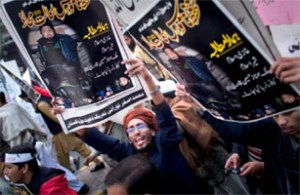
“I believe in Jesus Christ who has given his own life for us,” the doomed man said, staring straight into the video camera. “And I am ready to die for a cause.” Shahbaz Bhatti had no hesitation in his voice as he responded to a question about threats from the Taliban and al-Qaeda. “I’m living for my community … and I will die to defend their rights.” It was his last answer in a four-month-old self-produced video that was to be broadcast in the event of his death. But the radicals had the final say. On March 2, Bhatti, Pakistan’s Minister for Minority Affairs, was shot dead in Islamabad. Pamphlets scattered on the ground claimed the act for a new alliance of “the organization of al-Qaeda and the Punjabi Taliban” and asserted that other infidels and apostates would meet the same fate.

Bhatti’s death had been foretold not just by himself but also in the nation’s response to a previous assassination, that of Punjab governor Salmaan Taseer on Jan. 4. Taseer, a self-made millionaire, had turned his largely ceremonial post into a platform for a campaign to amend Pakistan’s blasphemy laws. Bhatti, the only Christian in the Cabinet, refused to be a token and swore to battle intolerance. Both men supported clemency for Aasia Noreen, a Christian woman who had been accused of blasphemy and sentenced to death. Taseer’s stance on the issue infuriated a large part of the population that, thanks to religious leaders and school curriculums, believes that blasphemy is a sin deserving of execution. In the weeks leading up to his assassination, Taseer had been denounced at Friday prayers, excoriated in the media and largely abandoned by his Pakistan People’s Party (PPP) for fears that his campaign would prove politically toxic. The witch hunt culminated in a bodyguard’s pumping 27 rounds into his head and chest in the parking lot of a popular Islamabad shopping center.

Within hours of Taseer’s death, telephone text messages celebrating his assassination made the rounds. “Justice has been done,” read one. “If you love the Prophet, pass this on.” A Facebook fan page for assassin Malik Mumtaz Hussain Qadri garnered more than 2,000 members before site administrators shut it down. Even the leaders of state-funded mosques refused to say funeral prayers for the slain governor. When Qadri was transferred to a local jail, he was garlanded with roses by hundreds of lawyers — the vanguard of a movement that in 2008 helped unseat a military dictator — offering to take on his case for free.

At his court appearance a few days later, Qadri told the judge that he believed in a Pakistan where loyalty to the Prophet eclipses all other rights. According to Taseer’s daughter Shehrbano, her father “wanted an egalitarian society where open debate is protected and people are not killed for speaking out.” And Bhatti dreamed of a nation true to founder Muhammad Ali Jinnah’s vision, one where “you are free to go to your temples, you are free to go to your mosques or to any other place of worship.” Which vision prevails — Qadri’s or Taseer and Bhatti’s — will decide the future of the country.

The Roots of Extremism

 
It is not news that Pakistan has a lunatic fringe. What is disturbing is that after Taseer’s murder, when the silent majority finally spoke up, it praised Qadri, not his victim. The public reaction exploded the myth of Pakistan’s moderate Islam; Qadri belongs to a mainstream sect that routinely condemns the Taliban. “The Pakistan we saw in the wake of Taseer’s killing is the real Pakistan,” says Amir Muhammad Rana of the Pak Institute for Peace Studies. For the past two years, Rana’s organization has conducted in-depth interviews with a broad spectrum of Pakistani citizens. “They might dress Western and eat at McDonald’s, but when it comes to religion, most Pakistanis have a very conservative mind-set.”

Pakistan’s religious parties rarely do well at the polls — a fact often cited by those countering concerns that the country is going fundamentalist — but their street power is considerable. The furor over blasphemy appears to be partly in response to significant losses for the religious right in the 2008 elections. With the current government on the verge of collapse and popular sentiment against the PPP mounting, the religious parties are betting on significant gains if fresh elections are called. The case of Raymond Davis, a CIA contractor accused of killing two Pakistanis during what appears to have been a botched attempt to rob him, demonstrates the state of Pakistan’s politics. It has gone virtually unremarked in Pakistan that Qadri, a confessed murderer, has been hailed as a national hero, while Davis — who, whatever his background, seems to have been acting in self-defense — is considered worthy of the death penalty. Over the past few weeks, street rallies led by the religious right have simultaneously called for the release of Qadri and the hanging of Davis. (Read: “Pakistan’s Christians Mourn, and Fear for Their Future.”)

Using religion to shore up political support is nothing new in Pakistan. Founded as a Muslim nation carved from a newly independent India in 1947, Pakistan has long struggled to unite a diverse population divided by language, culture and ethnicity. Islam was the common denominator, but Jinnah was famously enigmatic about its role in government.

Then, in 1977, Muhammad Zia-ul-Haq, an Islamist military general, overthrew the democratically elected government of Zulfikar Ali Bhutto, who was already retrenching his secular vision of Pakistan in an effort to win religious support. To further appease Muslim religious leaders, Zia-ul-Haq strengthened the colonial-era blasphemy laws, mandating that breaches should be answered by the death penalty. Since then, more than 1,274 cases have been lodged. As repeating blasphemous words could be considered to be perpetuating the crime, many cases are accepted without evidence, a system well primed for the pursuit of vendettas. That nobody has yet been executed by court order is hardly reassuring: 37 of the accused have been killed by vigilantes. (In 1929, Jinnah famously defended an illiterate carpenter who shot to death a Hindu publisher accused of blasphemy. The plea failed, and after the carpenter was hanged, Taseer’s father was one of the pallbearers.)

The Uses of Blasphemy
When a nation rises up in support of a murderer instead of his victim, it’s hard not to believe it is heading down a dangerous path. “What is happening now won’t matter in five years,” says Shehrbano Taseer. “It will matter in 25 years. What we are seeing now is the fruit of what happened 30 years ago. If people had stood up against [Zia-ul-Haq], we would not be here today. Because of that silence we have madrasahs spewing venom, a true Islam threatened by the same people who claim to serve it, and a cowed majority too afraid to speak.”

President Asif Ali Zardari, an old friend of Taseer’s, condemned the murders but didn’t go to either funeral. After paying his respects to Taseer’s family, Interior Minister Rehman Malik gave an impromptu press conference outside Taseer’s house during which he announced that he too would kill any blasphemer “with his own hands.” A few days later, the Prime Minister announced that he would drop the issue of the blasphemy laws altogether. Meanwhile, the government is under pressure to go through with Aasia’s sentence, and now her two champions are dead.

Reaction to Bhatti’s murder has been muted, characterized mostly by denial. What little newspaper coverage there was focused on security lapses or the role of the country’s Christian community rather than on the motives of the killer. On television talk shows, members of the religious parties and right-wing commentators spun a conspiracy theory that alleged that Bhatti’s murder had been “a plot” hatched by “outside forces” to “divert attention from the Raymond Davis affair.” There was no mention of the fact that Bhatti was campaigning alongside Taseer on the issue of blasphemy.

The PPP was founded in 1967 with the goal of bringing secular democracy to a nation under military rule. It vowed to give power to the people and promised to protect the nation’s downtrodden. That Pakistan’s most progressive party — one that has already endured the assassination of former Prime Minister Benazir Bhutto — should cave in the face of religious fundamentalism speaks volumes about the strength of the religious right. A candlelight vigil promoting a progressive Pakistan a few days after Taseer’s assassination drew nearly 1,000 supporters; a religious rally in Karachi the same day had 40,000 in the street chanting Qadri’s name. “Taseer’s murderer was tried in the court of public opinion, and he has emerged a hero,” says a woman shopping for vegetables in the same market where the governor was killed. “If someone kills me because I criticize Qadri, will he too be called a hero?” She declined to give her name. (Read: “Murder in Islamabad: Pakistan’s Deepening Religious Divide.”)

Of course, few Pakistanis would ever go as far as Taseer’s or Bhatti’s killers. But their ambivalence can easily be manipulated. “Just because we are religious does not mean we will all be reaching for guns the next time someone says something wrong,” says Malik Khan, a university student who spent a recent afternoon at a shrine in Lahore dedicated to a revered Islamic saint. “But Salmaan Taseer was an extremist as well. He should not have touched the blasphemy law.” Khan received a text message praising Qadri and exhorting him to pass it along. It posed a moral quandary: “I don’t agree with the message,” he says. “But I love the Prophet. My thumb hesitated a long time over the delete button.” In the end, he passed the hate along.

Qadri himself was the religious-minded youngest son of a family just stepping into the middle class. Like his brother, he joined the special-forces branch of the Punjab police in 2002. He had been flagged as a security risk because of his strong religious leanings but was nevertheless appointed to Taseer’s security detail when he visited Islamabad. In his confession, Qadri said he had been inspired by the teachings of his local mullah, Hanif Qureshi. At a rally a few days later, Qureshi claimed credit for motivating Qadri. “He would come to my Friday prayers and listen to my sermons,” he said. Then he repeated his point: “The punishment for a blasphemer is death.”

But is it? Two weeks after Taseer’s murder, I visited Qari Muhammad Zawar Bahadur, the head of one of Pakistan’s mainstream religious groups and a co-signer of a statement that advised Muslims not to show “grief or sympathy on the death of the governor, as those who support blasphemy of the Prophet are themselves indulging in blasphemy.” For more than an hour, he justified his group’s stance, telling me that the Koran was clear on the issue. I asked Bahadur to show me the exact verse that detailed the punishments for blasphemy. He mumbled that “there are several passages,” as if there were so many, he couldn’t decide which one to quote. When pressed further, he consulted a Koran and read aloud a passage that spoke of killing a man who had once harmed the Prophet.

That verse has routinely been dismissed by leading Islamic scholars as referring to a specific case and having nothing to do with blasphemy. They say there is no definition of blasphemy in the Koran, nor any prescription for its punishment. “Nobody challenges these mullahs, and that is our problem,” says Omar Fazal Jamil, who runs a p.r. firm in Lahore. “We can’t invoke liberal secular values anymore. I have to have the knowledge to contradict these men who distort our religion for their own political gain. I have to be able to say, ‘No, this did not happen, this is not right, and show me where it says in the Koran that blasphemers should be shot on sight.’ ”

The Sin of Silence
In the absence of such challenges, those favoring religious intolerance will continue to have things go their way. In late 2007, Benazir Bhutto released an updated manifesto for her father’s party. “The statutes that discriminate against religious minorities and are sources of communal disharmony will be reviewed,” it said. Less than a month later she was dead, killed in a bomb attack just 13 km from where both Taseer and Bhatti were murdered. Her death was an opportunity to rally the nation against the forces of extremism. Instead the party focused on consolidating power. The manifesto remains an empty promise, and two more voices of tolerance have been silenced. For evil to prevail, goes the old aphorism, all that is required is for good men to do nothing.

— With reporting by Ershad Mahmud / Lahore and Omar Waraich / Rawalpindi
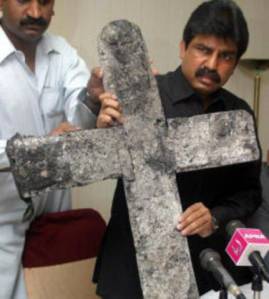
The Myth of ‘Moderate Pakistan’

By Sadanand Dhume for The Wall Street Journal

It’s time to bury the myth of moderate Pakistan. You know the one: the notion, repeated ad nauseam in magazine articles, think-tank reports and congressional testimony—as though saying it often enough will make it true—that Pakistan is an essentially tolerant country threatened by a rising tide of fundamentalism. Here’s a news flash: The tide has risen.

The most recent reminder of this came last Wednesday in Islamabad, when suspected Taliban militants shot dead Shahbaz Bhatti, Pakistan’s 42-year-old minister for minority affairs and the only Christian in the overwhelmingly Muslim nation’s cabinet. His crime? Supporting the repeal of a barbaric blasphemy law that makes insulting the prophet Muhammad punishable by death.

The law is often used to settle scores with hapless religious minorities, especially Christians such as Asia Bibi, an illiterate peasant sentenced to hang last year after she allegedly badmouthed the prophet during a row with Muslim coworkers. Bhatti’s assassination comes two months after a bodyguard murdered Punjab Gov. Salmaan Taseer for visiting Ms. Bibi in jail and speaking out against abuse of the law.

To be fair, Pakistan’s claim to relative moderation has been kept alive thus far by more than just wishful thinking. Overtly Islamist parties such as the Jamaat-e-Islami have rarely commanded more than a fraction of the national vote. Women enjoy freedoms in the public square that their counterparts in Saudi Arabia and Iran could only dream of. At great personal risk, a small but courageous group of activists, intellectuals and politicians speak out publicly against bigotry and religious intolerance.

Scratch the surface, however, and a bleaker picture emerges. Islamist parties may not garner large-scale electoral support, but Islamist ideas are widely tolerated by mainstream political parties. The major opposition party, former Prime Minister Nawaz Sharif’s Pakistan Muslim League, flaunts its closeness to sundry Islamists, including Jamaat-ud-Dawa, the parent organization of the international terrorist group Lashkar-e-Taiba.

Ostensibly secular, the ruling Pakistan Peoples Party supported both Kashmiri militancy and the Afghan Taliban in the past. In its current incarnation it appears permanently cowed by the country’s legion of vocal fundamentalists. President Asif Ali Zardari failed to attend the funerals of either Taseer or Bhatti. His government has made it clear that it will not touch the controversial blasphemy law. Interior Minister Rehman Malik declared that he would personally kill anyone who dared blaspheme Muhammad’s name.

As for Pakistan’s undeniably brave activists and intellectuals, unfortunately they appear to have more admirers overseas than among their compatriots. Hand-wringing in the pages of Dawn and the Friday Times, two of the country’s leading English-language newspapers, has not prevented Mumtaz Qadri, Taseer’s murderer, from becoming a national hero.

Not surprisingly, anti-American sentiment—often a reliable shorthand for a society’s paranoia and self-loathing—is rampant. According to the Pew Global Attitudes Project, American favorability ratings stood at 17% last year, the lowest of all countries surveyed. On the streets, bloodcurdling yells for the execution of alleged Central Intelligence Agency operative Raymond Davis, accused of killing two Pakistanis in January, have prevented the government from granting Mr. Davis the diplomatic immunity that the U.S. claims he is entitled to. This despite personal pleas by President Barack Obama and Sen. John Kerry.

By now the reasons for Pakistan’s predicament are well known. They include the intolerance embedded in the nation’s founding idea of a separate “land of the pure” for Indian Muslims, the malign shadow of Saudi Arabia on religious life, blowback from the anti-Soviet jihad of the 1980s, and the overwhelming influence that the army and its thuggish intelligence wing, the Inter-Services Intelligence, wield on national life. The army’s very motto, Jihad-fi-Sabilillah, or jihad in the path of Allah, is an exhortation to holy war.

For the international community, the long road to fixing Pakistan begins with the simple recognition that the country’s true face is not the urbane intellectual making reasoned arguments, but the frenzied mob showering rose petals on a murderer for his services to the faith. Over time, Pakistan can only be saved by re- arranging the basic building blocks of the country.

This means backing provincial autonomy and linguistic identity as an alternative to the centralized pan-Islamism used by the military and its supporters to weld the country together. It means deploying social networks and satellite television to open the door to reasonable discourse about religion. It means channeling aid to ensure that children are no longer taught to glorify Islamic conquest and reflexively mistrust the West and India. It means accepting that the most poisonous madrassas—such as Jamia Binoria in Karachi and Darul Uloom Haqqania outside Peshawar—must be shuttered if they can’t be reformed.

Needless to say, none of this will be easy. But the consequences of the alternative—pandering to fundamentalists while blaming outsiders for all the country’s ills—can be seen in the freshly turned soil of Bhatti’s grave.

-Sadanand Dhume is a resident fellow at the American Enterprise Institute and a columnist for WSJ.com.

Pakistan must put their act together before it’s too late

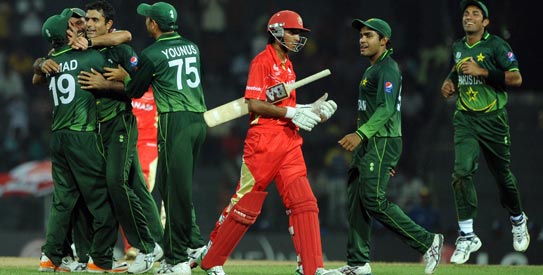
Phew! What a close shave that was for Pakistan. The batsmen were self destructing at will and had done enough to lose the game and open a fresh can of worms. An unexpected loss against the minnows and against heavy odds could have been interpreted as intentional by the rumour mongers and portrayed Pakistan in bad light.

And it wouldn’t have been difficult to convince the cricket world to believe it as true gospel, as unfortunately it has developed a jaundiced view to everything regarding Pakistan cricket.

Canada, who were not only raw with their skills but in an unfamiliar territory to create history, got tensed up and could not close out the game.

Pakistan batting was technically poor. Most of the batsmen were caught on the crease, playing across the line and falling prey to their own mistakes rather than opponents’ craft. In fact the team technicians read the pitch poorly and blindly made the decision to bat first on a moist track. Good teams are not only about bat and ball but about good support staff who can prepare a brief for the captain consisting of healthy options and intelligent analysis. Remember, big thinkers of the game and not big names make for a winning formula in the dressing room.

In seaming conditions, the openers were quickly thrown out of rhythm. Ahmed Shehzad’s brazen aggression at times borders on cockiness.

His pattern of attack on the day was ill suited for the conditions. He takes uncalculated risks and gives the impression of a spoilt millionaire at a roulette table! Nobody wants him to sacrifice his aggression but lot of people want him to curb his urge to be a kamikaze pilot on a suicide mission.

Hafeez is a utility article. Bit like a sofa cum bed he adjusts and adapts to the demands of the game. He has not yet set the world on fire in this World Cup but Pakistan must not panic and think to uncouple the two openers. In the 1992 Cup, in our losses to India, South Africa and West Indies, we made the mistake of trying three different opening combinations which unsettled the entire team.

Afridi as a leader had a mixed outing. While his sleight of hand once again amazed the batsmen, his captaincy spell was rather flat. In a low scoring game with choices curtailed, a constant dose of pressure and aggression could have earned Pakistan an early win. But Afridi, in the middle overs, unwisely chose to sit in and attacked with just four fielders in the circle.

Most captains in ODIs seem to operate with a rigid mind and a set routine to clog up runs and through it suffocate batsmen. They don’t seem to have a plan for unconventional situations that demand for out of box thinking.

Andrew Strauss, the other day against Ireland was caught out because of lack of intent to pick wickets. Afridi needs to be more innovative as a leader, bit like his batting and bowling, and open up to all kinds of plans rather than following a basic dated one. Trying to super impose a particular game plan on all situations cannot work.

Good thing about the win was how Pakistan fought tooth and nail till the end. They were feisty on the field and did not surrender to the pressure of the situation. Umar Gul looked to be at home with the new ball and Saeed Ajmal did not look rusty in his first outing.

Daryl Harper, the umpire, though was completely out of tune and had four reviews turned against him. His time is up as it’s not a one off instance of poor umpiring but a trial of shocking 18 months out in the center.

Umpires are like players and can have good and bad days on the field, but when a lean patch in the late years of a career start to stretch to longer cycles, then it is time to hang up the boots and exit gracefully.

—The writer is a former Pakistan captain.

Pakistan plan to spread the grief

As reported by Agence France-Presse

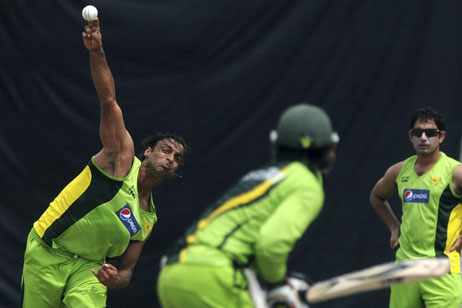
Pakistan are still reeling from the cricket corruption scandal that has dogged the side since last summer, but Shoaib Akhtar has warned that he and his teammates plan to take out their frustrations over the affair on their World Cup opponents.

Salman Butt, Pakistan’s then Test captain, and the bowlers Mohammad Asif and Mohammad Aamer were banned by the International Cricket Council (ICC) last month, after being found guilty of spot-fixing, which depleted Pakistan’s bowling options just two weeks before the start of the World Cup.

But Akhtar said the loss of the trio has helped unite the squad and galvanised them to push for a second World Cup victory to replicate their 1992 success.

“We are a hurt side so we are here to hurt others,” Akhtar said yesterday. “It’s better that it happened to us because every time a controversy happens it gathers us together and what better situation than before a World Cup?”

Pakistan beat co-hosts Sri Lanka by 11 runs in their last match after seeing off Kenya by 205 runs in their opening game.

Akhtar, 35, admitted he was missing Aamer and Asif but said others have stepped up.

“Obviously without Aamer and Asif we have suffered badly, they were the best with the new ball, it’s unfortunate what happened to them. Had they been with us it would have been the most lethal bowling attack,” he said.

“But the way [Umar] Gul and [Abdul] Razzaq have been bowling, the way [Wahab] Riaz is bowling, we can still do a much better job as we have variety in our attack.”

Akhtar, who has taken 246 wickets in 162 one-day internationals, said he had changed his bowling style to maintain his fitness, concentrating on accuracy rather than the pure pace that in the past regularly saw him bowl in excess of 100mph.

“I left this race of bowling at 100mph a long time ago,” he said. “I am nearing 36 now and am more mature, so I am focusing more on getting wickets now than bowling fast. But I crossed 98mph the other day.”

He said he is enjoying the chance to perform on the world stage after injury and discipline problems left him sidelined four years ago.

But he warned his teammates – who next face Canada in Colombo on Thursday – not to be over confident after beating Sri Lanka. “We have to move on and we shouldn’t get complacent,” he said.

Dig Deeper and You’ll Find the Other Oslo

By Rick Steves,Tribune Media Services

In the Norwegian capital of Oslo, a big statue of a tiger sits in front of the train station. A local once explained that Oslo is nicknamed the Tiger City because in the 19th century, when country boys visited the wild and crazy “New York City of Norway,” it made “a mark on their soul.”

I find Oslo more of a kitten than a tiger. Its mix of grand neoclassical facades, boxy 1960s-style modernism, pastoral parks and homogenous culture always have felt a bit tame for my taste. But by digging deeper, you can find more texture here, from gritty neighborhoods to troubled artists.

The city’s grand boulevard, Karl Johans Gate (street), cuts from the train station through the center of town to the Royal Palace. Lively with restaurants, parks and people, the street is lined with landmarks, including Oslo Cathedral, Parliament and Stortorvet Square, with its lively flower and produce market.

The boulevard also is the address of the Grand Cafe, once the meeting place of Oslo’s intellectual and creative elite. At the back of the cafe, a mural shows Norway’s literary and artistic clientele enjoying this fine hangout, from playwright Henrik Ibsen (who came in every day at 1 p.m.) to Edvard Munch, leaning against the window, looking drugged.

Munch is Norway’s most famous and influential painter. To see his most important work, head to the nearby National Gallery. Munch helped to pioneer a new style, expressionism, using lurid colors and bold lines to “express” inner turmoil and the angst of the modern world. His most iconic painting is The Scream, which he described as “the work of a madman.”

A few blocks down from the National Gallery is Oslo’s people-friendly harbor front, situated at the head of the 60-mile-long Oslofjord. As in many European cities, residents are reclaiming their waterfront area. In the past, you would have dodged several lanes of traffic to get to the harborfront, but now, most traffic has been diverted through tunnels under the city.

Facing the harbor, Oslo’s striking city hall is famous for hosting the Nobel Peace Prize ceremony. Completed in 1950 to celebrate the city’s 900th birthday, the building was an avant-garde thrill in its day. Entering here, I’m reminded that in this most highly taxed corner of Europe, city halls, rather than churches, are the dominant buildings. Though the state religion is Lutheranism, people rarely go to church. Instead, they seem to almost worship good government. The main hall actually feels like a temple.

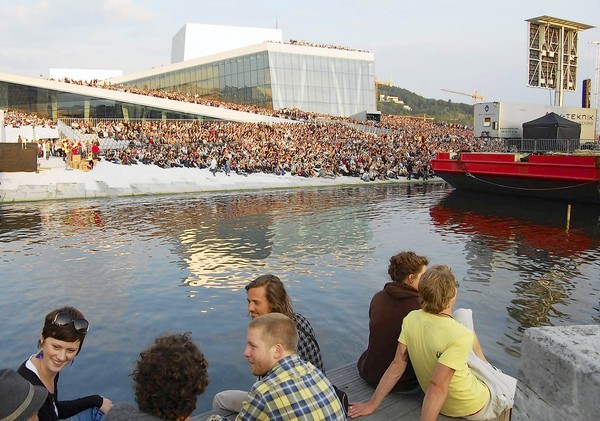
Along the eastern harbor, the marble Opera House seems to rise like an iceberg from the sea. This is the only opera house in the world that doubles as a public plaza, with a roof designed to be walked on. Opened in 2008, this cultural venue is a huge hit. On my last visit, I joined 8,000 people on the rooftop to watch a hot English group named Antony and the Johnsons (with a lead singer who looks like a cross between Meatloaf and Marilyn Manson) perform on a stage raft anchored just offshore.

In summer, Norwegians practically live outdoors. Frogner Park not only offers a great peek at Norwegians at play but also features a fine sculpture garden showcasing a lifetime of work by Norway’s greatest sculptor, Gustav Vigeland.

From 1924 to 1943, Vigeland created a world of bronze and granite statues — around 600 nude figures in all. The centerpiece is a teeming monolith of life, with 121 figures carved out of a single block of stone rocketing skyward. Like Munch, Vigeland was troubled. Those who know his life story can read it clearly in the granite and bronze, but I ignore it all and simply see his art as observations on the bittersweet cycle of life.

As much as I love Norway, goat cheese and my blond cousins, sometimes I need to inject some color into my days. At night, I head to two trendy multiethnic zones. Grunerlokka is the Greenwich Village of Oslo. A former working-class district, this neighborhood of funky shops, old hippies and bohemian cafes is a favorite of Oslo’s artsy set. Locals come here for its convivial night scene and colorful eateries.

Oslo’s rough and tumble immigrant zone is a stretch of a street called Gronland. This is where Turks, Indians, Pakistanis and the rest of Oslo’s immigrant community congregate. Colorful green grocer carts spill onto sidewalks. Various kebabs and spicy borek cost just $2 to go. Dueling tandoori restaurants offer meals for under $10, otherwise unheard of in Oslo.

I love dining street-side here. It’s cheap — and seeing a rainbow of people and a few rough edges makes the city feel less like Wonder bread. But that’s the beauty of Oslo. Just when you think you have it figured out, it gives you a taste of something different.

Rick Steves (ricksteves.com) writes European travel guidebooks and hosts travel shows on public television and public radio. E-mail him at rick@ricksteves.com and follow his Facebook blog.


It is The Women Who Have the Guts in Pakistan”

By Bina Shah for Dawn

In Pakistan, Salman Taseer’s assassination in early January has blown the lid off the seething cauldron that has been bubbling in Pakistan for the last several years: the divide between Pakistan’s extremist forces and its minority liberal community is now so wide that it seems nothing can bridge the gap anymore. Worse, the extremists greatly outnumber the liberals, endangering whatever advances have been made in the Pakistani society.

But the women intelligentsia of Pakistan is determined not to let the religious right gain any more ground in the struggle for Pakistan’s soul. They have responded to the onslaught of the right wing with such ferocity that a Pakistani man said on Twitter: “I definitely see more women out on the streets after Salman Taseer’s killing. Does this mean that it is the women that have the guts in this country?”

It all started with a woman: Aasia Bibi, the hapless Pakistani-Christian mother of five who made the mistake of getting on the wrong side of a group of malicious village women. One moment Aasia Bibi was offering her coworkers a cup of water; the next, she was facing the death penalty for having supposedly committed “blasphemy”. 

Activists and women’s rights groups, aghast at the blatant abuse of human rights that Aasia Bibi’s case represented, agitated for the country’s leaders to have her acquitted. Pakistan’s progressives, especially women, got in touch with the Governor of Punjab Salman Taseer through his Twitter account – one which he used mostly to tweak rival politicians’ noses, share his favorite Urdu poetry, and communicate with his daughters. They besieged him with 140-character-long appeals to save Aasia Bibi’s life, hoping against hope that he would listen.

Taseer not only took Aasia Bibi under his protection, but he widened his scope to take aim at the blasphemy law itself. But Taseer’s strong voice was silenced on January 4, when his own bodyguard, Mumtaz Qadri, shot him 27 times with his state-issued Kalashnikov.

After the initial shock of the assassination, women activists vowed to use it as a rallying point: not just because they feel for Aasia Bibi, the first woman in Pakistan to face the death penalty for blasphemy, but because they know that women are the first to lose their freedoms when extremism takes over a nation. They are organising candlelight vigils, rallies, and media campaigns to defend their hard-won rights, despite knowing they are outnumbered by the other side.

One of the bravest women in today’s Pakistan is Shehrbano Taseer, daughter of the slain Governor, who wrote several pieces for the newspapers protesting the death of her father and the way in which his killer was showered with rose petals by lawyers who vowed to defend him in court. For this, she received threats from extremists: “She should remember the fate of her father and refrain from issuing statements.”

Taseer, a graduate of Smith College in the US, draws inspiration from other brave women in Pakistan who came up against the same forces: Asma Jehangir, Benazir Bhutto, Jugnu Mohsin, Sherry Rehman (who is now living under virtual house arrest in Karachi because of death threats she has received for her stance against the blasphemy law), Sharmeen Obaid Chinoy, Beena Sarwar, and Marvi Sirmed are some of the women whose struggles against injustice in Pakistani society have inspired her.

And of course, there is her father’s legacy: “My father’s fire has come inside me … I don’t wish for any other family to have suffered what mine has had to.”  Her father’s violent death has illustrated most vividly to her how both men and women in Pakistan have worked together for generations in the name of social activism. “Men and women have marched on the streets together and sacrificed a lot, so I don’t feel one sex is more dominant than the other in this regard.”

But it is not enough. The men in Pakistan need to step it up greatly when it comes to supporting women in social activism. Nuzhat Kidvai, a human rights activist in Karachi, says, “In general, men are more active in the left and labour movements – they will march for economic or political reasons. But when it comes to supporting women’s issues, they just aren’t there.” Her husband, Zaheer Kidvai, a long-time proponent of social activism in Pakistan, agrees that “women are certainly more engaged in this battle and despite bad attacks – lathis, jail, beating, and even rapes by the police! – they have moved this forward against all these odds. If there is any way for this society to evolve further, it’ll have to have even more women come out.”

So, back to the original question: is it really the women in Pakistan who have the guts? When it comes to fighting for their rights, definitely. Life in Pakistan is hard for women, but they don’t give up easily. Perhaps this is why they haven’t yet suffered the fates of their compatriots in Saudi Arabia, Afghanistan, and other supremely conservative Muslim countries in the region.

VJ Syra, Most Wanted and MTV Pakistan

Taking a break away from all the current events, news, and politics to talk briefly about something completely different, my favorite MTV Pakistan VJ/Personality: Vy Syra Khan. The VJ of MTV Pakistan for the last couple years.

Pakistan Army Propaganda Drama Set for TV

By Khurram hahzad for The Associated Press

Pakistan’s Taliban-fighting soldiers are set for celebrity status with the launch of a multi-million-dollar glossy television drama hailing army victories over militants.

Emotive tales of 11 “brave Pakistanis” battling an Islamist insurgency that is plaguing Pakistan and neighbouring Afghanistan, will air on the small screen in an army-funded drama that casts the anti-terror fight in a positive light.

Focused on the heroism of soldiers fighting a key air and ground offensive in the northwestern Swat valley in 2009, one tale looks at the deeds of soldier Hawaldar Naeem Asghar who died fighting an insurgent checkpoint.

Asghar, portrayed as a hardworking soldier from peasant roots, sacrifices his life to overcome Taliban dug in to a hilltop, during operations in the town of Mingora to flush militants from the picturesque valley.

Throwing grenades from his bunker without success, Asghar is depicted abandoning cover and climbing the hill, tossing more explosives on his way as bullets rain down from the rebels’ post.

The checkpoint is destroyed, but Asghar is killed.

“Hawaldar Asghar’s story is a common man’s story. It’s a message to the public that everybody can play a role in the fight against extremism,” says Sajjad Saji, one of the drama serial’s writers.

“It is filmed to encourage the common people in this war,” he adds.

Urged by its key but critical ally the United States to launch further operations in the lawless tribal areas bordering Afghanistan, the army wants to show the sacrifices it has already endured in the war on terror.

“The basic purpose is to reveal the deeds of bravery of our soldiers, officers and civilians who are at the front of this war…. This drama shows the human face of the war,” says Major General Athar Abbas, head of the army’s publicity wing.

“The nation should own these stories of bravery and sacrifice, they should be proud of our sons and daughters of the land who created these true stories with their blood and defended the motherland.”

One of the filmmakers, who would not be named, said the high-end production was a “multi-million-dollar” effort, but refused to put a precise figure on costs.

The production, peppered with special effects, was filmed amid rugged verdant hills and forests close to the Swat valley — scene of major operations by Pakistan’s military in 2009 to rid the area of rampant militancy.

“We travelled extensively to film this serial. A crew of more than 35 people with trucks of luggage roamed in the forests and hills for months to show the reality,” said Khawar Azhar, the show’s executive producer.

The former tourism hotspot of Swat slipped out of government control after a radical cleric led an uprising in July 2007, beheading opponents, burning schools and fighting to enforce a harsh brand of Islamic law.

Pakistan launched a blistering air and ground offensive in the valley after militants marched out of Swat and advanced to within 100 kilometres (60 miles) of the capital Islamabad in April 2009.

After heavy fighting that displaced an estimated two million people, the military declared the region back under army control last summer and efforts have begun to revive the local economy amid sporadic outbreaks of violence.

Television productions are one of the tools adopted by the military’s publicity wing to polish its image and boost recruitment and morale at a key juncture in anti-Taliban efforts and with religious conservatism on the rise.

Accused by US-based Human Rights Watch of carrying out collective punishments on relatives of militants since it re-established control over the Swat valley, the army knows the importance of securing local hearts and minds.

More than 4,000 people have been killed in Taliban and Al Qaeda-linked attacks since government forces launched an attack against militants in a mosque in Islamabad in 2007.

The television drama depicts the bitter divide between Pakistan’s opposing cultures as the moderate middle class fights religious extremism in a country fractured by deep regional political divided.

In other episodes the film makers show the victims of Taliban power — one girl is subject to brutal gang rape by militants, while in another a young boy is brain-washed into becoming a suicide bomber.

Pakistan: The Voices of Reason Must not be Silenced by Fear

By Sadiq Khan for The Independent

The news that Salman Taseer, the powerful governor of Pakistan’s most populous province, had been gunned down by his own security guard for standing up against the country’s draconian blasphemy laws, came as a bleak reminder of political fissures that divide the country.

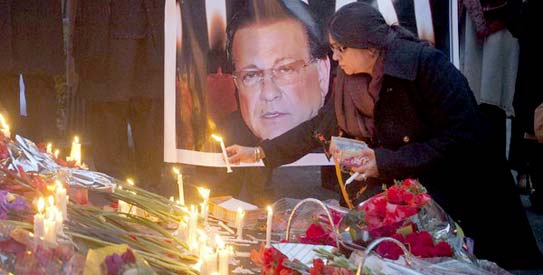
The sickening scenes of Taseer’s murderer, Mumtaz Qadri, being showered by rose petals as he entered court to lodge his guilty plea were starkly juxtaposed with images of candlelit vigils at the spot where he was shot 27 times in the back.  These contrasting responses to Taseer’s assassination are illustrative of a fundamental split between those who want to see Pakistan fulfill her potential as a thriving, liberal and tolerant democracy and those that want to terrorize and isolate Pakistani citizens under a misguided and perverted interpretation of Islam.

While denouncement of last week’s criminal act was muted amongst Pakistan’s clerics and politicians – including those from the Pakistan Peoples Party, to which Taseer belonged – British citizens of Pakistani descent have been vocal in our condemnation and our mantra is clear – this death due to terrorism, as with the 25,000 others in Pakistan in recent years, is not in our name. It is not in the name of Islam and it is not in the name of Pakistan.  And while saddened by this loss, the real tragedy of Salman Taseer’s murder would be if it stopped other progressive, liberal people in Pakistan speaking up for fear of violent repercussions.

Qadri, though responsible for his own deplorable actions, was spurred on by inflammatory rhetoric from extremists preaching hatred and inciting violence against all those who stand up for the pluralist founding ideals of Pakistan. It is not only in Pakistan where irresponsible political language has repercussions beyond the boundaries of discourse and spill over into violence, but in Pakistan there is a danger that the voices of reason will be drowned out by the increasing clamor of hate, or silenced in fear.

Moderation and liberalism in Pakistan must not be allowed to die with Governor Taseer. Right-minded politicians and religious leaders must speak up, knowing that the UK as well as Muslims and non-Muslims around the world, are behind them.  Addressing a distinguished audience at the memorial meeting for Taseer at the Pakistani High Commission in London this week, MPs from all major British political parties spoke in solidarity with Pakistan and I was encouraged by the various Pakistani leaders who attacked those who corrupt Islam’s peaceful message and sought to assure Christians and other minority groups that they will be defended and protected.

If a society is ultimately judged by how it treats its most vulnerable and marginalized, then Pakistan is at a crossroads. Those, like Salman Taseer, who believe in a modern, peaceful Pakistan, governed by the rule of law, under which all people are equal and all faiths are free to worship, need to speak out in defense of it and in condemnation of the alternative.

After being struck by a natural disaster that swept away the lives, crops and livelihoods of hundreds of thousands of people in Pakistan last year, there is the potential that Pakistan could slip into a political disaster of its own making. Salman Taseer paid the ultimate price in trying to ensure this didn’t happen, but let that not be in vain.

India Urges Pakistan to Resume Onion Exports

As Reported by The BBC

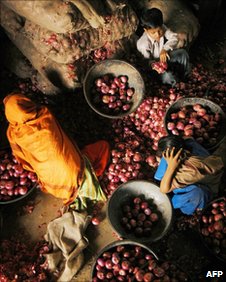
India is trying to persuade Pakistan to resume exporting onions overland to curb soaring prices. The matter has been taken up with the government of Pakistan, External Affairs Minister SM Krishna said.

Pakistan banned overland exports of onions to India on Tuesday with traders saying they feared shortages at home. Last month, India abolished import taxes on onions after prices nearly tripled in a month.

“We have initiated talks and before not too long, we are hopeful we will find a solution to this, easing pressure within our country for onions,” Mr Krishna told a press conference in Delhi.

Pakistan banned exports to India through the land route via the Attari-Wagah border crossing, although the sea route is still open. Much of the trade, however, is by road and rail which are cheaper and quicker.

India’s food inflation has risen for the fifth straight week this week to 18.32% – the highest in more than a year.

The price of onions, a key food staple for Indian families used in almost all dishes, has risen dramatically over the past month.

A kilogram which usually costs 20 rupees went up to 85 rupees ($1.87; £1.20) last month. At present, it is 65 to 70 rupees a kilo.

The rise has been blamed on unusually heavy rains in the bulk-producing western states of Maharashtra and Gujarat and in southern states, as well as on hoarders and speculators.

Discontent over food inflation has been a major headache for the government.

High prices of essential commodities such as onions have previously sparked unrest and helped bring down the national government in 2004.

Blasphemy Cases Draw Focus in Pakistan

By Alex Rodriguez for The Los Angeles Times

NANKANA SAHIB, Pakistan | Muslim cleric Muhammad Salim isn’t worried that a court or Pakistan’s president might spare a Christian mother from this village who has been sentenced to death on blasphemy charges.

After all, if Asia Bibi escapes the hangman’s noose, he’s confident someone else will kill her.

“Any Muslim, if given the chance, would kill such a person,” Salim said calmly, seated cross-legged on a straw mat at a mosque here. “You would be rewarded in heaven for it.”

Salim isn’t the only one calling for vigilante justice. A cleric in Peshawar has offered 500,000 rupees, or $6,000, to anyone who kills Asia Bibi, if her execution doesn’t take place.

The mother of five is accused of disparaging the prophet Muhammad and the Qur’an during a dispute with three other women. She denies the charge. “My God knows that I never used those words,” she told investigators.

Her case has exposed deep rifts in Pakistan over the blasphemy law, seen by some as an appropriate measure to defend the tenets of Islam, but viewed by others as a dangerous tool easily abused in a society that is a volatile patchwork of ethnicities, religions and sects.

There have been other controversial blasphemy cases. Accused of burning pages from the Koran, Imran Latif was charged with blasphemy in Lahore but then released on bail Nov. 3. Eight days later, two men shot him to death.

This month in the southern city of Hyderabad, a Shiite doctor was arrested on blasphemy charges after police received a complaint that he had maligned the prophet Muhammad. His crime? He tossed out the business card of a pharmaceutical company representative whose first name, Muhammad, was printed on it. The doctor belongs to the smaller Shiite sect known as Ismailis.

“There’s a fundamental lunacy to it,” said Ali Dayan Hasan, South Asia researcher for Human Rights Watch. “There is no good spin to put on the blasphemy law. It’s used frequently in these preposterous ways, for preposterous reasons.”

The law dates to the 1980s and the rule of Gen. Zia ul-Haq. Since Zia’s rule, 974 people have been charged under the law, according to the Pakistani news media. No one has been put to death for a blasphemy conviction.

The Illiteracy of Hate

A News and Opinion Special Report by Manzer Munir for Paksitanis for Peace

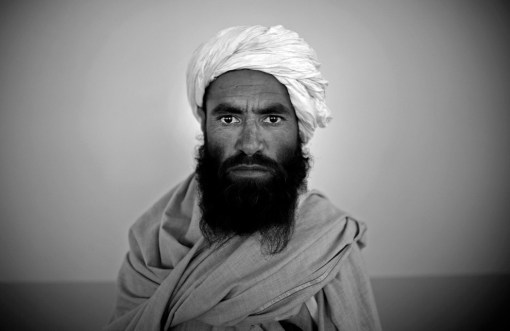
Alleged Taliban Member pic courtsey of Boston Globe

The Taliban are not just simply a bunch of illiterate thugs and bullies for they too often prove to be even worse than animals and barbarians.

Nowhere else in the world has a country experienced a more tragic and callous attack as the one on Christmas day, the birth day of Jesus, the Prince of Peace, than the one Pakistan experienced. In an attack described by President Obama as an “affront on humanity”, the cowards attacked helpless women, children and men while they queued up in food and aid distribution site such as the WFP depot, people who mind you are already suffering from the ongoing war, once in a lifetime floods, and the poverty and radicalism of a generation of desperate, hopeless and increasingly uneducated young men brainwashed by the Taliban and other radical Muslim extremists.

I am still disturbed by the disdain for basic human life that this new attack proves about this radical and extreme enemy. I imagine another one of their brain washed ‘walking zombies’, this time purportedly a woman suicide bomber, a first, even for Pakistan, killed in excess of 43 people in Bajur Pakistan at a World Food Program rations and aid storage and distribution center.

The Pakistani authorities and several domestic and foreign NGO’s who provide food aid at various centers in the area are temporarily closing these centers in order to have increased security. This means that aid distribution will come to a crawl and up to several hundred thousand people will now have to suffer at the hands of the attacker and their backers, the Taliban who have claimed responsibility. The authorities will have to ensure the safety of aid organizations and their personnel for both Pakistani and non Pakistanis relief workers involved in getting food, water and medicine to many people who are either suffering from the war or from the floods.

This catastrophe, although not of near Biblical proportions, does present both a security and humanitarian problem to both the government of Pakistan as well the suffering citizens in the northwest areas of the country where; Taliban fighters take sanctuary from the war in Afghanistan to regroup and return to the fight in warmer weather after the winter months as we have seen in years past. In fact, the reach of the Taliban in Pakistan is now not only reputed to be in the headquartered areas such as in Quetta Pakistan among the restive Baluchi population, now they are so often found to be in major cities like Karachi, Lahore, Rawalpindi, Peshawar and many points in between as they use their religious cover to endear themselves to certain impressionable, weakened or illiterate individuals that are so commonly found in throughout the country. 

Here are the some of the depressing facts. Pakistan, a nation approaching 180 million people at current estimates, perhaps only boasts to having about 60-65% of the male population at a literate level and at best, the females to be only at 40-45% of the total female population. Sadly, what this means is that 4 out of 10 Pakistani males are completely illiterate while up to as many as 6 out of 10 women are not able to read or write. Poverty breeds extremism since there is no support from any government programs or hope for any solution.

Time and time again throughout history and not just of Pakistan’s, we can see that the role of the church, synagogue or mosque in building the community is deeper than that of any government initiatives or other measures. The poverty for these young men along with the lack of jobs like for those individuals who are either very poorly paid construction site workers, household labor or servants, or beggars and sewer workers, a job sadly almost seems to have been reserved for Pakistan’s Christian community members as many can attest in Pakistan of their unfortunate and depressing state. One does not need to remind the reader of the plight of Asia Bibi (also Aasia and Ayesa), the Christian Pakistani woman who is still awaiting her fate in Pakistani courts after more than a year and a half since first being accused of a BS blasphemy charge and being in jail ever since. 

The medieval mentality of these radical extremists is not something that needs to be described as the evidence is here in this latest attack . Certainly anyone alive in any part of the world outside Pakistan and Afghanistan with eyes, TV, radio or newspaper within their reach can see plenty of near daily reminders of the carnage that many natives of these lands see, and to what they have painfully become accustomed.

 The Pakistani and Afghani Talibans have by all the various reports in newspapers and media sources over the last several years have pointed out to the fact that these groups all have too often similar goals. Not only that, these groups all share the same characteristics. The anti-Americanism, the pro-Wahaabi or Orthodox version of Islam, the need for justice for the ‘suffering of the Palestinian people’ , and the anti-colonial and often times anti western sentiment amongst these groups. The radicalization of certain Muslim groups be they Hamas and Hezbollah in the Mideast or Lashkar e taiba, or any other militant outfit operating in this part of the world as mentioned in this quote a few days before he passed, the late Richard Holbrooke of the US State department said that there are a range of militant groups such as the Afghan Taliban, the Pakistani Taliban, the Haqqani Network, Lashkar-e-Taiba, and that “an expert could add another 30.” His exact words are in quotations. 

The radical Muslim groups who take prey of the weaker, cannot think for themselves because they are scions of those abjectly illiterate segments of the society who are only educated in the madrassahs of Pakistan. This is the de facto way of educating Pakistan’s poorer children in little mosque schools which consist of nothing but Qu’ranic surahs and words of ‘wisdom’ or ‘interpretation’ by the local mullah of the said mosque/school. Most probably these children in many Pakistani madrassahs, especially the ones who live near the border areas within the NWFP or North West Frontier Province of Pakistan as this is the part of the country most affected by its close proximity to Afghanistan.

The people in this area of Pakistan, as well as their cousins in Afghanistan have been fighting one enemy or another for the better part of 100 years now. Whether to them the enemy be the British, during the height of the British Raj rule in India, or to the Soviets and the Red army and the Cold War, then in chronological order came the infighting after the Russian withdrawal as various Tajik, Afghani, Uzbek, Pakistani warlords came in to try and consolidate power to now us Americans and the Pakistanis who are our allies in this war.

Granted we do often hear that the Pakistanis can be doing more. By all accounts, the Pakistani government can do more in terms of fighting this war on terror. Numerous western reports and articles in respected dailies have alleged that small elements within both Pakistan’s Army as well as the spy agency, the ISI, have sympathizers to either the Taliban’s cause or they want to be on favorable terms with a powerful entity that most in Pakistan’s establishment believes that Pakistan will be dealing with and not a weakened Karzai once the US begins to draw down troops and end the war by 2014. If this is indeed true, then these ‘officers’ and supposed ‘leaders’ of Pakistan should realize that the colluding with the enemy, which in this case is the Taliban, is tantamount to treason, and the members of the armed forces of Pakistan as well as the intelligence community should not be assisting the enemies of all concerned: Afghanistan, Pakistan and the United States. 

Of course we must not kid ourselves and assume that only alleviating the illiteracy and poverty of the Pakistani youth will and bettering the education system of the Pakistani poor, particularly that of the refugees and residents of the northwest areas near the Afghan border. No there needs to be a study and introspection by the people of these two countries where this hatred breeds. To to get out of this darkness, the population needs be provided not only safety when delivering food aid and or medicine but aldo most importantly give them a book, a pen, and a paper. And teach them how to fish for knowledge with basic comprehension and deductive reasoning skills that can reject a radical and violent view of Islam too often manipulated by the clergy. This is the only way we can come to end this illiteracy of hate.

–Manzer Munir, is a proud and patriotic Pakistani American, an author, who plans to write a book on Pakistan, who is also a blogger and journalist, and as the Founder of Pakistanis for Peace  can be found at www.PakistanisforPeace.com, www.DigitalJournal.com ,www.Open.Salon.com, www.Examiner.com, as well at other websites as a freelance journalist and writer.