Posts Tagged ‘ Pakistanis ’

Deadly Bombings in Pakistan Target Mosques, Killing More Than 70 Worshippers

By Owais Tohid for The Christian Science Monitor

Two deadly bombings today in Pakistan targeted mosques and killed more than 70 worshipers, following an increasingly deadly pattern of Pakistani Taliban attacks on tribes that dare to defy its influence.

In the town of Dara Adam Khel, in Pakistan’s northwest territory, a young suicide bomber detonated his load amid 300 worshipers during Friday prayers. He killed at least 67 people and injured more than 100.

On Friday evening, four grenades were hurled inside a mosque in the Suleman Khel village, which is on the outskirts of Khyber tribal region. The blasts killed at least four people.

The bombing in Dara Adam Khel appeared to be targeting the Akhoorwaal tribe because it has been resisting Taliban expansion. Pakistani Taliban claimed the responsibility.

“There is no right for traitors of mujahids and Islam to live,” read a message from the Taliban, quoting notorious leader Tariq Afridi. Mr. Afridi is the commander of Tehrik-e-Taliban Pakistan (TTP), which is commonly known as the Pakistani Taliban and is linked with Al Qaeda.

The attack was seemingly designed for maximum impact, as the bomb was detonated in the middle of Friday prayers, and combined two increasingly common Taliban targets: the mosque and the jirga (council of tribal elders). The targeted mosque was inside the hujra, or congregation spot, of the tribal council leader.

The suicide attack was one of the deadliest in series of attacks by Al Qaeda and Taliban across Pakistan in which hundreds of people have lost their lives this year.

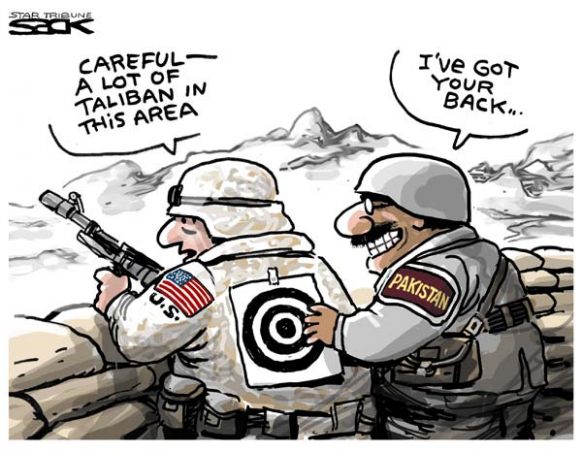
Taliban commanders are trying desperately to strengthen their hold across the region, say analysts. The US continues drone attacks on the semi-autonomous tribal region of North Waziristan along Pakistan-Afghanistan border while pressuring Pakistan to increase operations there. What’s more, Pakistani security forces are ramping up operations in other tribal regions.

The bombing was meant to “terrorize tribesmen,” says Brig. Mehmood Shah (ret.), a Peshawar-based analyst. “Taliban want to control the region so they are targeting locals who have raised voice against them. They want to eliminate the dissent,” he says.

“It is the worst revenge tactic and showing that they are desperate and weakened,” says Mr. Shah.

Dara Adam Khel lies about 31 miles south of Peshawar and links Orakzai and Khyber tribal region in the west through a hilly terrain. Pakistan’s security forces have been pounding the area with bombs in a bid to rout militants in the ongoing operation. The forces have also been going after them in Khyber region where the militants attack NATO supply convoys.


Eyewitnesses of the mosque attack described the moments before the blast occurred.

“I saw a young boy walking toward the worshipers. The moment he raised his arms, he exploded,” says Mohammad Nasir.

The attack triggered terror alerts and warnings for additional attacks by Taliban across the country, especially in the northwest.

“It’s a cowardly act. The terrorists might try to carry out more attacks but we are not afraid,” says Provincial Minister Mian Iftikhar, whose only son was assassinated by the Taliban three months ago. “It’s a long battle against terrorists and extremists. They can be defeated once we remain united.”

“The US, Afghanistan, and Pakistan should have to continue to wage war to eliminate terrorism,” he says.

In Dara Adam Khel, members of the Akhoorwaal tribe vowed to continue fighting the Taliban.

“We will not let the sacrifices of our tribesmen be in vain. We won’t let them convert our future generation into terrorists and destabilize the country. We will start mobilizing other tribes in our war against terrorists,” says tribesman Javed Ur Rehman Akhoorwaal.

Atif Aslam, Todd Shea & Lanny- We Will Rise Again

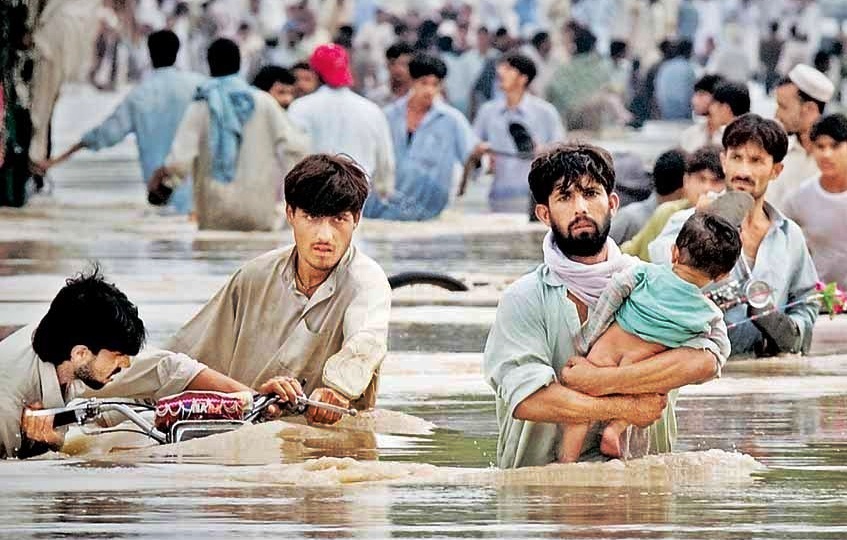
Please watch this video and donate to help the people suffering as result of the Pakistan Floods of 2010.

To donate please visit link below:
https://secure.unicefusa.org/site/Donation2?df_id=8320&8320.donation=form1

Pakistan Looks Ahead to End of Afghan War

By Olivia Ward for The Toronto Star

As NATO forces prepare to pull out of Afghanistan, worries about the country falling back to Taliban control are paramount. But in neighbouring Pakistan, where suicide bombings and brazen attacks on security forces have become regular occurrences, the stakes are also high.

“What happens in Afghanistan affects us and vice-versa,” says Akbar Zeb, Pakistan’s High Commissioner to Canada. “We have four million Afghan refugees still living in Pakistan, and it’s in our interest to have a stable country where we can send them back. A Taliban takeover won’t be just detrimental to Afghanistan. It would harm Pakistan and the whole region.”

Zeb said that under the civilian government of President Asif Ali Zardari, relations have improved with Afghanistan, and contrary to reports of friction, there are “frequent contacts” between the two countries that would be helpful in creating stability.

But he added that Canada, and other Western countries, should not repeat the mistakes of the post-Soviet era, when the West lost interest in Afghanistan and Pakistan as soon as the Soviet troops withdrew.

During the rule of Pakistan’s military leader, President Pervez Musharraf, groups of Taliban-linked militants got a foothold in Pakistan, but were not seen as a danger to the country until internal attacks began to spread. Former prime minister Benazir Bhutto was assassinated, and suicide bombings took the lives of hundreds of civilians. Under pressure from the U.S., the Pakistani military began a massive campaign against the Taliban along the Afghan border.

“We have managed to clear a lot of areas from the Taliban,” said Zeb. “Military campaigns are the only language they understand. But they alone won’t help to win the war. We have border regions with a lot of poverty, and backward elements that have been ignored for a long time.”

Canada has announced support for road and rail projects linking Afghanistan and Pakistan to speed trade between the two countries.

“It’s a very good initiative, but scope is limited,” said Zeb.”We wish the projects were larger and not just (confined to) those that involve both Afghanistan and Pakistan.”

Talks with Islamabad are also ongoing on the use of ports in Karachi for shipping out Canadian troops and military supplies from Afghanistan.

But as the war continues, Pakistan has also been urged to be tougher on the Taliban. In the past two years it has carried out attacks against the militants in its border regions with some success, while American-launched drone strikes have killed high-ranking Taliban. The catastrophic floods that wiped out some of the most important agricultural areas of Pakistan brought a temporary truce, but militant attacks have resumed since the waters receded.

Last week, talk of a peace deal between the notorious Taliban-linked Haqqani network, and an opposing tribe in the remote northwest raised fears that it could open the way for Taliban access to strategic border areas. But the U.S. has also urged a Pakistani offensive against the network in North Waziristan, a volatile region where 400,000 civilians are vulnerable to displacement.

According to Pakistani officials, the country has lost some 7,000 security forces in a decade of fighting the militants — more than three times the coalition deaths in Afghanistan. Meanwhile 30,000 Pakistani civilians have died. The border region, a tangle of mutually hostile tribes, remains a haven for militants.

“It’s a difficult balance for Pakistan,” said Zeb. “Foreign troops may leave, and for them Afghanistan is a distant land. We’re Afghanistan’s neighbours. We helped with the fighting in the decade-long war against the Soviets. And we have to live with the outcome of this war.”

New U.S. Ambassador to Pakistan Delivers Flood Relief

By Gunnery Sgt Bryce Piper for The Defense Video & Imagery Distribution Sysem

 U.S. Ambassador to Pakistan Cameron P. Munter distributed flood relief supplies today at a World Food Program distribution point at Hassan Khan Jamali, Pakistan.

As the newly-appointed ambassador, Munter participated in the operation to see and participate in the Pakistan and U.S. military flood relief efforts conducted in Sindh province.

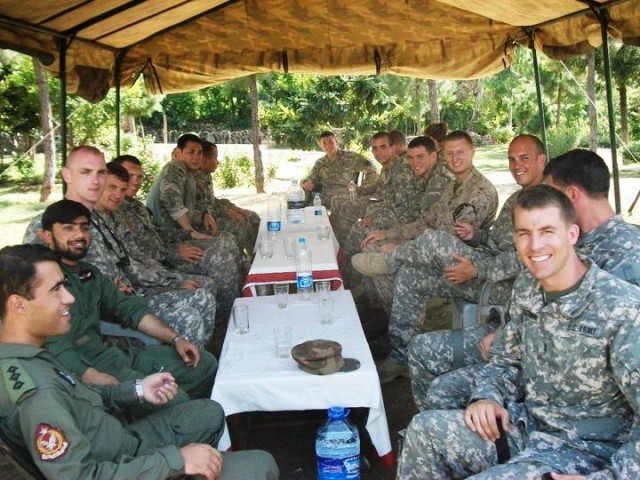
“It is an honor to have the chance to work with the Pakistani military and the American military together, who are working to help the Pakistani people,” said Munter. “This is a place that I think all of us will remember as a symbol and as a reality of our cooperation, what we can do when we work together, when we face problems together. And I’m very, very grateful to the Pakistanis and Americans who’ve done all this work.”

Munter arrived at the Pakistan military’s Pano Aqil Cantonment in the afternoon and then flew to the Hassan Khan Jamali relief site where he and a team of Pakistani and U.S. military members unloaded approximately four tons of food aid from two helicopters. Pakistanis waiting at the site collected the humanitarian supplies for distribution in the surrounding area.

This was the ambassador’s first trip to flood-affected areas of Sindh since arriving in Pakistan Oct. 27.

In addition to delivering food aid, Munter and his wife Marilyn Wyatt had an opportunity to meet with local flood victims. The couple flew to Hassan Khan Jamali aboard a U.S. CH-53E Super Stallion helicopter of the 26th Marine Expeditionary Unit. 26th and 15th MEUs have been conducting humanitarian relief efforts from Pano Aqil Cantonment since Sept. 3, 2010.

The Marines there have delivered more than 3.7 million pounds (over 1.6 kilograms) of food and other supplies to more than 150 locations throughout Sindh Province, flying more than 450 heavy-lift helicopter sorties.

Since Aug. 5, 2010, U.S. military aircraft and personnel, working shoulder-to-shoulder with the Pakistan military, have provided humanitarian airlift for the delivery of more than 20 million pounds (over 9 million kilograms) of relief supplies and the transport of more than 27,000 displaced persons throughout Pakistan.

In addition to humanitarian airlift, the U.S. Government is providing more than $398 million to assist Pakistan with relief and recovery efforts, while USAID and other U.S. civilian agencies continue to provide assistance to flood victims.

U.S. efforts are part of a multi-national humanitarian assistance and support effort lead by the Pakistani government to bring aid to flood victims.

Accused DC Bomb Plotter Farooque Ahmed’s Goal Was ‘Killing as Many Metro Riders as Possible’

By Kerry Wills, James Gordon Meek, and Helen Kennedy for The NY Daily News

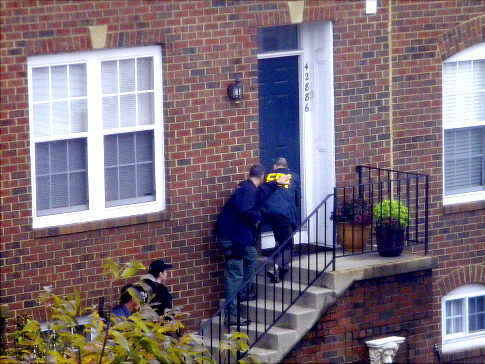
A former Staten Island man was busted in Washington on Wednesday for helping what he thought were Al Qaeda terrorists plotting to bomb the capital’s subways.

It was really the FBI stringing him along, the feds say.

Farooque Ahmed, 34, a computer engineer who lives with his wife and baby in suburban Virginia, was accused of making sketches and surveillance videos of busy subway stops near the Pentagon and tourist-packed Arlington Cemetery.

The stations Ahmed helped case are popular with Defense Department workers. He thought the stations would be blown up sometime next year, the indictment says.

His goal was “killing as many Metro riders as possible through simultaneous bomb attacks,” U.S. Attorney Neil MacBride said. “It’s chilling.”

The feds said straphangers were never in any danger.

Much like the four men convicted this month of plotting to attack a Bronx synagogue, Ahmed was stung by an undercover FBI operation and never met any real terrorists.

His face hidden by a long beard, mustache and glasses, Ahmed appeared briefly in federal court and will be held until a detention hearing tomorrow. He said he could not afford a lawyer.

A Pakistani who became a naturalized citizen in New York 17 years ago, Ahmed worked for Ericsson telecommunications in Virginia setting up routers for the Sprint network, his LinkedIn profile says.

He received a bachelor’s degree in computer science from the College of Staten Island in 2003 and studied mechanical engineering at City College, but did not receive the graduate degree, college officials said.

Ahmed’s online profile blamed that on “a political issue between computer science and (engineering) departments.” Officials said the dispute was over academic credits, not geopolitics.

He registered as a Republican in the borough in 2002.

Neighbors in Ashburn, Va., said he moved there a year ago with his British wife, Sahar Mirza, and toddler son.

Sahar Mirza is co-organizer of a Meetup.com group for mothers of new babies called Hip Muslim Moms.

He wore casual clothes – he appeared in court in jeans – but she wore more traditional garb and covered her hair.
“He was out back mowing the lawn over the weekend. He just seemed like a normal guy. He never talked about politics,” said neighbor Barbi Shires, 43. “I’m just glad it was the FBI he did it for, not al Qaeda.”

Next door neighbor, Tanya Minor, 32, who works in a doctor’s office, said Ahmed “came to look at the house with a man who spoke his language, who said he helped people from New York find apartments here. They were very quiet. They always had the blinds closed.”


Pakistanis for Peace Editor’s Note–The arrest of Faisal Shahzad and now Farooque Ahmed illustrates that unfortunately there are some within the large Pakistani and Muslim American community in the United States who mean to do us harm and they need to be caught and brought to justice. We urge all Pakistani and Muslim Americans to be vigilant and proactive in reporting anyone to the authorities who they believe have become radicalized and deemed a threat to the safety of others.

Arundhati’s Statement From Srinagar: Full Text

By Arundhati Roy
October 26, 2010
Noted Indian Hindu writer Arundhati Roy Tuesday said her speeches supporting the call for azadi were what “millions” in Kashmir say every day and were “fundamentally a call for justice”. Following is the full text of the statement that she has issued.
 
“I write this from Srinagar, Kashmir. This morning’s papers say that I may be arrested on charges of sedition for what I have said at recent public meetings on Kashmir. I said what millions of people here say every day. I said what I, as well as other commentators have written and said for years. Anybody who cares to read the transcripts of my speeches will see that they were fundamentally a call for justice. I spoke about justice for the people of Kashmir who live under one of the most brutal military occupations in the world; for Kashmiri Pandits who live out the tragedy of having been driven out of their homeland; for Dalit soldiers killed in Kashmir whose graves I visited on garbage heaps in their villags in Cuddalore; for the Indian poor who pay the price of this occupation in material ways and who are now learning to live in the terror of what is becoming a police state.  

“Yesterday I traveled to Shopian, the apple-town in South Kashmir which had remained closed for 47 days last year in protest against the brutal rape and murder of Asiya and Nilofer, the young women whose bodies were found in a shallow stream near their homes and whose murderers have still not been brought to justice. I met Shakeel, who is Nilofer’s husband and Asiya’s brother. We sat in a circle of people crazed with grief and anger who had lost hope that they would ever get ‘insaf’—justice—from India, and now believed that Azadi—freedom— was their only hope. I met young stone pelters who had been shot through their eyes. I traveled with a young man who told me how three of his friends, teenagers in Anantnag district, had been taken into custody and had their finger-nails pulled out as punishment for throwing stones.

“In the papers some have accused me of giving ‘hate-speeches’, of wanting India to break up. On the contrary, what I say comes from love and pride. It comes from not wanting people to be killed, raped, imprisoned or have their finger-nails pulled out in order to force them to say they are Indians. It comes from wanting to live in a society that is striving to be a just one. Pity the nation that has to silence its writers for speaking their minds. Pity the nation that needs to jail those who ask for justice, while communal killers, mass murderers, corporate scamsters, looters, rapists, and those who prey on the poorest of the poor, roam free.”

Arundhati Roy is a novelist, essayist and human rights activist. She won a Booker Prize in 1997 for her novel, The God of Small Things. For more on her read http://en.wikipedia.org/wiki/Arundhati_Roy

Pakistanis for Peace Editor’s Note– Arundhati Roy’s courageous plea to her country is to be lauded. Although branded a traitor by many in India and within the government, she knows that she stands for peace, justice and fairness for all humanity. She wants self determination for all Kashmiris, be they Muslim, Hindu, Buddhist or Christian.

We at Pakistanis for Peace want nothing more than peace between India and Pakistan and therefore understand that Kashmir is the one and single most important issue between the two countries. Solve it and you do not have the threat of cross border attacks, friction, animosity, perpetual war and a tense border between two neighbors of nearly 2,000 miles. If we continue to ignore it then it will eventually be the crisis that starts a 4th and possibly nuclear war between the two neighbors. A war that neither the neighborhood nor the world can afford.

The Pakistan Paradox

By Bret Stephens for The Wall Street Journal

Any serious observer of the war in Afghanistan will tell you that we can’t win without striking hard at the safe havens the Taliban and its allies enjoy in Pakistan. That means going beyond drone strikes and deploying ground forces in places like North Waziristan.

Any serious observer of Pakistan will also tell you that such strikes would complicate, and perhaps fatally compromise, our relations with the country whose cooperation we require to win in Afghanistan.

Both observations are on the mark. Isolating the battlefield is a cardinal rule of warfare. So long as the Taliban can shrink away to Pakistan to lick their wounds and plot their return—as they have in the wake of their recent reversals in Kandahar—then we have failed to isolate them. Yet if Pakistan should begin to turn against us—as they briefly did earlier this month following the accidental killing of Pakistani border guards in a NATO strike—then we are the ones who will be isolated.

So how do we finesse the Pakistan paradox?

It helps to see the country for what it is. Pakistan suffers from an abandonment complex rooted in historical facts, especially the Pressler Amendment that cut off Pakistan-U.S. military ties throughout the 1990s. Those fears are compounded by a national paranoia that is the product of conspiracy theory, misplaced indignation and jingoism. The country’s elites typically divide between secularists, mainly feudal aristocrats or corrupt parvenus like President Asif Ali Zardari, and Islamists of either conservative or radical bent.

Standing astride the Islamist-secular divide is the military, which profits from cultivating both connections and is Pakistan’s most competent—and least accountable—institution. Down below is an ethnically fractious and largely destitute population of 170 million people, just emerging from a flood that swamped 20% of the country.

From this unsavory stew it’s unrealistic to expect a high degree of clarity or consistency in Pakistani policy. At best it leans one way or the other, never very far and rarely for very long. Mr. Zardari’s government has deployed the army against the Taliban, or parts of it, and consented to a dramatic increase in Predator strikes. But that’s happening concurrently with the intelligence service, or ISI, providing material aid to the al Qaeda-linked Haqqani network, and failing (or more likely refusing) to break up the so-called Quetta Shura of Mullah Mohammed Omar.

If there’s an overarching logic here it’s that Islamabad wants to preserve its options. Uncertainty about U.S. staying power in Afghanistan helps explain why Pakistan will not entirely forsake its erstwhile clients in the Taliban and the mujahedeen. Pakistani fears are further exacerbated by America’s recent tilt toward India. And while the Obama administration has made much of its aid packages for Pakistan—$1.5 billion a year on the civilian side, followed last week by the announcement of another $2 billion for the military—Pakistani officials complain that only a small fraction of the funds have been disbursed.

What, then, to do? First, instead of publicly lecturing Pakistanis on how they need to get tough with the Taliban, the administration would do better to make good on its existing commitments. Say what you will about Mr. Zardari’s abilities, he has aided the U.S. military effort in a way his predecessor Pervez Musharraf, supposedly a pro-American strongman, never did.

That’s a relationship to build on, quietly and incrementally, not to tear down. So it would be helpful if the administration doesn’t repeat the mistake of blabbing to Bob Woodward, whose book may have helped Mr. Obama seem more presidential but didn’t do any favors to his presidency.

Equally helpful would be to stop mindlessly demanding that military assistance to Pakistan go toward fighting the Taliban instead of arming against India. The missing ingredient in Pakistan’s counterinsurgency effort isn’t the right military tool kit, such as night-vision goggles or Apache helicopters. It’s the will of the Pakistani general staff to cooperate more fully in the fight. If that cooperation can be secured by selling conventional weapons such as F-15s and M-1 tanks to Pakistan, so much the better.

(As for India, it has less to fear from a reasonably well-armed, confident Pakistani army that has strong ties to the U.S. than it does from a poorly armed Pakistan that mistrusts the U.S. and continues to consort with jihadists as a way of compensating for its weakness.)

Finally, the administration ought to understand that Pakistan’s reluctance to defeat the Taliban at any price is a mirror image of our own reluctance. The July 2011 “deadline” to begin withdrawing troops was bound to affect Islamabad’s calculations, and not for the better. The sooner we junk it, the better the cooperation we’ll get.

It’s an old American habit to lament the incompetence and duplicity of our wartime allies, and Pakistan abounds in both qualities. But unless we are prepared to deal with Pakistan as an adversary, we must make do with it as a friend.

Pakistan Urges US to Intervene in Kashmir Dispute

As Reported by The Associated Press

Pakistan called Friday for President Barack Obama to intervene in its longstanding dispute with India over the Himalayan region of Kashmir, the cause of two of the three wars the nuclear-armed rivals have fought.

Pakistani Foreign Minister Shah Mahmood Qureshi made the unusually blunt appeal for Obama to seek a resolution of the dispute when he visits India next month, saying he should “redeem the pledge” he made as a candidate.

The conflict over Kashmir has been the main source of friction between India and Pakistan since they won independence from Britain in 1947. Pakistan has frequently sought outside intervention to resolve it but India vehemently opposes such involvement and the United States has traditionally stayed above the fray.

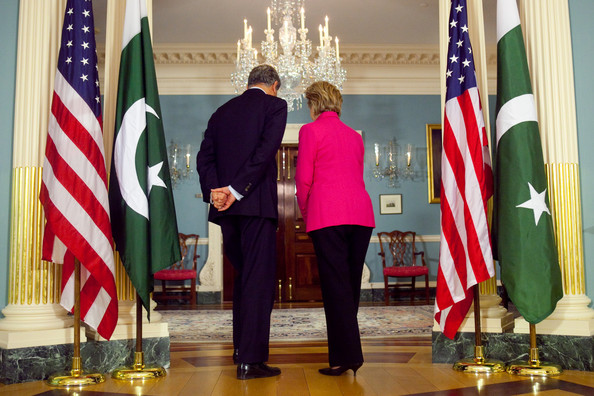
Qureshi, speaking next to Secretary of State Hillary Rodham Clinton at the closing day of three days of U.S.-Pakistan talks, said Obama must get involved because a crackdown against suspected Muslim militants in Indian-controlled Kashmir threatens the entire region.

“It is in the U.S. strategic interest to work for peace, stability and resolution of the disputes in South Asia,” he said. “The starting point in this quest is justice for the Kashmiri people.”

“President Obama has always understood the importance of a Kashmir solution,” Qureshi said. “His coming visit to the region is the time to begin to redeem the pledge that he made earlier.”

As a presidential candidate in 2008, Obama suggested that the U.S. should encourage India and Pakistan to resolve the Kashmir dispute so Pakistan could better focus on fighting extremists on its own territory and Afghanistan. Although he did not advocate direct mediation, his comments were met with disdain in India.

Obama will not visit Pakistan on his upcoming trip but he plans to spend several days in India, which has cracked down on violent anti-Indian protests in Kashmir since June. The violence has killed at least 111 people, mostly teenage boys and young men in their 20s. Authorities have imposed off-and-on curfews in an attempt to halt the unrest.

Quershi expressed astonishment that the U.S. and other major powers had said little about India’s response to the protests.

“People of conscience have protested the use of force against the defenseless people of Kashmir, in particular the targeting of the Kashmiri youth,” he said. “But the Kashmiri mothers are baffled by the deafening silence of the world’s leadership. History has proved that the force of arms cannot suppress the legitimate aspirations of the Kashmiri people.”

India and Pakistan fought two wars for control of Muslim-majority Kashmir, where rebels have sought independence from India or incorportation with neighboring Pakistan.

More than 68,000 people, most of them civilians, have been killed in Kashmir since fighting began in earnest in 1989.

Flood Relief: A US Helicopter Pilot’s Tale

By John Bockmann for The Express Tribune

I am an American helicopter pilot in Pakistan.  My colleagues and I came because Pakistan and its people are enduring the aftermath of a devastating flood.  We were ordered to be here, and we miss our homes, but most of us are glad to help because we believe it’s the right thing to do.

I did not know much about Pakistan before I arrived here.  I knew of the food.  I knew of monsoons and Mohenjo Daro, Karachi and the Khyber Pass, but I had no concept of what Pakistan looked, felt, or sounded like. I even thought many Pakistanis would want us to leave.

I had no idea what the people would be like in person.  I wondered if they would resemble the images I’d seen on TV – would they protest our presence in the streets?  Would they tolerate us?  Or would they simply ignore us and go about their business?

After a few weeks of packing and planning, we were ready to deploy.  Full of excitement and some anxiety, I kissed my wife, took one last picture and was gone. We flew on a cargo jet from Alaska to Islamabad and the flight took so long I hardly knew whether it was day or night when we finally arrived.  Shouldering my gear, I headed to the terminal, weaving among Pakistani military and civilians on the tarmac.  A US Marine captain guided my group inside where we filled out information cards and relaxed in the cool quietness, surveying our area; smooth stone floors, low-slung furniture, and ceiling fans spinning high above.  The captain was talking to a Pakistani man who had been helping us.  Before we left, the man shook my hand and looked me in the eyes. “Thank you for coming to my poor country,” he said quietly.

I wanted to convey the depth of my feelings toward him and his homeland, but all I said was, “You would probably do the same for us” as I walked away.

That was my first interaction with a Pakistani here.

The days since arriving have passed quickly.  Every day we take rice, flour, blankets, housing materials, cooking oil – anything – up and down the Swat and Indus River Valleys.  We also bring sick, injured, and displaced people to hospitals and hometowns.

My first mission took us up the Indus river valley, and I embarrassed myself by constantly exclaiming its beauty.  Below me was the Karakorum Highway – the old Silk Road into China – and the valley itself, with terraced farmland overshadowed by majestic, snow-capped mountains.

Along with the beauty, though, I see reminders of the flood, bridges that are broken or missing and roads and fields that have been washed away.  I am beginning to see widespread reconstruction now as well and feel hope for the people in these villages.  They will soon have another way to get help.

I realize that some who read this will question our intentions and some may even wish us ill.  I certainly did not imagine that cheering throngs would greet us at each village though – we are always welcomed.  I did not expect our goodwill to be taken at face value by all of Pakistan, but we have received immense support.

I have learned in my time here that Pakistani people are truly gracious.  Strangers have invited me for chai and conversation.  Almost anyone will shake my hand and ask my name, inquire about my health and how I am getting along.  Instead of a handshake at our first meeting, I have sometimes been embraced.  “Strangers shake hands,” my new friend Mahmood explained, “but brothers hug each other.”

This warms my heart.  My mission, our mission, is straightforward, noble, and good.  I am deeply grateful to those who support us here, for we need all the help we can get in order to help those in need.   I am honored to do this work. I feel at home here beyond anything I could have expected.

Ah, home!  I miss my home, my wife and family; each day I wonder when I will see them again. But we have a humanitarian mission to accomplish.  Since I must be away, I’m glad that I am here, doing work that’s needed and good.

When I do return home, I will bring with me hundreds of pictures, dozens of journal entries, six duffel bags, and several recipes for local dishes that I have enjoyed, but I will also bring innumerable memories that I will treasure for life — memories of Pakistan and its people.  They have surprised me with friendship.  I hope that through our work of compassion we may surprise them with friendship as well.

Pakistan’s Musharraf is Launching a Long-Shot, Long-Distance Bid to be President Again

By Zain Shauk for The Houston Chronicle

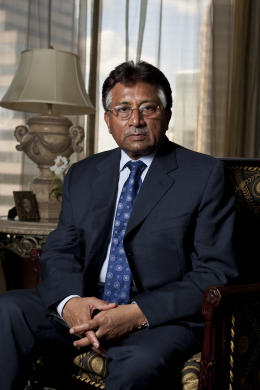
Former Pakistani President Pervez Musharraf hopes to retake the leadership of his country, and he is actively campaigning — in Texas.

Musharraf, who relinquished his presidency in 2008, has a set of Houston meetings planned this week with wealthy Pakistani-Americans and corporate leaders.

He is scheduled to meet today with former President George H.W. Bush and Joanne King Herring, a longtime advocate for development in Afghanistan and Pakistan who was played by actress Julia Roberts in the film Charlie Wilson’s War.

Musharraf, a London resident, announced this month the creation of a new political party and a plan to run in Pakistan’s 2013 parliamentary elections.

But he has kicked off his campaign in the U.S., a decision that could say more about the perceived influence of the Pakistani-American community in cities such as Houston than Musharraf’s chances for success, experts say.

Musharraf said he believes connecting with Pakistanis in America will give him enough backing — financially and politically — to carry him to victory in Pakistan.

“I do need financial support, and I would ask the American Pakistani diaspora to support me … because I see darkness in Pakistan,” Musharraf said. “Because I don’t see a political party or a leader in Pakistan to be able to tackle the problems that Pakistan is facing.”

While Musharraf enjoys backing from the Pakistani-American elite, experts say he will be hard-pressed to develop a political base within his country and likely does not stand a chance against more established parties.

He is also in no position to campaign within Pakistan. Safety is a concern after multiple assassination attempts during his presidency, and he would likely face prosecution in connection with several criminal cases currently pending in Pakistani courts, experts said.

Still, Musharraf’s interest in wooing deep-pocketed Pakistani-Americans is revealing, said Walter Andersen, associate director of the South Asia program at Johns Hopkins University.

Not only do Pakistani-Americans play a role in financially supporting candidates, but their meetings in America are covered by Pakistani news media and seem to give politicians the idea that they are gaining traction, Andersen said.

Former Prime Ministers Benazir Bhutto and Nawaz Sharif also visited U.S. communities while campaigning, he said.

“Whether it works is not important,” Andersen said. “The perception among them (politicians) is that it works.”

Wide-ranging itinerary
U.S. communities don’t play a visible role in Pakistani elections, but Musharraf could stand to gain from his current North America tour, said Jamal Elias, an expert on contemporary Pakistan and chairman of the religious studies department at the University of Pennsylvania.

Musharraf’s itinerary will include stops in Chicago, New York, San Francisco and Toronto. He visited Dallas last week.

“Appearing statesman-like is going to help him in Pakistan,” Elias said. “It’s not going to build a constituency, but it may help him.”

There are more than 75,000 people of Pakistani origin in the Houston area, which includes more than 800 doctors, executives in the energy and information technology industries and scores of business owners, according to the Consulate of Pakistan in Houston.

Many of them have in the past contributed financially to political parties in Pakistan and will likely do so again, said M.J. Khan, a former Houston city councilman and member of the Pakistani community.

Khan said he does not send money to Pakistani political candidates, but knows U.S. residents in Houston and elsewhere who do. “They’re an educated community, and they send a lot of resources to Pakistan,” Khan said. “So I think every politician in Pakistan feels the Pakistani-American community is an important group to reach out to.”

Tactics questioned
Some community members – including Sajjad Burki, president of a Houston chapter for a political party headed by Pakistani cricket star Imran Khan – were not sure of the former president’s legitimacy as a candidate. Burki questioned Musharraf’s campaign tactics and priorities.

“It doesn’t make sense for him to be creating a political party and campaigning abroad rather than campaigning in Pakistan,” he said.

Herring, who is hoping to build support for Musharraf’s candidacy, said she planned to back him because of his support for her development efforts in Afghanistan.

“I think that Musharraf is interested in my plan,” Herring said. “I know he is. He supports it.”

Seeks ‘legitimacy’
Musharraf, a retired general, said he hopes a possible election to office will give him “the legitimacy that maybe I didn’t have in the past” as someone who had seized control of the government in a 1999 military coup.

He spent much of a luncheon Tuesday discussing the threats to Pakistan created by instability and lack of development in Afghanistan. Asked how he would solve that and a host of other challenges, Musharraf paused and smiled at his audience.

“First of all, get me elected,” he said.

U.S. Had Warnings on Plotter of Mumbai Attack

By Jane Perlez, Eric Schmitt and Ginger Thompson for The New York Times
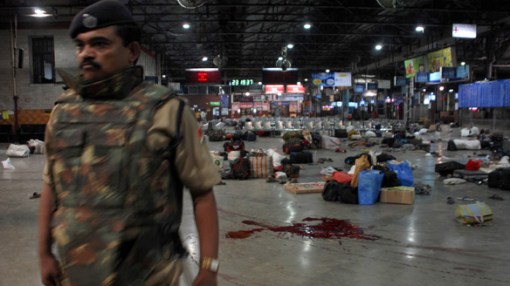
Less than a year before terrorists killed at least 163 people in Mumbai, India, a young Moroccan woman went to American authorities in Pakistan to warn them that she believed her husband, David C. Headley, was plotting an attack.

It was not the first time American law enforcement authorities were warned about Mr. Headley, a longtime informer in Pakistan for the United States Drug Enforcement Administration whose roots in Pakistan and the United States allowed him to move easily in both worlds.

Two years earlier, in 2005, an American woman who was also married to the 50-year-old Mr. Headley told federal investigators in New York that she believed he was a member of the militant group Lashkar-e-Taiba created and sponsored by Pakistan’s powerful intelligence agency.

Despite those warnings by two of his three wives, Mr. Headley roamed far and wide on Lashkar’s behalf between 2002 and 2009, receiving training in small-caliber weapons and countersurveillance, scouting targets for attacks, and building a network of connections that extended from Chicago to Pakistan’s lawless northwestern frontier.

Then in 2008, it was his handiwork as chief reconnaissance scout that set the stage for Lashkar’s strike against Mumbai, an assault intended to provoke a conflict between nuclear-armed adversaries, Pakistan and India.

An examination of Mr. Headley’s movements in the years before the bombing, based on interviews in Washington, Pakistan, India and Morocco, shows that he had overlapping, even baffling, contacts among seemingly disparate groups — Pakistani intelligence, terrorists, and American drug investigators.

Those ties are rekindling concerns that the Mumbai bombings represent another communications breakdown in the fight against terrorism, and are raising the question of whether United States officials were reluctant to dig deeper into Mr. Headley’s movements because he had been an informant for the D.E.A.

More significantly, they may indicate American wariness to pursue evidence that some officials in Pakistan, its major ally in the war against Al Qaeda, were involved in planning an attack that killed six Americans.

The Pakistani government has insisted that its spy agency, the Inter-Services Intelligence Directorate, a close partner of the C.I.A., did not know of the attack. The United States says it has no evidence to counter this, though officials acknowledge that some current or retired ISI officers probably played some role.

It is unclear what United States officials did with the warnings they had gotten about Mr. Headley, who has pleaded guilty to the crimes and is cooperating with authorities, or whether they saw them as complaints from wives whose motives might be colored by strained relations with their husband.

Federal officials say that the State Department and the F.B.I. investigated the warnings they received about Mr. Headley at the time, but that they could not confirm any connections between him and Lashkar-e-Taiba. D.E.A. officials have said they ended their association with him at the end of 2001, at least two months before Mr. Headley reportedly attended his first terrorist training. But some Indian officials say they suspect that Mr. Headley’s contacts with the American drug agency lasted much longer.

The investigative news organization ProPublica reported the 2005 warning from Mr. Headley’s American former wife on its Web site and in the Saturday issue of The Washington Post. By ProPublica’s account, she told the authorities that Mr. Headley boasted about working as an American informant while he trained with Lashkar.

On Saturday, Mike Hammer, a spokesman for the National Security Council, said in a statement, “The United States regularly provided threat information to Indian officials in 2008 before the attacks in Mumbai.” He also said, “Had we known about the timing and other specifics related to the Mumbai attacks, we would have immediately shared those details with the government of India.”

Mr. Headley’s American wife was not the only one to come forward. The Moroccan wife described her separate warnings in an interview with The New York Times. Interviews with United States and allied intelligence and security officials illustrate his longstanding connections to American law enforcement and the ISI:

¶ An officer of the Pakistani spy agency handed Mr. Headley $25,000 in early 2006 to open an office and set up a house in Mumbai to be used as a front during his scouting trips, according to Mr. Headley’s testimony to Indian investigators in Chicago in June. As part of Mr. Headley’s plea agreement, Indian investigators were allowed to interview him in Chicago, where he was arrested in October 2009. ¶ The ISI officer who gave Mr. Headley the cash, known as Major Iqbal, served as the supervisor of Lashkar’s planning, helping to arrange a communications system for the attack, and overseeing a model of the Taj Mahal Hotel, according to Mr. Headley’s testimony to the Indians.

¶ While working for Lashkar, which has close ties to the ISI, Mr. Headley was also enlisted by the Pakistani spy agency to recruit Indian agents to monitor Indian troop levels and movements, an American official said.

Besides Mr. Headley’s guilty plea in a United States court, seven Pakistani suspects have been charged there. American investigators say a critical figure who has not been charged is Sajid Mir, a Lashkar operative who became close to Mr. Headley as the plans for the Mumbai operation unfolded. The investigators fear he is still working on other plots.

Mr. Headley was known both to Pakistani and American security officials long before his arrest as a terrorist. He went to an elite military high school in Pakistan. After arrests in 1988 and 1997 on drug-trafficking charges, Mr. Headley became such a valued D.E.A. informant that the drug agency sent him back and forth between Pakistan and the United States. In several interviews in her home, Mr. Headley’s Moroccan wife, Faiza Outalha, described the warnings she gave to American officials less than a year before gunmen attacked several popular tourist attractions in Mumbai. She claims she even showed the embassy officials a photo of Mr. Headley and herself in the Taj Mahal Hotel, where they stayed twice in April and May 2007. Hotel records confirm their stay.

Ms. Outalha, 27, said that in two meetings with American officials at the United States Embassy in Islamabad, she told the authorities that her husband had many friends who were known members of Lashkar-e-Taiba. She said she told them that he was passionately anti-Indian, but that he traveled to India all the time for business deals that never seemed to amount to much.

And she said she told them Mr. Headley assumed different identities: as a devout Muslim who went by the name Daood when he was in Pakistan, and as an American playboy named David, when he was in India.

“I told them, he’s either a terrorist, or he’s working for you,” she recalled saying to American officials at the United States Embassy in Islamabad. “Indirectly, they told me to get lost.”

Though there are lots of gaping holes left in Mr. Headley’s public profile, the one thing that is clear is he assumed multiple personas.

He was born in the United States, the son of a Pakistani diplomat and a socialite from Philadelphia’s Main Line. When he was about a year old, his parents took him to Pakistan, where he attended the Hasan Abdal Cadet College, the country’s oldest military boarding school, just outside of Islamabad.

Mr. Headley’s parents divorced. And before he finished high school, he moved to Philadelphia to help his American mother run a bar, called the Khyber Pass. Later he opened a couple of video rental stores.

But at the same time he was involved in a life of crime. Each time he was arrested on drug trafficking charges, he used his roots in the United States and Pakistan to make himself as valuable an asset to law enforcement as he was to the traffickers; one with the looks and passports to move easily across borders, and the charisma to penetrate secretive organizations.

He was married at least three times. For one period he was married to all three wives — Ms. Outalha, who is a medical student half his age, a New York makeup artist, and a conservative Pakistani Muslim — at the same time.

Those relationships, however, caused him trouble. In 2005, his American wife filed domestic abuse charges against Mr. Headley, according to federal investigators in New York, and reported his ties to Lashkar-e-Taiba. The investigators said the tip was passed on to the F.B.I.’s Joint Terrorism Task Force.

Then in December 2007, Ms. Outalha talked her way into the heavily guarded American Embassy in Islamabad. She went back a month later with more information. A senior administration official acknowledged that Ms. Outalha met twice with an assistant regional security officer and an Immigration and Customs Enforcement officer at the embassy. However, the administration official said Ms. Outalha offered almost no details to give credibility to her warnings.

“The texture of the meeting was that her husband was involved with bad people, and they were planning jihad,” the official said. “But she gave no details about who was involved, or what they planned to target.”

Given that she had been jilted, Ms. Outalha acknowledged she may not have been composed. “I wanted him in Guantánamo,” she said. More than that, however, Ms. Outalha says, she went to American authorities looking for answers to questions about Mr. Headley’s real identity. In public he criticized the United States for the war in Iraq and Afghanistan. But at night he loved watching “Seinfeld” and Jay Leno.

Sipping tea in a cafe overlooking a plaza in Morocco, Ms. Outalha said that in hindsight, she is convinced that he is both men. She claims to be puzzled that American officials did not heed her warning.

“I told them anything I could to get their attention,” she said of the American authorities at the embassy in Islamabad. “It was as if I was shouting, ‘This guy was a terrorist! You have to do something.’ ”

Police: Plot to Kill Pakistan PM Uncovered

By Frederik Pleitgen for CNN

Several people have been seized in a plot to kill Pakistan’s prime minister, and the suspects claim they were getting orders from a militant in the country’s volatile tribal region, police said.

Police official Babar Bakhat Qureshi told CNN that officers arrested several suspects who were plotting to attack the compound of Pakistani Prime Minister Yousaf Raza Gilani.

Shabir Anwar, Gilani’s press secretary, had no comment on the alleged plot because it is a security matter.

The plot to strike the compound, located in the Punjab provincial city of Multan, was in its “final planning stages,” Qureshi said. The location is about 395 kilometers, or 245 miles, southeast of the nation’s capital, Islamabad.

The suspects were planning to use a car bomb for the attack, and that they had acquired large amounts of fertilizer to manufacture an improvised explosive device, since confiscated by police, he said.

A vehicle for the attack had not been acquired yet.

The police confiscated one kilogram of gold and and two and a half kilograms of silver, which the men were going to sell to fund the plot, the official said.

Qureshi said the suspects have confessed that they were getting their orders and instructions from Kari Imram, a leader of a Taliban offshoot group from Miran Shah in North Waziristan. Drone strikes said to be conducted by the United States have targeted militants in North Waziristan, one of seven of the county’s tribal districts.

The arrests were made after police stopped three suspects traveling on two motorcycles near Multan in the town of Ahmed Pur Sharkia on a check during a police patrol. Questioning led police to other suspects.

Sufi Shrine in Pakistan Is Hit by a Lethal Double Bombing

By Huma Imtiaz for The New York Times

KARACHI, Pakistan — A nearly simultaneous double explosion that may have been the work of suicide bombers struck a crowded Sufi shrine in Pakistan’s main port city of Karachi on Thursday evening, killing at least 7 people and wounding 65, officials and rescue workers said. Pakistani women mourn the death of a child killed in an attack on the shrine Sufi Saint Abdullah Shah Ghazi.

It was the first attack on the shrine, the grave of the Sufi saint Abdullah Shah Ghazi, and it appeared to be an effort by hard-line militants in Pakistan to strike at the heart of Sufism, the moderate, more flexible blend of Islam practiced by most Pakistanis.

The attack came three months after militants struck one of the country’s most important Sufi shrines in the city of Lahore, which left at least 42 people dead.

The first blast at the Karachi shrine occurred at the main gate. Police officials said that within 25 seconds, the second blast hit the steps leading up to the saint’s grave.

Rescuers said three children were among the dead.

Dr. Seemi Jamali, deputy director of the emergency ward at Jinnah Hospital in Karachi, where the wounded were taken, said “many of them have severe injuries, trauma to the head and neck.”

Television channels showed body parts strewn at the site and chaotic scenes of unnerved, sobbing survivors.

The home minister of Sindh Province, Zulfiqar Mirza, told reporters that the severed heads of two suspected suicide bombers had been recovered from the site. Police officials were more circumspect, saying it was premature to conclude that the attack was by suicide bombers.

Local TV channels reported later that Tehreek-e-Taliban, or Movement of Taliban, an umbrella group of militants, had claimed responsibility for the attack. The group is known to have trained cohorts of suicide bombers for attacks in Pakistan and Afghanistan.

The attackers apparently chose Thursday night because it is one of the most crowded times of the week at the shrine, when hundreds throng to seek blessings from the saint and to receive free food.

The government closed all shrines in the city after the bombings.

The Media Turns a Blind Eye to Pakistan

By Maryam Jameel for North by Northwestern

U.S. media coverage of Pakistan’s flood disaster remains low while apathy and misinformation run high.

Throughout the summer, while politicians and news correspondents debated endlessly over the precise coordinates of New York’s Park 51 community center, an immense disaster struck the nation of Pakistan. Floods covered much of the country, leaving an area roughly the size of England underwater, and inflicting more damage than South-East Asia’s tsunami, and Haiti and Kashmir’s recent earthquakes combined.

The U.S. media, however, has scarcely reported on the flooding. In the two weeks following Haiti’s earthquakes, The New York Times published 88 articles on the topic. About the flooding? 15. And only one of these was front page – one discussing “hard-line Islam” in flooded Pakistan.

In an effort to raise awareness of Pakistan’s situation and contribute donations for flood relief, Northwestern students have launched a campaign called NU Stands with Pakistan. Weinberg junior and SASA co-president Sahil Mehta is one of the students leading the initiative. “I think it’s a unique opportunity to push a world view of saying we’re all in this together, these people are the same people who are suffering in the United States, the people who are suffering in Pakistan are the same people who were suffering in New Orleans during Katrina, the same people who are suffering in Haiti,” he says.

Members of Northwestern’s community were personally affected; Northwestern has a large number of Pakistani international students and students of Pakistani descent. “NU Stands with Pakistan is about what stance our community takes when something like this happens. Whether its in Haiti, whether it’s a tsunami, whether it’s in Pakistan,” Mehta says.

Alongside the underreporting of Pakistan’s floods, there has been a low response in aid donated for Pakistani flood relief compared with other recent natural disasters. “I think at the end of the day our information controls our action, we are reactions to what we see, and if we’re not seeing anything, I think it’s going to de-motivate people to act,“ Mehta says.

Weinberg senior Sana Rahim is also at the head of NU Stands with Pakistan. “There is mass Islamophobia in this country, and I don’t want to say it, and I don’t want to believe it, but I do think that has to have some kind of hand in why so many people are not paying attention,” says Rahim. “When they see images of Pakistan, and when the media talks about the terrorist activities in Pakistan, it’s not going to really call people to respond.”

Professor Loren Ghiglione says that while U.S. media is a large influence upon its audience, it is also a reflection of its audience. “There’s good coverage [available], but it’s probably in a limited number of places, and the question is also who bothers to look at it? Partly, it’s the public’s response too,” he says.

McCormick sophomore Khalid Aziz lives in Lahore, Pakistan. Lahore, alongside Pakistan’s other major cities, was not directly affected by the flooding; however, most of Pakistan is experiencing the economic effects of the disaster and the pain of watching so much of its population displaced. “Whenever we tried going out, you just couldn’t have fun in Pakistan because you were feeling so guilty, because one fifth of the population was directly affected by these floods, and the rest were indirectly effected by the rising food prices, and it’s only going to get worse because so much of agrarian life is underwater,” Aziz says.

Though the majority of Pakistanis have zero connection to the so-called terrorist groups that the media frequently covers, the constant news reports affiliating Pakistan with terror creates quite the opposite impression. “I think that the media needs to have a bit more of a conscience in this regard. [When] the only thing [the average American] sees about Pakistan is about terrorism, he might not send in the 10 dollars or 20 dollars he could have otherwise sent to the flood victims,” Aziz says.

Aziz reflects that to expect Americans to express nothing but kindness and generosity towards Pakistanis after years of negative, often sensationalized reports, would be unrealistic. On articles depicting Pakistanis’ current situation, he saw many individuals write comments saying that they would not want to spend their hard-earned money to help a “terrorist country.”

With the limited media coverage of Pakistan, most of which talks of violence and some of which now speaks of suffering, displaced human beings, deciding how to feel towards Pakistan remains a challenge for many. “There may be a sense of ‘is Pakistan our friend or our enemy or what?’” Ghiglione says.

“Pakistanis are people who Americans’ fear is instinctively telling them not to feel bad for, but their human side is saying that these are just regular people, these are average people who are trying to lead lives and earn honest livings just like myself and my neighbor,” Mehta says.

NU Stands with Pakistan is raising funds throughout this week at Norris and Scott Hall. Funds will go to Oxfam to assist with flood relief efforts.

“We’re hoping to motivate a dialogue that continues past this campaign, that continues into the year and continues in classes and discussions an other events,” Mehta says.

Loud Cheers for Pakistan, British Team Sports Indian Look

By Shivani Kala for The Indian Express

The loudest applause, predictably, was reserved for the Indian contingent. But what surprised many, perhaps even the participating athletes, was that the 60,000-plus crowd chose Pakistan for the second-loudest cheer.

If sheer crowd applause was any measure of the popularity of the participating countries, the 54-member Pakistani delegation, distinct in their green coats, was by far the most loved after India. Of course, the Indian delegation, led by flag-bearer Abhinav Bindra, was received with a standing ovation across the stadium, with even President Pratibha Patil and Prince Charles standing up to welcome the participants. UPA chairperson Sonia Gandhi was the last to sit down after the resounding applause that lasted several minutes.

In contrast, to the embarrassment of the Organising Committee (OC), as soon as its chairman Suresh Kalmadi stepped on stage to make the opening remarks, a rather cold silence descended, following by distinct booing. The only exception was when he mentioned Delhi Chief Minister Sheila Dikshit, whose name was greeted with loud cheers.

Besides Pakistan, other cricket-playing countries also received loud cheers. In fact, the British participants struck a chord with the host country with their choice of outfit — white kurta with the signature Nehru collar and a red jacket. The marching members of the 371-strong contingent turned out in the best of fashion inspired by India.