Posts Tagged ‘ Pakistanis ’

India, Pakistan Ties Hinge on Hope

By Mir Ayoob Ali Khan for The Times of India

When hope is lost, everything seems to be lost. But when we hear the adage, Ummid pe dunya khayam hai (the world stands on hope), we visualize a ray of light at the end of a tunnel.

The rollercoaster ties between India and Pakistan are an unending reading in despair. It is hope that makes people believe that one day, some day, we will live like good neighbours. That someday becomes believably close when we hear that Indian and Pakistani politicians, officials and members of the civil society are ‘seriously’ talking about the benefits of developing stronger economic and commercial links between the two nations. Or, when the Supreme Court of India allows aging Pakistani virologist Mohammed Khalil Chishti, a murder convict, to visit his hometown Karachi.

It is an unprecedented move by the Supreme Court which took a humane approach in a murder case. The apex court spoke of Chishti’s age (82), his global reputation as an accomplished microbiologist and his previous clean record to say that he is free to go to his country but on certain conditions. He should be back in India in November to face trial in court. Though the Supreme Court’s order is solely based on the prudence of the judges, there is hope that Islamabad would show some reciprocation with regard to Indians stranded in Pakistan prisons. For instance, many are waiting to see if they would free Sarabjit Singh, an Indian convicted of life imprisonment in a case of mistaken identity.

Chishti and Singh have been in the public eye owing to the extensive coverage of their plight in the media. However, there are numerous Indians languishing in Pakistani prisons and vice versa who have hardly been covered by any media agency or their cases taken up by any human rights organization seriously. They too deserve attention as their loved ones are waiting to see them. In the meantime, the air over India and Pakistan is thick with hope that the two countries are about to enter into a new era of trade and commercial cooperation. Activity in this direction gained momentum ever since Pakistan decided to give the MFN-the Most Favoured Nation-status to India last year.

The two sides have realised that the trade volume was a paltry $2.6 billion in the year ending 2011. Officials and members of the trading community believe that this could be taken to $10 billion to $12 billion in the next three to five years. In the forefront of trade with Pakistan which is expected to grow in the coming weeks, not years, are tomatoes from Maharashtra. About 4,000 trucks carrying tomatoes have crossed over to Pakistan in the past three months. Lorries containing soya beans followed. Not to lag behind, Pakistan has started exporting cement and other construction material to India. Talks are on to allow 8,000 items from Pakistan to enter India in the next couple of years.

Hope is now fuelled by the foundation laying of an oil refinery in Bathinda, a town in Punjab which is160 km from Lahore, by billionaire Lakshmi Mittal and Indian Oil Company Ltd costing $4 billion. Pakistan that is already importing kerosene and diesel from India is hungry for petroleum products. The refinery in Punjab and another one owned by the Reliance Group in Gujarat which is close to Karachi could meet the fuel needs of Pakistan, at least to some extent. There are also talks to dismantle hurdles in matters pertaining to education and IT sectors, visa regimes, especially for the business community and tourists, opening of more land and air trade routes.

In India-Pakistan relations, hope is the key word. Let’s hope that it becomes a reality extending benefits to the people of the two neighbouring nations.

Is Parcham Ke Saye Talay by Hadiqa Kiani

Song By Hadiqa Kiani

India and Pakistan: The Truth of the One Nation Theory

By Aakar Patel for FirstPost

The first time I came to Pakistan, I was taken aback at how good some of the infrastructure was. The airports at Karachi and Lahore were small, but they were efficient and well designed. I think my host told me the Japanese had built one or both of them, and those airports were a very different thing from the ones I had just taken off from in India.

This was when the government made the airports and as with all things the Indian government takes up, our airports were clumsy and barely functional. But a few years later this changed. Today the airports at Mumbai, Delhi and Bangalore are pretty good. They’re not world class (nothing in India can ever be), but they are not embarrassing as the earlier ones were.

The differences that I had thought were significant turned out not to be so.

This led me to think of how similar we were as nations. Not in the sense that Mohd Ali Jinnah meant. I think it is fairly obvious that the character of India and of Pakistan is different when we observe their constitutions. India’s secularism is fundamentally Hindu in its nature. Pakistans constitution is Islamic by design and in appearance.

Though this is an important aspect of nationhood, however, it is only one aspect.

What I mean is how we are one nation in all the negative aspects. Our neighbourhoods and streets are among the most shameful in the world, because we are selfish and blind to the concern of others. Delhi’s drivers are as terrible as those in Lahore (and the women of Delhi and Lahore would concur on the behaviour of the loutish men of those cities). Half of us are illiterate and the half who are literate don’t really read much. The comments sections of Indian and Pakistani websites are the most dreadful in the world, without qualification. Hateful and pedantic, the product of minds who are only functionally literate. We think time will bring some big change in our society but it isn’t easy to see where this change is going to come from.

I know of few other nations where people would not be embarrassed at the thought of keeping servants. Few cultures would be so unaffected, so uncaring of privacy to not mind the constant presence of the servant in the house. I am not even talking about the bestial manner in which we treat them, because every reader of this piece, whether Indian or Pakistani already knows what I mean.

We divide ourselves into nations based on things like which animal the other eats or does not eat. The outsider probably sees no difference between us, and rightly.

We produce very little of meaning to the outside world, and it is tough to think of what our contribution is to the nations from whom we take so much. In science and technology we have nothing to offer the West, despite the boasts of Indians that we gave the world Arabic numerals and zero (I agree with that; we have given the world zero).

Pakistanis stake claim to Islams golden age. Daily Jang columnist Hassan Nisar often takes up this point. He says that the Arabs laugh when Pakistanis owns Islams achievements. What aspect of the conquest of Spain or the scientific revolution in Baghdad did Punjabis and Sindhis participate in?
To the world we are one people in that sense.

My friend Col Iftikhar, from Musharrafs batch in the Pakistan Military Academy, said he discovered this horrifying fact when he went to Mecca a few decades ago for Haj. He met some Saudis, one of whom asked him where he was from. Lahore, said Ifti. Where’s that, the Saudi asked (this was in the 70s). Pakistan, said Ifti proudly. Where’s that, the puzzled Saudi asked. Ifti took out a map and pointed. Ah, said the Saudi to his friends, he’s Hindi.

Our problems are so primitive that they should make us stop and repair ourselves immediately. But they don’t seem to affect us at all. Our media carry on like we are normal people. Reading the militant bombast of the strategic affairs experts in the newspapers of these two nations, the outsider would never suspect that these were two nations unable to even keep their public toilets clean.

Weeping Relatives Demand Pakistan Crash Answers

As Reported by Agence France Presse

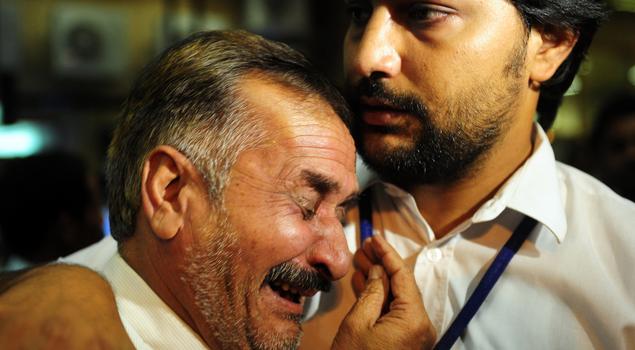
Dozens of coffins lined a hallway at Islamabad’s main hospital on Saturday as weeping relatives of the victims of the Bhoja Air plane crash slammed the authorities for the disaster.

All 127 people on board perished when the Boeing 737 from Karachi crashed and burst into flames as it attempted to land at Islamabad airport in bad weather on Friday evening.

The plane was smashed to pieces by the impact of the crash, with wreckage and human limbs strewn over a wide area of farmland on the outskirts of the Pakistani capital.

Staff at the Pakistan Institute of Medical Sciences (PIMS), their faces covered with masks, sprayed air freshener to mask the smell of burnt flesh in the room where the remains lay.

Some remains were no more than body parts, kept on stretchers and covered by white sheets.

The disaster is the city’s second major plane crash in less than two years — an Airblue plane came down in bad weather in July 2010, killing 152 — and victims’ families voiced fury at the authorities.

A visibly dejected woman identifying herself as Mrs Hassan, 45, said she had come to collect the body of her 45-year old cousin Mohammad Yunus, a Muslim scholar who had been running a madrassa (Islamic seminary) in Karachi.

“We could not get the full body. We recognized his hand and hair along with his jacket,” she said.

“It’s sheer incompetence of the government. This is the second major accident here in less than two years but the president and the prime minister remain unmoved.

“If the weather was bad why they did not warn the pilot. Why did they allow the plane to land?”

Abdul Raoof, 55, said he had come for the body of his cousin Ghulam Farooq, 45, who worked for the State Life Insurance Corporation in Islamabad.

“We have been roaming here since early morning. We go inside the mortuary and return in depression after seeing body parts and severed limbs lying there.

“We wait, get impatient and then go inside again only to return disappointed. We are traumatized. We want to get the body and leave this place as early as possible.”

Raoof blamed the airport control tower for negligence.

“If the weather was bad the plane should have been turned away,” he said.

“It is also a mistake of the airline. They sacrificed 127 lives just to save some fuel.”

Many of the family members flown from Karachi on a special Pakistan International Airlines (PIA) flight were inconsolable, too overwhelmed with grief to speak.

One young man wept bitterly for the cousin and aunt he lost in the crash, who were returning from pilgrimage in Saudi Arabia.

“I don’t want to talk, please leave us alone,” he told journalists.

Hospital staff sprinkled rose petals on some of the coffins as a gesture of compassion, while police and soldiers consoled relatives.

At the scene of the crash, sniffer dogs joined rescue workers as they resumed the operation to recover bodies.

Debris was scattered over a two-kilometer (one-mile) area, with torn fragments of the fuselage, including a large section bearing the Bhoja Air logo, littering the fields around the village of Hussain Abad.

Prime Minister Yousuf Raza Gilani told reporters a judicial commission would investigate the crash

iPakistan- Rebranding Pakistan

About

iPakistan is simply an intitative to bring Pakistan to the world and the world to Pakistan.

WHO ARE THEY?

iPakistan ia a group of university students and young professionals who are done whining about Pakistan’s image and want to do something about it. Most of them are studying in foreign universities and so have first hand experience of various kinds of stereotypes that Pakistanis overseas face as well as the tarnished image of the nation is portrayed in other countries.

Sadly, terrorism has become synonymous with Pakistan. There was this one time when a team member of this group was asked as a serious question by a Chinese students : “Does your family have any Taliban?” IMAGINE!

So iPakistan and iLahore are collaborative efforts about changing this wrongly propagated image, and even if we the group members are only able to neutralize one person’s opinion, they will feel happy that they made a small difference.

THE TEAM

Founder – Rehman Ilyas

He is the guy most pissed about Pakistan’s image and hence the one who came up with iPakistan and iLahore. He studies Economics and Finance at the University of Hong Kong and is particularly interested in Development Economics. Reads up on Chinese economy a lot and plans to heavily promote Chinese recipe of economics success, and apply it to Pakistan with a few unique ingredients of his own, through the Business section of ilahore.

Mentor – Khalid Malik

Mr. Khalid Malik is a famous Business Studies A-Levels teacher in Lahore. He is a visiting lecturer at various top schools including LGS Defence, LGS Paragon, SICAS etc. Recently he has been gaining further acclaim for his efforts to get the beloved festival of Basant, back to the people of Lahore.

Mentor – Ali Murtaza

Mr. Murtaza is a visiting professor at Beacon House National University (BNU) where he teaches design and illustration. In addition he works for a social marketing company and does commercial web site designing. His awesome illustrations, animations & creations have earned him the prestigious

Fulbright scholarship recently.

Editor Health – Burhan Ahmad
MBBS
Founder & CEO Medicalopedia, LLC

Editor Tourism – Muhammad Zargam Arshad

“BBA Accounting and Finance student at University of Hong Kong. Zargam is fondly known as “Ziggy”. He has extensive travel experience: Saudi Arabia, Hong Kong, Austria, England and of course Pakistan! Fond of reading two diverse types of poetry: Modernist and Sufi poetry. Currently working with
“YES Network” on breaking down discrimination barriers in Hong Kong society. “

Editor Fashion – Khizra Wynne

Although i have crippled my four senses while Majoring in Economics and Finance but, the sense of sight still stands to fight because it’s all about living to look ravishing.

Editor Wisdom – Hassan Riaz

Hassan is an engineering student at the University of Hong Kong and claims to be very ‘Wisdomistic’.

Editor Religion – Syed Abrar Ahamd

Abar is an active member of the Muslim Scoiety at the University of Hong Kong and wants to share his passion for Islam and peace through ‘religion’ ilahore.

Editor HumourAli – Mohiudin Ahmad

There is no single description which fits Ali, and you will get to more about him andh is personality based on his upcoming awesome humour at iPakitsan.

Editor ‘Read’ – Hinna Malik

Hinna did her Masters in Mass Communication from the University of Surrey and has worked in RBS for several years.

Editor Music – Muhammad Hamza Bukhari

Hamza is a Biotechnology major in the University of Hong Kong and claims that there isn’t a single article/ blog on metal music that hasn’t passed through his eyes.

Editor Food – Mahnum and Mahnoor

The awesome duo loves dining out and usually are present at every restaurant opening.

Editors, Romancing the Border – Pulkit Saneja, Shirin Soni, Sonica Dunichand, Rehman Ilyas

Sonica and Rehman are from Pakistan, Shirin and pulpit from India and they are typicals, fighting and arguing over Kashmir, Sania Mirza and other crucial issues on a day to day basis.

Editor The world and Us – Mark Gray

“Mark is interested in issues of law and international relations. An American and a graduate from Princeton, he is currently living in Asia doing legal research, and plans to go to law school. He enjoys travel, photography, and music.”

Editor Business – Minahil Haroon

Completing her BBA in Wealth management at the University of Hong Kong. Loves Pakistan and is hoping to represent the real Pakistan through iLahore.
But they are different too, in the sense that they love each other and want to extend their love to the entire region!

Ambassadors

UK ambassador: Bilal Mustafa(Kings College)
India Ambassador: Shirin Soni ( HKU)
Karachi Ambassador: Minahil Haroon (HKU)
Multan Ambassador : Iqra Amjad (Punjab College)
Lahore School of Economics Ambassador: Mehreen Saba
LGS (JT) Ambassador: Ahmed Awais
Salamat School group Ambassador : Rahema Hassan
And counting…

Pakistanis for Peace Editor’s Note–  Groups like iPakistan and Friends Across LOC are attempting to do the same things that we here at Pakistanis for Peace are doing as well and that is to bring the people of India and Pakistan closer together. We feel that the only solution to Pakistan and India’s problems and indeed over a billion people of the sub-continent is through a dialogue and peace. The neighborhood can not suffer another war between the two, which surely would be nuclear. Let’s hope that the our vision of peace between India and Pakistan succeeds and Pakistan is able to rid itself of a terrible image globally that its wonderful people do not deserve.

Pakistan Leader’s India Visit Hailed For Its Symbolism

By Mark Magnier for The Los Angeles Times

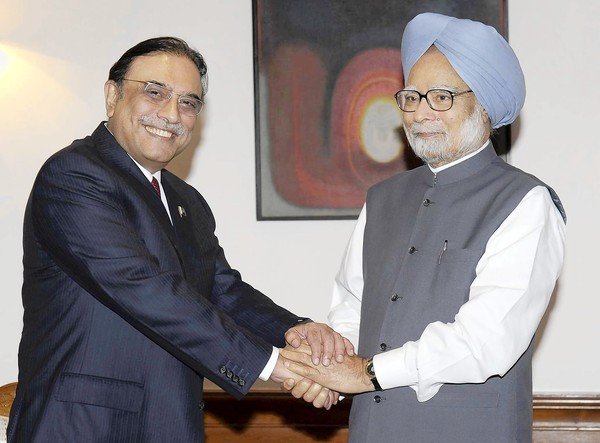
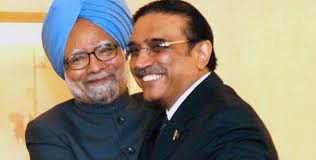
Pakistan’s president arrived in India on Sunday, the first official visit one leader of the wary neighbors has paid to the other nation in seven years. No breakthroughs were announced, but both sides hailed the meeting as a sign of easing tensions along one of the world’s most dangerous borders.

Spinmeisters on both sides worked overtime to lower public expectations of the “private” trip that saw Pakistani President Asif Ali Zardari and Indian Prime Minister Manmohan Singh discuss the 2008 terrorist attack on the Indian city of Mumbai, modest if expanding trade links, the disputed territory of Kashmir and efforts to bring various militants to justice.

The Pakistani president then visited a famous Muslim shrine for Sufi saint Moinuddin Chishti, offering a $1-million contribution.

“I am very satisfied with the outcome of this visit,” Singh said. “The relations between India and Pakistan should become normal — that is our common desire.”

The rapid-fire luncheon and shrine visit weren’t enough to overturn long-standing distrust between the nuclear neighbors, however, as summed up in a headline in India’s Mail Today tabloid newspaper: “Eat, Pray, No Love.”

The meeting is part of an apparent effort to follow the diplomatic model in place between India and China, which fought a war in 1962 over their disputed border: Put aside the most nettlesome issues for the time being and focus on building investment and trade links that benefit both sides.

This year, India and Pakistan approved a most-favored-nation agreement, lowering taxes that impede trade. Although India had offered this benefit to Pakistan in 1996, it wasn’t reciprocated until recently. Official two-way trade of about $2.6 billion is heavily weighted in India’s favor.

Sunday’s one-day visit was heavy on symbolism if not on substance. Zardari invited Singh for a reciprocal visit to Pakistan, which the Indian leader accepted, although no date was set. Zardari’s 23-year-old son, Bilawal, invited ruling Congress Party General Secretary Rahul Gandhi to Pakistan, which was also accepted, again with no date set.

On other fronts, both sides agreed in principle to ease visa restrictions. India offered its assistance in the wake of this weekend’s massive avalanche in the Siachen Glacier area, which buried about 130 people on the Pakistani-controlled side of the border in disputed Kashmir. And both sides did lots of glad-handing for the cameras.

“We had fruitful bilateral talks,” Zardari said. We “hope to meet on Pakistani soil very soon.”

But any bid to bring to justice those who planned the 2008 Mumbai attack that killed at least 166 people was sidestepped. India has long blamed Pakistani-based groups for plotting the attack.

Last week, Washington offered a $10-million reward for information leading to the capture of one Pakistani militant leader, Hafiz Muhammad Saeed, who enjoys widespread support in Pakistan.

Analysts on both sides of the divide welcomed the gradual thaw even as they acknowledged its slow pace. That no date was set for a return visit, and that Congress Party head Sonia Gandhi — characterized by some as India’s real leader behind the scenes — didn’t meet Zardari or attend the lunch, suggests the Indian government is wary of getting too far ahead of public opinion, some observers said.

“There have been some useful steps forward,” said B. Raman, director of Chennai’s Institute for Topical Studies and a former Indian intelligence officer on the Pakistan desk. “But the government has taken a cautious line.”

The fact that Zardari, 56, made the trip at all suggests that Pakistan’s military realizes improved relations are in its interest, added Talat Masood, an analyst and retired Pakistani general.

“They’re overstretched, realize the economy’s in a shambles and that you can’t have a genuine defense without a good economy,” Masood said. “It’s very sad in a way, that the process has been held hostage to jihadi groups and hard-rightists on both sides.”

Singh, 79, heading a weak government beset by corruption scandals, has pushed for improved ties with Pakistan in a bid to secure a legacy, analysts on both sides said. “Prime Minister Singh realizes he’s only going to be there a few more months,” said Masood. “He wants to do something positive so he’s remembered.”

Pakistani Troops Dig for 135 Missing in Avalanche

By Chris Brummitt for The Associated Press

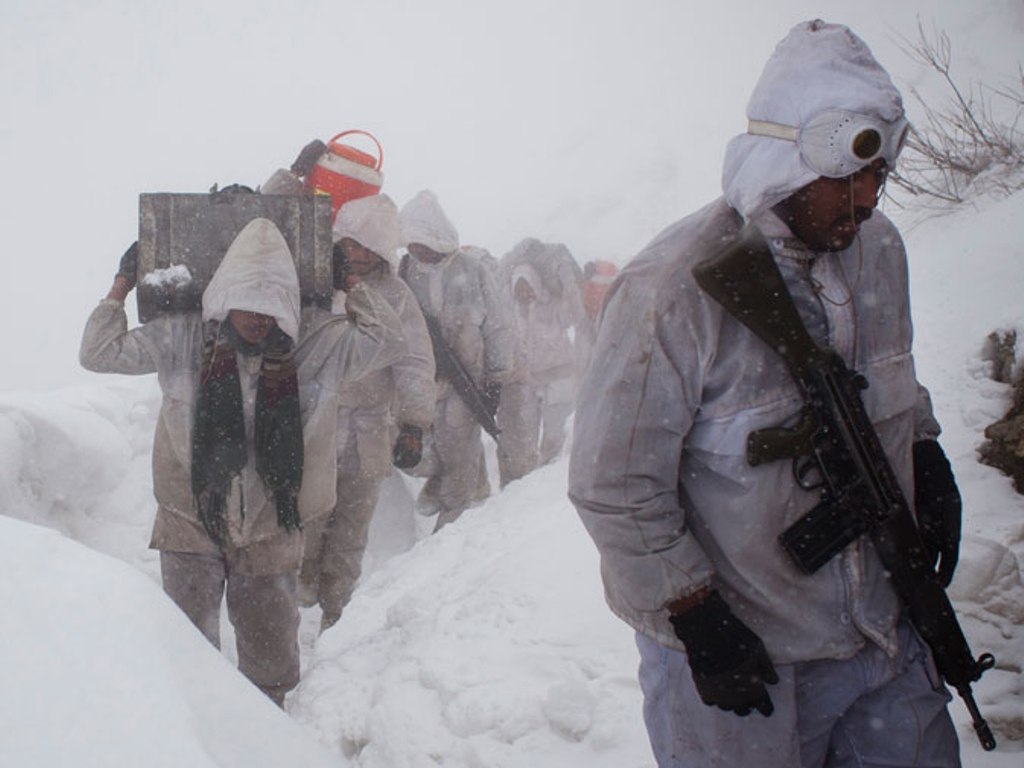
Pakistani soldiers dug into a massive avalanche in a mountain battleground close to the Indian border on Saturday, searching for at least 135 people buried when the wall of snow engulfed a military complex.

More than 12 hours after the disaster at the entrance to the Siachen Glacier, no survivors had been found.

“We are waiting for news and keeping our fingers crossed,” said army spokesman Maj. Gen. Athar Abbas.

Hundreds of troops, sniffer dogs and mechanical equipment were at the scene, but were struggling to make much headway into the avalanche, which crashed down onto the rear headquarters building in the Gayari sector early in the morning, burying it under some 21 meters (70 feet) of snow, Abbas said.

“It’s on a massive scale,” he added. “Everything is completely covered.”

The military said in a statement that at least 124 soldiers and 11 civilian contractors were missing.

Siachen is on the northern tip of the divided Kashmir region claimed by both India and Pakistan.

The accident highlighted the risks of deploying troops to one of the most inhospitable places on earth.

The thousands of troops from both nations stationed there brave viciously cold temperatures, altitude sickness, high winds and isolation for months at a time. Troops have been deployed at elevations of up to 6,700 meters (22,000 feet) and have skirmished intermittently since 1984, though the area has been quiet since a cease-fire in 2003. The glacier is known as the world’s highest battlefield.

Prime Minister Yousuf Raza Gilani expressed his shock at the incident, which he said “would in no way would undermine the high morale of soldiers and officers.”

The headquarters in Gayari, situated at around 4,572 meters (15,000 feet) is the main gateway through which troops and supplies pass on their to other more remote outposts in the sector. It is situated in a valley between two high mountains, close to a military hospital, according to an officer who was stationed there in 2003.

“I can’t comprehend how an avalanche can reach that place,” said the officer, who didn’t give his name because he is not authorized to speak to the media. “It was supposed to be safe.”

More soldiers have died from the weather than combat on the glacier, which was uninhabited before troops moved there.

Conflict there began in 1984 when India occupied the heights of the 78-kilometer (49-mile)-long glacier, fearing Pakistan wanted to claim the territory. Pakistan also deployed its troops. Both armies remain entrenched despite the cease-fire, costing the poverty-stricken countries many millions of dollars each year.

Pakistan and India have fought three wars since the partition of the subcontinent on independence from Britain in 1947. Two of the wars have been over Kashmir, which both claim in its entirety.

Pakistanis for Peace Editor’s Note– The death of these 135 and allegedly more soldiers should prove to be a defining moment for Pakistan in regards to the urgency of peace with India just as the death of the 24 killed by “friendly” NATO attack that killed so many near the Afghanistan border last November.  It is high time India and Pakistan find a way to make peace and end this 60+ year battle and hatred with ourselves as we are one people.  This may not completely apply for India, but the ONLY way to fix EVERYTHING that ails Pakistan is a peace treaty with India~ RIP to the patriots of my sacred land~ MM

Why President Zardari’s Visit Is A Small Bonus

By Soutik Biswas for The BBC

Hope is not a policy, but neither is despair, as South Asia expert Stephen Cohen says in a recent essay on Pakistan.

So it is with relations between India and Pakistan.

The past few days have shown how fragile the relationship can be – even as India welcomed President Asif Ali Zardari’s private trip to India on Sunday – the first by a Pakistani head of state for seven years – and PM Manmohan Singh invited him for lunch, the $10m US bounty for Hafiz Saeed, the founder of Pakistan-based militant group Lashkar-e-Taiba, provoked the cleric to openly launch a fresh attack against India (and the US).

But people live in hope, so Indian media is gung-ho about Mr Zardari’s visit.

They say the Pakistani president must be applauded for trying to end trade discrimination against India, easing petroleum imports from across the border, and moving towards a liberal visa deal.

“Under Mr Zardari’s watch, India and Pakistan are considering a sweeping agenda for economic co-operation for the first time in decades. The prime minister has every reason to welcome Mr Zardari warmly and consider the next steps in consolidating the unexpected movement in bilateral relations,” the Indian Express wrote.

Analyst C Raja Mohan believes Mr Singh must make an official trip to Pakistan after his meeting with Mr Zardari. “For his part,” he wrote, “Mr Singh should convey to Mr Zardari his readiness to move as fast and as far as the Pakistan president is willing to go.” Others like Jyoti Malhotra actually find Mr Zardari’s visit to the shrine of a famous Sufi Muslim saint in Rajasthan loaded with symbolism in these troubled times. “Clearly, Mr Zardari has stolen an imaginative moment from the bitter-sullen history of India-Pakistan, by asking to come to pay his respects to a cherished and much-beloved saint across the Indian subcontinent,” she wrote.

The relations between two neighbours remain complex. A 2010 Pew survey found 53% of the respondents in Pakistan chose India as the greater threat to their country, and only 26% chose the Taliban and al-Qaeda. At the same time 72% said it was important to improve relations with India, and about 75% wanted more trade relations and talks with India.

Pundits like Mr Cohen believe that it will “take the [Pakistan] army’s compliance, strong political leadership, and resolutely independent-minded foreign ministers to secure any significant shift of approach towards India”.

None of this appears to be in much evidence at the moment.

Both countries have seriously weakened governments that makes them unable to move towards any radical confidence building measures. In the current circumstances, President Zardari’s visit can only be a small bonus. And as scholars like Kanti Bajpai suggest, India must remain patient (even if faced with another Mumbai-style attack), continue to engage with Islamabad, help the civilian government in Pakistan politically, try to resolve a few outstanding disputes like Siachen and Sir Creek, build a relationship with the army and explore the possibility of cooperating with Islamabad on the future of Afghanistan. Despair does not help mend a stormy relationship.

Pakistani militant taunts US: ‘I will be in Lahore tomorrow’

By Sebastian Abbot for The Associated Press

One of Pakistan’s most notorious extremists mocked the United States during a defiant media conference close to the country’s military headquarters Wednesday, a day after the US slapped a $10 million bounty on him.

“I am here, I am visible. America should give that reward money to me,” said Hafiz Mohammad Saeed, referring to the fact that the bounty was given to a man whose whereabouts are not a mystery. “I will be in Lahore tomorrow. America can contact me whenever it wants to.”

Analysts have said Pakistan is unlikely to arrest Saeed, founder of the militant group Lashkar-e-Taiba, because of his alleged links with the country’s intelligence agency and the political danger of doing Washington’s bidding in a country where anti-American sentiment is rampant.

Saeed, 61, has been accused of orchestrating the 2008 attacks in the Indian city of Mumbai that killed 166 people, including six American citizens. But he operates openly in Pakistan, giving public speeches and appearing on TV talk shows.

He has used his high-profile status in recent months to lead a protest movement against US drone strikes and the resumption of NATO supplies for troops in Afghanistan sent through Pakistan. The supplies were suspended in November in retaliation for American airstrikes that accidentally killed 24 Pakistani soldiers.

Hours before Saeed spoke, US Deputy Secretary of State Thomas Nides met Pakistani Foreign Minister Hina Rabbani Khar in the nearby capital, Islamabad, for talks about rebuilding the two nation’s relationship. In a brief statement, Nides did not mention the bounty offer but reaffirmed America’s commitment to “work through” the challenges bedeviling ties.

Increasingly ‘brazen’ appearances
The US said Tuesday it issued the bounty for information leading to Saeed’s arrest and conviction in response to his increasingly “brazen” appearances. It also offered up to $2 million for Lashkar-e-Taiba’s deputy leader, Hafiz Abdul Rahman Makki, who is Saeed’s brother-in-law.

The rewards marked a shift in the long-standing US calculation that going after the leadership of an organization used as a proxy by the Pakistani military against archenemy India would cause too much friction with the Pakistani government.

This shift has occurred as the US-Pakistani relationship steadily deteriorated over the last year, and as the perception of Lashkar-e-Taiba’s potential threat to the West increased.

Bounty backfire?
The US may be hoping the bounty will force Pakistan to curb Saeed’s activities, even if it isn’t willing to arrest him. But the press conference he called at a hotel in the garrison city of Rawalpindi on Wednesday was an indication that is unlikely, and the bounty may even help him by boosting his visibility.

At the hotel, located near the Pakistani army’s main base and only a half hour drive from the US Embassy in Islamabad, Saeed was flanked by more than a dozen right-wing politicians and hardline Islamists who make up the leadership of the Difa-e-Pakistan, or Defense of Pakistan, Council. The group has held a series of large demonstrations against the US and India in recent months.

Some in the media have speculated the movement has the tacit support of the Pakistani military, possibly to put pressure on Washington.

“I want to tell America we will continue our peaceful struggle,” said Saeed. “Life and death is in the hands of God, not in the hands of America.”

Denies involvement in Mumbai massacre
He denied involvement in the Mumbai attacks and said he had been exonerated by Pakistani courts.

Pakistan kept Saeed under house arrest for several months after the attacks but released him after he challenged his detention in court. It has also resisted Indian demands to do more, saying there isn’t sufficient evidence.

The bounty offers could complicate US efforts to get the NATO supply line reopened. Pakistan’s parliament is currently debating a revised framework for ties with the US that Washington hopes will get supplies moving again. But the bounties could be seen by lawmakers and the country’s powerful army as a provocation and an attempt to gain favor with India.

Origins in the Kashmir dispute
Saeed founded Lashkar-e-Taiba in the 1980s allegedly with ISI support to pressure India over the disputed territory of Kashmir. The two countries have fought three major wars since they were carved out of the British empire in 1947, two of them over Kashmir.

Pakistan banned the group in 2002 under US pressure, but it operates with relative freedom under the name of its social welfare wing Jamaat-ud-Dawwa — even doing charity work using government money.

The US has designated both groups foreign terrorist organizations. Intelligence officials and terrorism experts say Lashkar-e-Taiba has expanded its focus beyond India in recent years and has plotted attacks in Europe and Australia. Some have called it “the next Al Qaeda” and fear it could set its sights on the US

* Associated Press writer Asif Shahzad contributed to this report from Islamabad.

Ornate, but not lavish: Another bin Laden home located in Pakistan

By Kathy Gannon for The Associated Press

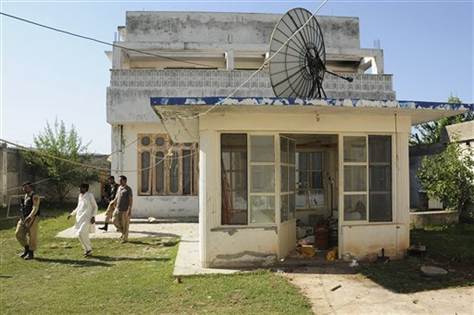
It’s an ornate but not lavish two-story house tucked away at the end of a mud clogged street. This is where Pakistan’s intelligence agency believes Osama bin Laden lived for nearly a year until he moved into the villa in which he was eventually killed.

The residence in the frontier town of Haripur was one of five safe houses used by the slain Al Qaeda leader while on the run in Pakistan according to information revealed by his youngest wife, who has been detained.

Retired Pakistani Brig. Shaukat Qadir, who has spent the last eight months tracking bin Laden’s movements, told The Associated Press that he was taken to the Haripur house last November by intelligence agents who located it from a description they got from Amal Ahmed Abdel-Fatah al-Sada.

Al-Sada, a 30-year-old Yemeni, has been in Pakistani custody since May 2 when US Navy SEALs overran the Abbottabad compound, killing bin Laden and four other people inside. Since then, Pakistan’s intelligence agency, known as the ISI, has been trying to uncover the trail that brought him to Abbottabad villa in the summer of 2005.

The best information appears to have come from al-Sada, who was believed to be his favorite and who traveled with bin Laden since his escape from Afghanistan’s eastern Tora Bora mountain range in 2001.

Qadir, a 35-year army veteran who is now a security consultant, was given rare access to transcripts of Pakistani intelligence’s interrogation of al-Sada and access to other documents on bin-Laden’s movements. He provided the AP with details in a recent interview.

The details of bin Laden’s life as a fugitive — which were first published by the Pakistani newspaper Dawn — raise fresh questions over how bin Laden was able to remain undetected for so long in Pakistan after the Sept. 11, 2001 attacks, despite being the subject of a massive international manhunt.

Yet a senior US official, who is familiar with the contents recovered in bin Laden’s Abbottabad house, said there was no evidence that Pakistani officials were aware of bin Laden’s presence. “There was no smoking gun. We didn’t find anything,” he said on condition of anonymity because he was not authorized to speak about the contents of the Abbottabad house

According to the interrogation report, bin Laden lived in five safe houses and fathered four children — the two youngest born in a public hospital in Abbotabad. But investigators have only located the houses in Abbottabad and Haripur.

Al-Sada’s descriptions of the homes have been vague and the Haripur house was found only after a series of hits and misses.

She knew only that it was located on the edge of Haripur, it was two stories and it had a basement. It apparently was used by bin Laden while he waited for construction crews to finish his new home Abbottabad, a garrison town just 20 miles away.

Investigators scoured the area looking for properties until they found the Haripur house in Naseem Town, a chaotic suburb where relatively affluent houses bump up against sun-baked mud huts that belong to nomadic Afghans.

Like the CIA, the Pakistani agency also tracked the movements of bin Laden’s Pakistani courier who used the pseudonym Abu Ahmed al-Kuwaiti and his brother. The two were ethnic Pashtuns from Pakistan’s Khyber Pukhtunkhwa province on the border with Afghanistan. They were bin Laden’s front men.

The ISI discovered that the Haripur house, like the land on which bin Laden’s Abbottabad villa was built, was rented by two Pashtun brothers claiming to be from Charsadda, a Pashtun dominated town about 80 miles away.

The AP located the Haripur house that Qadir said ISI agents had taken him to last November and found the real estate broker, Pir Mohammed, who rented the four-bedroom house to the two brothers, Salim and Javed Khan from Charsadda, for $150 a month.

At the time Pir Mohammed ran a small real estate firm called Mashallah. He said his meeting with the brothers was random.

“They must have seen my sign and come in,” Mohammed said, adding that he had met the brothers only three times — when they signed the contract, when they moved into the house, and when they moved out 11 months later.

Two months ago several ISI agents took all the records of the house and its tenants since its construction in 2000, said Qasi Anis Rahman, the brother of the widow who owns the house.

“All they said was that it was for ‘security purposes,'” said Rahman.

Al-Sada is currently in Pakistani custody, along with bin Laden’s two other wives and several children. They were arrested after the raid. The US Navy SEALs shot al-Sada in the leg during the operation.

Mohammed Amir Khalil, a lawyer for the three widows, said the women would be formally charged for illegally staying in Pakistan on April 2. That charge carries a maximum five-year prison sentence.

Pakistan PM Prefers Jail to Writing to Swiss

As Reported by Agence France-Presse

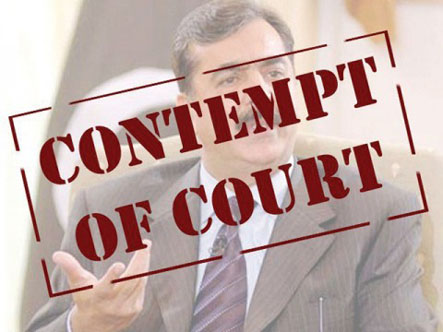
Pakistan’s embattled Prime Minister Yousuf Raza Gilani said Thursday he would rather go to jail than obey a court order and ask Switzerland to re-open graft cases against the president.

Gilani’s remarks revive speculation that he would rather risk losing his job than capitulate in a two-year showdown with the judiciary that culminated last month with him being charged with contempt by the Supreme Court.

He has always insisted that President Asif Ali Zardari is immune from prosecution as president and says the cases against him are politically motivated.

“If I write a letter it will be a violation of the constitution, which is treason and which carries the death sentence,” Gilani told PhD students in central Punjab province, with a few in the audience shouting “do not write, do not write”.

“If I don’t write, I will be convicted for contempt, the punishment for which is six months’ imprisonment,” Gilani said. “It’s better to face six months’ imprisonment than face the death sentence.”

Pakistan’s top court last week ordered Gilani to ask Switzerland to reopen corruption cases against Zardari by March 21.

It was the first time the court asked Gilani personally to write to the Swiss. It previously addressed repeated demands to the government since revoking in 2009 an amnesty freezing legal proceedings against key politicians.

Zardari and his late wife, former premier Benazir Bhutto, were suspected of using Swiss accounts to launder about $12 million in alleged bribes paid by companies seeking customs inspection contracts in the 1990s.

Playing to the gallery, Gilani asked the students in Bahawalpur district whether he should write the letter, to which the audience shouted: “No, no.”

“Ok, we will send your message to the court and tell them that they should charge parliament with contempt of court because parliament has given immunity to the president. All heads of state all over the world have this immunity.”

Zardari is so tainted by corruption allegations that he is nicknamed “Mr 10 Percent”. He has already spent 11 years in jail in Pakistan on charges ranging from corruption to murder although he has never been convicted.

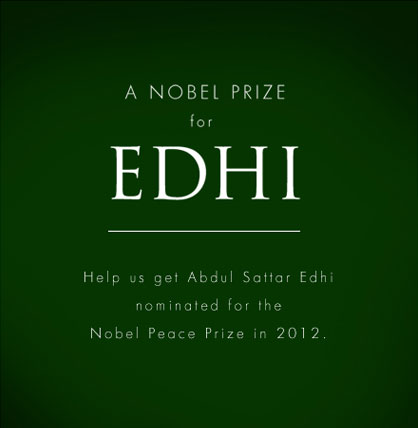
A Nobel Prize for Edhi

Pakistanis for Peace and Manzer Munir cordially and humbly request you to please sign this petition to nominate Abdul Sattar Edhi for the Nobel Peace Prize.

The Nobel Peace prize is an annual prize awarded to individuals who have made formidable contributions to the pursuit of peace and have, through their work, changed the world for the better.

As the founder of Pakistan’s largest welfare organization, the Edhi Foundation and trust, Mr Abdul Sattar Edhi embodies the spirit of this prize, and is a deserving candidate for this honour. He has single-handedly served countless Pakistani’s and has left a lasting impact on his fellow countrymen and the world.

Quite simply, there has never been anyone more deserving of the Nobel Peace prize in its entire history than Mr Abdul Sattar Edhi. Please help us get him his dues by having him finally nominated this year.

Please sign this petition to show your support for the nomination of Mr.Edhi for the 2012 Nobel Peace Prize.


Security Forces in Kashmir Charged With Rights Abuses

By Riyaz Masroor for The BBC

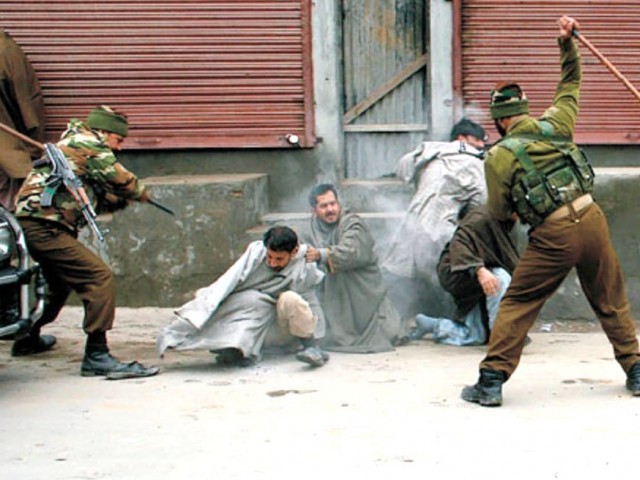
The authorities in Indian-administered Kashmir have launched more than 400 cases of alleged human rights abuses against security forces personnel. The region’s minister for internal security released the figures in the Jammu and Kashmir legislative assembly.

Kashmiri officials want to revoke the Armed Forces Special Powers Act, which prevents prosecution of security staff. There has been a rebellion against Indian rule in divided Kashmir, which is also claimed by Pakistan.

Thousands of people have been killed in the region since the rebellion began in 1989, though violence has dropped off recently. India’s defence ministry has resisted moves to revoke the Armed Forces Special Powers Act (AFSPA).

According to the state government of Indian-administered Kashmir, 444 soldiers, police and security officials have been charged in the past three years.

Nearly 300 cases have been seen in local courts, the government said on Monday in a written response to the Jammu and Kashmir assembly. Human rights activists say the Indian authorities are forcing the Kashmir government to move slowly on these cases.

Kashmiri officials have been pleading with Delhi to scrap the AFSPA so they can proceed with prosecuting security officials against whom cases are pending.

But army officials say it is needed to prevent militant groups based in Pakistan from focusing their resources on Kashmir.

Pakistan Wins Its First Oscar

By Manzer Munir for Pakistanis for Peace

Pakistan won its first Oscar Sunday night when director Sharmeen Obaid Chinoy’s film, Saving Face, won at the 84th Academy Awards at the Kodak Theatre in Los Angeles, California.

The film was directed by Daniel Junge and Pakistani born Sharmeen Obaid Chinoy and won in its category for the Best Documentary (Short Subject), making it the first win for Chinoy and for Pakistan. Earlier in the evening, Asghar Farhadi of Iran won that country its first Oscar when his movie, A Separation, won in the Best Foreign Language Film category.

Sharmeen’s film, Saving Face, follows London-based Pakistani plastic surgeon, Dr Muhammad Jawad, on his travels to Pakistan where he performs reconstructive surgery on survivors of acid violence. The short film features two women who were attacked by acid and their struggles for justice as well as healing. It is estimated that over 100 such attacks occur each year in Pakistan and many more are feared unreported as under-reporting of this ‘acid violence‘ due to the many inequalities that women face in Pakistan.

Sharmeen Obaid-Chinoy earlier won an Emmy for her documentary, Pakistan: Children of the Taliban in 2010. “To all the women in Pakistan working for your dreams, this is for you”, Sharmeen said at her acceptance speech Sunday night in front of the packed star studded audience in the Kodak Theatre.

It is hoped by many in Pakistan that this Oscar win will bring more attention to the plight of women in their beleaguered country.

Pakistan is a Nation at Odds With Itself, U.S.

By Stephen Magagnini for The Sacremento Bee
KARACHI, Pakistan — On a moonlit Thursday night in February, a television network executive hosted an elegant affair for journalists and diplomats at his villa above the Arabian Sea.

Karachi’s privileged dined on lamb, shrimp, chicken, mutton and fettuccine in mushroom sauce, and were surprised by a quartet of wandering minstrels, soulful Sufi poets who serenade for their supper, uncorking ballads about love.

On the south side of this city of 18 million, a group of Afghan refugees, who scrape out a living collecting cardboard and other recyclables in a slum straddling a swamp of open sewage, were mopping up gravy with roti – Pakistani bread.

About 900 Afghans live in this fetid slum, down the street from poor Pakistanis and water buffalo. They earn about $60 a month and survive on bottled water, chewing tobacco and roti.

“We’re happy in Pakistan,” said 33-year-old Shaezhad, leader of a cardboard collection station. “We get food and respect.”

At the party across town, talk-show hosts and other Pakistani elites blew cigarette smoke into the faces of U.S. journalists, criticizing U.S. foreign policy and the toll the war in Afghanistan has taken on their country.

Many Pakistanis resent American aggression in the region and want more respect from U.S. policymakers, but they don’t hold individual Americans responsible. Yet everywhere we went, we were held to answer for U.S. wars and Americans’ deep misunderstanding of Pakistan.

“You are arrogant, playing video games with our lives,” Abdul Moiz Jaferii, political analyst for CNBC Pakistan, said over lunch one day in Karachi. He was referring to U.S. drone attacks that have killed Pakistani and Afghan civilians.

“And we hate America because the U.S. has always been the biggest, closest ally of the military dictators. You have done nothing to help democracy.”

The impact of the war in Afghanistan has permeated nearly every pore of this country of 180 million. More than 2 million Afghan refugees have fled to Pakistan, and some have brought a culture of violence. Since 9/11, 35,000 Pakistanis have been killed in terrorist attacks by suicide bombers and other war-related violence, according to Pakistan’s intelligence agency. The victims include 6,000 soldiers and 29,000 civilians.

The unpredictable violence and the kidnapping of foreign workers have created a climate of fear in this country. We weren’t allowed to visit villages outside urban areas, where 40 percent of Pakistanis live. Two shotgun-wielding security guards protected our buses in Islamabad, Lahore and Karachi. We entered our hotels through metal detectors and were rarely allowed to interact with average citizens in public places.

Pakistan – strategically located between Afghanistan, India, China and Iran and influenced by Saudi Arabia – remains an enigma to many Americans, who aren’t sure whether it’s friend or foe, democracy or military dictatorship.

Pakistan has provided critical support to NATO troops in the Afghan war – drones are launched from here, NATO supplies are sent through this country, and Pakistani troops have helped recapture terrorist strongholds along the volatile Afghan border.

But distrust of the United States in the wake of deadly drone attacks and the deaths of 24 Pakistani soldiers in a cross-border battle in November is such that rather than calling for more U.S. aid to build needed power plants, schools and hospitals, a growing number of Pakistanis want nothing to do with the United States. The government of Punjab – Pakistan’s most powerful state with about 90 million people – has decided to reject U.S. aid.

The killing of Osama bin Laden by U.S. Navy SEALs in Abbottabad in the heart of this country embarrassed and angered the Pakistan military and made Americans question why bin Laden was allowed to live in essentially a resort town. Some U.S. politicians have called for an end to the $18 billion in financial aid pledged since 9/11.

An Islamic republic?

Some of the world’s largest, most beautiful mosques are here, and to celebrate the Prophet Muhammad’s birthday on Feb. 4, 10,000 people named Muhammad gathered in prayer in Karachi.

We saw few women wearing hijabs, or head coverings, except those at Islamabad’s Faisal Mosque, which can hold 10,000 people for Juma, or Friday prayer.

Professional women drive cars, dress like their counterparts in U.S. cities and run government ministries, clinics and newsrooms. Women, who constitute 52 percent of the population, are increasingly getting advanced degrees. There’s a Pakistani proverb: “Every girl who goes to university gets a husband.”

Despite Islam’s ban on liquor, at a party in Islamabad guests of both sexes repaired to a speakeasy in the basement to drink wine or Johnny Walker Black and smoke cigars.

Though most marriages are still arranged, as many as 20 percent are “love marriages,” said Samina Parvez, director general of the government’s external publicity agency. “The divorce rate is also increasing – it’s about 10 or 15 percent,” Parvez said. “The majority of us are not practicing Muslims.”

Kamoran Sani, sales and marketing director for the Sheraton Hotel in Karachi, declared, “What you’ve heard about the Islamic Republic of Pakistan’s a big farce. There are orgies, voyeurs’ lounges, raves.”

A diverse nation

Pakistan didn’t become a nation until the British sliced India into Muslim and Hindu majority states in 1947. Pakistan – an Urdu acronym for Punjab, Afghania, Kashmir, Sindh province and Baluchistan (“stan” means nation) – varies wildly from region to region.

“There is no such thing as Pakistan,” Jaferii said. “First comes your family, then your clan, third your region, fourth your province – the nation comes a distant fifth.”

Much of rural Pakistan is a feudal society dating back to the 13th century. Mullahs, or religious leaders, still invoke blasphemy laws exacting punishment against those accused of insulting Islam. Last year, the governor of Punjab was killed by his bodyguard for criticizing the law as he sought a pardon for a Christian woman sentenced to death.

But Pakistan has tremendous religious and ethnic diversity. Muslims include Sunnis, Shiites, Ismaelis, Ahmadis and Sufis – each practicing their own brand of Islam. At Lahore University of Management Sciences, I chatted with Muslims, Hindus and Christians who were all friends.

From the Sufi love poems to Pashtun folk songs about social justice, music plays a key role in Pakistani identity.

In the center of Karachi there’s a Catholic church – St. Patrick’s Cathedral, built by the Jesuits in 1931. There’s a Jewish cemetery. Sikhs worship throughout Pakistan. The ancient city of Taxila was occupied by Alexander the Great and reflects Persian, Moghul, Buddhist and Christian traditions.

Pakistan’s future

Sixty percent of Pakistan’s population is under age 30; half is under age 20. Half the kids haven’t been to school, and fifth-grade students are reading at a second-grade level, said Nadeem ul-Haq, deputy chairman of the government’s planning commission.

“We have 2 million kids a year entering the labor force. What are these kids going to do?” ul-Haq said. There is no building boom to provide jobs, and foreign investments have been scared away by terrorism.

“Entrepreneurship is the key thing we need to focus on,” he said. “Overseas Pakistanis have been very entrepreneurial, sending back $13 billion a year to their poorer relatives.”

From 7-Elevens to Silicon Valley firms and venture capital funds, ex-pat Pakistanis are thriving in the United States. The 500,000 Pakistanis in the United States, including 100,000 in California, send $100 million a year to charities in Pakistan, said Ahson Rabbani, CEO of I-Care, which connects donors with 30 nonprofits.

In Northern California, Pakistanis raised more than $100,000 for Pakistani flood relief efforts spearheaded by cricket star Imran Khan, who may lead the country if his party wins the next election. Khan has gained credibility by building a cancer hospital for the poor in honor of his late mother. His party includes a women’s wing that has direct access to him.

Philanthropy is playing a growing role in Pakistan, financing schools in poor villages and slums. The Citizens Foundation is educating 100,000 students.

“I mentored six girls,” said Karachi journalist Samia Saleem. “One was 13 and said she didn’t want to get married – she wants to be a teacher.”

Ali Shah Haider, 17, wants to be a commercial pilot. “I sleep from 2 p.m. until 4:30 p.m., then go to work at the textile factory from 8 p.m. to 5 a.m. to support my family – there are 12 of us. I do my homework between shifts.”

A nation’s dreams

Though life seems cheap in Pakistan, the people are upbeat survivors who often describe life as bo hat acha, which means “great!” in Urdu, their main language.

Last year 1,575 people were killed in Karachi, where 2 million weapons are in circulation, said Francisco Quinones of Arcis International Security. A doctor was killed in Karachi the day before we landed. Violence has been blamed on the Taliban, rival political gangs, Sunni and Shia militants, rogue security forces, and Afghan refugees.

Some refugees have been recruited by the Taliban. Others like Shaezhad, who collects recyclables in the slums of Karachi, are glad to be alive under the green and white crescent flag of this country.

Still, he wants to go home to Afghanistan. “We want our land back, we want to live with respect and we want employment.”

Azhar Abbas, the managing director of Geo TV news who hosted the party in Karachi, said that “democracy is taking hold” in his Pakistan despite the violence many here believe followed the U.S. war on terror.

The business editor of daily newspaper the News, Amir Zia, said the United States can still play a positive role in Pakistan. “If Americans pull out without getting the job done, the Islamic extremists will say it’s a victory and will become much more organized.”

But at the National Defense University, business and technology expert Bilal Munshi called Pakistan “a psychologically scarred nation suffering from a mass form of PTSD (post-traumatic stress disorder).”

If the 4 million young people entering the workforce each year get jobs, “we will be a power … but if they don’t see a future they’re going to pick up the gun, and you’re going to be in real trouble.”

The U.S. can help develop Pakistani schools, Bilal said, “but don’t interfere in our internal affairs – let us do things our way.”