Posts Tagged ‘ Pakistanis ’

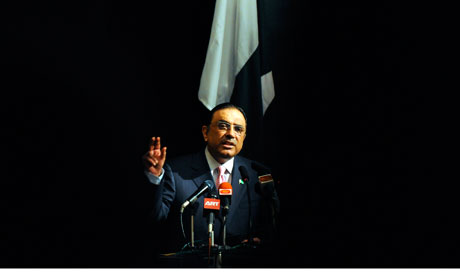
Pakistan President Zardari in Dubai For Treatment as Coup Rumors Intensify

By Saeed Shah for The Guardian

Pakistan’s embattled president, Asif Ali Zardari, has been hospitalised in Dubai with a heart condition, triggering speculation that it could be used as an excuse for him to step down amid growing pressure from the military.

A government adviser said Zardari had suffered a “minor heart attack”, but this was at odds with the official spokesman for the president, who said the president had gone for routine tests for a pre-existing heart condition.

Rumours of a coup or a resignation forced by the military consumed the media and the internet, fuelled by a report in Foreign Policy magazine that said Zardari was “incoherent” on Monday night during a telephone conversation with Barack Obama.

Zardari’s son and political heir-apparent, Bilawal, met prime minister Yousaf Raza Gilani in Islamabad, adding to media hysteria about imminent change. Bilawal is chairman of the ruling Pakistan Peoples party.

The speculation hit a receptive, febrile political atmosphere, rocked by a diplomatic scandal and the recent jolt to relations with the US over the deaths of Pakistani soldiers at a border checkpost.

Pakistan has been ruled for half its existence by the military, and the armed forces have pulled the strings the rest of the time, meaning that the threat of coups are ever present .

Zardari’s aides said he would not resign. The president is deeply unpopular with Pakistan’s military establishment, which is widely believed to be behind repeated attempts to oust him.

“He had a minor heart attack on Tuesday. He flew to Dubai where he had an angioplasty. He’s in good health now. He will come back tomorrow. There’s no question of any resignation,” Mustafa Khokhar, the government’s adviser on human rights told the AFP news agency.

However, Farhatullah Babar, the president’s spokesman, dismissed media speculation, saying “Zardari is in a Dubai hospital for medical tests and checkup as planned”.

The president is under pressure from the “memogate” scandal in Pakistan, where he is accused of being behind a written offer delivered to the US military leadership in the days after the raid on Osasma bin Laden in May this year.

The anonymous memo offered to rein in the Pakistani military, in return for US support. Pakistan’s former US ambassador and close Zardari aide, Husain Haqqani, has already been forced to resign over the issue and faces possible treason charges.

Ali Dayan Hasan, of Human Rights Watch, the international campaigning group, warned against any military intervention. “Constitutional rule of law must be followed and civilian supremacy must be maintained,” he said. “Governance must be through genuine periodic elections.”

We Are Free to Choose Peace

By Ethan Casey for Dawn.com

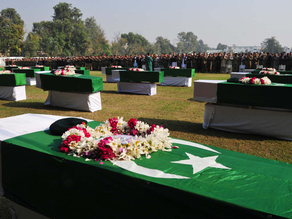
I was planning to devote this column to Memogate and Ambassador Husain Haqqani’s resignation, then I woke up one morning to learn that the topic had been rendered quaint by a Nato cross-border attack killing two dozen Pakistani soldiers and bringing the already fragile (not to say ostensible or notional) alliance between Pakistan and the United States very close to the breaking point. Then I realised that the two topics are aspects of a larger one, indeed of the twin elephants in both societies’ living rooms: the damage done when a military establishment becomes too powerful and unaccountable.

The only time I’ve ever met Husain Haqqani was at a seminar at Harvard University in 2006, organised by the journalist and activist Beena Sarwar. He wasn’t yet Ambassador to the US; Musharraf was still president. Most of the discussion was, I felt, preaching to the converted among elite-class Pakistani liberals about how the military was the problem and the solution was democracy in the form of elections and civilian rule. I’m not Pakistani, but I was an invited panelist at the seminar, so I took the liberty of challenging that consensus. Recall, I said, the sorry tit-for-tat excuse for democracy that Benazir Bhutto and Nawaz Sharif and their undemocratic parties inflicted on the country throughout the 1990s. That rivalry’s personal vindictiveness and pettiness, I asserted, did a lot of damage to the credibility of civilian leadership. Was it really clear that civilian rule was preferable to military rule under Musharraf?

For my pains I was, as I remember it, ganged up on by Husain Haqqani, the stern and formidable historian Ayesha Jalal, and Ayesha Siddiqa, whose book Military Inc. was about to be published. Haqqani in particular accused me of being “merely anecdotal,” meaning that the foibles of civilian politicians were incidental, whereas the military was a problem institutionally and structurally.

I still believe that my point was well taken, because there’s much that elected leaders can and should do to claim political space and assert their own authority, even – especially – if they’re being besieged or undermined by the military. If you’re elected to lead, you must accept the responsibility to do just that, and you must demonstrate courage and personal character in disdaining consequences to yourself when necessary. And I’m a reporter; merely anecdotal is what I do. But Haqqani was all too right – wasn’t he?

I’m aware that conspiracy theories have been flying about the notorious memo’s provenance. Like most conspiracy theories, they’re beside the point. It doesn’t matter whether Haqqani wrote the memo himself or was framed by the ISI; the result is the same. And the question to ask is Lenin’s: Who benefits?

A.J.P. Taylor (among many others) was right to point out that the armed forces are a fundamental institution of any state. But if the state is going to serve the interests of anyone else, the armed forces must be subject – and obedient – to civilian authority. This is what the authors of the US constitution understood in the 18th century, when they made the president the commander-in-chief of the armed forces. And it’s what President Truman understood when he fired the insubordinate General Douglas MacArthur in 1951, even though MacArthur was more popular with the American public at the time than Truman himself.

But Americans should be anything but self-congratulatory about such things. President Eisenhower, himself a retired general, was not only prescient but brave and patriotic when he took the occasion of his leaving office in 1961 to warn, in a rightly famous nationally televised speech, that a “military-industrial complex” (he coined the phrase) was poised to dominate America’s public life and economy. Half a century later America is hip-deep in the muck of Afghanistan, and – in addition to the death and destruction in Afghanistan itself and in Pakistan – the only Americans who are benefiting are the military itself and the shareholders of the companies that supply the war effort with everything from “contractors” (mercenaries) to drones to cheeseburgers for the troops. Military Inc., indeed.

Which brings us to the cross-border attack. Maybe Nato mistakenly or aggressively attacked over the border; maybe Pakistani troops fired first. Who knows? The New York Times has published a de rigueur, pro forma editorial urging an inquiry. Whatever the truth, it doesn’t matter, because the only people who gain from such an incident are the people who gain from war, and that’s not you or me. It’s also not the soldiers on all sides who are being killed. If I were Pakistani I would be furious, as I know many Pakistanis are, at the contempt for sovereignty that the attack shows. At the same time, we know that the Pakistani establishment is duplicitous. So where does that leave you and me? Does it help anyone if I claim your establishment is more duplicitous than mine, and vice versa?

Our two countries have arrived at a depressing and discouraging pass, both in relation to each other and internally. The exigencies of “defense,” which is a euphemism for war, have brought us here. As individuals, we feel (because we are) largely powerless to affect the course of events. As human communities there’s more we can do, as the Occupy Wall Street movement has been showing in America, and as the lawyers’ movement showed in Pakistan.

We’re in this together – and by “we” I mean Americans and Pakistanis. We’re not on opposing sides; we’re on the same side, against the warmongers of both states. And we are free to choose both our actions and our attitudes. As an American, Ken Williams, commented just this week on my Facebook page: “We can live with generosity and trust OR greed and fear. Each choice has outcomes.”

-Pakistanis for Peace group member Ethan Casey is the author of Alive and Well in Pakistan and Overtaken By Events: A Pakistan Road Trip. He can be reached at www.facebook.com/ethancaseyfansand www.ethancasey.com

Why They Get Pakistan Wrong

By Mohsin Hamid for The New York Review of Books
Nearly ten years after the terrorist attacks of September 11, 2001, and the commencement of the US-led war in Afghanistan, the alliance between the US and Pakistan is on shaky ground. The killing of Osama bin Laden by US special forces this May in Abbottabad, Pakistan, has incensed officials on both sides: on the American side because bin Laden’s hiding place appears to suggest Pakistani perfidy; and on the Pakistani side because the US raid humiliatingly violated Pakistan’s sovereignty.

As Ted Poe, a Republican congressman on the House Foreign Affairs Committee, puts it: “Unless the State Department can certify to Congress that Pakistan was not harboring America’s number one enemy, Pakistan should not receive one more cent of American funding.” Dramatic words,1 for Pakistan has been allocated quite a few cents of American funding. Yet this money has bought little love. According to the Pew Global Attitudes Project, only 12 percent of Pakistanis have a favorable opinion of the United States, and only 8 percent would like to see US troops “stay in Afghanistan until the situation has stabilized.” Why might this be the case?

The past decade has been devastating for Pakistan. The country’s annual death toll from terrorist attacks rose from 164 in 2003 to 3,318 in 2009, a level exceeding the number of Americans killed on September 11. Some 35,000 Pakistanis, including 3,500 members of security forces, have died in terror and counterterror violence. Millions more have been displaced by fighting. It is difficult to convey how profoundly the country has been wounded. In 1989, my Lahore American School classmates and I (including children from Pakistan, America, Canada, Sweden, Germany, and Korea) were able to go to the beautiful valley of Swat by bus for a weeklong field trip with no security arrangements whatsoever. In 2009, the battle to retake Swat from Taliban militants involved two full divisions of the Pakistani army and hundreds of casualties among Pakistani soldiers. (Similarly, until a few years ago, there had never been a suicide bombing in Lahore. Now one occurs every three or four months.) The Pakistani government puts direct and indirect economic losses from terrorism over the last ten years at $68 billion.

Of the $20.7 billion in US funding allocated to Pakistan from 2002 to 2010, $14.2 billion was for the Pakistani military. On paper, economic assistance came to $6.5 billion, less than a third of the total. In reality the civilian share was even smaller, probably less than a quarter, for the $6.5 billion figure reflects “commitments” (amounts budgeted by the US), not “disbursements” (amounts actually given to Pakistan). The United States Government Accountability Office reports that only 12 percent of the $1.5 billion in economic assistance to Pakistan authorized for 2010 was actually disbursed that year. Independent calculations by the Center for Global Development suggest that $2.2 billion of civilian aid budgeted for Pakistan is currently undisbursed, meaning that total economic assistance actually received from the US over the past nine years is in the vicinity of $4.3 billion, or $480 million per year. (By comparison, Pakistanis abroad remit $11 billion to their families in Pakistan annually, over twenty times the flow of US economic aid.)

Pakistan is a large country, with a population of 180 million and a GDP of $175 billion. Average annual US economic assistance comes to less than 0.3 percent of Pakistan’s current GDP, or $2.67 per Pakistani citizen. Here in Lahore, that’s the price of a six-inch personal-size pizza with no extra toppings from Pizza Hut.

The alliance between the US and Pakistan is thus predominantly between the US and the Pakistani military. To enter the US as a Pakistani civilian “ally” now (a Herculean task, given ever-tighter visa restrictions) is to be subjected to hours of inane secondary screening upon arrival. (“Have you ever had combat training, sir?”) For a decade, meanwhile, successive civilian Pakistani finance ministers have gone to Washington reciting a mantra of “trade not aid.” They have been rebuffed, despite a WikiLeaked 2010 cable from the US embassy in Islamabad strongly supporting a free trade agreement with Pakistan and citing research showing that such an arrangement would likely create 1.4 million new jobs in Pakistan, increase Pakistani GDP growth by 1.5 percent per year, double inflows of foreign direct investment to Pakistan, and (because Pakistani exports would come largely from textile industries that US-based manufacturers are already exiting) have “no discernible impact” on future US employment.

Perhaps the vast majority of Pakistanis with an unfavorable view of the United States simply believe their annual free pizza is not worth the price of a conflict that claims the lives of thousands of their fellow citizens each year.

Pakistani journalist Zahid Hussain, in The Scorpion’s Tail, his examination of the rise of militants in Pakistan, makes clear that both sides of the alliance between the US and the Pakistani military share blame for the violence currently afflicting Pakistan. A long series of mutual policy missteps led to the present bloodshed.

As Hussain reminds us, the US and the Pakistani military together backed the Afghanistan guerrilla campaign against the Soviet invasion in the 1980s, thereby bequeathing to the world unprecedented international networks of well-trained jihadist militants. For the US, as in its previous alliance with the Pakistani military in the 1950s and 1960s, the primary objective was to counter the Soviets. For the Pakistani military, as ever, the primary objective of the alliance was to lessen India’s superiority in conventional arms. The US gained a proxy fighting force in the form of the Afghan Mujahideen (literally: “people who do jihad”). The Pakistani military gained access to advanced US-made weapons, the most important of which were forty F-16 fighter aircraft: too few, obviously, to resist any full-blown Soviet air assault, but enough to strengthen meaningfully the Pakistan air force against its Indian rival.

With the Soviet withdrawal, America turned abruptly away from the region and washed its hands of its militant cocreations; in the ensuing power vacuum Afghanistan descended into a bloody civil war among former Mujahideen. The US also severed its alliance with the Pakistani military, cutting off supplies of spare parts for Pakistan’s American weapons and withholding delivery of further F-16s that Pakistan had paid for but not yet received.

The outraged Pakistani military was seriously weakened as a conventional fighting force vis-à-vis India. But it now, as Hussain shows, had enormous experience of projecting power through jihadist militants and two opportunities to continue doing so. One was in the Indian-controlled part of Kashmir (the divided Muslim-majority territory at the center of the Indian–Pakistani conflict, claimed in its entirety by both Hindu-majority India and Muslim-majority Pakistan), where an insurgency against Indian troops had broken out in 1989 following a disputed election.

The other was in Afghanistan, where the largely ethnic-Pashtun, Pakistan-backed Taliban were battling the largely non-Pashtun, India-backed Northern Alliance, consisting of Tajiks, Uzbeks, Hazaras, and others. During the 1990s, Hussain writes,

the jihadist movement in Pakistan was focused entirely on supporting the regional strategy of the Pakistani military establishment: to liberate Kashmir from India and install a Pashtun government in Afghanistan.
But following the terrorist attacks of September 11, linked to members of al-Qaeda living under Taliban protection in Afghanistan, the US returned to the region in force and demanded that Pakistan choose sides. President Pervez Musharraf’s subsequent decision to align Pakistan with the US was perceived by many militants as a “betrayal.” Still, Musharraf hoped the Pakistani military’s conflict with its infuriated, jihadist offspring could be circumscribed, that it might be possible “to drive a wedge between the Pakistani militants and the al-Qaeda foreigners.”

This plan, besides denying the extent of the militant threat to Pakistan, was also undermined by US strategy, a strategy that suffered from the outset from what Hussein identifies as two “fundamental flaws.” The first of these was a failure to understand that unless Pashtun grievances were addressed—particularly their demand for a fair share of power—the war in Afghanistan would become “a Pashtun war, and that the Pashtuns in Pakistan would become…strongly allied with both al Qaeda and the Taliban.”

As the US campaign in Afghanistan began, Hussain writes, Musharraf “warned the United States not to allow the [Northern] Alliance forces to enter Kabul before a broad-based Afghan national government was put in place.” But the US ignored this advice, and later, at the Bonn conference of December 2001, Hamid Karzai was installed as chairman (and subsequently president) as Pashtun “window dressing, while the Northern Alliance took over the most powerful sections of the government.”

By backing the Northern Alliance against the Taliban and then failing to include a meaningful representation of Pashtuns in a power-sharing deal in Kabul, the US not only sided with India in the Indian–Pakistani proxy war in Afghanistan, it also elevated a coalition of Afghanistan’s smaller ethnicities above its largest ethnic group, the Pashtuns. Conflict was inevitable, and since twice as many Pashtuns live in Pakistan as in Afghanistan, it was also inevitable that this conflict would spill over the border.

The results for Pakistan were catastrophic. Over the following decade, as Hussain describes in detail, the Pakistani military’s attempts to separate “good” militants from “bad” foundered. Instead, strong networks developed between radical groups in Pakistan’s Punjabi east and those in its Pashtun west. With each move of the Pakistani military against them, the frequency and lethality of counterattacks by terrorists inside Pakistan, on both military and civilian targets, intensified. Pakistani casualties soared.

The only way out of this trap, in which an unwinnable “Pashtun war” threatens to swamp an essential Pakistani program to neutralize militants, Hussain suggests, is to address the second “fundamental flaw” in US strategy: the “failure to appreciate that combating the militant threat required something far more than a military campaign,” namely a “political settlement with the insurgents, requiring direct talks with the Taliban.”

Equally vital, it must be added, is a push toward political settlement between India and Pakistan over Kashmir. This simmering conflict fuels the Indian–Pakistani proxy war between the Northern Alliance and the Taliban in Afghanistan, encourages the Pakistani military’s embrace of militants, and helps subordinate Pakistani civilian governments to the Pakistani military (by allowing a near-perpetual state of security crisis to be maintained in Pakistan). The outlines of a deal on Kashmir were reportedly secretly agreed upon in 2007, but progress has been frozen since Musharraf’s fall from power in 2008 and the terrorist attacks on Mumbai that same year.

As a presidential candidate, Barack Obama acknowledged Kashmir’s central role. “The most important thing we’re going to have to do with respect to Afghanistan is actually deal with Pakistan,” he said in October 2008.

We should probably try to facilitate a better understanding between Pakistan and India, and try to resolve the Kashmir crisis so that they can stay focused not on India but on the situation with those militants.
Once he was elected, however, talk of Kashmir and peace between India and Pakistan receded from President Obama’s official pronouncements, and he embarked upon an Afghanistan policy that might be described as “shoot first, talk later.” US drone strikes in Pakistan’s Pashtun belt intensified, with more—53—in 2009, Obama’s first year in office, than during the entire Bush administration—42—followed by a further sharp increase in 2010, to 118. This unmanned assault was accompanied by a tripling of US military manpower in Afghanistan, which in turn resulted in a fourfold increase in the American fatality rate, with more deaths there of US soldiers in twenty-nine months under Obama (974) than in eighty-seven months under Bush (630).

Obama has now begun to reverse his Afghanistan escalation. His June 22 speech announced that 33,000 US forces (described as those of his “surge,” but more accurately representing the second of his two roughly equal-sized surges) would begin withdrawing this summer and be gone by the end of the next. There will then, he said, be a “steady pace” of further reductions until by 2014 the change of mission “from combat to support…will be complete.” He also stated that “America will join initiatives that reconcile the Afghan people, including the Taliban.”

The following day, in an interview with the Voice of America, Obama acknowledged a US “focus shifted to Pakistan” and declared:

I think what’s happened is that the [US–Pakistan] relationship has become more honest over time and that raises some differences that are real. And obviously the operation to take out Osama bin Laden created additional tensions, but I had always been very clear with Pakistan that if we ever found him and had a shot, that we would take it. We think that if Pakistan recognizes the threat to its sovereignty that comes out of the extremists in its midst, that there’s no reason why we can’t work cooperatively….
The tone of Obama’s underlying message to Pakistan is certainly much improved from that of the US in September 2001, when Deputy Secretary of State Richard Armitage reportedly told Pakistan to cooperate with the imminent US campaign in Afghanistan or be prepared to be bombed “back to the stone age.” But implicit in Obama’s words, and explicit in his actions, is a continued willingness to escalate US armed intervention in Pakistan should Pakistani cooperation prove insufficient. The alliance between the US and the Pakistani military remains, therefore, a relationship between parties viewing one another through gunsights. Each side blames the other for putting its citizens in grave danger, and each is correct to do so.

A gunsight is not, however, the primary lens through which King’s College professor and former London Times journalist Anatol Lieven sees Pakistan. Quite the opposite: his Pakistan: A Hard Country, by far the most insightful survey of Pakistan I have read in recent years, reflects sensitivity and considerable, if clear-eyed, affection. Lieven has traveled extensively through Pakistan (dismayingly atypical for a contemporary foreign commentator), exploring all of its provinces and speaking with Pakistanis from a very broad range of backgrounds. He has also immersed himself in written sources, including pertinent anthropological research produced over a period of some two hundred years.

Pakistan’s is a diverse society, so diverse, in fact, that observers who deal best in generalizations are bound to get the country horribly wrong. Lieven recognizes this diversity and makes it central to his analysis. For him, Pakistan is a place of competing and overlapping clans, sects, tribes, beliefs, and practices. Its society, in order to function, has evolved powerful mechanisms to deal with rivalries inside shared localities. As a result, Lieven argues, Pakistan is characterized by structures—military, bureaucratic, social, political, spiritual, judicial—that are profoundly “Janus-faced,” in the manner of the two-faced Roman deity who gazes and speaks in opposite, contradictory directions. These structures, at once predatory and protective, operate to make the country both (frustratingly for reformers) very difficult to change and (bafflingly for forecasters of its demise) remarkably resilient.2

At the heart of Lieven’s account of Pakistan is kinship, pervasive networks of clans and biradiris (groups of extended kin) that he identifies as “the most important force in society,” usually far stronger than any competing religious, ethnic, or political cause. Several millennia of invasions, occupations, colonizations, and rule by self-interested states resulted in a “collective solidarity for interest and defense” based on kinship becoming paramount in the area that is Pakistan. It now, as Lieven points out, “is a cultural system so strong that it can persuade a father to kill a much-loved daughter, not even for having an affair or becoming pregnant, but for marrying outside her kinship group without permission.” Moreover it is enduring, having survived, for example, “more than half a century of transplantation of Pakistani immigrants to the very different climes of Britain.” It has done much the same in the far less dislocating shift to Pakistan’s cities, sustained, as in Britain, through constant replenishment by newly migrating kin from the countryside.

The effects of kinship on Pakistani politics are profound. Most of Pakistan’s leading political parties are dynastic, including the Bhutto family’s PPP and the Sharif family’s PML-N; even individual members of parliament are often elected on the basis of clan alliances and support. Politics is therefore about patronage far more than ideology. Furthermore, the Pakistani state is relatively weak, collecting taxes that amount to less than 10 percent of GDP.

As a consequence, Lieven notes, Pakistani governments follow a predictable pattern. They are elected (usually as coalitions, Pakistan’s many divisions making absolute majorities exceedingly rare) on general promises of higher living standards for the population and individual promises to particular politicians, families, and districts. The governments lack the resources to keep many of these promises (which are, in any case, often conflicting); their majorities ebb away; they lose power and await another turn.

Yet because of patronage, much of what politicians extract financially from official positions circulates among their kinship groups, which cut across class. Lieven believes this system, while hugely ineffective at driving real change, helps explain “Pakistan’s remarkably low inequality rating according to the Gini Co-efficient, measuring the ratio of the income of the poorest group in society relative to the richest.” By that measure in 2002 “the figure for Pakistan was 30.6, compared with 36.8 for India, 40.8 for the US, and 43.7 for Nigeria.”

The role of religion in Pakistan, a source of much hand-wringing in policy think tanks, is similarly complex. As Lieven points out: “the Islam of the Pakistani masses contains very different traditions.” Moreover, unlike in Saudi Arabia or Iran, where an oil-bankrolled state has tried to impose one monolithic version of Islam, “the Pakistani state is too weak to achieve this even if it wanted to.” Lieven describes the theological divisions among Sunnis sustained by Pakistan’s clan and kinship diversity. The Ahl-e-Hadith, heavily influenced by Wahabism, loathe saintly traditions. The Deobandis may praise saints but object to worshiping them. The Barelvis, Pakistan’s most numerous (and “fissiparous”) school, tend to embrace the intercession of saints with God. Veneration of saints is also central to Pakistan’s Shias. Because saintliness can be inherited, the heads of Pakistan’s powerful landowning “pir families remain of immense political importance.” They can actively create bridges among religious groups and they serve as major bosses in several mainstream political parties, especially the “secular” PPP.

Religiosity thus fuses with kinship networks and politics to reinforce Pakistan’s existing elite. But it also helps marginalize Pakistan’s Islamist parties, drawn primarily from the Ahl-e-Hadith and Deobandi schools, which struggle to capture more than a few percent of the country’s vote. (Away from politics and “hardly noticed outside the country,” Lieven believes Pakistan’s religiosity also softens “the misery of Pakistan’s poor” by contributing to an astounding level of charitable donation, which, “at almost 5 percent of GDP, is one of the highest rates in the world.”)

Throughout his analysis, Lieven rejects the notion that Pakistan fits somehow in a category apart from the rest of the South Asian subcontinent, a sui generis nuclear-armed “failed state” on the verge of collapse. Rather, he writes,

Pakistan is in fact a great deal more like India—or India like Pakistan—than either country would wish to admit. If Pakistan were an Indian state, then in terms of development, order and per capita income it would find itself somewhere in the middle, considerably below Karnataka but considerably above Bihar.

Indeed, even in the violent challenges confronting its state authority, Pakistan is like its subcontinental neighbors: “All of the states of this region have faced insurgencies over the past generation,” Lieven notes, and by comparison to the Taliban conflict in Pakistan, Sri Lanka’s Tamil rebellion “caused proportionally far more casualties” and India’s Naxalite Maoist insurgency controls “a far greater proportion of India.”

Lieven has evident sympathy for the Pakistani military (indeed there are points when, in referring to a uniformed ancestor who served during British rule in what is now Pakistan, one suspects Lieven may have his own feelings of kinship with the Pakistan army). But he is clear about the role the army has played in fomenting militancy, and about the deadly threat militants now pose to Pakistan, especially the potential for far worse bloodshed if the remaining militant groups that have not yet turned on the military and are therefore being kept “in existence ‘on the shelf ‘”—including Pashtun militants focused on Afghanistan and Punjabi militants focused on India—were to do so.

Still, despite the ineffectiveness of much of the Pakistani state, he believes Pakistan’s kinship groups and its stabilizing and antireformist social structures give the country a combination of diversity and toughness that makes successful revolution highly unlikely. He also writes that the Pakistani army, as it demonstrated in the “brutal but in the end brutally effective” operation to liberate Swat from militant control in 2009, is fully capable of routing guerrillas who seize territory when it sets its mind to doing so.

A key question, therefore, is whether the army itself could split. Lieven thinks not (and we must fervently hope that he is right). The army, he explains, is an all-volunteer institution with a strong shared ethos, nationalistic rather than pan-Islamic in outlook, and increasingly vigilant against Taliban sympathizers within—”after all, we are not suicidal idiots,” an officer tells him. The real risk, which Lieven argues must be avoided at all costs, is of “open intervention of US ground forces” in Pakistan. For if ordered by their commanders not to resist, “parts of the Pakistani army would mutiny in order to fight the invaders,” and in such an eventuality “Islamist upheaval and the collapse of the state would indeed be all too likely.”

In passages such as this, Lieven comes close to describing Pakistan as if through a gunsight; but the gunsight belongs to an American decision-maker on the hunt, with Lieven playing the role of preservationist guide. The best Western strategy, he counsels, would “stem from a recognition that Pakistan’s goals in Afghanistan are in part legitimate—even if the means with which they have been sought have not been”—and would “seek a peaceful solution to the Kashmir dispute, despite all the immense obstacles in both India and Pakistan.” For in the end, “not even the greatest imaginable benefits of US–Indian friendship could compensate for the actual collapse of Pakistan, with all the frightful dangers this would create not just for the West but for India too.”

Lieven’s is a vital book, with much wisdom in its advice for the West. But equally importantly, this detailed and nuanced survey offers Pakistanis a mirror in which to look hard at their country and themselves. Pakistan’s resilience is bound up with its resistance to reform, yet reform will be essential for facing the great challenges ahead, including the potentially devastating impacts of climate change on a dry and overpopulated land that is dependent on a single river and its tributaries. Pakistanis, and above all members of Pakistan’s military, would do well finally to reject their country’s disastrous embrace of militants. Pakistan must urgently mend its relationships in its own neighborhood and refocus on taking care of itself. Time is not on its side.

1
Indeed, perhaps more than just words: on July 9 the US announced it was holding back $800 million of military aid for Pakistan. ↩

2
Lieven is careful to point out that his analysis refers only to Pakistan as it has been configured for the past forty years, a territory with “more of a natural unity…[and] a degree of common history and ethnic intertwining stretching back long before British rule,” and not to what he terms 1947–1971’s “freak of history…[with] its two ethnically and culturally very different wings separated by 1,000 miles of hostile India,” a situation from which Bangladesh should have been given a “civilized divorce” but which instead “ended in horrible bloodshed.”

-Mohsin Hamid is the author of the novels Moth Smoke and The Reluctant Fundamentalist. He lives in Lahore, London, and New York. (Article originally appeared late September 2011)

Pakistanis for Peace Editor’s Note– The views expressed in this article are the solely the opinions of the writer and although interesting, do not necessarily reflect nor represent the views of Pakistanis for Peace and or Manzer Munir. 
What Happened on the Border?

As Reported by The New York Times

It’s not clear what led to NATO strikes on two Pakistani border posts this weekend, but there can be no dispute that the loss of lives is tragic. At least 24 Pakistani troops were killed. We regret those deaths, as we do those of all American, NATO and Afghan troops and Pakistani and Afghan civilians killed by extremists.

Washington and Islamabad need to work together, urgently, to ensure that this incident does not destroy their deeply troubled relationship. The United States needs Pakistan’s cooperation — as grudging as it is — to pursue the fight against the Taliban. And without American support, Pakistan’s fragile government will be even more vulnerable to extremist attacks.

So far, Pakistan’s leaders seem most interested in fanning popular anger. The Obama administration and NATO have wasted precious time, allowing the crisis to escalate.

On Saturday, after the first reports, Secretary of State Hillary Rodham Clinton and Defense Secretary Leon Panetta issued a statement offering their “deepest condolences for the loss of life.” We’re not sure why President Obama waited until Monday to add his voice.

We are also puzzled, and concerned, by the delay in opening a full and transparent inquiry. On Saturday, the top American commander in Afghanistan, Gen. John Allen, said he would “thoroughly” investigate the incident. But that was never going to be enough.

It took until Monday for Gen. James Mattis, leader of the Pentagon’s Central Command, to announce a more formal investigation and to name Brig. Gen. Stephen Clark to lead it. The inquiry will include representatives of NATO and General Allen’s team. Significantly, Central Command said Pakistan and Afghanistan would be invited to participate. Islamabad and Kabul should both agree. The panel needs to move ahead quickly and credibly, with full disclosure no matter what it finds.

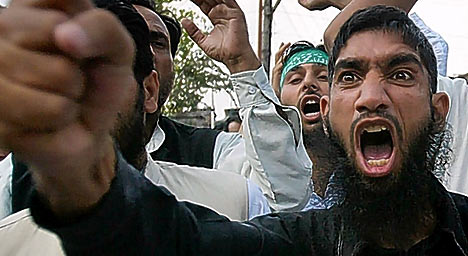
Pakistan’s leaders, as ever, are playing a very dangerous game. On Monday, Prime Minister Yousaf Raza Gilani vowed in an interview on CNN, that “business as usual will not be there.” His government has already shut down NATO supply routes to Afghanistan, ordered a base used for drone strikes evacuated and threatened to boycott a conference on Afghanistan’s security and development. Some news reports are also quoting ordinary Pakistanis demanding that their government retaliate militarily against American forces across the border.

Before things get out of control, Pakistan’s leaders need to lower their rhetoric and make clear that it is in their country’s interest to work with the Americans to find out what happened and ensure it will not happen again.

There are many questions that need to be answered. Who first fired on the American-Afghan force? Pakistan’s army is far too cozy with the Taliban. Were fighters sheltering near the Pakistani outposts? What about Pakistan’s claim that the NATO strikes continued for two hours even after Pakistan alerted allied officials? What needs to be done differently going forward?

The two sides need answers if there is any hope of finding a way back from the brink.

Pakistan’s New U.S. Envoy Faces Tough Task Ahead

As Reported by Xinhuanet

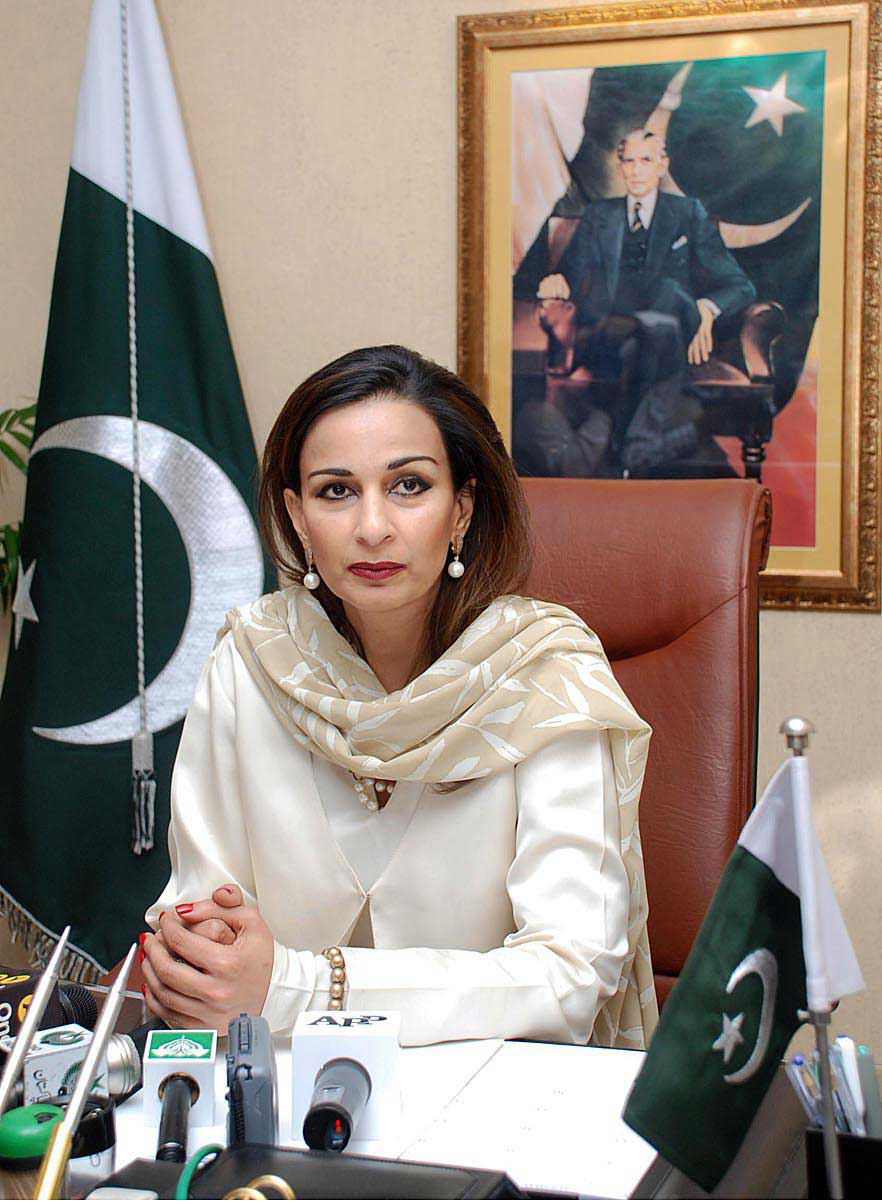
A journalist-turned politician, Ms. Sherry Rehman, will soon proceed to Washington to assume responsibility as Pakistan’s new ambassador where she would face tough task as how to bridge the trust gap with the United States.

Prime Minister Yusuf Raza Gilani appointed Sherry Rehman as Pakistan’s new ambassador in Washington a day after her predecessor Hussain Haqqani resigned over a recent claim by a Pakistani-American business tycoon that he had been asked by Haqqani to deliver the alleged President Asif Ali Zardari’s memo to the former U.S. Chairman of the Joint Chiefs of Staff Mike Mullen, seeking Washington’s help to rein in the powerful army.

Haqqani, who was summoned to Pakistan this week after the memo controversy dragged the country into crisis, was asked by the Prime Minister to quit during a meeting attended by the President, the Army Chief General Ashaq Pervaiz Kayani and Intelligence Chief, Lt. Gen. Ahmad Shuja Pasha in Islamabad on Tuesday.

Sherry Rehman, a former Information Minister and current member of the National Assembly or Lower House of the parliament, is also a central leader of the ruling Pakistan Peoples Party. She was chosen for the key post only because of her association with the ruling party as she has no diplomatic career. Islamabad routinely appoints ambassadors to the United States on a political basis. Several retired military men have also served as the country’s ambassadors to the U.S..

The Pakistani government has designated a political loyalist and the woman ambassador to the U.S at a time when mistrust between the two key allies in the so-called war on terror is at peak. Pakistan and the U.S. cooperation is considered a key to stability in Afghanistan as Washington is mounting pressure on Islamabad to take measures in “days and weeks” to encourage the Taliban, the dreaded Haqqani network and other Afghan armed groups to join the peace and reconciliation process in the war-ravaged Afghanistan.

“It’s like that old story – you can’t keep snakes in your backyard and expect them only to bite your neighbors. Eventually those snakes are going to turn on whoever has them in the backyard, ” US Secretary of State Hillary Clinton said while standing along with her Pakistani counterpart in Islamabad last month in a blunt message to Pakistan.

The first major challenge the Pakistan new ambassador will have to face is how to address to the U.S. concern about the Afghan Taliban and Haqqani network, which the U.S. officials say are operating from Pakistan’s tribal region. Washington seemed to be in haste on the Afghan peace process in view of its troops’ withdrawal, which already began in July and will be completed by 2014.

The Pakistani Taliban is also an issue for the U.S. as the CIA says that they are sheltering Afghan armed militants in the country’s lawless tribal regions bordering Afghanistan. In view of its frustration, the U.S. routinely uses its spy aircraft to hit targets in Pakistan tribal regions, which is also a source of tension in bilateral relationship and the U.S. is in no mood to stop drone strikes despite Pakistan’s criticism.

The new Pakistani ambassador will also have to convince the U.S. administration to unblock the suspended military aid to Pakistan. The U.S. withheld some 800 million US dollars in assistance to the country’s armed forces in July just two months after Osama bin Laden was killed in a U.S. military raid, the U.S. unilateral action had itself worsened relationship. The U.S. has also attached tough conditions with the civilian aid for Pakistan.

Pakistan is nowadays under fire during the Presidential nomination campaign in the U.S. and even on Tuesday Republican presidential candidates attacked Pakistan in their foreign policy debate. The Republican presidential hopefuls ganged up on Pakistan and questioned whether the United States could trust it. Texas Governor Rick Perry called Pakistan unworthy of U.S. aid because it had not done enough to help fight al-Qaida.

Criticism at Pakistan by the Republican hopefuls shows how much tough environment she would face after she assumes the office of ambassador in the coming days. She vowed on Wednesday, a day when she was designated as ambassador, to work for improvement of ties with the U.S..

The United States on Wednesday acknowledged the impending change of guard at the Pakistani embassy in Washington as they praised deposed Ambassador Husain Haqqani for his services and announced their anticipation of working with Pakistan’s new Ambassador Sherry Rehman to continue strengthening bilateral ties between the two countries. In Washington too, the State Department spokesman on Wednesday said the U.S. looks forward to working together with her as both countries “continue to build a strong, cooperative relationship between our two countries.”

The former Pakistani ambassador to the U.S. had also good ties with the U.S. administration and his role was praised by the State Department spokesman, Mark Toner, but even then the relationship had been worst during his tenure. Now Sherry Rehman will not only have to address to the U.S. concern but also to serve the interests of Pakistan where a majority of the people are against the U.S. policies.

Pakistani Envoy Offers to Resign Over Memo

By Salmaan Masood for The New York Times

Pakistan’s ambassador to the United States, Husain Haqqani, has offered to resign amid a political and diplomatic storm in Pakistan over a mysterious memo, which asks for American help in dealing with the Pakistani military and Mr. Haqqani is accused of orchestrating.

Mr. Haqqani denies any involvement with the memo, but he said he offered to resign to end the continuing controversy.

The claims that Mr. Haqqani wrote the memo were made by Mansoor Ijaz, an American citizen of Pakistani origin, who said he was asked to ensure the delivery of the document to Adm. Mike Mullen, who was chairman of the Joint Chiefs of Staff at the time.

Mr. Ijaz described the memo, which he has not made public, as saying that the civilian government in Pakistan was seeking help in preventing a possible military coup in May. The military had just suffered humiliation over the American raid into Pakistan that killed Osama bin Laden.

Mr. Ijaz said that the memo indicated that Pakistan promised, in return, to dismantle a part of its premier intelligence agency — which some American officials have come to distrust.

On Wednesday, Admiral Mullen’s former spokesman, Capt. John Kirby, said that the memo was delivered, but that Admiral Mullen “did not find the memo at all credible.”

“Therefore,” Captain Kirby said, “he addressed it with no one.”

Captain Kirby added that the memo was unsigned and was delivered by someone other than Mr. Ijaz.

Supporters of Mr. Haqqani say that he maintains close contacts with American officials, including Admiral Mullen, and did not need an intermediary to deliver a message, especially one as explosive and diplomatically delicate as what was said to be included in the memo.

The controversy over the memo threatens to further aggravate the differences between Pakistan’s civilian government and the powerful military.

Many people in Pakistan view Mr. Haqqani as too close to the United States because he often pushes for closer cooperation between the countries. Before becoming ambassador, Mr. Haqqani was also a vocal critic of the military, but since taking his job he has sometimes been supportive of the military in speaking with American officials. Many in the Pakistani military view him with suspicion.

The prime minister announced this week that Mr. Haqqani had been told that he needed to return to Pakistan to answer questions about the memo.

Mr. Haqqani said the decision of whether he continued at his job or not rested with President Asif Ali Zardari.

“I do not want this nonissue of an insignificant memo written by a private individual and not considered credible by its lone recipient to undermine democracy,” Mr. Haqqani said in an e-mail.

The news of the memo first surfaced last month when Mr. Ijaz wrote an op-ed article for The Financial Times. At the time, he did not name the diplomat he said he was behind the memo. He only recently said it was Mr. Haqqani.

Thom Shanker contributed reporting from Washington, and Matthew Rosenberg from New York.

New Neurological Test By a Pakistani

By Suhail Yusuf for Dawn.com

A Pakistani scholar has devised a non-invasive way to sense brain pressure which could significantly change the current paradigm of neurological care of those suffering from brain injury or disease.

Monitoring intracranial pressure (ICP) is the most important thing to assess brain injury, hemorrhage (internal blood flow), tumors and other neurological problems. But current methods to measure this pressure are highly invasive – requiring a neurosurgeon to drill a hole in the skull to place a pressure sensor or catheter inside the brain – and are thus restricted to the very severe cases.

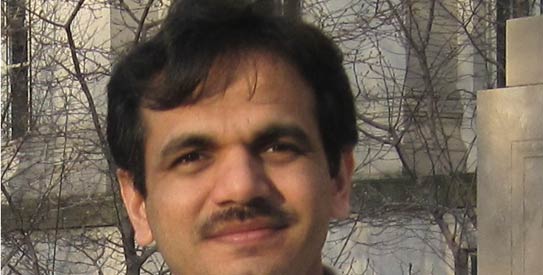
Pakistani scientist, Faisal Kashif has devised a non-invasive technology for ICP monitoring in his PhD thesis at the Massachusetts Institute of Technology, US. The method is based on processing available clinical signals using a mathematical model of relevant physiology. It provides real time estimates of ICP and cerebrovascular impedance, the latter is an indicator of brain’s ability to maintain its blood supply.

“ICP is a key neurological vital sign and is affected in several brain pathologies – even in concussions and migranes – and this non-invasive method could help in monitoring a vastly larger pool of patients,” said Kashif. He further added that unlike the invasive approaches which require a neurosurgical facility, the non-invasive method can also be applied in emergency-care settings where most trauma patients are first brought. Having access to ICP in a timely manner can guide doctors to provide life-saving interventions.

The initial validation studies show that the new method is equally precise as compared to other painful surgery based procedures. Now Kashif and his colleagues are setting up their prototype device for real time monitoring by the doctors, and to run relevant clinical trials. He is also hopeful that the device could be easily developed in Pakistan as well.

The Helen Carr Peake research prize

In April this year, Dr. Faisal Kashif won MIT’s Helen Carr Peake research prize for his doctoral thesis contributions to the field of bioengineering. He has also presented his findings at two major international conferences, American Heart Association’s Stroke 2010 in US, and ICP 2010 in Germany.

His research work was also declared as “Most Innovative Research” at the Innovation Congress 2009, Boston, US. In 2000, he was awarded two Gold Medals at Ghulam Ishaq Khan Institute of Technology (GIKI) and won four years HEC’s overseas scholarships as he was accepted for the doctorate program at MIT, though he only partially used these funds as support became available from MIT’s research, teaching and a medical engineering fellowship, which he was awarded for his proposed research.

A Thesis dedicated to Pakistan

His doctoral thesis entitled “Modeling and estimation for non-invasive monitoring of intracranial pressure and cerebrovascular autoregulation” was a milestone in Kashif’s career. Four years ago, in his Masters thesis, he developed a method for efficient communication through a nonlinear channel, such as the one encountered in satellite and optical fiber links. He dedicated this thesis to his parents and to all the martyrs of independence, which shows his dedication to Pakistan.

“I am proud to be a Pakistani because I know the reasons for its creation. I am very happy to associate my honours to the ideology behind it. I want to do a lot more Insha-Allah, and contribute in all ways I can,” he told to Dawn.com.

Pak Bans Dirty Texting: Just Say No To Monkey Crotch

By Shivam Vij for FirstPost

You cannot SMS ullu chod in Pakistan anymore. Nor can you SMS monkey crotch if you had any reason to do so.

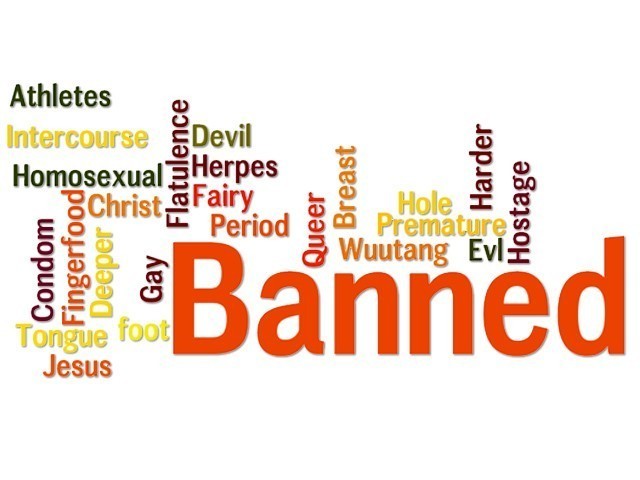
The Pakistan Telecommunication Authority (PTA) has banned 1,795 expletives on SMS, ordering telecom companies to filter out SMS-es containing these offending words with effect from 21 November 2011. The letter includes a list of 1,109 English words, more pornographic terms than expletives, and another 586 Urdu words which are more colourful sexual expletives of the standard South Asian kind rather than the plain garden variety pornography.

A letter from the PTA, dated 14 November and signed by its Director General (Services), Muhammed Talib Doger invokes the “Protection from Spam, Unsolicited, Fraudulent and Obnoxious Communication Regulations, 2009″ to pass the order.

The Pakistan Telecommunication Authority (PTA) has banned 1,795 expletives on SMS, ordering telecom companies to filter out SMS-es containing these offending words with effect from 21 November 2011. Vivek Prakash/Reuters
The Pakistani Twitterverse was on fire last night as the two lists make for hilarious reading. The English list begins with A.S.S. and ends with yellowman. Some words sound harmless (crap and crappy), others bizarre (Jesus Christ, flatulence, murder, monkey crotch). Many are commonly used obscene words (“FUCK YOU”) and care has been taken to account for alternative spellings (biatch, muthafucka). While many spelling variations of ‘masturbation’ are on it, the correct spelling is not. Most words seem to be designed to prevent ‘sexting’ or sending sexually explicit texts (sexy, lick me, do me, S&M, lotion and porn). The list comes down on anal sex as much as vaginal sex. But it isn’t just sex. By banning drunken they perhaps hope to reduce alcoholism.

The Express Tribune points out, “While much of the list contains expletives, a number of words to be banned include medical terms, terms used by particular minority groups, common words from the English language and rap group, Wu Tang Clan.” The ‘medical terms’ include athelete’s foot, breast, intercourse, condom and period. The ‘daily use’ terms include hole, hostage and harder. Words like gay and homosexual don’t surprise but it’s curious why wuutang raised the censor’s hackles.

In fact, thanks to this helpful compendium many Pakistanis are finding their expletive vocabulary enhanced. @UroojZia asked what bumblefuck and ladyboog meant.

@Zakoota said the lists should be required reading in schools to give children the vocabulary to describe politicians and cricketers. With the amount of phrases that include the word “BUTT”, @KhaLeak wondered if Aijaz Butt was banned as well.

The Urdu list has standard gaalis also popular in north India, but many of them may not be familiar to Indians (such as “dani mani fudi chus“). Some are unfamiliar even to Pakistanis. @FurhanHussain said the presence of Punjabi gaalis in the Urdu list amounted to cheating, but others noted that there is no list of Sindhi and Punjabi language expletives, a grievous omission given that the Punjabi language is particularly full of colourful expletives.

“Padosi ki aulaad” doesn’t sound very obscene. There are some 15 spelling and gender variations of ‘kanjar’, a popular Pakistani expletive meaning dancing girls, often also used to describe cross-dressing or men dancing like women. Some of the Urdu ones are quite creative. There are four variations of “Chipkali ke gaand ke pasine” and some are inexplicable (“Nimbu sharbat“, “carrom board”) and some are zoologically bizarre (“ullu chod” or owl fucker). Some are rather vanilla everyday terms like “Buckwaas” (nonsense) and “Bewakoof” (foolish).

There were so many oddball terms in there at first people though it was a spoof. However, Shahzad Ahmad, an internet rights activist who tweets as @bytesforall, said he confirmed with a source at the PTA that the list was real. The Express Tribune story referred to above has been updated to quote a PTA spokesperson who denied knowledge of any letter and said that the PTA “does not take such decisions and only passes on the instructions to licensees once a decision is taken by a ministerial committee.” The PTA, which is also in the news for directing ISPs to block access to 1,71,261 pornographic sites, is said to have convened a meeting this morning to discuss the uproar.

It’s unclear how telecom companies who cannot even filter out commercial spam will be able to handle this new morality burden. But Pakistanis, used to growing online censorship administered by the PTA, took little time to come up with the obvious workaround to the SMS censorship. The offending words are numbered on the blacklist. Many including @SamadK came up with the idea, “Now instead of typing the whole gaali you just need to send the number. Thank you PTA for making is even lazier.”

Many have already started testing it: @KhanDanish tweeted “I hope Imran Farhat 143 doesn’t do 471 in Friday’s match. #Urdu.”

The Urdu list is here and the English list here.

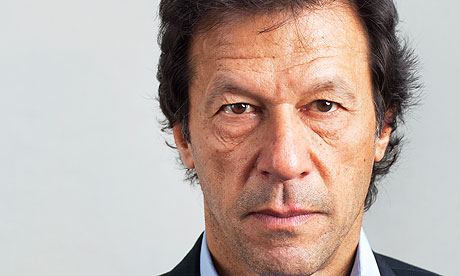
Imran Khan Laps Up Acclaim in Pakistan

Declan Walsh for The Guardian

For a decade Imran Khan has occupied the hinterland, if not quite the wilderness, of Pakistani politics. The cricket legend has won just one seat in parliament – his own – and been scorned by critics as a celebrity windbag at best and a Taliban sympathiser at worst.

But this weekend Khan dramatically transformed his standing at a stroke, bursting onto the national stage with an impressive show of street power that jolted Pakistan’s largest parties and turned received wisdom on its head.

At least 100,000 people gathered to hear Khan issue a rousing call to political “revolution” spiced with strident denunciations of government corruption.

“Declare your assets or face the wrath of the people,” he shouted, drawing roars of approval, in the largest rally for decades in Lahore, Pakistan’s political heartland.

The crowd reflected the vein that Khan has tapped – young, urban and mostly educated Pakistanis who have grown disillusioned by the chaotic politicking and inept governance of the traditional political elite. “It’s an activation of the upper middle class – people who, over the years, haven’t had a voice in Pakistani politics,” said political analyst Mosharraf Zaidi.

In contrast Khan enjoys a reputation for being incorruptible and straight-talking, polished by a glint of fame. Also in Lahore was his ex-wife Jemima, who remains a supporter, and Jennifer Robinson, a London media lawyer whose clients include WikiLeaks founder Julian Assange. “Yes we Khan,” she tweeted afterwards.

The rally set the political scene abuzz with speculation; “Imran’s Lahore rally stuns opponents” read the headline in Dawn. But large questions loom about whether he can transform his acclaim into power.

Despite his claims of a “revolution” against President Asif Ali Zardari, Khan is more likely to hurt Nawaz Sharif, the opposition leader who considers Lahore his political base. Sunday’s rally crowned a wave of smaller yet well-attended rallies across the surrounding Punjab province over the past three months.

“It’s been slowly taking root. People are getting disillusioned, they saw Imran as more dynamic and focused,” said Najam Sethi, a veteran journalist and analyst.

National elections are not scheduled until 2013, although a midterm Senate election next March – which is likely to see the Pakistan People’s party led by Zardari seize control of the upper house of parliament – has caused the political temperature to soar.

Electoral success for Khan would likely fracture politics further – a prospect that would please Pakistan’s spymasters and generals, who have traditionally liked their civilian leaders both shaken and stirred. Khan has faced accusations that his new-found popularity is being quietly boosted by the military, and his Lahore speech was notable for his lack of criticism of the army. Khan denies any link. “I think Imran and the army will get along very well – if he ever comes to power,” said Sethi. He entered politics in 1996 as one of the most loved public figures in a cricket-crazy nation, and the founder of a cancer hospital that remains one of Pakistan’s most respected charities.

But his politics have been more controversial. He supported Pervez Musharraf’s coup in 1999, sided with Islamist mullahs and, in 2009, opposed an army operation against the Taliban in the Swat valley, arguing it was better to talk than fight. He boycotted the 2008 election, a move that relegated him to the chat show fringe of politics.

But in recent years he has steadily built his popularity among young Pakistanis, capitalising on disillusionment with political corruption and anger at US drone strikes in the tribal belt.

His Lahore rally echoed many of those themes. Pakistan wanted “independence, not slavery” in its relations with the US, he said, before announcing that he would be leaving for China hours later. “I am leaving at the invitation of the Chinese government. Friendship with them will be pursued to the fullest,” he said.

But critics said that while his speech was high on inflammatory rhetoric – including gratuitous attacks at some rivals and one diplomat – it was lacking in concrete prescriptions. “His next challenge is to show that he understands Pakistan’s problems – and can formulate policy to deal with them” said Zaidi.

Pakistan, Islam & Radicalism

By Syed Ali Abbas Zaidi for The Huffington Post

I was in Kasur, a small town near Lahore, Pakistan, where the celebrated mystic poet Bulleh Shah is buried. Thousands gathered for the 254th anniversary of his death. Slogans chanted on that occasion would be branded ‘blasphemous’ by extremist organisations in Pakistan.

Neither Hindu nor Muslim,
Sacrificing pride, let us sit together.
Neither Sunni nor Shia,
Let us walk the road of peace.

Bulleh Shah penned these verses challenging religious extremism and orthodoxy that plagued Muslim society hundreds of years ago. He was exiled from his home town and, history has it, he was denied a burial in Muslim cemetery. His advice has clearly gone unheeded as my country is still yet to find peace. Not even the founder of Pakistan, Muhammad Ali Jinnah has been spared being labelled ‘the great infidel’.

Incidentally, the same ilk of religio-political parties who now manipulate public discourse were at the forefront of using religious narrative for political point scoring before Pakistan came into being.

4 January 2011 is a day I cannot forget. Salmaan Taseer, the Governor of Pakistan’s biggest province Punjab, was gunned down by his bodyguard. He was killed for supporting a Christian woman accused of insulting the Prophet Muhammad. He was shot twenty six times.

For the entire week after the killing, I was scared. I don’t remember being in that state of mind since Benazir Bhutto was assassinated. It’s not a very heartening sight to see fellow ‘educated’ countrymen glorifying a murderer and justifying his actions based on ignorant rhetoric. Scores of fan pages popped up on Facebook, many of my friends changed their profile pictures to one of the killer, Mumtaz Qadri, exalting a murderer as hero.

Very few turned out to pay homage to the slain governor in days to come, as ‘liberals’ arranged vigils in his remembrance. Yet thousands poured on to the streets to defend Mumtaz Qadri, his assassin. The media, which has been a primary tool in fanning conspiracy theories in public, had again played a pivotal role in enticing ‘religious’ emotions on this issue.

The killer of Salman Taseer had confessed proudly. The brave judge who sentenced him to death has gone into hiding and will not be re-appearing anytime soon.

7 March 2011. The start of another week of gloom and, if I’m honest, I was ashamed to be a Pakistani. We had arranged a protest to condemn the killing of Shahbaz Bhatti, the Federal Minister for Minorities who was brutally assassinated on 2 March. He was an outspoken critic of Pakistan’s blasphemy laws and the only Christian in the cabinet. Only a few youngsters turned up.

When it comes to numbers, we can gather thousands but the ’cause’ has to be against India, Israel or America. Not many will show up if the demonstration is against radical organisations, or asking for introspection within.

Many who rallied for Gaza in early 2009 were not seen in protests condemning Taliban atrocities in Swat at the same time. Many who burnt down shops in anger at the Danish cartoons of the Prophet Muhammad never stood up for Parachinar, a small town near the border of Afghanistan where thousands have been killed in sectarian violence between Sunni’s and Shia’s.

9 October 2011. I was stuck on the Islamabad Highway, the main road that connects Islamabad with Rawalpindi as it was blocked by flash mobs protesting for the release of Mumtaz Qadri.

Two decades and 40,000 deaths later which includes top politicians, generals and clerics – not many things have changed when it comes to checking radicalism within Islam.

Many attacks on places of worship of minority sects within Islam, recurring violent brawls between followers of different schools of thought, reaction to the murder of Salman Taseer and Shahbaz Bhatti, recent acts of violence in Baluchistan and the tale of Parachinar are chapters in recent history which expose the extent of radicalisation in Pakistani society.

Soon, we as citizens of a country founded because a minority felt discriminated against and followers of the great religion of Islam, need to face up to the challenge of the radical minded and their extremist ideology.

This is a war of ideologies and is inevitably a war that must be fought with opinions and ideas; it must encourage discourse and exchange of reason. It is a war that must form the basic pillar of a new and improved national paradigm for Pakistan

We as a society cannot ignore an emerging threat from radicalism within our ranks, because if it gets too late, there might be no ‘music’ left to face.

Wake up Pakistan

By Najam Sethi for The Friday Times

US- PAK relations have broken down. The United States has “ suspended” military aid and all but closed the Kerry- Lugar- Berman tap of funds for the civilians. Proud Pakistanis have puffed up their chests and vowed to eat grass, if necessary, in order to defend their country’s “sovereignty”. What’s the big deal, they aver, US aid was peanuts anyway, and our traditional friends like China and Saudi Arabia can bail us out of our problems.

To be sure, our relationship with the US has been no small disaster.

In the 1950s, we begged the US to befriend us instead of India, cheerily going along with the US into the Cold War against the USSR when it wasn’t our war at all. In consequence, the military became the dominant theme of our life and wrecked the budding impulse of democracy. Once again, in the 1980s and 2000s, we tripped over ourselves to rent out our services to the US in Afghanistan.

Today we are reaping the terrorist whirlwind of our greed and opportunism.

But a little introspection is in order to prove that we don’t need the US as an enemy because we are our own worst enemies.

More Pakistanis are eating “ grass” now than ever before. The number of Pakistanis below the poverty line has increased from 27 per cent five years ago to 33 per cent in 2011. And this has nothing to do with the US. The growth rate of the economy has fallen from 6.5 per cent five years ago to 3 per cent now. The fiscal deficit is yawning at 7.5 per cent of the GDP today compared to 4.5 per cent five years ago. And this has nothing to do with the US. The Rupee has fallen from 77 to the dollar five years ago to 90 today. General inflation is running at 15% and food inflation at 25%. And this has nothing to do with the US. The tax to GDP ratio is down to 8.7% in 2011 from 11.5% five years ago. And this has nothing to do with the US. Floods continue to devastate the lives and produce of millions of poor people across the country.

And this has nothing to do with the US. Sunni extremists are rampaging, killing Shias. Ethnic parties continue to mow down people in Karachi. And this has nothing to do with the US. Power breakdowns have made the lives of tens of millions wretched and miserable while rendering millions of others jobless.

And this has nothing to do with the US. Instead of rooting for Pakistani nationalism, we are proud to undermine it as Muslims first, or Sindhis, Muhajirs, Baloch, Pakhtun, Punjabi, Seraiki, Hazarajat, Kashmiri, Sunni, Shia, Deobandi, Barelvi. And this has nothing to do with the US. We are counted amongst the most corrupt countries of the world. We have waged four wars with India and lost each of them, in the bargain losing half of Pakistan.

And this has nothing to do with the US. As if this litany of self- induced failures isn’t enough, there is the hypocrisy of double standards to contend with too. Of course, the US has violated our sovereignty by raining drones on FATA. But so have the Afghan Taliban and Al- Qaeda who have established safe havens there too. But we are quick to blast the US and quicker still to pretend that Al- Qaeda doesn’t exist and the Taliban are innocent refugees for whom our traditional hospitality is on offer.

The story doesn’t end here.

The IMF is not welcome. How dare it demand that we tax the rich, plug the bleeding in public sector corporations, stop the theft of power, and spend according to our means. US aid is dispensable.

We don’t need to build dams and reservoirs for managing our natural resources, we don’t need schools and teachers for our children and hospitals for the poor.

Our all- weather friends are China and Saudi Arabia. Never mind that China doesn’t help us much when we are ravaged by earthquakes and floods or when we are short of cash to pay our foreign bills.

NEVER MIND that Saudi Arabia treats our migrant workers like slaves, rents our military to crack down on Shia majorities in Bahrain and exports extremist “ Islam” to our lands.

At the end of the day, who eats grass when we rise to defend our sovereignty? Not our pot- bellied traders and businessmen. Not our golf- playing generals. Not our Defence Housing Society residents.

Not our foreign- asset holding politicians whose kids go to English- medium private schools at home and abroad. Not our self righteous media Mughals who berate our slavish black- skins and white masks. Not our corrupt judges and civil servants. It’s the wretched of the earth, the poorest of the poor, who eat grass.

For too long we have made foreign scapegoats for our own failures and corruptions. It is time to wake up and set our house in order without begging or berating the US.

Caring for Pakistan’s Children

By Allison Zelkowitz for The Express Tribune

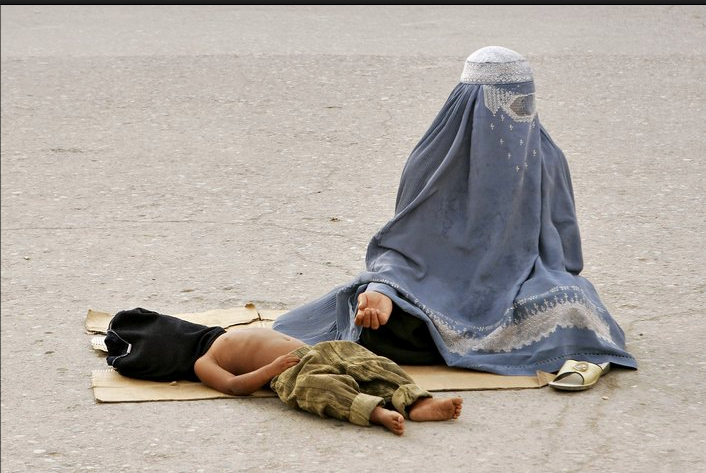
Every day we must each decide who to help, and who to ignore: the woman on the sidewalk begging for change, a neighbour carrying grocery bags up the apartment stairs, a colleague staying late in the office trying to finish a project. Sometimes we offer money, support, or time, and sometimes we walk by. Sometimes caring seems too hard.

These days, it seems that caring for Pakistan’s children is too hard. Millions of children are homeless, hungry, and sick in lower Sindh, which was devastated by flooding over a month ago. But Pakistan is not on the world’s good side at the moment — Osama Bin Laden was discovered here. Media reports on suicide attacks and terrorist networks abound. Relations between the US and Pakistan have soured. With so much negative news, it’s hard to feel good about helping Pakistan. Our hearts go out to the downtrodden and helpless, not those who are tinged with violence and controversy.

But Pakistan’s children don’t know this. They don’t know that if they had been born in a different country, they might not be going to bed hungry. They don’t know that if they spoke Japanese or Creole, rather than Sindhi, they might be sleeping in a waterproof tent, rather than under a plastic sack strung between trees. And they don’t know that, if they had survived last year’s floods, rather than this year’s – they might have clean water to drink.

More than two weeks ago, the United Nations launched a $357 million appeal to provide life-saving relief to over 5.4 million people affected by the floods, including 2 million children. Last year, when a $460 million appeal was issued to help victims of the 2010 floods, 64 per cent of this amount was committed by international donors in 18 days. This year, only 14 per cent has been pledged so far.

For aid workers like myself, the ‘humanitarian imperative’ guides our work — this principle avows that it is the duty of the international community to provide humanitarian assistance wherever needed. Our job is to save lives and reduce suffering when disaster strikes. We are trying to do this in flood-ravaged lower Sindh. Both the government and the humanitarian community in Pakistan have provided food, water, shelter, and medical care to hundreds of thousands of people. Save the Children — the organisation I work for — has reached over 240,000 people in less than four weeks. Yet there are still hundreds of communities who have received no support, and aid agencies will run out of funding soon. What, then, for Pakistan’s children?
In some areas of lower Sindh, it will take months for the flood waters to recede. While they wait, those with livestock will sell off their goats and cattle one by one, for ten to 20 per cent of their value, so they can feed their families. The less fortunate families, those without such assets, will take loans from wealthy landlords, and fall further into debt. Their children will eat once a day, and often only flatbread. They will suffer from skin diseases and diarrhoea, and some will contract malaria. As children become more malnourished, their immune systems will weaken. Soon many will die.

With so much need in the world, we often become deaf to cries for help. But national governments and international donor agencies are not deaf — they read the reports, they know the numbers. And 5.4 million people is no small number — it is more than the populations of Norway, Ireland, and New Zealand. Yet unlike these countries, the 5.4 million people in Pakistan affected by the floods do not have savings accounts or insurance. Right now, most have only make-shift shelters, a few clay pots, and some dirty blankets, and with that they are trying to get by.
Pakistan will likely remain at the forefront of global controversy for some time to come. But its children should not have to pay the price for this. The children in lower Sindh are not militants or politicians. They are like your children — hopeful, genuine, and kind — and they deserve to survive as all children do.

Pakistan’s Power Woes

By Huma Imtiaz for Foreign Policy

Pakistan’s power crisis has become a catastrophe. Power cuts of up to 14 hours a day have become the norm in Pakistan. In Karachi, four patients admitted in the largest public hospital died when the hospital’s backup generator failed after prolonged cuts. Riots have engulfed Punjab, and other major cities across the country, as the government wrings its hands and tries to get the situation under control. Allegations have flown between the leaders of the two major political parties — the Pakistan Muslim League (Nawaz) and the ruling Pakistan People’s Party (PPP). The PML (N) — has accused the PPP of being responsible for the crisis. In turn, the PPP has accused the PML-N of instigating the violence.

Riots over power cuts in the country, known as “load shedding,” have now become a matter of routine. In neighborhoods and cities across Pakistan, hundreds have taken to the streets to vent their anger at the frequent load shedding. This time around though, the PML-N, perhaps to apply more pressure as a political tactic against its rival PPP, has stepped in, and is supporting the protestors.

But as the flurry of allegations continues, the problem at hand grows more serious. Dubbed the circular debt issue, power companies have racked up billions in unpaid dues to petroleum companies, which supply them oil to run their powerhouses. On Sunday, Pakistan State Oil (PSO), tired of waiting for the dues long promised to them, decided to stop the petroleum supply to the power companies, leading to an increase in the already inhumane cuts.

While the Government of Pakistan (GoP) has now released some funds to appease PSO, this is not a long-term solution. The Federal Minister for Water and Power Naveed Qamar responded to the most recent protests by saying that there were no quick fixes, and then turned around and announced that the situation would improve in 24-36 hours. Last week in Washington DC, the Finance Minister of Pakistan Hafeez Sheikh solemnly announced that the government understood the severity of the circular debt issue, and would resolve it in the weeks to come. But with a growing fiscal deficit, and a refusal of the Asian Development Bank to fund programs in Pakistan after the GoP decided to end their International Monetary Fund (IMF) loan program, how Pakistan plans to resolve the circular debt issue is anyone’s guess.

One solution, according to Prime Minister Yousaf Raza Gilani, was that the United States “should help Pakistan solve its energy crisis if it wanted better ties.” The United States has previously said that it is investing in dams in Pakistan to help add to the power grid, and has helped in the reconstruction of existing dams in the country.

However, Pakistan needs to stop looking towards the West for a solution (or a scapegoat), and perhaps redirect its attention to how to fix its problems internally first — perhaps by collecting payment of unpaid bills, or cracking down against those stealing electricity. First, though, it has to deal with the political ramifications of these protests. The PML-N has played its cards right; by blaming the political center of which it is no longer part, it has easily scored political points while the PPP becomes the fall guy — and to an extent, perhaps deservedly so. Pakistan’s government, in turn, can only do so much. Strapped for cash, it barely has the funds to invest in power generation, and in cases where it has, such investments have barely led to a meaningful increase in the electricity grid.

Additionally, in the face of all of these problems, if Pakistan raises power tariffs on those that have been suffering for the last many years, the law and order situation could become even more perilous.

Meanwhile, the Pakistani population continue to take to the streets, hoping that it might eventually lead to the light bulbs burning bright again.

Huma Imtiaz works as a correspondent for Express News and is based in Washington, DC.

Gunmen Attack Shiite Muslims in Pakistan, 12 Dead

As Reported By USA Today

Suspected Sunni extremists opened fire on Shiite Muslims traveling through southwestern Pakistan on Tuesday, killing 12 people and wounding six others in the latest apparent sectarian attack to plague the country, police said.

Sunni militants with ideological and operational links to al-Qaida and the Taliban have carried out scores of bombings and shootings against minority Shiites in recent years, but the past couple weeks have been particularly bloody.

The gunmen who attacked Tuesday were riding on motorbikes and stopped a bus carrying mostly Shiite Muslims who were headed to work at a vegetable market on the outskirts of Quetta, the capital of Baluchistan province, said police official Hamid Shakeel.

The attackers forced the people off the bus, made them stand in a line and then opened fire, said Shakeel. The dead included 11 Shiites and one Sunni, he said. The wounded included four Shiites and two Sunnis.

Sunni extremists carried out a similar attack on Shiite pilgrims traveling through Baluchistan about two weeks ago, killing 26 people. Pakistan is a majority Sunni Muslim state, with around 15 percent Shiite.

Most Sunnis and Shiites live together peacefully in Pakistan, though tensions have existed for decades. In the 1980s and 1990s, Pakistan became the scene of a proxy war between mostly Shiite Iran and Sunni Saudi Arabia, with both sides funneling money to sectarian groups that regularly targeted each other.

The level of sectarian violence has declined somewhat since then, but attacks continue. In recent years, Sunni attacks on Shiites have been far more common.

The groups have been energized by al-Qaida and the Taliban, which are also Sunni and share the belief that Shiites are infidels and it is permissible to kill them. The Sunni-Shiite schism over the true heir to Islam’s Prophet Muhammad dates back to the seventh century.

Lashkar-e-Jhangvi, one of the country’s most ruthless Sunni militant groups, claimed responsibility for the attack in Baluchistan two weeks ago. One of its alleged leaders, Malik Ishaq, was released from prison on bail in July after being held for 14 years on charges, never proven, of killing Shiites.

Ishaq was re-arrested about a week ago after making inflammatory speeches against Shiites in the country. He was not charged but detained under a public order act, which means he can be held for three months.

It’s not clear if Ishaq’s speeches have been connected to the recent wave of sectarian attacks.

CIA Contractor Charged in Pakistan Deaths Arrested in Colorado

By Jim Spellman for CNN

Raymond Davis, who was charged with killing two men in Pakistan as a CIA contractor but was later released, was arrested Saturday after a fistfight at a shopping center in Colorado, authorities said.

Davis was charged with misdemeanor assault and disorderly conduct after allegedly getting into a fight over a parking space at a suburban Denver mall, according to Lt. Glenn Peitzmeier of the Douglas County Sheriff’s Office.

The incident at the Highlands Ranch Town Center began as an argument between 37-year-old Davis and 50-year-old Jeff Maes and then turned physical, Peitzmeier said. Davis was released after posting $1,750 bond, Peitzmeier said.

Davis’ wife, Rebecca, declined a CNN request for comment. Davis was charged with killing two men in Lahore, Pakistan, in January. He was released in March after compensation was paid to their families.

U.S. officials originally said Davis was a diplomat and tried to claim diplomatic immunity but then revealed that he was a CIA contractor.
Davis said he killed the two men in self-defense, though Lahore authorities called the case “clear-cut murder.”