Posts Tagged ‘ United States ’

This is not Prophet Muhammad’s Islam

By Manzer Munir for Pakistanis for Peace

The steady stream of negative news about the twisted way Islam is being practiced around the world seems to never end. In my view, it is not how the Prophet would have wanted his followers to behave.

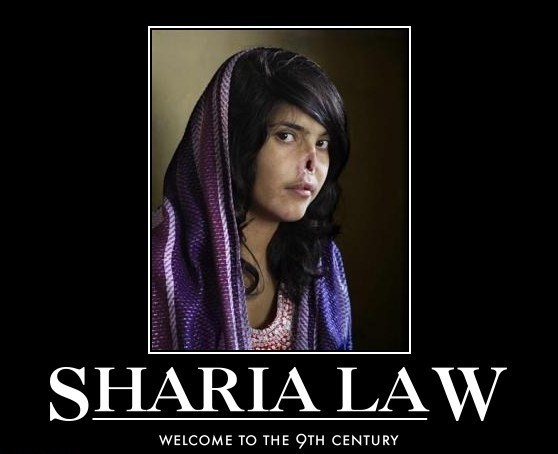
Just when I thought I was beginning to get used to the ridiculousness of the news coming out of Saudi Arabia, where a religious edict is trying to force women there with beautiful eyes to  completely cover up their face in order to stop the temptation of the men, along comes the grim news of Gulnaz  from Afghanistan. If you are not familiar with Gulnaz’s story, let me give you the facts.

Two years ago, in 2009, Gulnaz, a 19 year old single girl who lived with her elderly mother in Afghanistan, was brutally raped by her cousin’s husband. To describe the events, she recalls that on this day, the rapist came into her house when her mother left for a brief visit to the hospital. “He had filthy clothes on as he does metal and construction work. When my mother went out, he came into my house and he closed doors and windows. I started screaming, but he shut me up by putting his hands on my mouth,” she said.

Afterwards, she hid what had happened out of shame and fear, as shockingly there is no difference seen between women who are raped and women who commit actual adultery.  In Afghanistan and in many conservative Muslim countries, any sex outside marriage, whether the guilty party is single or married is considered adultery by the society and the justice system.

A few weeks after her rape, she began to vomit and started showing signs of pregnancy with her attacker’s child. Instead of sympathy and proof of her ordeal, she was charged and found guilty of adultery by the courts and for having sex outside marriage and was sentenced to twelve years in prison. She has already served two years and even gave birth to her rapist’s child, a little girl, in Kabul’s Badam Bagh jail where sadly, her innocent daughter is being raised in captivity alongside the unfortunate mother.

Rather than being freed from jail and given justice for her painful ordeal, the only way out of the dishonor of rape or adultery for her is incredibly only by marrying her attacker. In Afghan culture, and indeed in most Muslim communities, this is believed to be the only way to restore a woman’s honor, by marrying the man who she had sex with, damned be the fact whether it was willingly or unwillingly!

Sadly in many Muslim countries, rape remains a common form of violence against women. In addition, women are often blamed for being the victim of rape. Islam however, views rape as a violent crime against the victim, against society, and against God. The perpetrator who commits a crime is morally and legally responsible for that crime and should be held accountable. The victim, who is an unwilling partner in the sex act and so should bear neither blame nor stigma associated with the unfortunate act. To either ostracize or condemn the victim because she was compelled to engage in sexual intercourse is against the laws of Islam since the victim was an unwilling, and therefore a blameless, participant.

As common as her story and circumstances are for a woman in Afghanistan, the world has only learned of it due to a chance foreign documentary.  Gulnaz’s ordeal came to light because of a dispute between filmmakers and the European Union who hired the crew to film a documentary on the improving situation of women’s rights in Afghanistan and the assistance that the EU has been providing in the better treatment of women in the country. It was only when the documentarians came across her story and the grave injustice being done to Gulnaz and indeed by some accounts, hundreds of women across Afghanistan in similar circumstances, that the EU decided to cancel the project out of fear of harming their relations with Afghan government and institutions. Officially the EU states that it fears for the safety of the women in the film as they could be identified and face reprisals but many human rights organizations believe it is due to the fact that the film shows Afghan justice system in a poor light and the EU is concerned about the Afghan government’s sensitivities to the situation. It is despicable that the EU is more concerned with the sensitivities of the Afghan government rather than fighting for justice for Gulnaz.

Customs such as these in Afghanistan or the recent religious ruling in Saudi Arabia warning women to cover their attractive eyes, or the continued religious persecution of Christians and other minorities in Pakistan through the egregious blasphemy laws as seen in the case of Aasia Bibi, only serve to illustrate to many within and outside Islam the tremendous challenges that exist in what is right and what is logically very wrong and goes against all sense of justice and common sense, not to mention the very essence of Islam.

I am certainly not arguing for making any changes in the Quran or interpretations of religious text or any wholesale revisions whatsoever. That would not only be blasphemous but also counterproductive and unnecessary. Furthermore,  a big part of the beauty of our religion stems from the fact that it has remained unchanged as we Muslims believe that mutations and changes in both the Bible and the Torah necessitated the need for a third Abrahamic religion, Islam,  to arrive some 1400+ years ago to “set the record straight” after all the changes over the years in the two earlier Holy Books. Instead, I believe the only thing that needs to occur is the realization amongst the leaders and countries of the Organization of Islamic Conference (OIC) that in this day and age, there are certain rights and freedoms that should be guaranteed to citizens of all countries of the world and this does not require any changes in the great religion but rather some simple changes in the current laws.

Aristotle once said that “You can judge a nation by the way it treats its most vulnerable citizens”. You could be a Hindu or a Christian in Pakistan, a woman in Afghanistan or Saudi Arabia or a homosexual or transgendered person in Iran, you do not deserve to lose your life or liberty under the guise of religious laws. Allah almighty is a just and fair God in Islam, just as he is in the Christian and Jewish faiths. He most certainly would never condone the treatment of Gulnaz, Aasia Bibi and countless other poor souls who are being mistreated under the banner of Islam.

I am not a religious scholar and nor do I profess to know everything I need to know about Islam, Christianity and many other religions. Some may even question my faith and belief in calling myself Muslim simply because I am asking these tough questions, and in their version of Islam, you never question, you simply obey. Lest they forget, Islam also clearly states to seek knowledge and to be just and fair and respectful of other religions.  “Surely those who believe and those who are Jews and the Sabians and the Christians whoever believes in Allah and the last day and does good — they shall have no fear nor shall they grieve.” (Quran 5:69)

I am however certain that the Prophet Muhammad (peace be upon him) would indeed be very upset with the current state of affairs of most Muslim countries when it comes to morality, religious freedoms,  respect for other religions and the treatment of women. Sadly, I do not see the changes necessary coming into being voluntarily by these nations, I believe it is incumbent of the benefactors of these nations, such as the United Nations, United States, the European Union, China and other trading partners, to push for better treatment of women and religious minorities in many Muslim countries of the world.  It is high time that they pressure these nations into enacting basic rights and freedoms for all people, regardless of their race, religion, gender, and sexual orientation. It must become a precursor to being a part of the civilized nations of the world and in being a member of the world community of nations. Freedom after all is what the Arab Spring is all about!

-Manzer Munir, a proud American of Pakistani descent, is a practicing Sufi Muslim and member of Muslims for Progressive Values, he is also the founder of Pakistanis for Peace and blogs at www.PakistanisforPeace.com as well at other websites as a freelance journalist and writer.

US Hip Hop Troupe Praises Pakistan’s Rich Music

As Reported by Dawn.com

Pakistan has very rich music and through concerts we can open up conversations about different cultures and can make real relationships. The people we have met and worked with in Pakistan are amazing.

These were some of the views members of a United States hip hop troupe ‘FEW Collective’ that is currently visiting Pakistan as part of US cultural diplomacy programme shared with Dawn. The troupe is expected to perform in Lahore on Monday (tomorrow).

The troupe consists of six people — DJ Asad Jafri, Alsarah, a Sudanese-born singer and songwriter, Aquil Charlton, writer and performer, Manal Farhan, a performing artiste, Braveonk Daniel Haywood, dancer, and Jonathan St. Clair, aka Super Inlight, a multidisciplinary performing and teaching artiste.Throwing light on hip hop music and dance, Charlton said this genre of performing arts like rapping emerged in the United States at house parties in the late 1970s and early 1980s.

Charlton said The band ‘FEW Collective’ was formed in 2005 and its objectives included to convey positive message through the hip hop forum, to become the voice of the young and voice of the marginalised wanted to stand as an example for types of positive things that could happen and could bring young people from different backgrounds together and fuse their thoughts.
He said hip hop had four elements i.e. DJ, graffiti, break dance and know yourself, but ‘FEW Collective’ stood for ‘Fifth Element
Warriors’ since we are fighting for the knowledge.

St. Clair said the group had performed in Algeria, Morocco and China while Pakistan was their fourth destination.

Farhan said that Asad Jaffri, also her husband, had visited Pakistan a couple of times since his family belongs to Karachi. She said it’s been great here in Pakistan.

Asad Jaffri is also running a community-based non-profit charity organisation – Inner-city Muslim Action Network (IMAN).

Based in Chicago, IMAN organises works for social justice, provides direct services, and cultivates arts in urban communities.

Since 1997, IMAN has utilised arts as a vehicle for social change and to build bridges among communities and cultures. It also works closely with an international network of over 400 artists. This work includes artistic retreats, developmental workshops, and cultural exchanges. Through national and international efforts, IMAN stresses the importance of arts in creating mutual understanding, connecting cultures, and building community. Delivering a vast array of stories, music, movement and visual arts from rich cultures, IMAN highlights the work of Muslim artists and powerful artistic movements around the world.

The group members told Dawn that they had listened to Pakistani music which was very rich and they had also prepared a song ‘Dam Mast Qalandar’ in fusion with Pakistani instrumentalists.

During their stay in Lahore, they also worked and interacted with students of the BNU and LACAS.

The FEW is an artistic collective that believes in the power of art to engage, educate and inspire. It combines traditional forms of music, dance, and art with the elements of hip hop and theatre to address contemporary issues.

As representatives of hip hop culture, its members acknowledge the evolution of music, visual art, the spoken word, and dance as basic elements of the culture and knowledge as a master element.

Some know them as the Fifth Element Warriors, others relate them as From Every Walk, but they know themselves as always Finding Eternal Wisdom. The FEW specialises in hip hop theatre, concerts, arts workshops, team-building sessions and
leadership development.

Pakistanis for Peace Editor’s Note– This is a great initiative by the US State Department to help foster better understanding between the two countries who have hit a rough stretch after 60+ years of a close friendship and mutual regard between the people of the two nations.

Pakistani Envoy Offers to Resign Over Memo

By Salmaan Masood for The New York Times

Pakistan’s ambassador to the United States, Husain Haqqani, has offered to resign amid a political and diplomatic storm in Pakistan over a mysterious memo, which asks for American help in dealing with the Pakistani military and Mr. Haqqani is accused of orchestrating.

Mr. Haqqani denies any involvement with the memo, but he said he offered to resign to end the continuing controversy.

The claims that Mr. Haqqani wrote the memo were made by Mansoor Ijaz, an American citizen of Pakistani origin, who said he was asked to ensure the delivery of the document to Adm. Mike Mullen, who was chairman of the Joint Chiefs of Staff at the time.

Mr. Ijaz described the memo, which he has not made public, as saying that the civilian government in Pakistan was seeking help in preventing a possible military coup in May. The military had just suffered humiliation over the American raid into Pakistan that killed Osama bin Laden.

Mr. Ijaz said that the memo indicated that Pakistan promised, in return, to dismantle a part of its premier intelligence agency — which some American officials have come to distrust.

On Wednesday, Admiral Mullen’s former spokesman, Capt. John Kirby, said that the memo was delivered, but that Admiral Mullen “did not find the memo at all credible.”

“Therefore,” Captain Kirby said, “he addressed it with no one.”

Captain Kirby added that the memo was unsigned and was delivered by someone other than Mr. Ijaz.

Supporters of Mr. Haqqani say that he maintains close contacts with American officials, including Admiral Mullen, and did not need an intermediary to deliver a message, especially one as explosive and diplomatically delicate as what was said to be included in the memo.

The controversy over the memo threatens to further aggravate the differences between Pakistan’s civilian government and the powerful military.

Many people in Pakistan view Mr. Haqqani as too close to the United States because he often pushes for closer cooperation between the countries. Before becoming ambassador, Mr. Haqqani was also a vocal critic of the military, but since taking his job he has sometimes been supportive of the military in speaking with American officials. Many in the Pakistani military view him with suspicion.

The prime minister announced this week that Mr. Haqqani had been told that he needed to return to Pakistan to answer questions about the memo.

Mr. Haqqani said the decision of whether he continued at his job or not rested with President Asif Ali Zardari.

“I do not want this nonissue of an insignificant memo written by a private individual and not considered credible by its lone recipient to undermine democracy,” Mr. Haqqani said in an e-mail.

The news of the memo first surfaced last month when Mr. Ijaz wrote an op-ed article for The Financial Times. At the time, he did not name the diplomat he said he was behind the memo. He only recently said it was Mr. Haqqani.

Thom Shanker contributed reporting from Washington, and Matthew Rosenberg from New York.

Pakistan is the World’s Sixth Country to Map a Human Genome

As Reported by the Pamir Times

Pakistan has become the world’s sixth country and the first Muslim state to map the genome of the first Pakistani individual. The complete genome mapping was done jointly by the Panjwani Center for Molecular Medicine & Drug Research (PCMD) at Karachi University and Beijing Genomics Institute (BGI) in China.

The details were revealed to the Pakistani media by Prof. Dr. M. Iqbal Choudhary, Director International Centre for Chemical and Biological Sciences (ICCBS), Karachi University and Dr. Kamran Azim of ICCBS at a press conference at PCMD.

Highlighting the importance of the project, Dr. Choudhary said Pakistan had officially entered into the world of genome mapping and the details of the work would be published soon in a research journal. He disclosed that eminent Pakistani chemist and former chairman of the Higher Education Commission (HEC), Dr. Atta-ur-Rehman was the first Muslim and Pakistani whose complete genome was mapped by Dr. Kamran Azim.

“The important work will pave the way for research on heredity diseases, evolution and the over all genetic make up of Pakistanis which now hold a unique genetic pattern as a nation. In the past many people like Dr. Watson and others urged scientists not to reveal their genome publicly but Dr. Rehman has never put any restrictions for his genome draft,” Choudhary added.

The whole process cost US$ 40,000 and was equally contributed by PCMD and BGI.
The blood samples of Dr. Atta ur Rehman were sent to BGI where his genome was sequenced by state of the art gene sequencing machines, however, the technical and research work was mainly done by Dr. Azim.

Genome: The Book of Life

In his marvelous book, Genome, Matt Ridley wrote:

“Imagine that the genome is a book. There are 23 chapters, called chromosomes. Each chapter contains several thousand stories, called genes. Each story is made up of paragraphs called exons, which are interrupted by advertisements called introns. Each paragraph is made up of words called codons. Each word written in letters are called bases, which are Cytosine, Guanine, Adenine, Thiamine or shortly A,G,T,C.”

The remarkable achievement of the first genome mapping of any Pakistani is just like opening the software or book of life of a nation.

Later, in his presentation, Dr. Kamran Azim said the project would help improve the diagnosis of diseases and also help trace back mutations in genetics of the Pakistani nation. Both Dr. Azim and Dr. Choudhary emphasised to establish a national genomic center and Dr. Choudhary said that the center should be established at the PCMD premises because of the knowledge and infrastructure that exists at the center. [Originally published on DAWN in 2011]

China Seeks Military Bases in Pakistan

By Amir Mir for Asia Times

While Pakistan wants China to build a naval base at its southwestern seaport of Gwadar in Balochistan province, Beijing is more interested in setting up military bases either in the Federally Administered Tribal Areas (FATA) of Pakistan or in the Federally Administered Northern Areas (FANA) that border Xinjiang province.

The Chinese desire is meant to contain growing terrorist activities of Chinese rebels belonging to the al-Qaeda-linked East Turkestan Islamic Movement (ETIM) that is also described as the Turkistani Islamic Party (TIP).

The Chinese Muslim rebels want the creation of an independent Islamic state and are allegedly being trained in the tribal areas of Pakistan. According to well-placed diplomatic circles in Islamabad, Beijing’s wish for a military presence in Pakistan was discussed at length by the political and military leadership of both countries in recent months as China (which views the Uyghur separatist sentiment as a dire threat) has become ever-more concerned about Pakistan’s tribal areas as a haven for radicals.

Beijing believes that similar to the United States military presence in Pakistan, a Chinese attendance would enable its military to effectively counter the Muslim separatists who have been operating from the tribal areas of Pakistan for almost a decade, carrying out cross-border terrorist activities in trouble-stricken Xinjiang province.

There have been three high-profile visits from Pakistan to China in recent months; the first by Foreign Minister Hina Rabbani Khar; the second by President Asif Ali Zardari and the third by the director general of the Inter-Services Intelligence, Lieutenant General Ahmed Shuja Pasha.

The Pakistani visits were reciprocated by the September 28 visits to Islamabad by Chinese Vice Premier Meng Jianzhu and Public Security Minister Meng Jianzhu. This was prompted by two bomb blasts in Kashgar city of Xinjiang province on July 30 and 31 in which 18 people were killed.

The explosions provoked senior government officials in Xinjiang to publicly claim for the first time in recent years that the attackers had been trained in explosives in ETIM/TIP camps run by Chinese separatists in the Waziristan tribal regions of Pakistan.

The Chinese allegation was described by many in the diplomatic circles of Islamabad as a clear sign of the growing impatience of Beijing with Islamabad’s failure to control radical groups operating within its borders.

The Chinese charge was made on the basis of a confession by a Uyghur militant arrested by the Chinese authorities. Pakistan swiftly extended all possible cooperation to Beijing against the ETIM/TIP network. “Terrorists, extremists and separatists in Xinjiang province constitute an evil force,” said an August 1 statement issued by the Pakistani Foreign Ministry after Chinese President Hu Jintao rang Zardari to express his grave concern over the growing activities of “terrorists” belonging to the Pakistan-based ETIM/TIP network.

In a subsequent video released on September 7, ETIM/TIP corroborated earlier Chinese claims that it was involved in attacks in Xinjiang in July.

The ETIM/TIP, run by natives of Xinjiang province, a Muslim-dominated region three times the size of France, is fighting against the settlement of China’s majority Han ethnic group in the western province, describing its struggle as a freedom movement.

The ETIM/TIP maintains that the Chinese are a colonial force in Xinjiang province – which it refers to as Turkistan – and emphasizes Islam over ethnicity. Though the ETIM/TIP network on the Pakistan-Afghanistan border has been much weakened in recent years in the wake of the killing of many of its top leaders in US drone attacks, hardcore Uyghur militants are still shuttling between China and Pakistan, mainly because Xinjiang province shares a border with Pakistan.

The ETIM/TIP presence in Pakistan was first confirmed when one of its founding leaders, Hasan Mahsum alias Abu Muhammad al-Turkistan, was killed by Pakistani security forces in South Waziristan in October 2003.

The next one to be killed by the Americans in a drone attack was Memetiming Memeti alias Abdul Haq al-Turkistani, the ETIM/TIP chief, who was targeted in North Waziristan on February 15, 2010. Abdul Haq was succeeded by Abdul Shakoor Turkistani, a Chinese Uyghur, who is well known for his friendly terms with major Taliban groups in Waziristan.

He has taken control of overall command of Chinese and Uzbek militants in North Waziristan, due to his past association with the late Abdul Haq and late Tahir Yuldashev of the Islamic Movement of Uzbekistan.

Beijing believes that the Chinese rebels operating from the Pakistani tribal areas are well-connected to al-Qaeda, which not only trains them but also provides funding.

Thus, Pakistan and China, which have cooperated for a long time in the field of counter-terrorism, have intensified their efforts to nip the terrorism in the bud, especially after the Kashgar blasts.

In fact, it was in the aftermath of the May 2 US raid which killed al-Qaeda chief Osama bin Laden in his Abbottabad hideout that Islamabad started playing its China card aggressively, perhaps to caution Washington against pushing it too hard. Shortly after the Abbottabad raid, Pakistani Prime Minister Yousaf Raza Gillani traveled to Beijing.

Accompanying Defense Minister Ahmed Mukhtar had stated on May 21 that whatever requests for assistance the Pakistani side made, the Chinese government was more than happy to oblige, including agreeing to take over operations of the strategically positioned but underused port of Gwadar on the Arabian Sea on expiry of a contract with a Singaporean government company.

He disclosed that Pakistan had asked China to begin building a naval base at Gwadar, where Beijing funded and built the port. “We would be grateful to the Chinese government if a naval base is constructed at the site of Gwadar for Pakistan,” he said in a statement. Mukhtar later told a British newspaper in an interview: “We have asked our Chinese brothers to please build a naval base at Gwadar port.”

Knowledgeable Defense Ministry sources in Islamabad say that by having a Chinese naval base in the Gwadar area, Pakistan intends to counter-balance Indian naval forces.

However, diplomatic circles in Islamabad say Beijing, which has no military bases outside its territory and has often been vocal in criticizing American moves for operating such bases, first wants to establish military bases in Pakistan, which could be followed by the setting up of the naval base.

Therefore, Chinese Defense Minister Liang Guanglie promptly dismissed (on June 6) suggestions that Beijing was carving out a permanent naval presence in India’s neighborhood.

Answering questions at the 10th Asia Security Summit, organized by the London-based International Institute for Strategic Studies, Liang disclaimed moves to build naval bases at Gwadar and at a Sri Lankan port. Emphasizing his credentials as a member of the Chinese State Council and Central Military Commission, he said:
We will have a very serious and careful study of an issue of such importance to the government and the military like the reported move for establishing naval bases in Pakistan and Sri Lanka. Indeed, we will have exact plans and set up a panel to discuss it if the move were for real. However, I haven’t heard of it.

Asked by Manish Tewari, the Indian Congress party’s spokesman, to spell out China’s core interests in South Asia and the Indian Ocean area, Liang said:
The core interests include anything related to sovereignty, stability and form of government. China is now pursuing socialism. If there is any attempt to reject this path, it will touch upon China’s core interests. Or, if there is any attempt to encourage any part of China to secede, that also touches upon China’s core interests related to our land, sea or air. Then, anything that is related to China’s national economic and social development also touches upon China’s core interests.
The Chinese desire to have military bases in Pakistan is not a new one and has been discussed in the past.

An article published on the official website of the Chinese central government (www.gov.cn) on January 28, 2010, signaled that Beijing wanted to go the US way and set up military bases in overseas locations that would possibly include Pakistan. The obvious purpose would be to exert pressure on India as well as counter American influence in Pakistan and Afghanistan. The article stated:
Setting up overseas military bases is not an idea we have to shun; on the contrary, it is our right. It is baseless to say that we will not set up any military bases in future because we have never sent troops abroad. As for the military aspect, we should be able to conduct a retaliatory attack within the country or at the neighboring area of our potential enemies. We should also be able to put pressure on the overseas interests of potential enemies. With further development, China will be in great demand of military protection.
Analysts say although it might not be politically feasible for the Pakistani government to openly allow China to set up military bases on its soil, Islamabad might allow Beijing the use of its military facilities without any public announcement as a first step.

The Chinese demand to set up military bases in Pakistan has gained momentum at a time when the Indian military leadership is already raising a hue and cry over the alleged presence of People’s Liberation Army (PLA) troops in the Pakistan-administered part of Kashmir as well as in the FANA, which was earlier called Gilgit and Baltistan.

In August 2009, the Pakistan government passed the Gilgit-Baltistan Empowerment and Self-Governance Order to grant self-rule to the people of the area and create an elected legislative assembly. Gilgit-Baltistan thus gained de facto province-like status without doing so constitutionally.

Gilgit Baltistan province borders Pakistan’s Khyber Pukhtunkhwa province to the west, Afghanistan’s Wakhan Corridor to the north, China to the east and northeast, Pakistan-administered Kashmir to the southwest, and Jammu Kashmir to the southeast.

Although the supposed Chinese military presence in Pakistan’s northern areas of Gilgit Baltistan has been a matter of intense speculation in India, it was on October 5 that Indian army chief General V K Singh went public for the first time with the Indian establishment’s assessment of the kind of Chinese presence in the northern areas of Pakistan. “Around 4,000 Chinese including troops of the People’s Liberation Army are present in Pakistan-occupied Kashmir,” Singh told journalists in New Delhi.

However, senior Foreign Office officials of Xinjiang told this writer during a briefing in Urumqi, the capital of the province, that the Indian army chief’s claim was fallacious and must be based on some misunderstanding.

Despite the fact that diplomatic ties between China and India have improved in recent years, they are still at odds over territorial claims from both countries dating back to the India-China border war in 1962.

While India and Pakistan control Pakistan-administered Kashmir (Azad) and Jammu Kashmir states respectively, China claims part of northeastern Kashmir that it says is a part of Tibet. Therefore, Beijing is highly critical of India’s support for the Tibetan spiritual leader, the Dalai Lama, who fled Tibet in 1959 and set up a government in exile in the northern Indian hill town of Dharmsala.

The Indian army chief was not the first senior military official to have talked about the alleged Chinese presence in the northern areas of Pakistan.

In April this year, Northern Army Commander Lieutenant General K T Parnaik, while addressing a seminar in Jammu and Kashmir, said that the Chinese footprint in Pakistan-administered Kashmir was increasing steadily and its troops were actually present along the line of control (LoC) that divides the disputed Kashmir area.

“The Chinese presence in Gilgit-Baltistan and the northern areas of Pakistan is increasing steadily. There are many who are concerned about the fact that if there was to be hostility between India and Pakistan, what would be the complicity of the Chinese. Not only are they in the neighborhood, but the fact is that they are actually present and stationed along the LoC,” Parnaik said.

Zhang Xiaodi, the director general of the foreign affairs office in Urumqi, told this writer in a meeting on October 10 that there is no truth in the allegations leveled by Indian military officials. “There are only Chinese construction teams working in the northern areas of Pakistan on certain development projects being carried out by Pakistan and China jointly. The presence of People’s Liberation Army troops there is out of question.”

At the same time, there are those in the Pakistani Embassy in Beijing who view the Indian army chief’s allegation against the backdrop of the Pakistan army’s recent decision to include for the first time Chinese troops in military exercises along the border with the Indian states of Punjab and Rajasthan; the 101 Engineering Regiment of the PLA took part in exercises with their Pakistani counterparts in August this year.

Analysts say China’s deepening strategic penetration of Pakistan and the joint plans to set up not only new oil pipelines and railroads but also naval and military bases, are enough to set alarm bells ringing in New Delhi and Washington. The repercussions are particularly stark for India because both Beijing and Islamabad refuse to accept the territorial status quo and lay claim to large tracts of Indian land that could come under Chinese sway once Beijing is allowed to establish military bases in Pakistan.

The fact that Gilgit and Baltistan is located in the Pakistani-administered part of Kashmir presents India with a two-front theater in the event of a war with either country. By deploying troops near the LoC and playing the Kashmir card against New Delhi, Beijing is clearly signaling that Kashmir is where the Sino-Pakistan nexus can squeeze India.

Amir Mir is a senior Pakistani journalist and the author of several books on the subject of militant Islam and terrorism, the latest being The Bhutto murder trail: From Waziristan to GHQ.

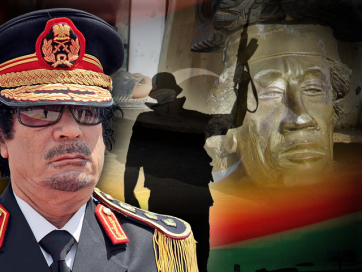
Sharia Law Surprise for Secular-Minded Libyans

By Mary Fitzgerald for The Irish Times

ANALYSIS: The role of Islam could prove to be a contentious issue in the new Libya

LIBYA’S INTERIM authorities formally declared liberation yesterday with soaring speeches that praised their revolution’s victory over tyranny, paid tribute to the fallen and offered clues as to what kind of state might emerge from the ashes of Muammar Gadafy’s idiosyncratic rule.

The long-awaited declaration, made in front of tens of thousands of jubilant Libyans gathered in Benghazi, the eastern city where the uprising against Gadafy began in February, came more than two months after Tripoli fell to revolutionary forces, allowing them to seized control of most of the country.

It ushers in a process agreed by the interim body known as the National Transitional Council which will see the NTC move its headquarters from Benghazi to Tripoli and form a transitional government within 30 days. A 200-member national assembly is to be elected within 240 days, and this will appoint a prime minister a month later who will then nominate a cabinet. The national assembly will also be given deadlines to oversee the drafting of a new constitution – none existed under Gadafy – and the holding of parliamentary and presidential elections.

Already the process of forming a united and representative government promises to be fraught. With Gadafy dead, the fissures that always existed within the revolution, whether along regional or tribal lines or between Islamists and secular liberals, threaten to widen.

Even the fact that liberation was declared in Benghazi, rather than Tripoli, points to friction between leadership figures in the two cities – many of the NTC’s members, especially those from eastern Libya, have remained in Benghazi, the second-biggest city.

The question of who did what, whether during the war of the last eight months or during the four decades Gadafy was in power, will also determine much in the new order.

On Saturday, the de facto prime minister Mahmoud Jibril said progress would hinge on two things. “First what kind of resolve the NTC will show in the next few days, and the other thing depends mainly on the Libyan people – whether they differentiate between the past and the future,” he said. “I am counting on them to look ahead and remember the kind of agony they went through in the last 42 years.” Jibril also warned that Libya needed to swiftly find another source of income because the country had already consumed 62 per cent of its oil under Gadafy.

Those seeking hints as to what the new Libya may look like seized on particular sections of NTC head Mustafa Abdel Jalil’s speech in Benghazi yesterday, in which he went into some detail about the place of Islam in the post-Gadafy scenario.

“This revolution was blessed by God to achieve victory,” Jalil, who is considered devout but moderate, told the crowd. “And we must go on the right path.”

Libya, he said, would be a state where Sharia law would be the “fundamental source” of legislation and any existing legislation that contradicted Islamic principles would be immediately annulled.

It was not the first time Jalil had made such statements, and many other Arab countries have similar constitutional provisions, but Libyans of a more liberal bent may have baulked at what came next.

The new state “will not disallow polygamy” Jalil said, and charging interest will be forbidden. Some Libyans point out that polygamy was practised discreetly under Gadafy, while others interpreted Jalil’s remarks as a practical measure to address the issue of the thousands of women left widowed during the war.

These declarations, though met with cheers from the crowd, will have raised eyebrows among more secular-minded Libyans who would prefer to have such matters decided through a democratic process rather than presented almost as a fait accompli at such an early stage.

The Islamist tint to Jalil’s speech could be interpreted in different ways: it may have been an attempt to undercut the influence of more hardline elements while Libya finds its feet after Gadafy, or a bid to keep the grassroots on board as one of North Africa’s most conservative societies enters what will be a challenging period.

Either way, it shows that questions over what role Islam should play promise to be among the most pressing in the new Libya.

Pakistanis for Peace Editor’s Note– We are happy for the Libyan people for overthrowing a brutal and oppressive dictator. We condemn however his killing and not being brought to justice and the treatment of his corpse to not be treated to Islamic last rites and custom. We are also concerned by the announcement by the revolution’s leadership that Sharia Law will be the new form of law in Libya. This is not acceptable as a secular democracy is the form of government similar to Turkey that must be the model. We urge the US and other NATO benefactors that made the overthrow of Gaddafi possible to insist on a secular democratic government in Libya, otherwise all is for naught.

Karzai’s Pakistan Comment Jolts West

By Dion Nissenbaum for The Wall Street Journal

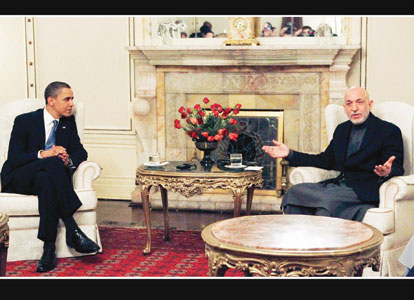
America’s latest attempts to strengthen its relationship with Afghan President Hamid Karzai received an unexpected jolt over the weekend, as the Afghan leader said he would back Pakistan if it went to war with the U.S.

“God forbid, if any war took place between Pakistan and the United States, we will stand by Pakistan,” Mr. Karzai said an interview broadcast Saturday on Pakistan’s Geo television network. “If Pakistan is attacked and if the people of Pakistan needed Afghanistan’s help, Afghanistan will be there with you.”

The prospects for a U.S. war with Pakistan are remote, and Mr. Karzai’s comments were viewed by some Afghan and Western officials in Kabul as a poorly executed effort to blunt his recent angry comments about Pakistan’s support for Afghan insurgent groups. “This is not about war with each other,” said Gavin Sundwall, spokesman for the U.S. Embassy in Kabul. “This is about a joint approach to a threat to all three of our countries.”

Mr. Karzai’s comments came as a surprise to some Western officials in Kabul, who were heartened by the success of last week’s visit by U.S. Secretary of State Hillary Clinton.

In the past, Mr. Karzai has alienated his Western allies with comments suggesting that he might side with the Taliban, or that America could come to be seen as an occupier if its forces didn’t stop killing Afghan civilians.

Mr. Karzai’s latest remarks struck a nerve with some Afghan and Western officials in Kabul who were reminded of the president’s penchant for criticizing the U.S.-led coalition that supports and funds his government. “It was totally careless, unnecessary and, yes, irresponsible,” said one Afghan official. “He hasn’t pleased anyone except, maybe, a few Pakistani generals.”

American officials said, however, that Mr. Karzai’s remarks wouldn’t overshadow Mrs. Clinton’s visit. Mr. Karzai and Mrs. Clinton were united during her trip in demanding that Pakistan stop supporting the Taliban and other Afghan insurgent groups.

Relations between Afghanistan and Pakistan have vacillated over the past year between spells of political chill and attempts at a rapprochement.
Mr. Karzai and the U.S. have sought to pressure Pakistan in recent weeks to clamp down on the Haqqani insurgent network suspected of staging a series of deadly attacks on American and Afghan targets.

Afghan officials also accused Pakistan’s spy agency of involvement in last month’s assassination of Burhanuddin Rabbani, the former Afghan president who had been leading the country’s peace entreaties to the Taliban. Pakistan denied these accusations. Earlier this month, Mr. Karzai unexpectedly flew to New Delhi to sign a strategic agreement with Pakistan’s archenemy India. The move angered Pakistani officials, who viewed it as political provocation.

In the Saturday TV interview, Mr. Karzai repeated his characterization of Pakistan as a “brother” and said Afghanistan wouldn’t let the U.S. or any other country dictate its foreign policy. “Afghanistan is a brother,” he said “But, please brother, stop using all methods that hurt us and are now hurting you. Let us engage from a different platform.” Separately, Afghanistan’s interior minister Sunday evaded an apparent assassination attempt near Kabul.

Officials said a suicide bomber targeted a convoy thought to be carrying Interior Minister Bismullah Khan Mohammadi. But the attacker was shot dead before he could do any harm, and the interior minister wasn’t in the convoy, the Interior Ministry said.
–Ziaulhaq Sultani contributed to this article.

With Gaddafi Dead, The Arab Spring Has Finally Sprung

By Manzer Munir for Pakistanis for Peace

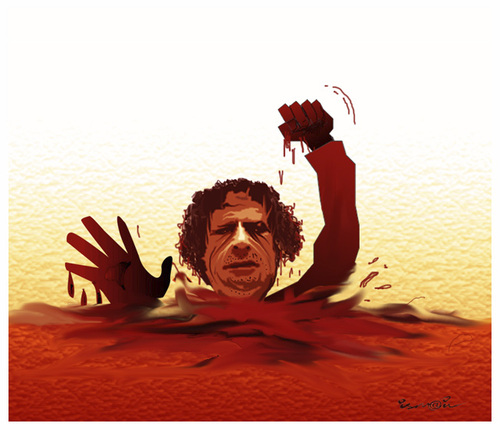
In the end, it does not matter whether Muammar Gaddafi was executed due to an order by members of the Libyan Transitional National Council leadership or whether he was killed at the hands of a vigilante mob in the run up to his capture and death. There is no question that initially there was confusion Thursday when unconfirmed reports out of Libya stated that Gaddafi was captured. However within a few hours news came that he had been killed during a battle between the rebels and forces loyal to Gaddafi . Sure enough, within another hour it was confirmed that Gaddafi was killed as mobile phone videos appeared showing a bloodied Gaddafi dazed and confused as rebels jostled all around him to get a piece of the brutal dictator that they had known for more than 42 years.

Exact details are presently murky in regards to his capture and death but it appears that during a battle in Gaddafi’s hometown of Sirte on Thursday morning, Gaddafi’s convoy was spotted by NATO drone aircraft and surveillance and was reportedly fired upon by French air strike on a road fighter jets killing a few dozen fighters. Gaddafi escaped with a few of his bodyguards and was found hiding in a sewage pipe with a couple of his bodyguards by a huge mob of rebels. Hours later, the world saw footages of a severely wounded Gaddafi being held up and surrounded by rebels begging for mercy. Reports sate that he was shot and killed during the crossfire between rebels and his loyalists. And yet there is a sense that he was executed either by those that captured him or by order of the ruling Transitional National Council.

Regardless of how he was killed, more important questions need to be asked. What happens next in Libya? How will a government be formed for a country that is effectively starting over from scratch? This after all is a country that had been held hostage by a dictator for nearly half a century and it is going to need lots of international assistance in transitioning into having an effective and competent government, one that is far better that what the people of Libya have lived under for so long. And how will the Arab Spring and this momentum affect the tenuous situation in several other Arab capitals dealing with their own unrest and near civil wars.

Gaddafi’s graphic last few days were not unlike those of Saddam Hussein of Iraq. His last few hours being injured and captured hiding in a large sewage pipe must have been a far cry from the life he had led for so long as one of the longest serving heads of state and richest people in the world. Saddam too was found near his hometown of Tikrit as he was hiding like a common criminal in a spiderhole when he was caught. In the last few moments of their capture, neither men could not have believed that their worst fears had been realized and their long reign was coming to an end. More rulers across the Arab and indeed Muslim world today must be cognizant of the consequences of their actions as rulers.

The revolts of the Arab Spring have now succeeded in changing repressive governments in Tunisia, Egypt, and now Libya. Further east still in Syria an even more brutal dictator in Bashar al Assad must know that his time is coming near and his day of reckoning is a day closer when his countrymen stand up to brutality, repression, and mass murder at the hands of those who are supposed to be their leaders.

To be consistent, NATO and Western nations must remain vigilant and oppose the brutality presently happening in Syria, Yemen, Algeria, Bahrain and all other nations of the region and world regardless of strategic and mineral importance simply on the basis of principles and what is right. Only exerting pressure or using force against countries that are either strategically important like Egypt for its Suez canal or oil rich nations like Iraq and Libya for their natural resources will only send the wrong message to many other people in the region who are also yearning to be free. How this change in power happens is not as important as the fact that power changes hands in these long repressive regimes. It does not matter how Gaddafi died, what is important is that he is dead and his death could help gain momentum for the Arab Spring that has now clearly sprung far and wide.

Qaddafi Is Dead, Libyan Officials Say

By Kareem Fahim for The New York Times

Col. Muammar el-Qaddafi, the former Libyan strongman who fled into hiding after rebels toppled his regime two months ago in the Arab Spring’s most tumultuous uprising, was killed Thursday as fighters battling the vestiges of his loyalist forces wrested control of his hometown of Surt, the interim government announced.

Al Jazeera television showed what it said was Colonel Qaddafi’s corpse as jubilant fighters in Surt fired automatic weapons in the air, punctuating an emphatic and violent ending to his four decades as a ruthless and bombastic autocrat who basked in his reputation as the self-styled king of kings of Africa.

Libyans rejoiced as news of his death spread. Car horns blared in Tripoli as residents poured into the streets to celebrate.

Mahmoud Shammam, the chief spokesman of the Transitional National Council, the interim government that replaced Colonel Qaddafi’s regime after he fled Tripoli in late August, confirmed that Colonel Qaddafi was killed, though he did not provide other details.

“A new Libya is born today,” he said. “This is the day of real liberation. We were serious about giving him a fair trial. It seems God has some other wish.”

Abdul Hakim Belhaj, the leader of the Tripoli military council, said on Al Jazeera that anti-Qaddafi forces had Colonel Qaddafi’s body.

It was not clear precisely how he died. Mohamed Benrasali, a member of the national council’s Tripoli Stabilization Committee, said fighters from Misurata who were deployed in Surt told him that Colonel Qaddafi was captured alive in a car leaving Surt. He was badly injured, with wounds in his head and both legs, Mr. Benrasali said, and died soon after.

Colonel Qaddafi had defied repeated attempts to corner and capture him, taunting his enemies with audio broadcasts denouncing the rebel forces that felled him as stooges of NATO, which conducted a bombing campaign against his military during the uprising under the auspices of a Security Council mandate to protect Libyan civilians.

Libya’s interim leaders had said they believed that some Qaddafi family members including the colonel himself and some of his sons had been hiding in Surt or in Bani Walid, another loyalist bastion that the anti-Qaddafi forces captured earlier this week.

There was no immediate comment on the news of his death from American officials. .

Victoria Nuland, the State Department spokeswoman, traveling with Secretary of State Hillary Rodham Clinton in Afghanistan, said the department was aware of the reports “on the capture or killing of Muammar Qaddafi.”

There was also no immediate comment from Mustafa Abdel-Jalil, the interim government’s top official. But he had said that the death or capture of Colonel Qaddafi would allow him to declare the country liberated and in control of its borders, and to start a process that would lead to a general election for a national council within eight months.

Libyan fighters said earlier on Thursday that they had routed the last remaining forces loyal to Colonel Qaddafi from Surt, ending weeks of fierce fighting in that Mediterranean enclave east of Tripoli.

A military spokesman for the interim government, Abdel Rahman Busin, said, “Surt is fully liberated.”

The battle for Surt was supposed to have been a postscript to the Libyan conflict, but for weeks soldiers loyal to Colonel Qaddafi, fiercely defended the city, first weathering NATO airstrikes and then repeated assaults by anti-Qaddafi fighters. Former rebel leaders were caught off guard by the depth of the divisions in western Libya, where the colonel’s policy of playing favorites and stoking rivalries has resulted in a series of violent confrontations.

Surt emerged as the stage for one of the war’s bloodiest fights, killing and injuring scores on both sides, decimating the city and leading to fears that the weak transitional leaders would not be able to unify the country.

The battle turned nearly two weeks ago, when the anti-Qaddafi fighters laid siege to an enormous convention center that the pro-Qaddafi troops had used as a base.

The interim leaders had claimed that the ongoing fighting had prevented them from focusing on other pressing concerns, including the proliferation of armed militias that answered to no central authority.

Steven Lee Myers contributed reporting from Kabul, Afghanistan, and J. David Goodman and Rick Gladstone from New York.

Decade After 9/11, Afghans Languish in Pakistan

By Qasim Nauman and Rebecca Conway for Reuters

When Ghulum Nabi’s father heard U.S.-backed troops toppled Afghanistan’s Taliban after the September 11, 2001, attacks, he rushed to their family home in an Afghan refugee camp in Pakistan to spread the news.

Perhaps, one day they could all return to a peaceful and prosperous Afghanistan supported by a Western superpower.

After 10 years of U.S.-led efforts to pacify one of the world’s most turbulent countries, Afghan refugees in Pakistan have little hope for stability in their homeland.

“I grew up here and Pakistan is my country. When my father pushes me to go back to visit, I end up having a fight with him. I’m never going to live there. I want to get Pakistani nationality. This is my home,” said Nabi, 22, who runs a crockery shop.

“It doesn’t matter if it is America or anyone else trying to watch over Afghanistan. I will still be looking around to see if anyone is pointing a gun at me.”

Afghan President Hamid Karzai would welcome a return of the millions of Afghans living in Pakistan.

It would be a vote of confidence in his administration, which faces many problems, from widespread allegations of state corruption, to a resilient Taliban.

SOVIET INVASION TRIGGERED LIFE OF UNCERTAINTY

Many of the refugees are skilled labourers who could boost reconstruction and help revive a weak economy if they return. But it’s unlikely to happen.

Most of the refugees in Pakistan arrived after the Soviet invasion of Afghanistan in 1979. The conflict that followed consumed their homeland. After the mujahideen warriors defeated the Russians, warlords turned on each other and tore Afghanistan apart.

Many refugees fear a repeat of that chaos as a U.S. troop withdrawal looms.

Some would like to go home but feel they can’t. Others regard Pakistan as home despite its many disadvantages. Without proper Pakistani identification cards, Afghans can’t open bank accounts or buy or lease property.

Many are openly mistreated by Pakistanis who have little fear of being held to account.

On August 14, the anniversary of Pakistan’s independence, Saeed Anwar’s landlord showed up with three men armed with AK-47 assault rifles at his clothing shop at a busy bazaar in the city of Haripur, home to 80,000 Afghan refugees who live in camps.

“They threw around my merchandise and said I need to pay them a 300,000 Pakistani rupees ($3,450) advance on the rent. I had already paid the rent,” said Anwar, wearing traditional, loose Pakistani trousers.

“I went to the police to register a case. But when they see a dispute between a Pakistani and an Afghan, they automatically assume the Afghan has done something wrong.”

Still, many Afghans believe its wiser, and safer, to just accept the frequent humiliation than return to a homeland still shattered, despite a long U.S.-led military campaign against militancy and billions of dollars in Western aid.

Afghans — from elders who vividly remember the first Soviet gunship helicopters in Afghanistan, to teenagers who have only visited a few times — work for Pakistanis as welders or carpenters and tailors in Haripur and other cities.

Most of them prefer to run their own small businesses, from food carts to car dealerships. It’s the only sense of independence they have in the camps which consist of small cement and mud housing units near a reservoir.

The elders have set up a jirga, or tribal gathering, to settle internal disputes, as is done in much of Afghanistan. Cricket games are the only form of entertainment and leisure activity for most youths.

Two years ago Pakistan agreed to let displaced Afghans stay until the end of 2012, after a resurgence of militant violence along the Pakistan-Afghanistan border hindered repatriation.

Still, people like Sherullah, whose nine children were born in Pakistan, feel vulnerable. What if Pakistan asks them to leave one day?

“There is a lot of confusion. If there’s one thing I want, it’s for this confusion to go away, for us to know if we will be staying or not,” said Sherullah, who was cutting women’s clothing in his tailor shop.

“There are many people living here that can afford to build a proper house but don’t want to. They think ‘what if next year we are told to leave?’. So they continue to live in mud houses.”

Aside from 1.7 million officially registered Afghans in Pakistan, there are an additional 800,000 with no documentation.

According to the United Nations, Pakistan is home to the world’s largest refugee population, mostly Afghans, who strain the country’s troubled economy.

Pakistan would like to repatriate them.

There are, however, few incentives for refugees to head back to Afghanistan. So life in camps may drag on for many years.

Even though the U.S. disengagement is gradual, it brings back painful memories of what was widely seen as American abandonment of Afghanistan after the Soviet exit in 1989. Warlords soon took over and bloodshed returned.

Haji Aslam, 65, an elder in one of the camps, has seen conflict in Afghanistan over the last 30 years — from the battlefields where he fought the Soviets to what he sees today on his television screen. He is betting on the Taliban to prevail once the Americans leave.

“Even if just 10 Taliban show up, the Afghan government will flee Kabul,” said Aslam, a man with a white beard wearing a traditional flat Afghan cap. “In Pakistan, I am at peace. I know my children are safe.”

Al Qaeda’s Roots Grow Deeper in Pakistan’

As Reported in Zee News

Ten years after the 9/11 terrorist attacks and the subsequent “war on terror” launched by United Stated-led forces against al Qaeda, the terrorist outfit “continues to pose a serious threat to the world as it keeps surviving and thriving mainly on the Pakistan-Afghanistan tribal belt”, a senior Pakistani journalist and author has said.

“In these rugged areas, it [al Qaeda] has established an effective jihadi network that increasingly exploits its Pakistani affiliates to carry on the global jihadi agenda of Osama bin Laden, despite his May 02 killing in a United States military raid in Abbottabad in Pakistan,” Amir Mir wrote in a piece for Asia Times Online.

Until recently, analysts have been mostly focusing on the dangers posed by the growing Talibanisation of Pakistan, he noted.

“Yet, it has now become abundantly clear that the time has come to pay more attention to the bigger dangers posed by the Pakistanisation of al Qaeda,” he added.

Mir, who has written several books on the subject of militant Islam and terrorism, the latest being ‘The Bhutto murder trail: From Waziristan to GHQ’, said that the al Qaeda leadership’s choice of using the FATA region, especially the North and South Waziristan tribal agencies as their hideout, has enabled the terror outfit to build a new power base, separate from Afghanistan.

“As a result, despite Pakistan’s extensive contribution to the “war on terror”, many questions persist about the extent to which al Qaeda and its allied groups are operating within Pakistan,” he observed.

He said that al Qaeda’s success in forging close ties to Pakistani jihadi groups has given it an increasingly secure haven in Pakistan’s mountainous tribal areas, which have “replaced Afghanistan as the key training and indoctrination grounds for al Qaeda recruits to be used in operations abroad and for training those indoctrinated and radicalised elsewhere.”

The journalist also said it appears that al Qaeda not only remains in business in its traditional stronghold in the Waziristan tribal region, it has “also clearly advanced to the urban areas in all four provinces of Pakistan”.

“This is confirmed by the growing belief of the Barack Obama administration that if there is one country that matters most to the future of al Qaeda, it is Pakistan,” he added.

No Evidence Pakistan Helped Osama Bin Laden: U.S. Security Adviser

As Reported by The International Business Times

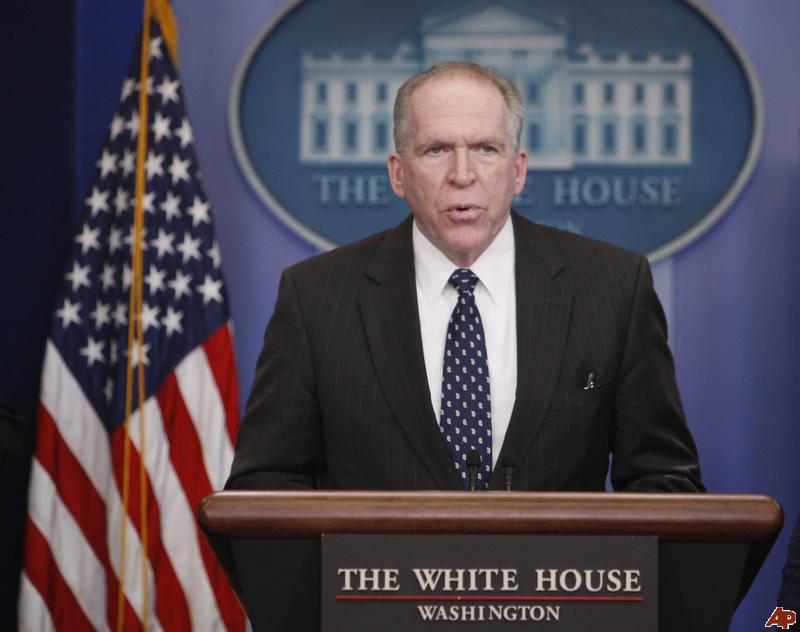
There is no evidence that Pakistan government officials helped and protected Osama bin Laden, claimed John Brennan, Deputy National Security adviser and President Barack Obama’s chief counter-terrorism adviser.

Brennan, speaking to reporters at a morning briefing said “I have not seen anything that the Pakistanis were aiding his refuge there.”

In May, Osama was found and killed by U.S. Navy SEALS in a large compound in the town of Abbottabad in northern Pakistan, near the capital Islamabad. Since that time, rumors have swirled that Pakistani intelligence officials had been aiding the former al-Qaeda terror chief as well as many other militants.

Brennan also said that based on examination of documents and data found and seized at Osama’s compound, it became apparent that bin Laden was “a little out of touch about how debilitated his organization was” after fighting for almost a decade against the U.S.

“It did reveal an organization in distress,” Brennan said.

Brennan also reportedly praised Pakistan’s offensive against terrorist groups operating the country and that Washington has a close working relationship with Islamabad in this joint effort.

He cited the recent arrest in Pakistan of Younis al-Mauritani, a senior al-Qaeda official, is proof that Islamabad is taking its responsibilities seriously.

He noted that al-Qaeda “has taken it on the chin” and has been “degraded significantly over the past couple of years.”

Brennan’s latest comments dramatically contradict assertions he made in May (just after the killing of Osama) when he declared that it was “inconceivable” that bin Laden did not have the support of officials within Pakistan.

Edible Arrangements–A Pakistani-American’s Success Story

By Riaz Haq for RiazHaq.com

Tariq Farid is the founder and CEO of Edible Arrangements, a successful international franchise business that specializes in delivering gifts of beautifully arranged bouquets of edibles like fruits and candy on holidays and various other special occasions.

Currently in its 11th year of operation, the company boasts 883 franchise locations in the United States, the United Kingdom and Kuwait. The company earned $300 million in revenue last year, according to published reports.

Born near Sahiwal in Pakistan, Tariq Farid has founded several other companies. One is Frutation by Edible Arrangements, which includes salads and fruit drinks. They’re sold in Edible Arrangements stores and stand-alone stores. He also created Netsolace, which provides software for the franchise industry. Another, BerryDirect, offers containers, vases and other products to our Edible Arrangements franchisees and other companies. His latest start-up is Farid Capital Corporation, a financing company that helps franchisees buy equipment.

The key to Farid’s success, he says, has come from paying attention to often overlooked details such as the website, order tracking and follow-up customer service, the logo and branding, and employee training.

The economy may need more entrepreneurs like Farid – according to the International Franchise Association, every $1 million lent to franchise small businesses creates 34 jobs and $3.6 million in annual economic output, cited Reuters.

Here is Farid in his own words describing his journey:

I was born in Pakistan and came to the United States in 1981, when I was 11. My grandfather owned a farm in Pakistan and we had been fairly well-to-do. We started at the bottom when we came here. My father found a job as a machinist during the day and worked at McDonald’s and Burger King at night.

All five of my siblings pitched in. I delivered newspapers to 300 houses. Instead of putting the paper into the mailbox, I’d deliver it to the door. I got great tips. When I was 13, a flower shop hired me to water the flowers. Soon I was taking care of orders. By 16, I had learned a lot.

One day my father found a flower shop for sale in the paper. The owner wanted $6,000. My dad asked me if I could run the shop, and I said sure. We got a cash advance and a loan from a friend. I thought I’d negotiate, and asked the owner what terms he was offering. He looked at me as if to say, “What can this kid possibly know?”

We opened a week before Easter and earned about $50 a day. I stayed open until 7 p.m., seven days a week, because few other flower shops did. I thought $350 a week was wonderful. Soon, sales doubled, and I was shocked. Five years later, we had three shops and were making close to $1 million a year. I said we needed to make more, about $5,000 a day. My mother asked me if I remembered when I was making $50 a day and she suggested that I relax. I told her that it never really ends, and that I could achieve that goal.

It was a lot of work. I didn’t really have a social life. We stayed open on holidays. On my way to high school, I’d drop off my mother at the shop. She spoke no English, so I told her what to do to supervise the two employees. After school I’d make flower arrangements and deliver them myself until I could hire a driver.

I attended college part-time, but I started weighing the benefit against what I was making. I decided to put off school, and I never finished. I was so young when I started a career that I blindly jumped into it.

Edible Arrangements, which I started in 1999 with my brother, Kamran, goes back to our roots. In Pakistan, my father always brought home tons of fruit for us. When we started the company, we created basic fruit arrangements that included fresh pineapple, strawberries, cantaloupe and more, and later added extras like chocolate and cinnamon toppings.

We got 30 orders the first day. We had learned from our flower stores, so this time did everything right. A stranger asked about opening a store, which gave us the idea to franchise them. I knew nothing about the franchise industry, so I contacted an association for the names of experts and found Michael Seid. He gave great advice.

I’ve started several other companies. One is Frutation by Edible Arrangements, which includes salads and fruit drinks. They’re sold in Edible Arrangements stores and stand-alone stores. I also started Netsolace, which provides software for the franchise industry. Another, BerryDirect, offers containers, vases and other products to our Edible Arrangements franchisees and other companies. I just started the Farid Capital Corporation, a financing company that helps franchisees buy equipment.

When I was starting out, I used to give my mother $50 a week. When I wanted to buy a building for our second Edible Arrangements location, I needed $40,000 more than I had. My mother had saved the money I gave her over the years and handed it back to me. She asked only that I do something in her name someday and give her $20,000 for my sister’s wedding.

When my mother passed away in 2000, I started a foundation in her memory. The organization built a hospital in Pakistan for needy people and an Islamic school in the United States.

Originally published in The New York Times as told to Patricia R. Olsen
.

Musharraf Moves to Mend US-Pakistan Relations

By Lydia Mulvany for The Mimami Hearld

Former Pakistani President Pervez Musharraf said Thursday that his country wasn’t complicit in hiding Osama bin Laden but was “extremely negligent” for not knowing that the al-Qaida leader was living a 75-mile drive from the Pakistani capital.

Speaking in Washington, the former military dictator sought to heal a U.S.-Pakistani relationship that’s become badly strained since the American raid May 2 that killed bin Laden, saying mutual interests in the global war on terrorism bound the countries and that blaming each other was counterproductive.

“The United States and Pakistan must restore trust,” Musharraf told an audience at the Woodrow Wilson International Center for Scholars. “Confrontation would be most unwise.”

The bin Laden incident pushed U.S.-Pakistani relations to their lowest point in years. American officials weren’t happy when, after a decade-long hunt, they found al-Qaida’s leader living in a garrison town so close to Islamabad. Pakistani officials were outraged that they weren’t told about the unilateral raid beforehand.

Since the raid, Pakistan has restricted visas for American officials and expelled military trainers. The U.S. has cut off $800 million, about one-third of its aid to Pakistan’s military. The U.S. has long complained of ties between Pakistan’s military and insurgent groups that have attacked American-led forces in neighboring Afghanistan.

But Musharraf said that if Pakistani intelligence had colluded with bin Laden, it also would have known that the CIA was operating a safe house nearby and whisked the al-Qaida leader away. He described bin Laden’s high-walled compound in the town of Abbottabad as a normal dwelling that wouldn’t have raised suspicion.

He also claimed that Abbottabad – which is home to a major military college that’s been described as Pakistan’s West Point, as well as other military installations – wasn’t a garrison town but a touristy resort area with many colleges.

The recent raid was a “violation of sovereignty,” Musharraf said, echoing a widespread Pakistani complaint. He added that Pakistani antipathy toward the U.S. also stems from the American campaign of drone strikes on militant targets, which reportedly have caused civilian casualties, as well as lingering bitterness over U.S. sanctions for developing nuclear weapons in the 1990s.

The way forward for Pakistan, Musharraf said, is to show that it isn’t complicit with terrorists and to deal with domestic extremism. It also needs to establish an honest, stable government in the 2013 elections, said the former leader, who’s expected to mount a run for president.

Musharraf, who seized power in a military coup in 1999 and resigned in 2008, embodied the frustration and contradictions of American policy toward Pakistan.

Mark Quarterman, a senior adviser at the Center for Strategic and International Studies, a nonpartisan Washington research center, said that many wanted to see Musharraf as a modern, progressive leader: He wasn’t an extremist, his wife and daughter didn’t wear veils and the family even had a dog, an animal many Muslims view as impure. Ultimately, however, Musharraf’s rule was a military dictatorship and, according to many experts, he didn’t do enough to rein in Taliban militants who were operating in remote corners of Pakistan.

Clinton Says US Encouraged by India-Pakistan Talks

By Matthew Lee and Ravi Nessman for The Associated Press

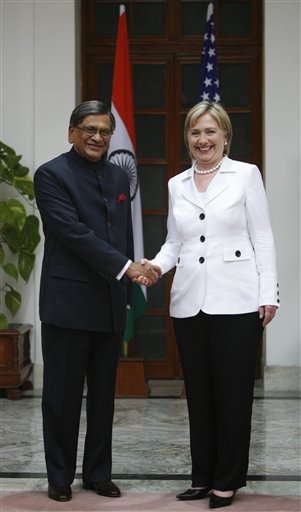
U.S. Secretary of State Hillary Rodham Clinton said Tuesday that the United States was “encouraged” by the ongoing talks between nuclear-armed rivals India and Pakistan and promised to give full support to Indian efforts to protect itself from terror.

Clinton’s visit to India came less than a week after a triple bombing killed 20 people in India’s financial capital of Mumbai, the worst terror strike in the country since 10 Pakistan-based gunmen rampaged through the city in 2008.

Her meetings with top Indian officials Tuesday focused on fighting terror, the U.S. withdrawal plans from Afghanistan and ways to broaden economic and security ties between the United States and India.

She also called for a swift resolution to their dispute over investments in nuclear energy, calling on India to ratify by the end of the year the Convention on Supplementary Compensation for Nuclear Damage and to adapt its liability laws to conform with the treaty.

The U.S. views India’s new nuclear liability law as too stringent on nuclear plant suppliers, making it difficult for private U.S. companies to compete against state-owned companies in India’s multibillion dollar nuclear reactor market.

Clinton’s trip here is part of a new round of U.S.-India strategic dialogue established last year to deepen ties between the world’s oldest and largest democracies.

S.M. Krishna, India’s foreign minister, expressed concerns that the planned U.S. troop withdrawal from Afghanistan that began this month could lead to a resurgence in Islamic extremism.

“It is in the larger interests of the region that it is necessary for the United States to work very closely with (Afghan) President (Hamid) Karzai and the government of Afghanistan and thereby create conditions where terrorists do not take any more advantage in Afghanistan,” Krishna said after 2 1/2 hours of talks with Clinton.

Clinton said she had outlined the drawdown strategy and stressed that the United States will not support Afghan reconciliation with insurgents unless it is inclusive and protects the rights of minority groups, religions and women.

Clinton also assured India of U.S. support in the fight against terror.

“We are allies in the fight against violent extremist networks. And homeland security is a high priority and a source of increasing partnership,” Clinton said.

While the U.S. and India have already signed agreements to cooperate in counterterrorism efforts, “the events in Mumbai have driven home how important it is that we get results,” she said.

Though India has not blamed Pakistan for last week’s attack, it has accused its neighbor of harboring violent extremist groups responsible for other attacks in India and of not doing enough to crack down on those responsible for the 2008 Mumbai siege.

For its part, U.S. officials fear Pakistan is not fully committed to combatting radical plots, such as the failed 2010 Times Square bombing in New York.

“We have made it clear to the Pakistani government that confronting violent extremists of all sorts is in its interest,” Clinton said.

India recently resumed peace talks with Pakistan that broke off following the 2008 Mumbai siege, and the two countries’ foreign ministers are expected to meet next week.

The U.S. is eager for the fragile talks to pick up steam, in part to allow Pakistan to focus its forces on the chaotic Afghan border.

“We are encouraged by the dialogue between India and Pakistan,” Clinton said, calling talks “the most promising approach” to build more confidence between them.

During the meeting Tuesday, Clinton and Krishna agreed to strengthen their countries’ ties in energy, security, education, the economy, science and promoting stability across the region. The two countries also signed an agreement promoting closer cooperation in cybersecurity.

Once frosty relations between India and the United States have warmed considerably in recent years as Washington has looked to India as stable ally in the turbulent South Asia region and its growing economy as a valuable market for U.S. goods.

President Barack Obama hosted Prime Minister Manmohan Singh at his first state dinner and visited India for three days last year, praising it as a new regional power. Clinton was to meet with Singh later Tuesday.

Growing business ties were among the top issues in the talks.

Western officials have looked to India’s rising economy and its 1.2 billion people as a coveted market to help stimulate growth in their own troubled economies.

“Each of our countries can do more to reduce barriers, open our markets, and find new opportunities for economic partnership,” Clinton said. “Taking these steps is in our mutual interest. We can improve millions of lives and increase both of our nations’ economic competitiveness.”

She praised India’s fight against piracy, and pushed for greater sales of U.S. arms to India — the world’s largest arms importer —as a way of deepening security cooperation between the two nations.

U.S. officials were annoyed earlier this year when Indian officials chose two European companies as finalists for an $11 billion order for 126 fighter jets. However, last month India signed an agreement to buy 10 Boeing C-17 cargo and troop-carrying aircraft for more than $4 billion.

From New Delhi, Clinton on Wednesday will move on to the southeastern port of Chennai, where she plans to deliver a speech on the importance of U.S.-Indian relations, the benefits of enhanced bilateral commercial ties and India’s role in South Asia and the greater Asia-Pacific region.

Clinton is in India on the third leg of a 12-day, around-the-world diplomatic tour that has already taken her to Turkey and Greece. After India, she will visit Indonesia, Hong Kong and southern mainland China before returning home July 25.