By Christa Case Bryant for The Christian Science Monitor
Suspicious packages found on United Parcel Service and FedEx planes reportedly originated in Yemen. While the planes appear to be undamaged, the incidents could bring fresh scrutiny to Al Qaeda in the Arabian Peninsula (AQAP), the relatively new franchise that claimed responsibility for the failed underwear bomber plot on Christmas Day last year.
A spokesman in Yemen’s US embassy said in a statement that the Yemeni government, which has carried out numerous strikes against suspected AQAP operatives over the past 10 months, has launched a full-scale investigation.
“We are working closely with international partners – including the US – on the incident,” said Mohammed Albasha, adding that no UPS cargo planes land or take off from Yemeni airports.
However, an airport employee in Sanaa, who did not want his name used, confirmed that there are private company flights from Sanaa to the United Kingdom, where a suspicious package was found at East Midlands airport at 3:28 a.m. local time.
The UPS store in Sanaa was staffed with one employee and one guard Friday evening local time. The employee refused to talk to the media.
The White House said that in addition to the package found in the UK, which according to CNN contained a “manipulated” toner cartridge, another suspicious item was found in Dubai. Both were said to have originated in Yemen.
“Last night, intelligence and law enforcement agencies discovered potential suspicious packages on two planes in transit to the US,” White House spokesman Robert Gibbs said Friday. “As a result of security precautions triggered by this threat, the additional measures were taken regarding the flights at Newark Liberty and Philadelphia International Airports.”
Among the suspected targets were Chicago-area synagogues.
The incident, which CNN posited could be a “dry run” for a future terrorist plot, is one of numerous red flags raised this year about suspected Al Qaeda militants operating in Yemen.
The country’s weak central government, which has difficulty maintaining order in Yemen’s rugged mountain terrain, has over the past year quietly strengthened its cooperation with US counterterrorism officials to address the militant threat.
The US military announced early this year it would more than double the $67 million aid package to the country. Since the failed Christmas Day bombing on a Detroit-bound airliner, international concern that Yemen could become the next Afghanistan – a lawless refuge from which to launch terrorist attacks on the West – has risen.
The rise in prominence of Anwar al-Awlaki, a Yemeni-American preacher linked to the Fort Hood shootings last year and now wanted by the CIA, has heightened fears that the militants could more easily navigate Western society with his help.
Experts have cautioned, however, that focusing US and international efforts solely on containing the Al Qaeda threat could backfire.
Yemen is the Arab world’s poorest country, and faces numerous other challenges, including corruption, a violent southern secessionist movement, tensions between powerful tribes and the central government, and dwindling resources.
Any serious observer of the war in Afghanistan will tell you that we can’t win without striking hard at the safe havens the Taliban and its allies enjoy in Pakistan. That means going beyond drone strikes and deploying ground forces in places like North Waziristan.
Any serious observer of Pakistan will also tell you that such strikes would complicate, and perhaps fatally compromise, our relations with the country whose cooperation we require to win in Afghanistan.
Both observations are on the mark. Isolating the battlefield is a cardinal rule of warfare. So long as the Taliban can shrink away to Pakistan to lick their wounds and plot their return—as they have in the wake of their recent reversals in Kandahar—then we have failed to isolate them. Yet if Pakistan should begin to turn against us—as they briefly did earlier this month following the accidental killing of Pakistani border guards in a NATO strike—then we are the ones who will be isolated.
So how do we finesse the Pakistan paradox?
It helps to see the country for what it is. Pakistan suffers from an abandonment complex rooted in historical facts, especially the Pressler Amendment that cut off Pakistan-U.S. military ties throughout the 1990s. Those fears are compounded by a national paranoia that is the product of conspiracy theory, misplaced indignation and jingoism. The country’s elites typically divide between secularists, mainly feudal aristocrats or corrupt parvenus like President Asif Ali Zardari, and Islamists of either conservative or radical bent.
Standing astride the Islamist-secular divide is the military, which profits from cultivating both connections and is Pakistan’s most competent—and least accountable—institution. Down below is an ethnically fractious and largely destitute population of 170 million people, just emerging from a flood that swamped 20% of the country.
From this unsavory stew it’s unrealistic to expect a high degree of clarity or consistency in Pakistani policy. At best it leans one way or the other, never very far and rarely for very long. Mr. Zardari’s government has deployed the army against the Taliban, or parts of it, and consented to a dramatic increase in Predator strikes. But that’s happening concurrently with the intelligence service, or ISI, providing material aid to the al Qaeda-linked Haqqani network, and failing (or more likely refusing) to break up the so-called Quetta Shura of Mullah Mohammed Omar.
If there’s an overarching logic here it’s that Islamabad wants to preserve its options. Uncertainty about U.S. staying power in Afghanistan helps explain why Pakistan will not entirely forsake its erstwhile clients in the Taliban and the mujahedeen. Pakistani fears are further exacerbated by America’s recent tilt toward India. And while the Obama administration has made much of its aid packages for Pakistan—$1.5 billion a year on the civilian side, followed last week by the announcement of another $2 billion for the military—Pakistani officials complain that only a small fraction of the funds have been disbursed.
What, then, to do? First, instead of publicly lecturing Pakistanis on how they need to get tough with the Taliban, the administration would do better to make good on its existing commitments. Say what you will about Mr. Zardari’s abilities, he has aided the U.S. military effort in a way his predecessor Pervez Musharraf, supposedly a pro-American strongman, never did.
That’s a relationship to build on, quietly and incrementally, not to tear down. So it would be helpful if the administration doesn’t repeat the mistake of blabbing to Bob Woodward, whose book may have helped Mr. Obama seem more presidential but didn’t do any favors to his presidency.
Equally helpful would be to stop mindlessly demanding that military assistance to Pakistan go toward fighting the Taliban instead of arming against India. The missing ingredient in Pakistan’s counterinsurgency effort isn’t the right military tool kit, such as night-vision goggles or Apache helicopters. It’s the will of the Pakistani general staff to cooperate more fully in the fight. If that cooperation can be secured by selling conventional weapons such as F-15s and M-1 tanks to Pakistan, so much the better.
(As for India, it has less to fear from a reasonably well-armed, confident Pakistani army that has strong ties to the U.S. than it does from a poorly armed Pakistan that mistrusts the U.S. and continues to consort with jihadists as a way of compensating for its weakness.)
Finally, the administration ought to understand that Pakistan’s reluctance to defeat the Taliban at any price is a mirror image of our own reluctance. The July 2011 “deadline” to begin withdrawing troops was bound to affect Islamabad’s calculations, and not for the better. The sooner we junk it, the better the cooperation we’ll get.
It’s an old American habit to lament the incompetence and duplicity of our wartime allies, and Pakistan abounds in both qualities. But unless we are prepared to deal with Pakistan as an adversary, we must make do with it as a friend.
Pakistan called Friday for President Barack Obama to intervene in its longstanding dispute with India over the Himalayan region of Kashmir, the cause of two of the three wars the nuclear-armed rivals have fought.
Pakistani Foreign Minister Shah Mahmood Qureshi made the unusually blunt appeal for Obama to seek a resolution of the dispute when he visits India next month, saying he should “redeem the pledge” he made as a candidate.
The conflict over Kashmir has been the main source of friction between India and Pakistan since they won independence from Britain in 1947. Pakistan has frequently sought outside intervention to resolve it but India vehemently opposes such involvement and the United States has traditionally stayed above the fray.
Qureshi, speaking next to Secretary of State Hillary Rodham Clinton at the closing day of three days of U.S.-Pakistan talks, said Obama must get involved because a crackdown against suspected Muslim militants in Indian-controlled Kashmir threatens the entire region.
“It is in the U.S. strategic interest to work for peace, stability and resolution of the disputes in South Asia,” he said. “The starting point in this quest is justice for the Kashmiri people.”
“President Obama has always understood the importance of a Kashmir solution,” Qureshi said. “His coming visit to the region is the time to begin to redeem the pledge that he made earlier.”
As a presidential candidate in 2008, Obama suggested that the U.S. should encourage India and Pakistan to resolve the Kashmir dispute so Pakistan could better focus on fighting extremists on its own territory and Afghanistan. Although he did not advocate direct mediation, his comments were met with disdain in India.
Obama will not visit Pakistan on his upcoming trip but he plans to spend several days in India, which has cracked down on violent anti-Indian protests in Kashmir since June. The violence has killed at least 111 people, mostly teenage boys and young men in their 20s. Authorities have imposed off-and-on curfews in an attempt to halt the unrest.
Quershi expressed astonishment that the U.S. and other major powers had said little about India’s response to the protests.
“People of conscience have protested the use of force against the defenseless people of Kashmir, in particular the targeting of the Kashmiri youth,” he said. “But the Kashmiri mothers are baffled by the deafening silence of the world’s leadership. History has proved that the force of arms cannot suppress the legitimate aspirations of the Kashmiri people.”
India and Pakistan fought two wars for control of Muslim-majority Kashmir, where rebels have sought independence from India or incorportation with neighboring Pakistan.
More than 68,000 people, most of them civilians, have been killed in Kashmir since fighting began in earnest in 1989.
Former Pakistani President Pervez Musharraf hopes to retake the leadership of his country, and he is actively campaigning — in Texas.
Musharraf, who relinquished his presidency in 2008, has a set of Houston meetings planned this week with wealthy Pakistani-Americans and corporate leaders.
He is scheduled to meet today with former President George H.W. Bush and Joanne King Herring, a longtime advocate for development in Afghanistan and Pakistan who was played by actress Julia Roberts in the film Charlie Wilson’s War.
Musharraf, a London resident, announced this month the creation of a new political party and a plan to run in Pakistan’s 2013 parliamentary elections.
But he has kicked off his campaign in the U.S., a decision that could say more about the perceived influence of the Pakistani-American community in cities such as Houston than Musharraf’s chances for success, experts say.
Musharraf said he believes connecting with Pakistanis in America will give him enough backing — financially and politically — to carry him to victory in Pakistan.
“I do need financial support, and I would ask the American Pakistani diaspora to support me … because I see darkness in Pakistan,” Musharraf said. “Because I don’t see a political party or a leader in Pakistan to be able to tackle the problems that Pakistan is facing.”
While Musharraf enjoys backing from the Pakistani-American elite, experts say he will be hard-pressed to develop a political base within his country and likely does not stand a chance against more established parties.
He is also in no position to campaign within Pakistan. Safety is a concern after multiple assassination attempts during his presidency, and he would likely face prosecution in connection with several criminal cases currently pending in Pakistani courts, experts said.
Still, Musharraf’s interest in wooing deep-pocketed Pakistani-Americans is revealing, said Walter Andersen, associate director of the South Asia program at Johns Hopkins University.
Not only do Pakistani-Americans play a role in financially supporting candidates, but their meetings in America are covered by Pakistani news media and seem to give politicians the idea that they are gaining traction, Andersen said.
Former Prime Ministers Benazir Bhutto and Nawaz Sharif also visited U.S. communities while campaigning, he said.
“Whether it works is not important,” Andersen said. “The perception among them (politicians) is that it works.”
Wide-ranging itinerary
U.S. communities don’t play a visible role in Pakistani elections, but Musharraf could stand to gain from his current North America tour, said Jamal Elias, an expert on contemporary Pakistan and chairman of the religious studies department at the University of Pennsylvania.
Musharraf’s itinerary will include stops in Chicago, New York, San Francisco and Toronto. He visited Dallas last week.
“Appearing statesman-like is going to help him in Pakistan,” Elias said. “It’s not going to build a constituency, but it may help him.”
There are more than 75,000 people of Pakistani origin in the Houston area, which includes more than 800 doctors, executives in the energy and information technology industries and scores of business owners, according to the Consulate of Pakistan in Houston.
Many of them have in the past contributed financially to political parties in Pakistan and will likely do so again, said M.J. Khan, a former Houston city councilman and member of the Pakistani community.
Khan said he does not send money to Pakistani political candidates, but knows U.S. residents in Houston and elsewhere who do. “They’re an educated community, and they send a lot of resources to Pakistan,” Khan said. “So I think every politician in Pakistan feels the Pakistani-American community is an important group to reach out to.”
Tactics questioned
Some community members – including Sajjad Burki, president of a Houston chapter for a political party headed by Pakistani cricket star Imran Khan – were not sure of the former president’s legitimacy as a candidate. Burki questioned Musharraf’s campaign tactics and priorities.
“It doesn’t make sense for him to be creating a political party and campaigning abroad rather than campaigning in Pakistan,” he said.
Herring, who is hoping to build support for Musharraf’s candidacy, said she planned to back him because of his support for her development efforts in Afghanistan.
“I think that Musharraf is interested in my plan,” Herring said. “I know he is. He supports it.”
Seeks ‘legitimacy’
Musharraf, a retired general, said he hopes a possible election to office will give him “the legitimacy that maybe I didn’t have in the past” as someone who had seized control of the government in a 1999 military coup.
He spent much of a luncheon Tuesday discussing the threats to Pakistan created by instability and lack of development in Afghanistan. Asked how he would solve that and a host of other challenges, Musharraf paused and smiled at his audience.
By Mark Landler and Eric Schmitt for The New York Times
WASHINGTON — As Pakistani civilian and military leaders arrive here this week for high-level meetings, the Obama administration will begin trying to mend a relationship badly damaged by the American military’s tough new stance in the region.
Among the sweeteners on the table will be a multiyear security pact with Pakistan, complete with more reliable military aid — something the Pakistani military has long sought to complement the five-year, $7.5 billion package of nonmilitary aid approved by Congress last year. The administration will also discuss how to channel money to help Pakistan rebuild after its ruinous flood.
But the American gestures come at a time of fraying patience on the part of the Obama administration, and they will carry a familiar warning, a senior American official said: if Pakistan does not intensify its efforts to crack down on militants hiding out in the tribal areas of North Waziristan, or if another terrorist plot against the United States were to emanate from Pakistani soil, the administration would find it hard to persuade Congress or the American public to keep supporting the country.
“Pakistan has taken aggressive action within its own borders. But clearly, this is an ongoing threat and more needs to be done,” the State Department spokesman, Philip J. Crowley, said Monday. “That will be among the issues talked about.”
The Pakistanis will come with a similarly mixed message. While Pakistan is grateful for the strong American support after the flood, Pakistani officials said, it remains frustrated by what it perceives as the slow pace of economic aid, the lack of access to American markets for Pakistani goods and the administration’s continued lack of sympathy for the country’s confrontation with India.
Other potentially divisive topics are likely to come up, too, including NATO’s role in reconciliation talks between President Hamid Karzai of Afghanistan and the Taliban. Pakistani officials say they are nervous about being left out of any political settlement involving the Taliban.
Still, in a relationship suffused by tension and flare-ups — most recently over a NATO helicopter gunship that accidentally killed three Pakistani soldiers and Pakistan’s subsequent decision to close a supply route into Afghanistan — this regular meeting, known here as the strategic dialogue, serves as a lubricant to keep both countries talking.
At this meeting, Secretary of State Hillary Rodham Clinton will formally introduce the new American ambassador to Pakistan, Cameron Munter. Mr. Munter, who recently served in Iraq, replaces Anne W. Patterson, who just wrapped up her tour of duty in Islamabad.
“No country has gotten more attention from Secretary Clinton than Pakistan,” said Richard C. Holbrooke, the administration’s special representative for Afghanistan and Pakistan. Pakistan’s delegation will be led by its foreign minister, Shah Mahmood Qureshi, but much of the attention will be on another official, the military chief, Gen. Ashfaq Parvez Kayani, who is viewed by many as the most powerful man in Pakistan.
White House and Pentagon officials said one immediate goal of this meeting was to ease the tensions that led Pakistan to close the border crossing at Torkham, halting NATO supplies into Afghanistan. Officials on both sides said that acrimony from the border flare-up had already receded, soothed by the multiple apologies that American officials made to Pakistan last week.
Last week, Adm. Mike Mullen, the chairman of the Joint Chiefs of Staff, said that General Kayani had assured him that Pakistan’s army would tackle the North Waziristan haven, but on Pakistan’s timetable. In an interview, Pakistan’s ambassador to the United States, Husain Haqqani, said, “Our American partners understand that we have 34,000 troops in North Waziristan. Our soldiers have been engaged in flood relief after history’s worst floods. It is not a question of lack of will.”
The new security pact would have three parts: the sale of American military equipment to Pakistan, a program to allow Pakistani military officers to study at American war colleges and counterinsurgency assistance to Pakistani troops.
Currently, the United States spends about $1.5 billion a year to provide this same assistance, but it is doled out year by year. The new agreement, if endorsed by Congress, would approve a multiyear plan assuring stability and continuity in the programs, although Congress would continue to appropriate the financing on a yearly basis. “This is designed to make our military and security assistance to Pakistan predictable and to signal to them that they can count on us,” said a senior official.
At the last dialogue in Islamabad in July, Mrs. Clinton presented more than $500 million in economic aid, including plans to renovate hospitals, upgrade hydroelectric dams, improve water distribution and help farmers export mangoes. But the floods upended those plans, and officials said they now planned to redirect funds to more urgent needs.
This week’s meeting will also be shadowed by a new eruption of political instability in Pakistan: the government of President Asif Ali Zardari is locked in a confrontation with the Supreme Court over the court’s demand that senior ministers be fired on corruption charges. Analysts said they were less worried about the atmospherics than the underlying differences in perspective. The administration’s public contrition for the cross-border attack has largely resolved that issue, said Daniel S. Markey, senior fellow for India, Pakistan and South Asia at the Council on Foreign Relations.
But Mr. Markey said he saw potential friction stemming from the American openness to reconciliation with the Taliban. With the United States facilitating rather than guiding the talks, he said, there could be poor coordination between the Afghans, NATO and others — all of which would rattle the Pakistanis.
“Washington is opening the door to a range of negotiations with groups that it has discouraged Pakistan against working with in the past,” he said. “This sends a mixed signal, and cannot help but encourage hedging on Islamabad’s part.”
Another potential bone of contention is one of President Obama’s nuclear objectives: a global accord to end the production of new nuclear fuel. Pakistan has led the opposition to the accord. And without its agreement, the treaty would be basically useless.
Mr. Qureshi blamed the United States for the situation, saying Washington signed a civilian nuclear accord with India that discriminated against Pakistan. “You have disturbed the nuclear balance,” he said in a recent interview in New York, “and we have been forced to develop a new strategy.”
The news from Pakistan is grim. NATO helicopters engage suspected militants inside Pakistan, killing three, only to discover they are Pakistani soldiers. The angry Pakistani government blocks NATO fuel shipments at the Khyber Pass, and militants attack the stalled trucks. An Obama administration report to Congress charges that the Pakistanis aren’t doing enough against the Taliban and al Qaeda. Press accounts quote unnamed officials asserting that elements in Pakistani intelligence are encouraging the Taliban to step up attacks on NATO forces. And Bob Woodward cites President Obama as saying “the cancer is in Pakistan.”
One could easily conclude that we are describing an enemy, not an ally. Many in Pakistan feel the same way. And yet the prospects for stabilizing Afghanistan, defeating al Qaeda and preventing further attacks on the United States are a direct function of that strained alliance. It is time for a collective deep breath.
Pakistan’s historical narrative focuses on how the U.S. worked with Pakistanis and Afghans to drive the Soviets from Afghanistan in the 1980s: We succeeded—and then we left. And on our way out, we slapped sanctions on Pakistan, ending all security and economic assistance because of the country’s nuclear program, which we had known about since 1974 when Pakistan’s prime minister announced it publicly. We left Pakistan alone to deal with a destabilizing civil war in Afghanistan, and when the Taliban emerged as a dominant force in the mid-1990s, Islamabad supported them as a means of ending the conflict.
Then came 9/11 and the U.S. was back. Pakistanis welcomed the renewed assistance. But a constant question I heard while serving as ambassador to Pakistan from 2004-2007 was “How long will you stay this time, and what mess will you leave us with when you go?” For a fragile state with innumerable problems, including a vicious internal insurgency, these are existential questions.
Never in Pakistan’s six decades of existence has the U.S. sustained a long-term, strategic commitment in the country. The Bush administration recognized this and enacted security and economic assistance programs designed to make a long-term difference in education, health care and governance. In 2006, I argued successfully for a five-year assistance package for Pakistan’s Federally Administered Tribal Areas (FATA), which are notable both for chronic underdevelopment and extremism. The Obama administration has built on this, and last year’s Kerry-Lugar bill provided $7.5 billion in assistance over five years. So we have the architecture in place to build a strategic relationship.
Still, short-term pressures risk undermining long-term strategy. When I was ambassador, voices in Congress, the media and even the administration were constantly calling for the U.S. to get tough on Pakistan, make Pakistanis do more, threaten them with consequences. Such exhortations were—and remain—generally counterproductive, as they fuel fears that the U.S. will again abandon Pakistan.
The U.S. can better work with Pakistan if we improve our understanding of history: Given its rivalry with India and its organic disunity, which dates back to its founding, Pakistan fears for its basic survival. The country has always had a difficult relationship with Afghanistan, not least because in the 19th century the British deliberately drew the Pakistani-Afghan border, the so-called Durand Line, in order to divide the Pashtun people. Today Pashtuns make up Afghanistan’s largest community, but there are more Pashtuns in Pakistan.
The Durand Line also set the groundwork for the tribal areas, which are legally distinct from the rest of Pakistan because the British could never exert direct control over them. No central authority ever has. Winston Churchill’s first published work, “The Story of the Malakand Field Force,” is about fierce tribesmen declaring jihad against a Western army. It could be a contemporary account.
So what does this mean in concrete terms?
First, the U.S. should appreciate Pakistan’s challenges and support its government in dealing with them. This summer’s devastating floods have disappeared from the U.S. media but will continue to wreak havoc in Pakistan for a long time to come. In 2005 and 2006, after an earthquake in Kashmir killed almost 80,000 Pakistanis, the U.S. organized the largest relief operation since the Berlin Airlift. The floods’ death toll is lower, but their long-term damage will be far greater. U.S. support should be commensurate.
Second, the U.S. should not carry out cross-border military actions, which I strongly resisted as ambassador. They are clearly counterproductive, and not just because we hit the wrong target. If NATO can carry out military actions in Pakistan from the west, Pakistanis wonder, what stops India from doing the same from the east? There are other options, including drone strikes, which the U.S. is now coordinating more closely with Pakistanis.
Third, with Pakistan’s government (as with Afghanistan’s), we must be private in our criticism and public in our support
Private talks should deepen regarding challenges like the insurgent Haqqani network in North Waziristan, and we need to listen at least as much as we lecture.Fourth, any talks between the U.S. or Afghanistan and the Taliban must be transparent to the Pakistanis. A nightmare for Islamabad is the prospect that the Americans and Afghans come to some accommodation with Taliban elements that would leave them hostile to Pakistan. If Pakistan is not part of the process, we will be working at cross-purposes and only the Taliban will benefit.
Pakistan’s arrest of Taliban leader Abdul Ghani Baradar—at a time when he had begun reconciliation talks with Afghan authorities—underscored the risks of leaving Islamabad out of the loop. Going forward, the timing and nature of talks with the Taliban should be set by Afghans, Pakistanis and Americans working together.
None of this will be easy, but it is essential. A sustained U.S.-Pakistani partnership after the Soviet withdrawal from Afghanistan could have produced a very different history than the one we wrestle with today. Writing a different future requires making long-term commitments—on both sides of the Durand Line.
Mr. Crocker, the dean of Texas A&M’s George Bush School of Government and Public Service, was U.S. ambassador to Pakistan from 2004 to 2007 and U.S. ambassador to Iraq from 2007 to 2009.
New York (CNN) — Afghan President Hamid Karzai has started talks with representatives of the Taliban, a move that analyst Fareed Zakaria says could bring an end to the nine-year-long war.
Karzai convened a meeting Thursday with the Afghan Peace Council, which was formed to help negotiate with the Taliban. Referring to the militants, Karzai said, “I call on them once again to use this opportunity and say ‘yes’ to this endeavor. I want them to come and bring peace to this land.”
The author and host of CNN’s “Fareed Zakaria GPS” spoke to CNN on Thursday. Here is an edited transcript:
CNN: Hamid Karzai has launched a council to help negotiate with the Taliban? What’s the significance of that step?
Fareed Zakaria: I think it’s about time. If you look at any good study of civil wars, what you find is that most of them end in a negotiated settlement. Maybe because Americans have the memory of our civil war in which the North crushes the South, we somehow think that that’s how civil wars end. But that’s actually is very unusual.
What normally happens is some kind of settlement that is negotiated in which the losers are reintegrated into the political order. Civil wars are unlike normal wars, because the winners and losers are going to have to live with one another.
CNN: How does that apply to Afghanistan?
Zakaria: The Taliban, which is mounting this insurgency, is not a foreign element within the body politic. The Taliban is basically the political representative of the conservative elements of the Pashtun community.
The Pashtuns are 50 percent of Afghanistan. … It is a political force in Afghanistan. Coming to terms with it politically and seeing if there’s some way it can be reintegrated into the political order makes sense. You’re not going to kill every member of the Taliban. They’re not going to be exiled to a foreign land. They’re going to be there at the end of the day so it’s better to to have them in the tent.
CNN: The U.S. military view seems to be that the talks haven’t yielded progress so far, and a senior defense official told CNN, “We don’t think the Taliban believe that they’re losing to the degree that they’d come to terms in large numbers.” Are the talks premature because the effects of the U.S. military buildup haven’t been felt yet?
Zakaria: First the very fact that the Taliban are coming to the table in a way they had not been willing to before suggests that they are feeling some pressure.
But I also think you can’t get too hung up with this idea that you have to negotiate from a position of strength. Ideally we would have them totally prostrate on the floor and that would be the time to negotiate. But the reality is that this is a very mixed military campaign. I don’t know if it’s going to be dramatically better one year from now or three years from now.
This is a little like somebody who owns a stock, who says, it’s at six now, I need to sell it, but I’m going to wait till it goes to eight. Well maybe it will go to eight, maybe it will go to four.
You might as well start talking at this point. First of all you learn a lot in the process of negotiations. And secondly, the military campaign could move in many different directions. If the surge starts succeeding even more, that will be reflected in our negotiating posture.
CNN: Is there an idea yet of what a negotiated settlement might involve?
Zakaria: It seems as though the Taliban demands are that they want all foreign troops out. They don’t want to accept the Afghan constitution and they don’t want to lay down their arms.
Now those are obviously their opening demands. Foreign troops aren’t going to be out, but one could point out that President Obama has said there is going to be a reduction of foreign forces next year.
On the Afghan constitution, there is a compromise there where there could be a few amendments to the constitution. But on laying down their arms, that it seems to me you can’t really compromise, they would have to lay down their arms. Could some elements be integrated into the militia, or the Afghan national army? Perhaps — that’s what happened in Iraq.
CNN: Isn’t there also a clashing conception of society, with the Taliban being a closed society that doesn’t recognize an elevated role for women as opposed to a potentially democratic kind of society that’s envisioned by the Afghan constitution?
Zakaria: Yes, it is the kind of society envisioned by the Afghan constitution. But Afghanistan is a fairly conservative society. While the extreme elements of the Taliban have draconian visions which are obviously not supported by the Afghans — the polls bear this out — it’s also true that on issues of women’s rights and some of the more progressive elements of the Afghan constitution, the Karzai government is in a minority and those rights are not popularly supported.
There are clashing visions, but there is probably a reality of Afghanistan which is a lot more progressive and open than the Taliban believe but is still a society that is somewhat conservative, and often tribal, and with very traditional views on something like women’s rights.
The key is creating a situation where these rights are guaranteed but not fetishizing it. For example, one of the things the Afghan constitution has is a requirement for 25 percent representation of women in parliament. We don’t have such a requirement either in the U.S. Constitution or in the amendments. Many European countries don’t.
Is it conceivable that something like that could be compromised? Perhaps, and that’s the kind of thing where we’d have to be creative in coming up with a solution that moderates and some elements of the Taliban could live with.
CNN: Is this an honorable exit for the United States?
Zakaria: I think so, and it’s not really an exit, it’s a reduction in our forces and in our role. And I think it would be appropriate. We’ve been there for nine years. It’s not the only battleground, the only place where al Qaeda operates. There are many more members of al Qaeda in Pakistan than in Afghanistan.
You’re trying to create a political settlement, and a self-sustaining political framework in Afghanistan that can survive the departure of American troops. And finally you’re leaving enough troops in there where you could still prosecute a fairly vigorous counterterrorism operation against those elements of the Taliban or al Qaeda that continue to plot and plan to do violence to civilians, foreigners, westerners.
And I do think, if we could get this kind of a settlement, it would be an honorable way for the United States to begin reducing its exposure in Afghanistan.
Fareed Zakaria is an author and foreign affairs analyst who hosts “Fareed Zakaria GPS” on CNN
Islamabad, Pakistan (CNN) — Gunmen in Pakistan opened fire on oil trucks bound for NATO forces in Afghanistan, setting some 20 vehicles on fire and killing three, police said Monday. The attack came shortly after Pakistan’s ambassador to the United States vowed his country would go after terrorists on its soil.
Naeem Iqbal, a police spokesman, said five people were wounded in the attack on tankers parked on a main road outside a housing complex near the capital city of Islamabad. Efforts to put out the blaze are ongoing, he said.
Bin Yamin, a deputy police chief, said eight gunmen entered the area on Monday around 12:15 a.m. local time. He said they told people near the trucks to run away and that most did. Then they opened fire.
The tankers were parked in the vicinity of an oil refinery where they were going to go to pick up fuel for NATO forces in Afghanistan, Yamin said. Video images of the scene showed firefighters working to put out flames that stood out in the night against the overturned trucks.
On Sunday, Pakistan’s ambassador to the United States insisted his country would go after terrorists on its soil and needed only “technical” help from Washington, not U.S. troops on the ground.
Husain Haqqani, told CNN’s “State of the Union” that Pakistan would reopen a NATO supply route into Afghanistan “relatively quickly,” probably in less than a week.
Pakistan halted the convoys Thursday after officials blamed cross-border NATO helicopter fire for the deaths of three Pakistani soldiers. Haqqani said the United States and Pakistan were investigating the killings together. He said Pakistan will move against militants on its own schedule, not Washington’s.
“Pakistan is saying we will take care of all terrorists on the Pakistani side of the border, but we will do it on our timeline,” Haqqani said Sunday. “We cannot always follow a timeline that our allies set for us, because we are allies, not a satellite.”
Pakistan has lodged protests against NATO helicopter incursions into its territory — which the International Security Assistance Force says its rules of engagement permit — and is very sensitive about reported U.S. drone strikes in Pakistan.
There were a record number of drone strikes last month, according to a CNN count. On Saturday, three suspected drone strikes killed 18 people.
Pakistani intelligence officials said 10 people died in one drone strike targeting a militant hideout, four people died when a vehicle was struck, and four others were killed when another hideout was targeted.
All three occurred in the Data Khel area of North Waziristan. The intelligence officials did not want to be named because they are not authorized to speak to the media.
Security analysts have described North Waziristan as a haven for various factions of Afghan and Pakistani Taliban and al Qaeda militants. The majority of reported strikes this year have hit targets in the district, a mountainous tribal area on Pakistan’s border with Afghanistan, analysts said.
The United States does not officially acknowledge that it has unmanned aircraft firing missiles at suspected militants in Pakistan, but it is the only country operating in the area that is known to have the ability to do so.
Ambassador Haqqani also said Pakistan couldn’t do everything Washington wants “because sometimes we don’t have the capacity and sometimes we don’t have the means.” He said Pakistan’s geography makes it hard to hit militants.
“Sometimes people in the U.S. think … that it’s all flat land with everything visible. Not even the drones can identify everyone in North Waziristan because of the complexity of terrain,” Haqqani said.
Haqqani also argued that Pakistani politicians, just like U.S. counterparts, are constrained by public opinion. “All politics is local and the local situation in Pakistan is that the United States is not very popular amongst our public,” he said. “The fact remains that an elected democratic government in Pakistan is limited by public opinion to the extent of what it can do,” he said.
In the same week when U.S. helicopters mistakenly killed three members of Pakistan’s Frontier Corps near the Afghan border, American Special Forces were training members of that same force on how to use radios, sniper rifles and other counterinsurgency tools at a remote base here.
Pakistanis and Americans don’t talk much about this joint training camp, northwest of Peshawar about 20 miles from Afghanistan. But the program is a symbol of the weird duality of the relationship — a mix of public distance and private cooperation that’s awkward for both sides.
“We have good relations; it’s going very well,” Col. Ahsan Raza, the camp commander, said when I visited Tuesday afternoon, two days before the fatal U.S. cross-border attack. But the Pakistani commandant was eager not to appear too close to America, stressing that the U.S. trainers were supplying technical skills, not running the show.
Both sides view the program here as a success story. But the joint effort masks a tension that is only likely to deepen in coming months.
Pakistan wants to use the 70,000-strong Frontier Corps to stabilize the Federally Administered Tribal Areas, or FATA, and halt the domestic Taliban insurgency. The United States, struggling in Afghanistan, wants Pakistan to help seal the border and destroy the sanctuaries used by al-Qaeda and the Afghan Taliban. The two sides talk as if their goals are identical, but they aren’t. The differing priorities became clear in conversations last week with Pakistani commanders.
Warsak is a pet project of Maj. Gen. Tariq Khan, the commander of the Frontier Corps. At his headquarters in the ancient Bala Hissar fortress in Peshawar, the traditional garb of the tribal “scouts,” as they’re called, makes you wonder whether the days of the British Raj ever really ended. Behind Khan’s desk is a plaque bearing the names of his predecessors back to 1907.
Khan argues that it’s time for Pakistan to move from big military offensives in the tribal areas to what he calls “policing” actions. “No steamroller operations,” he says.
Lt. Gen. Asif Yasin Malik, who commands the Pakistani army in the western border areas and is Khan’s boss, makes the same point. “Don’t expect major new kinetic operations,” he says. “We have changed gears to a softer approach.”
This can’t be comforting to Gen. David Petraeus, the U.S. commander in Afghanistan. He is said to have concluded, after several months in Kabul, that more Pakistani pressure on the havens is crucial for American success. That’s the basic conflict — an overstretched America wants a Pakistani surge in the tribal areas; an overstretched Pakistan just wants to keep the peace.
Khan’s strategy is an updated version of the old British approach: work through the tribal chiefs, or maliks, keep the roads open and pound any renegades back into line. He wants to maintain order through three tiers of force: local militias, known as “levies,” recruited by the maliks; the Frontier Corps dispersed across the FATA; and the big guns of the Pakistani army.
Working with the American trainers at Warsak, Khan has devised some smart tactics: Private vehicles in the FATA will have electronic chips that register their movements. The scouts will report suspicious activities on their American-made radios, and the snipers will blow away any miscreants using their American-made sniper rifles. To demonstrate that order is returning, the burly Khan, the scion of a princely Pashtun family, took a car trip last summer through the FATA with his wife and daughter.
Khan’s enthusiasm is infectious: “There are no safe havens in my area of responsibility — I can take you anywhere, any place, anytime.” That sidesteps the fact that North and South Waziristan, the main trouble spots, are still the responsibility of the army.
Driving down the roads of the border areas, you sometimes have the sense that you are traveling back in time. But that “back to the future” strategy is a temporary fix, at best. Pakistan, with U.S. support, should be moving forward, not in reverse. The years of war have shattered the old tribal order, and the long-run goal should be to bring the tribal areas into a modern Pakistan, rather than let them fester on their own.
U.S. drone attacks and other firepower can keep the insurgents on the run, but they won’t bring stability. Neither will Tariq Khan’s snipers. Somehow, the people in this desolate region have to feel they have a stake in a future that’s something other than continuous warfare.
It is 5:50 in the morning, and dark shadows scurry through narrow alleys to the mosque, as the call to prayer echoes from a minaret in Kaifeng. This city in central China’s Henan province has an Islamic enclave, where Muslims have lived for more than 1,000 years.
In an alleyway called Wangjia hutong, women go to their own mosque, where Yao Baoxia leads prayers. For 14 years, Yao has been a female imam, or ahong as they are called here, a word derived from Persian.
As she leads the service, Yao stands alongside the other women, not in front of them as a male imam would. But she says her role is the same as a male imam. “The status is the same,” Yao says confidently. “Men and women are equal here, maybe because we are a socialist country.”
Yao Baoxia is a female ahong, or imam, at Wangjia Hutong Women’s Mosque in Kaifeng, in central China. She sits alongside believers during prayers, not in front of them like male imams. She believes male and female imams are equal in their role as teachers and leaders of prayers. Yao Baoxia is a female ahong, or imam, at Wangjia Hutong Women’s Mosque in Kaifeng, in central China. She sits alongside believers during prayers, not in front of them like male imams. She believes male and female imams are equal in their role as teachers and leaders of prayers.
China has an estimated 21 million Muslims, who have developed their own set of Islamic practices with Chinese characteristics. The biggest difference is the development of independent women’s mosques with female imams, something scholars who have researched the issue say is unique to China.
Yao studied to become an imam for four years, after being laid off from her job as a factory worker. First she studied under a female imam, then with a male imam alongside male students.
Her main role is as a teacher, she says. “When people come to pray, they don’t know how to chant the Quran, so my job is teaching people about Islam, helping them to study one line at a time and leading the prayers,” she says.
Mosques Began As Quranic Schools
The modest courtyard of Wangjia Hutong Women’s Mosque contains within it the entire history of China’s mosques for females. It’s the oldest surviving women’s mosque in China, with one gray plaque high up on a wall dating back to 1820.
Like other women’s mosques, it began as a Quranic school for girls. These sprang up in the late 17th century in central China, including Shanxi and Shandong provinces. They morphed into women’s mosques about 100 years ago, starting in Henan province. Remembering her own childhood, 83-year-old Tang Guiying says even then the women’s mosque was the only place a girl could receive education.
“I didn’t go to school when I was small,” she chuckles. “We were all too poor; none of us girls studied. But I came here to play and study. The old imam was very, very old — she was 80-something, and she had bound feet.”
Tang is sitting in the mosque’s washroom as she talks. This is where women conduct ritual ablutions before prayer. This space — and the mosque itself — doubles as a social center for these women, the heart of a community. In Kaifeng, there are 16 women’s mosques, one-third the number of mosques for males.
A Unique Chinese Tradition
Shui Jingjun, of the Henan Academy of Social Sciences and co-author of a book on the phenomenon, says that so far there are no women’s mosques in other countries. In most of the Muslim world, women pray behind a partition or in a separate room, but in the same mosque as men.
Shui points out that the women’s mosques in China are administered independently, by women for women, in addition to being legally separate entities in some cases. “After reform and opening up [in 1979], some female mosques registered independently, which shows the equality of male and female mosques,” she explains.
Controversy still rages in the Muslim world about whether women can be imams. In 2006, Morocco became the first country in the Arab world to officially sanction the training of female religious leaders.
China is the only country to have such a long history of female imams. However, there are things that, according to the customary practices of Chinese Muslims, female imams can’t do.
They can’t, for instance, lead funeral rituals or wash male corpses. Forty miles away in the provincial capital of Zhengzhou, white-sashed mourners wail as they process through the streets carrying the coffin from a mosque. No female imams are participating.
Opposition Still Exists To Women’s Roles
In central China, most Muslims support the female mosques, but there is some resistance closer to China’s border with Pakistan and Afghanistan, closer to the harder-line Wahhabi and Salafi influences.
“Historically in northwestern China, there were no female mosques,” says Shui, the researcher. “There was resistance because people thought that building female mosques was against the rules of religion. But in central China and most provinces, people think it’s a good innovation for Islam.”
In the past decade, some women’s mosques have been established in northwest China. The phenomenon appears to be spreading, helped politically by the Islamic Association of China, a state-controlled body that regulates Islam and issues licenses to practice to male and female imams alike.
This is part of the anomaly that is religion in China — the atheist Chinese authorities are endorsing a practice some Muslims find unacceptable. While there is broad support among Kaifeng’s Muslims for female mosques and imams, there is also some opposition.
“The education of Islamic women is a very important job,” says Guo Baoguang, of the Islamic Association of Kaifeng. But he admits that he has been criticized for organizing religious education forums for Muslim men and women to take part in together.
“There were some criticisms that women ought to be in the home, and ought not take part in social activities. I think these criticisms are too conservative, and don’t account of the importance of women’s education in Islam,” he says.
Guo believes that when it comes to female imams, China is leading the way.”Given the fast development of China’s economy, and as its political status rises, I think Chinese Islam will become more important in the Islamic world,” Guo says. “The developments Chinese Islam has made, like the role played by Chinese women, will be more accepted by Muslims elsewhere in the world.”
Greatest Challenge Is Economic
In the women’s mosques, most of the faithful are elderly. Young women with families often don’t have the time to worship, especially given the lengthy purification rituals several times a day.
Third-generation imam Sun Chengying, who has been practicing for 21 years, worries about the future.
“I haven’t had any students since 1996,” she says, shaking her head. “Women don’t want be imams anymore, because the salaries in the mosques are too low. No one is willing to do it.”
Female imams sometimes earn as little as $40 a month, one-third of what can be earned in other jobs. Younger women need to earn more to support their families. And so it appears the future of female imams in China is threatened — not by the state, not by resistance from inside Islam, but by the forces of market economics.
-Pakistanis for Peace Editor’s Note- Chinese Muslim female imams are unique to China but this practice of allowing female imams is one that should be encouraged throughout the Muslim world. Female imams as well as increased rights for women in Islam across the board will only help strengthen Muslim societies.
Reported by Josh Rogin for Foreign Policy magazine
The Obama administration has always been clear that the path to winning the war in Afghanistan goes through Pakistan. But if Bob Woodward’s new book is accurate, the White House considers its war effort much more dependent on the success and survival of Pakistan’s civilian government than was previously known.
Woodward’s “Obama’s Wars,” which hit bookstores Monday, sheds new light on the Obama administration’s vast outreach to the Pakistani civilian government led by President Asif Ali Zardari. It paints a picture of an administration working hard to court the Pakistanis while remaining somewhat confused about Pakistani thinking on a range of issues.
Obama himself was confused about the nature of Pakistani intentions during two crucial decision points in his administration’s Afghan policy — the March 2009 strategy rollout and the deliberations in November 2009, which resulted in a troop surge and a huge expansion of covert operations in Pakistan. However, based on advice from the majority of his key advisers, he nonetheless tried to entice Pakistan to commit to a deep and long-term partnership with the United States by offering the Zardari government incentive after incentive, with relatively few pressures.
According to Woodward’s account, the centrality of Pakistan was championed early on byBruce Riedel, the Brookings scholar who was brought on as a key figure in the Obama administration’s March 2009 Afghanistan strategy review.
Riedel, who referred to Islamist extremists in Pakistan as the “real, central threat” to U.S. national security, personally convinced Obama, only two months after he took office, that Pakistan needed to be the centerpiece of his new strategy. Riedel’s plan involved arming the Pakistani military for counterinsurgency and increasing economic and other forms of aidto the civilian government. This marked the beginning of the term “Af-Pak,” which drove the administration’s belief that stability in Afghanistan and Pakistan were inextricably linked.
Riedel’s Pakistan focus was not due to his confidence that the civilian government could control the military and intelligence services. In fact, he referred to Army Chief of Staff Gen.Ashfaq Parvez Kayani as a “liar” with regards to the activities of the secretive Inter Services Intelligence agency (ISI), which is widely suspected of aiding the Taliban insurgency. Then Director of National Intelligence Dennis Blairreportedly echoed Riedel’s views on this matter.
Inside the administration, Blair argued that Obama was approaching Pakistan with too many carrots and not enough sticks. He at one point advocated bombing inside Pakistan and conducting raids there without the Pakistani government’s approval. “I think Pakistan would be completely, completely pissed off and they would probably take actions against us … but they would probably adjust,” he once told Obama.
Obama, however, opted to pursue a less confrontational path. He concluded the central task would be convincing the Pakistani leadership to throw its lot in with the United States He said at the time of the initial strategy review in March 2009, “that we had to have a serious heart-to-heart with Pakistani civilian, military and intelligence leaders.”
Later that year, when making the decision to send an additional 30,000 “surge” troops to Afghanistan, Obama knew that his plans to also expand the U.S. military presence in Pakistan and widen drone strikes would be a hard sell to the Zardari government. In an attempt to sweeten the deal, Obama framed the policy as a new “strategic partnership” with Pakistan, even tying the success of the U.S. mission in Afghanistan to the survival of Zardari and the legacy of his deceased wife Benazir Bhutto.
“I know that I am speaking to you on a personal level when I say that my commitment to ending the ability of these groups to strike at our families is as much about my family’s security as it is about yours,” Obama wrote in a letter to Zardari delivered by National Security Advisor Jim Jones and counterterrorism advisor John Brennan.
Zardari’s response to that letter reinforced what many in the administration already suspected: Pakistan’s government was in the grips of an internal struggle over whether to embrace the United States. Zardari’s initial response focused heavily on India, though the Pakistani president only referred obliquely to his country’s strategic rival. Woodward reports that the White House believed the letter was written by the Pakistani military and the ISI. However, the Zardari government did end up accepting Obama’s offer.
Obama’s top advisors told the U.S. president that he would have to accept something short of complete success in convincing Pakistan to turn away from its longstanding obsession with the military threat it perceives from India.
When Obama had a meeting with Zardari in May 2009, he told the Pakistani president the he did not want U.S. taxpayers to be funding Pakistan’s military buildup against India “We are trying to change our world view,” Zardari told Obama, “but it’s not going to happen overnight.”
At times, Obama was downright puzzled by his advisors’ advice regarding Pakistan. For example, intelligence reports confirmed that Pakistani officials were afraid that the United States would leave Afghanistan too early, as they believed had occurred after the end of the resistance to the Soviet regime in the 1980s. On the other hand, Pakistan worried that if the United States was too involved in Afghanistan, it might aid in the establishment of a larger Afghan army than Islamabad was comfortable with.
“What am I to believe?” Obama asked his senior staff. Secretary of State Hillary Clinton, Special Representative Richard Holbrooke, and Defense Secretary Robert Gates all told him these were the types of contradictions that were commonplace when dealing with Pakistan.
For its part, the Pakistani government was just as confused and puzzled by the Obama administration. Woodward recounts one anecdote, in which Zardari tells the former U.S. Ambassador to Afghanistan Zalmay Khalilzad that he believed the United States was involved in orchestrating attacks by the Pakistani Taliban against the Pakistani civilian government.
Pakistan’s Ambassador to Washington Husain Haqqani, a key go-between, tried several times to explain to the Obama administration how to court Pakistani leaders, comparing the dynamic to “a man who is trying to woo a woman.”
“We all know what he wants from her. Right?” Haqqani said in a meeting with Jones, Deputy National Security Advisor Tom Donilon and the NSC’s Gen. Doug Lute.
“But she has other ideas. She wants to be taken to the theater. She wants that nice new bottle of perfume,” Haqqani told them. “If you get down on one knee and give the ring, that’s the big prize. And boy, you know, it works.”
Haqqani said the “ring” was official U.S. recognition of Pakistan’s nuclear program as legitimate. He also warned that the Pakistanis would always ask for the moon as a starting point in negotiations. He compared it to the salesmanship of rug merchants.
“The guy starts at 10,000 and you settle for 1,200,” Haqqani told the Obama team. “So be reasonable, but never let the guy walk out of the shop without a sale.”
Although the Obama administration has had some success improving the relationship between the two governments, Pakistan’s civilian leadership still faces a series of difficulties in its goal of exerting control over its entire national security structure. Stability has also been threatened by the enormous pressures resulting from the war that it is waging inside its own borders, and political attacks leveled against it from the media and the courts. Zardari’s perceived sluggish response to the devastating flood crisis has cost him even more credibility among the Pakistani public.
But while the end of Zardari regime has often been predicted, it appears that he will remain in place for the foreseeable future. The Obama administration, meanwhile, is aware of how crucial his cooperation remains for the success of the mission in Afghanistan.
When Woodward sat down for his interview with Obama earlier this year, he asked the president if the situation was still that Pakistan is the centerpiece of the U.S. strategy. “It continues to this day,” Obama replied.
Two words that hold our country hostage is our policy of maintaining ‘strategic depth’ in Afghanistan. Apart from referring to a poorly titled adult film, the policy envisages to protect Pakistan’s eastern borders from unwanted Indian influence.
However, the consequences of continuing with this policy and differentiating between the ‘good’ and the ‘bad’ Taliban, has led to accusations of Pakistan playing a ‘double-game’ in Afghanistan. For many the accusation has become quite stale and repetitive. It seems to have become an open secret, with many accepting it as a reality, a part of the status-quo for dealing with the troubles in the region.
Whether the policy has been successful is debatable. The military’s and the ISI’s continued links with the Haqqani network ensures that they are a sought after broker for any back channel attempt to woo the Taliban.
The strategy aims to maintain Pakistani influence in/over Afghanistan, and to thwart alleged Indian designs. However, the policy has at the same time made Pakistan quite unpopular with large segments of the Afghan establishment. Interfering in Afghanistan’s affairs, while demanding an end to foreign influence in Pakistan is met with much ridicule in foreign capitals; it reeks of hypocrisy.
The policy is also questionable, as it breeds violence, and is responsible for the deaths of thousands in Pakistan and Afghanistan. As the violence continues, Pakistan is sure to be in the news, accused for fostering, abating or at the very least tolerating continued bloodshed to maintain its interests.
The result is the ‘image deficit’ that haunts Pakistan. The dismal public response to the floods in Pakistan for example was attributed to this effect. It has also been more difficult for our economic managers to garner favourable trade concessions and development grants. Winning over wider public support remains a problem, as Pakistan remains associated with fostering rather than curtailing violence in Afghanistan. Politicians in the west are portrayed as weak by the right-wing media, such as Fox News in the US, for taking initiatives to support Pakistan.
Look at any article posted on any western news outlet. The comments question the calls for sympathy for Pakistan as we are branded as supporters of terrorism, who inflict material and physical damage on their interests.
An alternative strategy
There needs to be an alternative to our current strategy. The alternative need not be between defending Pakistan from India or bowing before it and allowing it a free hand in Afghanistan. We need to engage with both Afghanistan and India to leverage our geographic position to develop strategic depth with positive connotations.
The US, Afghanistan and India have been pressing Pakistan to allow the transit of Indian goods over Pakistan through to Afghanistan and vice versa for years. I say, let the goods pass, hell put them on the trains. That will help to give our faltering railways a financial shot in the arm. Extend the Iran-Pakistan pipeline into India, let the gas flow. Transit fees galore! Rather than questioning Indian development aid to Afghanistan we should support it. Geographically it’s more of an advantage for us, as any increase in economic activity in Afghanistan will immediately suck in Pakistani exports.
What would the advantages be? Imagine the headlines. Pakistan would look like the peace builder, shunning international criticism and situating itself as committed to the development of an Afghan state. We would also be seen on the diplomatic offensive vis-à-vis India. With Pakistan offering so many incentives, India will have to respond in the affirmative. After all India is cultivating its image as a regional and global superpower, the ball will firmly be in India’s court. It cannot be seen rebuffing genuine gestures from its old foe.
Importantly, a policy that leverages our geographic position economically rather than militarily negates any association with violence. We would be treated as victims rather than the guilty.
If India is indeed developing consulates across Afghanistan housing RAW agents that ferment trouble in Pakistan, improved economic ties will help shed a spotlight on the functioning of these consulates. As Pakistan becomes vital for transporting Indian-Afghanistan exports and imports to each other, minimising any threat to these links will become a primary concern for Indian traders. This will build added pressure on those who dare concoct nefarious designs to fuel militancy in Balochistan for example.
India can switch on and off the belligerent rhetoric as India’s economy has little or no interests in Pakistan. However, a Pakistan which is vital for Indian trade, supply of resources etc will have no choice but to tone down any sabre rattling that seems to be a cyclical part of Pakistan-India relations.
So where does Pakistan’s security come in?
In any period of belligerent hostility Pakistan will have the ability to cut of energy and trade links. Containers can be seized, Indian traders in Pakistan arrested, and diplomatically we can garner support by portraying ourselves of peace. We have gone the extra mile to foster our relations with India and support a viable Afghanistan. India would be seen as the aggressor. How is that for maintaining strategic depth?
Our present policy allows for India’s security establishment to deal with her interests in Afghanistan ignoring any media or public scrutiny. A policy that places economic links at its foundations will open up Indian policy on Pakistan and Afghanistan and the actions of its security agencies to wider scrutiny. The competition between competing interests will insure that whatever policy is actually implemented is a watered down compromise that is not a real threat to Pakistan.
We have to find alternatives to the status-quo. With the nation reeling under flooding, terrorism and economic stagnation we are more dependent on foreign assistance than at any point in our history. They are not many variables that we can control for. We can’t control how the foreign press paints us, how we are perceived abroad etc. However, what little we can do to help alter these perceptions, we must. And this does not have to lead to subjugation to Indian influence that many right wing commentators would suggest.
If we are to continue with our obsession with thwarting Indian designs, can we please do it in a manner that doesn’t hold us all hostage to violence and paint us as terrorist?
Shaping global opinion is a long term effort which must start sooner than later. Our challenges for the future, access to water, natural disasters caused by climate change and development depends in a large part to interaction and support of our neighbours and the international community. Politics and security needs are always a concern, but we must get society at large, the world over on our sign. We are not the cause but the victims. Strategic depth? Sure, but by other means.
Many Americans have suggested that more moderate Muslims should stand up to extremists, speak out for tolerance, and apologize for sins committed by their brethren.
Go to Columnist Page »That’s reasonable advice, and as a moderate myself, I’m going to take it. (Throat clearing.) I hereby apologize to Muslims for the wave of bigotry and simple nuttiness that has lately been directed at you. The venom on the airwaves, equating Muslims with terrorists, should embarrass us more than you. Muslims are one of the last minorities in the United States that it is still possible to demean openly, and I apologize for the slurs.
I’m inspired by another journalistic apology. The Portland Press Herald in Maine published an innocuous front-page article and photo a week ago about 3,000 local Muslims praying together to mark the end of Ramadan. Readers were upset, because publication coincided with the ninth anniversary of 9/11, and they deluged the paper with protests.
So the newspaper published a groveling front-page apology for being too respectful of Muslims. “We sincerely apologize,” wrote the editor and publisher, Richard Connor, and he added: “we erred by at least not offering balance to the story and its prominent position on the front page.” As a blog by James Poniewozik of Time paraphrased it: “Sorry for Portraying Muslims as Human.”
I called Mr. Connor, and he seems like a nice guy. Surely his front page isn’t reserved for stories about Bad Muslims, with articles about Good Muslims going inside. Must coverage of law-abiding Muslims be “balanced” by a discussion of Muslim terrorists?
Ah, balance — who can be against that? But should reporting of Pope Benedict’s trip to Britain be “balanced” by a discussion of Catholic terrorists in Ireland? And what about journalism itself?
I interrupt this discussion of peaceful journalism in Maine to provide some “balance.” Journalists can also be terrorists, murderers and rapists. For example, radio journalists in Rwanda promoted genocide.
I apologize to Muslims for another reason. This isn’t about them, but about us. I want to defend Muslims from intolerance, but I also want to defend America against extremists engineering a spasm of religious hatred.
Granted, the reason for the nastiness isn’t hard to understand. Extremist Muslims have led to fear and repugnance toward Islam as a whole. Threats by Muslim crazies just in the last few days forced a Seattle cartoonist, Molly Norris, to go into hiding after she drew a cartoon about Muhammad that went viral.
And then there’s 9/11. When I recently compared today’s prejudice toward Muslims to the historical bigotry toward Catholics, Mormons, Jews and Asian-Americans, many readers protested that it was a false parallel. As one, Carla, put it on my blog: “Catholics and Jews did not come here and kill thousands of people.”
That’s true, but Japanese did attack Pearl Harbor and in the end killed far more Americans than Al Qaeda ever did. Consumed by our fears, we lumped together anyone of Japanese ancestry and rounded them up in internment camps. The threat was real, but so were the hysteria and the overreaction.
Radicals tend to empower radicals, creating a gulf of mutual misunderstanding and anger. Many Americans believe that Osama bin Laden is representative of Muslims, and many Afghans believe that the Rev. Terry Jones (who talked about burning Korans) is representative of Christians.
Many Americans honestly believe that Muslims are prone to violence, but humans are too complicated and diverse to lump into groups that we form invidious conclusions about. We’ve mostly learned that about blacks, Jews and other groups that suffered historic discrimination, but it’s still O.K. to make sweeping statements about “Muslims” as an undifferentiated mass.
In my travels, I’ve seen some of the worst of Islam: theocratic mullahs oppressing people in Iran; girls kept out of school in Afghanistan in the name of religion; girls subjected to genital mutilation in Africa in the name of Islam; warlords in Yemen and Sudan who wield AK-47s and claim to be doing God’s bidding.
But I’ve also seen the exact opposite: Muslim aid workers in Afghanistan who risk their lives to educate girls; a Pakistani imam who shelters rape victims; Muslim leaders who campaign against female genital mutilation and note that it is not really an Islamic practice; Pakistani Muslims who stand up for oppressed Christians and Hindus; and above all, the innumerable Muslim aid workers in Congo, Darfur, Bangladesh and so many other parts of the world who are inspired by the Koran to risk their lives to help others. Those Muslims have helped keep me alive, and they set a standard of compassion, peacefulness and altruism that we should all emulate.
I’m sickened when I hear such gentle souls lumped in with Qaeda terrorists, and when I hear the faith they hold sacred excoriated and mocked. To them and to others smeared, I apologize.
Aisam-Ul-Haq Qureshi delivered his message loud and peacefully, and it had nothing to do with forehands or backhands, or even the doubles title he failed to win.
As a Muslim from Pakistan playing in the U.S. Open doubles final, he said New York needed his words the most, as post-9/11 counsel. So the 30-year-old grabbed the microphone and addressed the estimated 15,000 at Arthur Ashe Stadium – probably the biggest crowd to watch a Grand Slam doubles final – and made sure the moment wasn’t lost.
“I want to say something on behalf of all Pakistanis,” he said following Friday’s 7-6 (5), 7-6 (4) defeat to the Bryan brothers, Bob and Mike. “Every time I come here, there’s a wrong perception about the people of Pakistan.
“They are very friendly, very loving people. We want peace in this world as much as you guys.”
The crowd cheered. By now, such poignancy is expected from Qureshi and, to a lesser extent, his doubles partner, Rohan Bopanna of India. Together, they’ve formed the politically charged tandem known as the Indo-Pak Express, breaking down barriers with their kinship and jettisoning expectations with their recent play.
Their respective neighboring countries have warred with and terrorized each other since the 1940s, citing religion as their great chasm. But Qureshi and Bopanna, a Hindu, represent peace, both on and off the court. Indian and Pakistani fans filled pockets of Arthur Ashe Friday, arriving as early as two hours before the match. U.N. ambassadors from both countries sat side-by-side in the President’s Box – the second straight match they’ve attended together – cheering the same unexpected struggle their team brought to the greatest doubles team of all time, the Bryan brothers. The 16th-seeded Qureshi and Bopanna followed up their run to the Wimbledon quarterfinals with five wins in Flushing.
“They’ve proven that when Indians and Pakistanis get together we can raise fire,” Pakistan ambassador Abdullah Hussain Haroon said. “I think on a people-to-people basis, they’re setting an example that the politicians should follow.”
Prize money and rankings were never a motivating factor, Qureshi said, only good news for his flood-stricken countrymen and a platform to express his message of American misunderstanding. He also defended the decision to build a mosque near the World Trade Center site.
“For me, as a Muslim, that’s what makes America the greatest country in the world – freedom of religion, freedom of speech,” Qureshi said. “If the mosque is built, I think it’s a huge gesture to all the Muslim community out there in the world. I would really appreciate it.”
Pakistan, which borders Afghanistan, has long been considered a headquarters of Al Qaeda.
Qureshi said he’s been stopped at airport immigration “every time” in New York – three hours at a time – including after his latest flight for the Open. And on the eve of the ninth anniversary of the 9/11 attacks, he wanted to defend his country’s masses.
“Since September 11, every time I come to the States or western countries I feel people have the wrong impression about Pakistan as a terrorist nation,” Qureshi said. “I just wanted to declare that we are very friendly, loving and caring people, and we want peace in this world as much as Americans and the rest of the world wants.
“There are extremists in every religion, but just because of them you cannot judge the whole country as a terrorist nation. I just wanted to get this message across as a Pakistani.”
Nagina drew her modest light-green cotton dupatta, the scarf that Pakistani women drape over their arms, head and chest, up over her face as she cautiously peered out from a muddy white tent to watch her youngest child, a barefoot, trouserless four-year-old boy in a navy blue shirt streaked with mud. The timid Pathan woman has four other children, three older girls and a boy, but her daughters are not with her in this overcrowded cluster of tents known as the Khandar relief camp in Nowshera, a flood-devastated northwestern district some 90 miles west of the capital Islamabad in the insurgency-plagued, religiously conservative Khyber Pakhtunkwa province. “We are trying to keep the girls away,” Nagina says, “because parda is impossible now.”
Parda, which is also spelled “purdah” and means “curtain” in Urdu, is the practice of shielding women from men they are not directly related to, both through physical segregation and through the custom of modesty, that is, with the women wearing clothing to conceal their shape. It is observed by many women in rural areas of Pakistan, including in the majority-Pathan northern belt bordering Afghanistan. In these parts, a family’s honor is often tied to the chastity and obedience of its women — and protecting and defending the honor of women from verbal and physical harm is part of an ancient code of honor and revenge. But the code is all too often taken to extremes. Barely a week goes by without stories appearing in the Pakistani media about an enraged male — from across Pakistan’s multiethnic spectrum — who has killed his female relative or relatives for some perceived infringement of “honor.” For women adhering to Parda, it’s usually easier and safer for them to simply remain secluded in their homes.
The floods have made that option unavailable in many places. Desperation has driven women to vigorously jostle with men for limited relief goods at distribution points. Overcrowding and densely pitched tents have forced them into close quarters with men they don’t know, the flimsy canvas coverings providing little privacy from prying eyes. In the camp at Nowsherra, Adiba nods in gloomy agreement as her sister-in-law Nagina discusses the limits of parda amid the calamity . Her tribal tattoos — a green dot on her forehead and another on her chin — mark her as a member of a conservative tribe from the Taliban-infested town of Bajaur. Both women say their husbands are understanding of the conditions but they fear that their men’s patience will run out. “My husband is very upset,” says Adiba, a mother of six. “This is why we’re just sitting in our tents during the day and the night, like in a cage.”
Pakistan’s northwest, the first region to be hit by the floods and the most devastated, “is an extremely conservative society,” says Imtiaz Gul, author of The Most Dangerous Place, a book about the Pakistan’s northwestern tribal belt bordering Afghanistan. “You hardly see women outside and they hardly have any role except for cooking and cleaning the house and that’s about it.”
Nagina, like many of the women in Nowsherra’s camps and other places the Pathan have sought refuge from the waters, has sent her unmarried daughters away to live with relatives whose homes were not washed away by the deluge. She hasn’t seen them for a month. “We have no choice,” she says sullenly. “This situation is forced on us.”
Gul says that the longer it takes to get people back to their homes, the greater the possibility of social unrest between men from different conservative towns who have been thrown together. The situation “is pregnant with the possibility of social friction,” he says. “Frustrations will start boiling over. People are saying the worst is over, but I would say that the worst has just started.”
Akbar Ali, a 27-year-old driver who has been in the Khandar camp for 18 days now with his wife and two-year-old daughter, is simmering. He is desperately trying to rent a house at any price he says, to get his family indoors, but there’s little left on the market. He has been offered work, but turned it down because he did not want to leave his wife, who used to be in parda, alone in the camp. “We are all Pathan but we are still very different from each other. The men move around the camp. I’m just afraid that one day if they say something to my wife, it will cause a problem, a fight because I will have to respond, it’s my duty.”
As relative newcomers to the camp, Ali and his small family had missed out on securing a tent on the grounds of the Government College of Technology, or a space inside the school’s two-storey brick structure. The classrooms were already brimming with evacuees, packed four or five families per room, by the time he arrived. And so, he has had to make do with a slab of concrete outside the college cafeteria open to the elements. “We have become like dogs,” he says bitterly from behind dark sunglasses. “Wherever we hear that relief supplies have arrived, we just run after them.”
To avoid violence, he and the several other men whose families are also squatting along the cafeteria wall, have banded together to try and prevent strangers from approaching them. “Some people have tried to come around here, but they only try once,” Ali says. “They know not to come around again.”
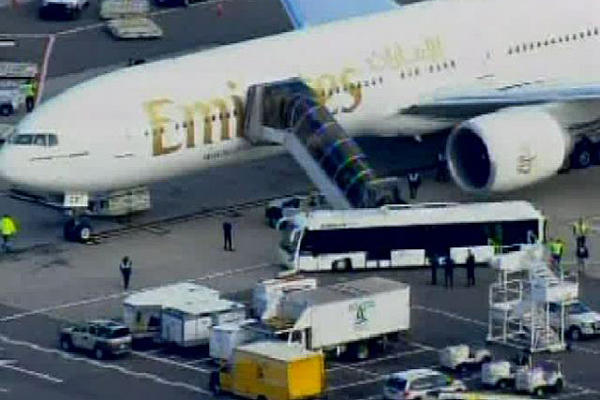
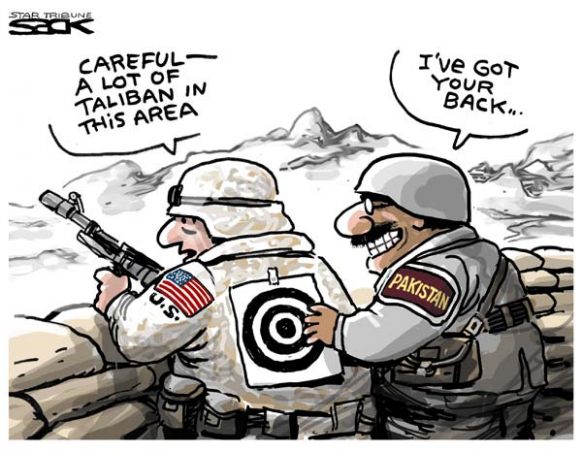

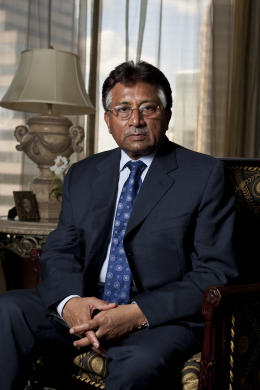

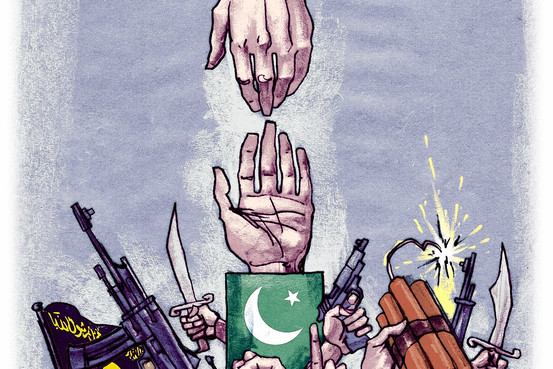
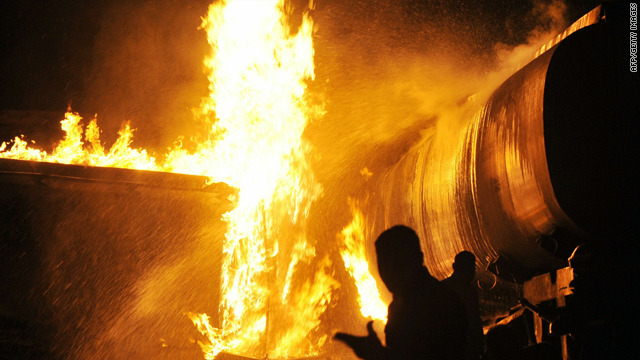
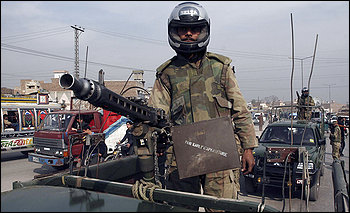



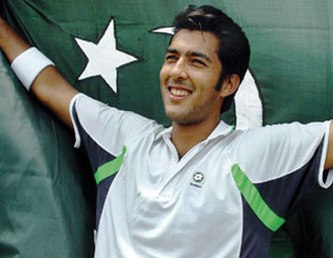
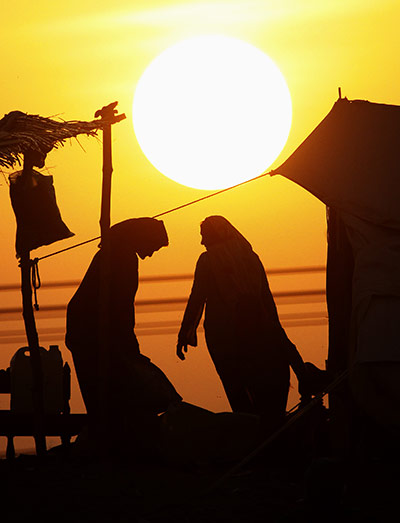


You must be logged in to post a comment.