Posts Tagged ‘ Afghanistan ’

Afghan Midwives Deliver Life-Saving Birth Education

By Nadene Ghouri for the BBC
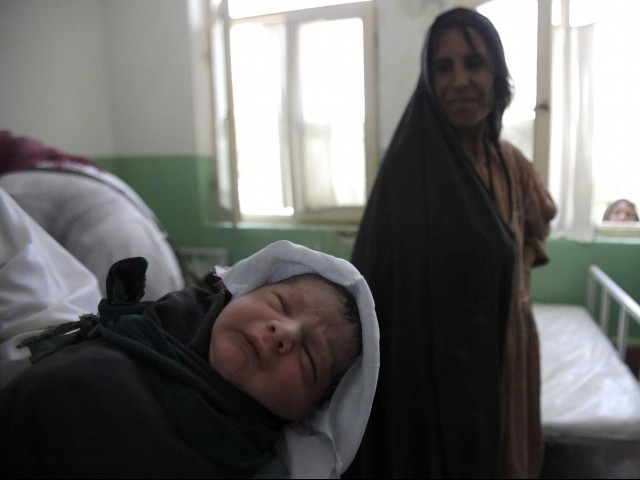
Afghanistan is one of the most dangerous places in the world to have a child. Women face a one-in-11 risk of dying during pregnancy and childbirth, while one in five children dies during or after birth or before the age of five. One initiative is under way to try to make giving birth safer.

Training and education is helping Rogul to save babies’ lives
Rogul wraps a grimy blue scarf around her face and uses the cleanest corner of it to wipe her tears.

She has just told me how nine of her babies died after she gave birth to them at home. Her firstborn, a little boy, was premature. Her mother asked a village mullah for advice. He suggested prayer and a type of holy water. The baby died.

Her second child died from an infection a few hours after birth. And so it went on – nine dead babies in total. I am sitting in an Afghan neonatal clinic in Guldara district, just 20 minutes drive from the capital city Kabul.

Women, some in traditional blue burka, others wearing the brightly coloured scarves and loose pantaloons more typical of the nomadic Kuchi tribe, are here.

Some are clutching roundly pregnant bellies, others are here to have their babies vaccinated. Few would be here at all, if they had not been persuaded to come by a local midwife.

A young girl called Pashtu, with a dirty face and scared eyes, agrees to talk. She does not know how old she is but looks no more than 15. She is eight months pregnant with her second child.

Next month she will give birth in the safety of the clinic. She gave birth to her first child in a filthy hole-in-the-ground toilet at home with only her elderly mother-in-law for help. Her son was born blue and barely breathing. He survived for just under an hour.

I ask her why the baby died? She gives me a nonchalant shrug. Her aunt, a large woman with long braided dark hair is sitting next to her. “Pashtu is too skinny and doesn’t eat enough,” she asserts loudly. “This is why her child died.”

Another woman tells me it is because Pashtu’s husband is an opium addict. Many babies in Afghanistan also die because of traditional cultural practices.

It is common for babies to be washed in freezing cold water immediately after birth – which can cause pneumonia – umbilical cords are cut with unsterile knives, or babies are placed on a dirty floor to ward off evil spirits, which can cause infection.

Few women breastfeed for the first few days because colostrum, the nutritious fluid in early breast milk – something which is vital for a baby’s immune system – is seen here as “dirty”. Instead newborns are often fed melted butter.

Istiqlal Hospital in central Kabul houses the city’s largest maternity ward. Here stories of ignorance prevail. Two teenage girls giggle as they tell me they had no idea how pregnancies happened, even after they were married.

One of them is here because she miscarried at five months. She had not known she was pregnant, because she was not aware of any of the symptoms of pregnancy.

“If we ask any questions about these things, we will be called bad girls,” they explain as their faces flush red with embarrassment. The doctor tells me that their mothers often assume they will work it out for themselves after they marry. But they often do not.

“I see many young girls who have married and still don’t realise sex with their husband equals babies,” he tells me. But change is beginning to happen. The ministry of public health has launched a programme to train and deploy 400 new midwives a year.

What is key is that the women are not outsiders forced on a mistrustful local population, but are local women from the communities they serve. This means religious leaders and conservative husbands do not prevent them from working.

Largely as a result of this, the number of women giving birth who were helped by a trained midwife has more than tripled since 2003. Rogul, who learned the hard way just what giving birth alone can mean has now been given midwifery training by the British charity Save the Children.

This woman who lost nine of her own babies has now saved lives of many others.

She tells me how, the week before, she had locked an angry mother-in-law out of a room where a young woman gave birth, because the mother-in-law had tuberculosis and could have passed the infection to the newborn.

She chuckles with glee as she recounts the tale of the mother-in-law banging on the door trying to get in.

It is clear what Rogul, with a combination of personal tragedy and a solid new education, can achieve in her community. But as yet, there are not enough Roguls to go around.

And for her the story has a happy ending. After her training she realised why her first nine babies had died. When she fell pregnant again, she knew what to do and now has a son and two daughters. “They are living proof of my work,” she says with a big smile.
Teen says 400 Pakistan suicide bombers in training

As Reported by The Deccan Chronicle

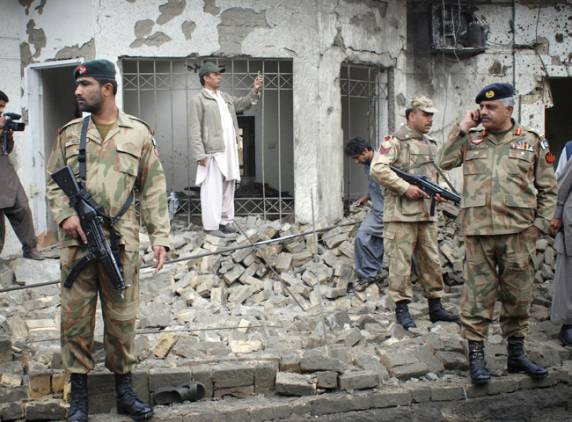
A teenager arrested as an accomplice to Pakistan’s deadliest suicide bombing of the year has said that up to 400 suicide bombers are being groomed to wage carnage in the nuclear-armed nation.

Umar Fidayee, 14, said the would-be bombers were being trained in North Waziristan, the premier Al-Qaeda and Taliban fortress in Pakistan’s tribal belt where US officials want Pakistan to flush out militant strongholds.

He made the remarks in an interview aired Friday from his hospital bedside, where he is being treated after detonating a hand grenade in the April 4 attack that killed 50 people at a 13th-century Sufi shrine.

It was Pakistan’s deadliest bomb attack since November.

Police arrested Fidayee as an alleged accomplice and said they removed his own suicide vest, which he failed to detonate in a crowd of hundreds in Dera Ghazi Khan just minutes after two other bombers blew themselves up.

Shown covered in tubes and bandages, the teen appeared to express remorse and lifted the lid on harrowing details of his training at the camp in the Mir Ali district of North Waziristan, which lies on the border with Afghanistan.

“Three hundred and fifty to 400 would-be suicide bombers are getting training in Mir Ali in North Waziristan,” he said in the interview broadcast by Pakistani television channels Samaa, Express, ARY and Geo.

“I was trained for two months and saw many boys being trained there,” he said, going on to appeal on Pakistanis to “please forgive me”.

“God has given me a new life but I am sad that we killed innocent people, innocent children,” he said.

Fidayee said he was initially recruited on the understanding that he would be smuggled into Afghanistan to kill non-Muslims.

“But they brought me here to Dera Ghazi Khan. I told them ‘there is no kafir (non-believer) here’,” he said.

“They told me these people are worse than kafirs,” Fidayee said.

Exposing an apparently disturbing recruitment at the gates of an ordinary school in North Waziristan, the teenager claimed a man he identified as Qari Zafar convinced him to begin a life of militancy.

“He told me that all this education is useless and said ‘become a fighter and you will go to heaven’,” Umar told the reporters.

He said he was told to attack the shrine 30 minutes after the other two detonated their bombs, in order to cause maximum carnage among those rushing to aid casualties of the first two blasts.

In a message to other potential suicide bombers he said: “Please refuse to carry suicide attacks. Such attacks are forbidden in Islam.”

Islamist militants have increasingly targeted Sufi worshippers, who follow a mystical strain of Islam, in Muslim-majority Pakistan.

Dera Ghazi Khan is close to Pakistan’s tribal belt which is described by Washington as the most dangerous place on Earth and an Al-Qaeda headquarters.

More than 4,200 people have been killed across Pakistan in attacks blamed on homegrown Taliban and other Islamist extremist networks since government troops stormed a radical mosque in Islamabad in July 2007.

Pakistan Rejects US Taliban Report

As Reported by The BBC

The Pakistani military has dismissed the findings of a US report that says it has no clear plans to defeat the Taliban insurgency.

The report assessing the war against militants in Pakistan and Afghanistan has been submitted by the Obama administration to the US congress.

But a senior Pakistan security official told the BBC that operations against militants have been a great success.

The official said that Pakistan should be proud of the progress it had made.

The White House report said that Pakistan still has no “clear path” to defeat militants on its soil.

But the senior official – who wished to remain anonymous – said that Pakistan’s plate was full enough already.

“Instead of pushing us to do more, the other side should carry out an introspection of its own operations,” he said.

“We are quite satisfied with our counter-insurgency campaign in the Swat and Malayan regions and parts of the tribal areas. We can safely say this has been a great success story.”

The BBC’s Shoaib Hasan in Pakistan says that the White House report has been released at a time when relations between the security establishments of the two countries have been strained.

Our correspondent says that the report is likely to raise the ire of the Pakistan military – which says it has lost more men than any other country in the fight against militancy in the region.

‘Vexing’

The White House report said that in spite of “tremendous human sacrifices” made by Pakistani security forces and increased military co-operation between Pakistan and US in the last three months, the fight against militancy was making little progress.

Pakistan claims to have lost more men than any other country in the fight against militancy It cited the example of the this January’s third operation in two years to clear insurgents from Mohmand and Bajaur tribal agencies.

The Pakistani military’s efforts have been hobbled by resistance from the militants, bad weather and the need to settle internally displaced people.

“What remains vexing is the lack of any indication of ‘hold’ and ‘build’ planning or staging efforts to complement ongoing clearing operations,” the White House report said.

“As such there remains no clear path to defeating the insurgency in Pakistan, despite the unprecedented and sustained deployment of over 147,000 forces.”

The report said that Pakistan and Afghanistan needed to co-operate more to destroy insurgent havens on both sides of the border.

The US has long expressed frustration about Pakistan’s reluctance to take on militants in the tribal areas.

Not much Islamic about Islamic Pakistan

By Haroon Siddiqui for The Toronto Star

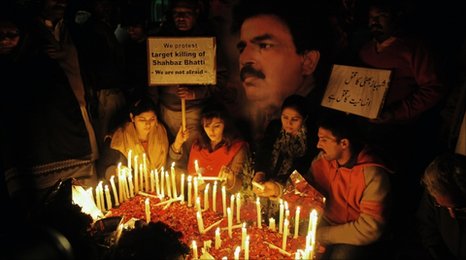
In the failing state of Pakistan, a junior cabinet minister is killed. Shahbaz Bhatti was a member of the Christian minority. He had taken up the cause of a poor Christian woman condemned to death for allegedly defaming Islam. He knew he was a marked man. But on a recent visit to Canada, where his brother lives, he said he was determined to carry on.

Eight weeks ago, a veteran politician was gunned down for the same sin. He, too, had championed the woman’s cause and condemned the blasphemy law that imposes the death penalty for insulting Islam or the Prophet Muhammad. Salman Taseer was the governor of Punjab, the most populous and prosperous province, and an influential billionaire tycoon, a socialite and an unrepentant liberal in a society that’s becoming militantly conservative. He was a Muslim.

Bhatti was gunned down by unknown assailants. Taseer was assassinated by a member of the elite security unit assigned to guard him. More shockingly, the assassin was hailed a hero. Hundreds turned up at his house, chanting “we salute your bravery.” About 500 clerics signed a statement calling him “a true soldier of Islam.” When he appeared in court, young lawyers showered rose petals and kissed him. At a rally in cosmopolitan Karachi, marchers waved his portrait.

This is a sick society. There’s little Islamic about the Islamic Republic of Pakistan.

The blasphemy law may have been enacted by the British colonials in 1860. But it was toughened by the Muslim rulers of Pakistan in the name of Islam. And both in its wording and implementation, the law violates the most basic principles of Islamic jurisprudence. In allowing hearsay evidence and innuendo, it ignores the necessity of incontrovertible proof for a finding of guilt.

The act is allowed to be abused in personal and property disputes. (A majority of those charged have been Muslims, according to the Human Rights Commission of Pakistan, a voluntary organization). Or it is wielded as a weapon in political and religious vendettas. In one particularly horrific case, two Christian brothers were framed with a handwritten note defaming the Prophet, found in a marketplace with their home address and phone number.

Yet local police and magistrates dare not toss out such trumped-up charges. Cases have to be taken to higher courts to be overturned. Not a single person has been executed under the act. Yet more than 30 people charged or acquitted have been killed.

Under Islamic law, such jungle justice constitutes a greater crime than the alleged original one. It is deemed particularly egregious when the innocents prosecuted are poor and powerless.

The blasphemy law is just one of many flashpoints.

Christian churches have been bombed. So have been mosques belonging to the minority Ahmadi sect, deemed heretic. So also mosques of the minority Shiite Muslim sect. So also Sufi shrines, along with the devotees who turn up for the anniversary festivals of dance and music dedicated to those saints.

Not just that.

Pakistani Taliban and other militants have been killing fellow Muslims who won’t side with them. Such attacks were once restricted to the remote Afghan-Pakistan border but now they are routine in the populated south. Tens of thousands have been killed, including Benazir Bhutto, assassinated in December of 2007.

Yet the government is too weak to provide basic security and too corrupt to care — both egregious Islamic crimes. The politicians and the bureaucrats are not the only ones on the take. Too many clerics are also money-grabbing machines.

Several reasons are proffered for this sad state of affairs.

One is that Pakistan has had too many military dictators, and that the longest-serving one, Zia ul-Haq (1977-88) Islamized Pakistan, which he did. But he did so in tandem with the American-led effort to Islamize the war against the Soviet occupation of Afghanistan. Another inconvenient truth is that while the military used jihadist proxy militias against India and Afghanistan, political parties use them as vote banks and to flex street muscle.

The secular-Islamic divide is also cited. Yet both religious and secular elites have pandered to extremists. It was the wine-sipping prime minister Zulfiqar Ali Bhutto who in the 1970s restricted liquor and declared the Ahmadi sect non-Muslim. It is his People’s Party, once again in power, that abandoned backbencher Sherry Rahman after she proposed amendments to the blasphemy law.

Meanwhile, the economy is in ruins. Inflation is rampant, the currency is losing value and the central bank is printing more rupees.

Don’t be surprised if Pakistanis begin clamouring, yet again, for the return of the military to power.

Haroon Siddiqui is the Star’s editorial page editor emeritus. His column appears on Thursday and Sunday. hsiddiqui@thestar.ca

Assassinations are a blemish on Pakistan’s soul

By Shahina Siddiqui for The Montreal Gazette

The assassination by terrorists of Pakistan’s federal minister for minorities, Shahbaz Bhatti, follows the brutal killing of Punjab Governor Salman Taseer a couple of months ago. Both were targeted by extremists because they called for the reformation of Pakistan’s controversial blasphemy laws. These and other attacks on Christians and Muslims in the name of blasphemy laws is a blemish on the national soul of Pakistan that cannot be washed away by empty rhetoric and the muted cowardly condemnations by the political and religious leadership in Pakistan.

There is no place for laws in Muslim countries that are the very antithesis of the spirit, soul, and letter of Islamic law. Prophet Muhammad in his lifetime was insulted, ridiculed and physically hurt, and yet he never ordered, condoned or recommended the killing or even harming of these individuals. There are documented cases where the prophet intervened to save the perpetrators from the wrath of his companions. We do not honour the prophet by murdering the innocent in his name. We honour him by practising compassion and dealing with mercy toward all of God’s creation, yes, even those who hurt us.

There is no justification for the blasphemy laws in the form they exist in Pakistan. The misuse and abuse of these laws have caused the security of religious minorities to deteriorate and be exploited, and it has become a licence to kill people, to destroy property and to create havoc for personal and political interests.

The terrorists are using this law to paralyze an entire nation into submitting to their whims through fear and trauma. The inept political leaders of Pakistan are more interested in maintaining their power and control on the country’s wealth then in actually working for the betterment of their country. The few who dare to stand up to this injustice find themselves isolated and without support.

The genuine religious leaders, on the other hand, are afraid to be labelled by these pseudo-religious terrorists as supporters of blasphemers, and thereby fear losing their own support base, their lives and their reputations. The socalled religious political parties are supporting these laws unconditionally, manipulating the love the masses have for their faith and their prophet, to ensure their own popularity and political gains.

In such a vacuum of moral, religious and human courage the terrorists thrive, the extremists dance in the streets and the ordinary Pakistanis struggle to survive. This ugly situation in Pakistan calls for an uprising of the silent majority. But the disconnect between rural and urban, rich and poor, and the excruciating poverty and illiteracy are barriers that make this an unlikely scenario.

Pakistanis, unlike their coreligionists in the Middle East, face brutality on many fronts: the war on terror that is consuming the country’s resources, the drone attacks that are killing hundreds of innocent civilians, the Talibanbacked terrorists who kidnap, torture, brainwash and blackmail poor rural youth into becoming suicide bombers who target fellow Pakistanis on an alarmingly frequent basis.

The indifference of the ruling elite – political and feudal – and the tyrannical pseudoreligious extremists seem to have paralyzed this nation into a pathological resignation to its “fate.” There is no credible leadership at the national level that is nurturing national pride, identity and vision. The people are adrift, holding on to any straw, no matter how fragile, that will keep them afloat.

In spite of these many challenges, however, I am confident – having observed firsthand the courage, resilience and moral strength of non-governmental organizations, selfless philanthropy by the affluent, and the development and growth of civil society – that Pakistanis will rise and can defend their nation. They must, however, break the chains of fear that are choking their conscience, and stand up for justice.

My prayer is for Pakistan to realize the vision of its founder, Mohammad Ali Jinnah: a vision in which all Pakistanis are granted freedom and security to practise their religions and maintain their places of worship, and where all Pakistanis thrive together, as equals under the law, regardless of ethnicity, gender and religion.

Peace In One Pakistani Tribal Valley Offers Hope

Reported by Abubakar Siddique for Radio Free Europe Radio Liberty
A fragile peace is taking root in Pakistan’s western Kurram tribal region after nearly four years of sectarian warfare between Shi’ite and Sunni Muslims.

Some have criticized a recent peace pact by saying that it is less about forging a lasting peace than about facilitating insurgents’ infiltration into neighboring Afghanistan. But the local population appears committed to making it work.

Success could have far-reaching implications. If peace is possible in a hotbed like Kurram, then it could serve as a model for millions suffering from war in other tribal areas.

‘Many People Were Injured’

Resident Noor Janan’s situation is typical. He lost his budding business in 2007 when clashes broke out between Shi’a and Sunnis in Parachinar. Rioting in the small border city, which serves as the headquarters of Kurram, soon devolved into sectarian war.

As the Sunni population of Parachinar was forced out, the city’s mostly Shi’a population was hemmed in — trapped by retreating Sunnis who blocked the main road to the outside and set siege on the city.

Janan’s priorities changed remarkably. For the past four years his main obligation has not been to look after his wife and four children, but to man frontline trenches and care for the sick and the injured.

Children displaced by fighting stand in line and wait for handouts in 2010.

“Many people were injured and many houses were destroyed,” he said. “I did all in my power to help my people.”

Janan is Turi — a tribe of 500,000 whose adherence to Shi’ite Islam makes it unique among Pashtuns. The Turis occupy a sliver of tribal territory known as the Parrot’s Beak that extends westward across Afghanistan’s eastern border. On the Pakistani side, Parachinar is positioned within striking distance of Kabul, which is just 100 kilometers to its east.

For the most part, the Turis lived in harmony with neighboring Sunni tribes for centuries, with a handful of exceptions. In the 1980s, predominantly Sunni Afghan Islamist guerillas attempted to overrun the strategically important region.

In 2007, a fierce sectarian war broke out when the Sunni Taliban attempted to conquer the Parachinar. More than 3,000 people have died and thousands more injured in the ensuing fighting. Some Sunnis blame Iran for the development, claiming the clerical regime supported and radicalized their Shi’a neighbors.

Both Sides Committed

Animosity remains high, but a cease-fire worked out in early February and backed by Islamabad offers proof that Shi’a and Sunni alike are committed to peace.

Middle-aged businessman Munir Khan Orakzai, who represents the Sunni population of the lower half of Kurram in Pakistan’s parliament, said that both sects realize that they have fought a useless cause that killed many innocent people. “There can be no logical end to this [sectarian violence],” he said. “That’s why people concluded this agreement.”

Tribal elders and government representatives attend a peace conference in Parachinar in 2008.

A peace agreement was signed before, in 2008, but it lacked government support and rival factions had one eye on possible military gains.

Under the new agreement, Islamabad is promising rehabilitation for the thousands of displaced families, and the deployment of additional troops to guard key routes.

Work Of The Haqqanis?

Skeptics abound. Pakistani pundits suggested that the deal was worked out by the Haqqanis — a large Pashtun family from Afghanistan whose elderly patriarch Jalaluddin Haqqani emerged as one of the most effective guerilla commanders in the 1980s.

His son, Sirajuddin Haqqani, now controls thousands of fighters and facilitates relations between Al-Qaeda Arabs, extremist Afghans, Pakistanis, and Central Asians out of his sanctuary in North Waziristan, which adjoins Kurram to the south. Considering the Haqqanis anti-Shi’ite bent and outsider status, any role in an agreement would be rejected by Kurram’s Shi’a.

Sajid Hussain Turi, a young lawmaker representing the region’s Shi’ite population in the Pakistani parliament, adamantly rejected any Haqqani role. “We, the Turis, have lost 1,200 people and more than 5,000 of our people were injured in this,” he said. “There is no question of involving people in this process that would ultimately harm us.”

Turi said that the weakened position of the Taliban, in disarray after years of military operations, opened the door to peace. He said that even local Sunni allies of the Taliban now see the futility of their military campaign.

Key intermediaries have high hopes for sustainable peace in Kurram. Waris Khan Afridi, a respected tribal leader from the neighboring Khyber tribal district, was among the mediators who put in countless hours bringing the two sides together.

Unforgettable Scene

On February 5, Afridi led the first civilian convoy of hundreds of vehicles to mark the break of Parachinar’s siege. He described an unforgettable scene of thousands of Sunni and Shi’ite villagers welcoming his entourage. “It was like they all were freed from prison that day,” he said.

Now, Afridi said, Pashtun tribes in neighboring tribal valleys are poised to follow the Kurram example. “We have always said that force is not a solution for anything and that the military operations will not solve our problems,” he said.

“Peace in Kurram,” Afridi said, “will positively affect all the tribal areas, the [neighboring] province of Khyber Pakhtunkhwa, and the whole country.”

A Reality Check on India, Pakistan

By Ahmad Majidyar & Apoorva Shah for The Diplomat

On February 10, India and Pakistan announced that they would resume peace talks that were suspended after Pakistan-based terrorists attacked multiple sites in Mumbai in November 2008, killing 170 people. Washington welcomed the announcement, no doubt hoping that détente between the two nuclear neighbours might lead them to end their proxy war in Afghanistan, and leave Pakistan better able to fight the Taliban and al-Qaeda on its own soil.

But it’s much too early to get carried away. After all, diplomacy conducted under terrorism’s shadow can backfire, and should there be another attack on Indian soil, Indian policymakers—even those in favour of reconciliation—may well conclude they have no partner in Pakistan, bringing the prospect of conflict closer.

It’s also not at all clear that Pakistan really is sincere in its desire for rapprochement. The country has reportedly doubled its nuclear arsenal over the last four years, and is believed to be building its fourth plutonium reactor. Western nations should be troubled that a country that professes to be committed to fighting Islamic militants at home has decided to focus so much attention on developing its nuclear prowess instead. 

Indians should also be concerned.  On July 15, 2010,India and Pakistan’s foreign ministers met in Islamabad supposedly in order to ‘restore trust.’ But the talks collapsed in acrimony, with the Indian side claiming that Pakistan had failed to move to resolve differences over the prosecution of anti-India terrorist groups operating from its territory. Just ahead of these talks, Indian Home Secretary G. K. Pillai had claimed that Pakistan’s Inter-Services Intelligence (ISI) had played a ‘much more significant’ role in the Mumbai attacks than was initially thought, adding that he believed Pakistan was ‘coordinating it from the beginning till the end.’

Testimony by captured alleged Pakistani-American terrorist David Headley appeared to support Pillai’s claims, with Headley reportedly telling FBI interrogators that the ISI went so far as ‘choosing the weapons to be used in the attack.’

If all this is true, then there can be no serious diplomacy until Pakistan stops seeking to leverage Islamist militancy as a weapon in Kashmir and against India. Lashkar-e-Taiba (LeT) and similar groups continue to operate freely in Pakistan. Last February, for example, LeT’s leader Hafiz Saeed led a 10,000-strong procession in Lahore to mark ‘Kashmir Solidarity Day’ and warned India to ‘liberate’ Kashmir or face jihad. Indeed, he also signalled a possible expansion of conflict, suggesting that the group might broaden its operations to the southern Indian—and largely Muslim—district of Hyderabad.

But it isn’t just militant leaders who are troubling Indian policymakers. Former Pakistani Prime Minister Nawaz Sharif’s political party, currently in control of Pakistan’s Punjab provincial government, appears to be promoting militancy, at least judging by its official budget last year. As the BBC reported at the time, the government allocated $1 million to Jamaat-ud-Dawa, a charity on the UN terrorism watch list and a Lashkar-e-Taiba front group.

The reality is that many Pakistani political leaders don’t seem to want to move forward on talks. Former Foreign Minister Shah Mahmood Qureshi, President Asif Ali Zardari, and Prime Minister Yusuf Raza Gilani have all appeared sincere, but they seem to lack even the limited control that former President and army chief Pervez Musharraf wielded over the military and intelligence apparatus during his tenure. Meanwhile, the man currently in charge of Pakistan’s military—Gen. Ashfaq Kayani—appears to show no interest in détente, conceding in his own words that he has an ‘India-centric’ bias to his military strategy. 

In theory, Indo-Pakistani diplomatic engagement is a must for regional security. In 2007, talks came close to reaching an agreement on the Kashmir dispute before being derailed by terrorism and domestic political unrest in Pakistan. But Indian diplomats shouldn’t succumb to the exuberance of rapid-fire talks so long as a disconnect remains between Pakistani civilian leaders and their military and intelligence establishment.

The same goes for the White House and State Department—hopes should not be placed on regional security talks without proper conditions for lasting progress being in place first. And the most important of these conditions? Ensuring a complete and no-nonsense end to any proxy support for terrorism at all levels of the Pakistani government.

Ahmad Majidyar and Apoorva Shah are researchers in South Asia studies at the American Enterprise Institute.

Veteran US Diplomat To Replace Holbrooke as Pakistan-Afghan Envoy

By David Usborne for The Independent, UK

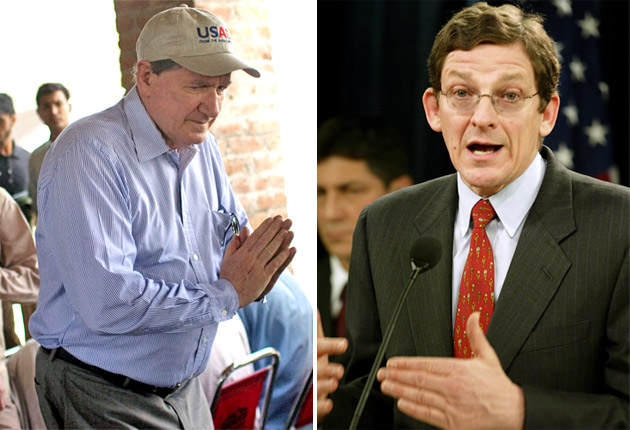
The long and fractious search for a replacement for the late Richard Holbrooke as a special US envoy to both Pakistan and Afghanistan is over, but the job of filling his shoes is looking more impossible than ever, not least because of an expected exodus of top American officials from Kabul this year.

Marc Grossman, who was a top-rank US diplomat for three decades until he moved to the private sector in 2005, has agreed to take on the post after others turned it down. His appointment is expected to be announced by Hillary Clinton, the US Secretary of State, during a speech in New York on Friday.

The death from a torn aorta of Mr Holbrooke, a giant on the diplomatic stage, left a void in America’s diplomatic front in Afghanistan and Pakistan. While some in the White House resented the wide remit he enjoyed dealing with both countries, Mrs Clinton was adamant she needed someone of similar stature in his place.

Several high profile names were passed over for the job or turned it down, including Strobe Talbott and John Podesta, both of whom served former President Bill Clinton. Another who declined to don the Holbrooke mantle was Frank Wisner, another former diplomat who unsuccessfully sought to mediate with Hosni Mubarak of Egypt before his ouster last week.

Mr Grossman, currently chairman of the Cohen Group which advises companies on ventures overseas, will take the job at a particularly tricky juncture. Relations between Washington and Islamabad are at an all time low, and in Afghanistan the clock is ticking on the start of US troop withdrawals this summer.

The diplomatic and military team he will inherit in Afghanistan will meanwhile begin to dissolve almost the moment he arrives there. Among those set to depart are Karl Eikenberry, the US Ambassador there, as well as all four of the top US officials in the embassy.

It is widely expected, meanwhile, that the top military commander of Nato forces in Afghanistan, General David Petraeus, will be rotated out before the end of the year. The number two military officer there, Lt Gen David Rodriguez, who runs day-to-day military operations, is also set to leave. Officials at the State Department and the Pentagon concede that finding replacements for the departing officials will be difficult.

Violence in Afghanistan is still at critical levels. On the political level, the US is striving to overcome long-running tensions with President Hamid Karzai, while trying to push forward a process of reconciliation talks with elements of the Taliban and other insurgent groups that are seen as crucial to achieving stability, and step up training of Afghan soldiers and police officers.

“Afghanistan is keen to work closely with the new Afghanistan-Pakistan envoy in better coordination and understanding,” commented Siamak Herawi, a spokesman for Mr Karzai, who had a prickly relationship with Mr Holbrooke.

The latest downturn in relations with Pakistan follows the arrest of an American at the US embassy on charges of murder. So far the Pakistani government has ignored calls from Washington that the accused, Raymond Davis, who is on the embassy staff, be given diplomatic immunity in the case. He has claimed that he shot the two men in self defence as they attempted to rob him.

In Islamabad yesterday on a mission to try to resolve the stand-off was Senator John Kerry, the chairman of the Senate Foreign Relations Committee and arguably the only person available in Washington with the stature to get the Pakistani government to focus on the issue. Bilateral talks that were scheduled to take place at the State Department next week have been postponed by Mrs Clinton because of the dispute.

The biggest challenge of all for Mr Grossman will be winning the trust and respect of leaders in both Pakistan and Afghanistan while navigating the sometimes conflicting priorities of his various bosses in Washington at the State Department, the Pentagon and the White House.

Leading players on their way out:

General David Petraeus

Unexpectedly pulled into Afghanistan after the sudden departure of General Stanley McChrystal last year, Petraeus is drafting withdrawal plans for President Obama. Once he has presented the President with options for the best exit strategy, which he is expected to do in July, there are suggestions that he could look to stand down. He has denied that he could seek the Republican presidential nomination for 2012.

Ambassador Karl Eikenberry

With his relationship with President Karzai strained at best, there have long been rumours in Washington of Eikenberry’s return home; any departure, though, was held up by the exit of McChrystal, when it was felt that another change at the top of Afghan policy would be unhelpful. A similar logic may have applied after Richard Holbrooke’s death. One of Grossman’s key tasks will be identifying the best candidates to replace him.

Lt. General David Rodriguez

Named as deputy commander in Afghanistan in 2009, Rodriguez has considerably more experience in the country than Petraeus, and holds responsibility for day-to-day operations, with particular expertise in counter-insurgency. If suggestions that he could be going home soon prove correct, there are fears that a shortage of top-class military leadership with knowledge of the country could be exposed.

Global Sufi Fest Attracts Thousands

As Reported by the Times of India

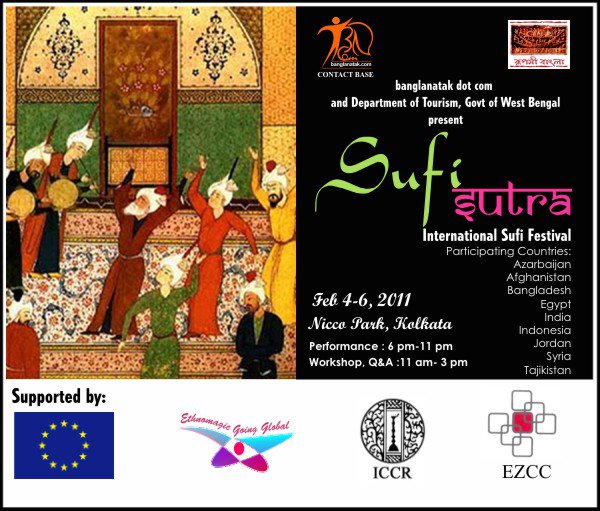
Soulful renderings of Sufi music by wandering minstrels from different parts of the world left the listeners spellbound here at the three-day ‘Sufi Sutra’ which ended on Sunday.

Besides Indians, Sufi singers and musicians from Afghanistan, Bangladesh, Egypt, Iran, Syria and Tajikistan presented mystic Islam through songs, dance and poetry.

Notwithstanding the current political turmoil back home, an eight-member Egyptian Mawlawyiah troupe enthralled the audience by an audio-visual of music and circular dervish dance whirling around singers in a circle.

A Bangladeshi team, led by Anusheh Anadil, sang the household songs of the famous 18th century poet-philosopher Fakir Lalon Shah, on whom based the recent Golden Peacock winning Bengali film ‘Moner Manush’.

The ‘bauls’ and ‘fakirs’ of West Bengal’s Nadia and Murshidabad districts were huge hits by their spontaneous, simple and meaningful lyrics.

Another Bengal team led by Armaan Fakir presented the little-known ‘Bangla Qawwali’. Traditionally performed at the Dargahs, the devotional songs had ‘Dhol’ and ‘Khol’ as percussions replacing Tabla.

The first Sufi ensemble also included the ‘Warsi Brothers’ from Hyderabad, Delhi’s ‘Druv Sangari’ and team, ‘Mirs’ from Bikaner and ‘Haji Md Ahmed Khan Warsi’s team from Uttar Pradesh.

“It is a peace concert in times of violence. We want to bring a convergence of ideas about truth, harmony, self-belief and peace through music. It is a celebration of the quest for the divine through love,” organiser Amitava Bhattacharya said.

Besides musical performances, the festival included workshops and exhibitions to showcase the traditional culture, beliefs and music of the Sufi mystics.

“We had more than 10,000 people at the open-air concert, while more than 700 people, including young students, learnt about Sufism at the pre-concert workshops,” Bhattacharya said.

The event would also help the poor musicians, most of whom were from the rural areas, to earn a livelihood, he said.  The festival was organised by Banglanatak.com in collaboration.

Pakistanis for Peace Editor’s Note– It’s a sad reality that singers from a  country rich in Sufi history and traditions like Pakistan, are  unable to attend this festival due to the 60+ year friction between the two brothers India and Pakistan. They are two halves of one nation.

Cultural exchanges like these, billions in cross border trade, Bollywood and Lollywood collaborations, sports matches, etc are just some of the things the two are missing out on due to their relations. We hope one day peace can finally come to this ancient and holy land that is the subcontinent.

Bombers target Shiites in Pakistan, killing 12

As reported by The Associated Press

Suicide bombers attacked police protecting marches by minority Shiite Muslims in Pakistan’s two largest cities Tuesday, killing 12 people and wounding dozens, officials said.

The first and most deadly attack occurred in the eastern city of Lahore, where the bomber detonated his explosives as police tried to search him, killing 10 people. About an hour later, a second bomber struck in the southern port city of Karachi, killing at least two people.

The attacks laid bare the challenges facing Pakistani officials trying to secure cities far from the northwest, where militants fighting Pakistan’s U.S.-allied government and American forces in neighboring Afghanistan have long thrived. Many recent attacks have targeted minority Muslim and other religious groups.

The Taliban claimed responsibility for the attack in Lahore, where thousands of Shiite worshippers were marking the end of a 40-day mourning period for the Islamic sect’s most beloved saint when the blast hit their procession early Tuesday evening.

The bomber is believed to have been a young teenage boy who was wearing a suicide bomb jacket and also carrying a bag full of explosives, said senior police official Aslam Tareen. He detonated his explosives when police tried to search him, he said.

“It is a great sacrifice by the police officers who laid down their lives to protect innocent people,” said Tareen.

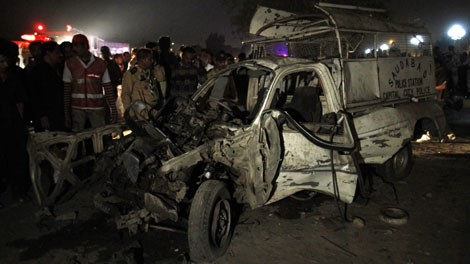
Footage from the scene showed ambulances racing to the area and men carrying away victims. One young man whose arm was apparently hurt screamed as he was placed on a stretcher. A white car caught up in the explosion was largely destroyed, its hood twisted upward. A man lay wounded on the ground with two women and a child weeping beside him.

Dr. Zahid Pervaiz at the city’s Mayo Hospital told reporters that 10 dead bodies had come in, while another 52 people were wounded.

Shakirullah Shakir, a spokesman for the Fidayeen-e-Islam wing of the Pakistani Taliban, told The Associated Press in a phone call that the militant group had dispatched the bomber and warned of more bombings.

Later Tuesday evening, a suicide bomber struck police protecting a group of people returning from a Shiite march in the Malir neighborhood of Karachi, Pakistan’s largest city.

Three people were killed and three wounded in the attack, said Hamid Paryar, a doctor at Karachi’s largest hospital. Two of those killed and one wounded were policemen, he said.

The third person killed is believed to be the suicide bomber, who was riding a motorcycle and carrying his explosives in a bag, said senior police official Shaukat Shah.

The blast occurred near a police van protecting the Shiite marchers, said Akbar Jaffry, who witnessed the bombing.

Attacks roughly tripled last year in Lahore and Karachi, according to a recent report by the Islamabad-based Pak Institute for Peace Studies.

The trend is a sign that militants are having greater success exporting the fight far from their northwest heartland along the Afghan border. The Pakistani army, under U.S. pressure, has carried out several offensives against militants in its northwest, but violence persists.

Pakistan Army Propaganda Drama Set for TV

By Khurram hahzad for The Associated Press

Pakistan’s Taliban-fighting soldiers are set for celebrity status with the launch of a multi-million-dollar glossy television drama hailing army victories over militants.

Emotive tales of 11 “brave Pakistanis” battling an Islamist insurgency that is plaguing Pakistan and neighbouring Afghanistan, will air on the small screen in an army-funded drama that casts the anti-terror fight in a positive light.

Focused on the heroism of soldiers fighting a key air and ground offensive in the northwestern Swat valley in 2009, one tale looks at the deeds of soldier Hawaldar Naeem Asghar who died fighting an insurgent checkpoint.

Asghar, portrayed as a hardworking soldier from peasant roots, sacrifices his life to overcome Taliban dug in to a hilltop, during operations in the town of Mingora to flush militants from the picturesque valley.

Throwing grenades from his bunker without success, Asghar is depicted abandoning cover and climbing the hill, tossing more explosives on his way as bullets rain down from the rebels’ post.

The checkpoint is destroyed, but Asghar is killed.

“Hawaldar Asghar’s story is a common man’s story. It’s a message to the public that everybody can play a role in the fight against extremism,” says Sajjad Saji, one of the drama serial’s writers.

“It is filmed to encourage the common people in this war,” he adds.

Urged by its key but critical ally the United States to launch further operations in the lawless tribal areas bordering Afghanistan, the army wants to show the sacrifices it has already endured in the war on terror.

“The basic purpose is to reveal the deeds of bravery of our soldiers, officers and civilians who are at the front of this war…. This drama shows the human face of the war,” says Major General Athar Abbas, head of the army’s publicity wing.

“The nation should own these stories of bravery and sacrifice, they should be proud of our sons and daughters of the land who created these true stories with their blood and defended the motherland.”

One of the filmmakers, who would not be named, said the high-end production was a “multi-million-dollar” effort, but refused to put a precise figure on costs.

The production, peppered with special effects, was filmed amid rugged verdant hills and forests close to the Swat valley — scene of major operations by Pakistan’s military in 2009 to rid the area of rampant militancy.

“We travelled extensively to film this serial. A crew of more than 35 people with trucks of luggage roamed in the forests and hills for months to show the reality,” said Khawar Azhar, the show’s executive producer.

The former tourism hotspot of Swat slipped out of government control after a radical cleric led an uprising in July 2007, beheading opponents, burning schools and fighting to enforce a harsh brand of Islamic law.

Pakistan launched a blistering air and ground offensive in the valley after militants marched out of Swat and advanced to within 100 kilometres (60 miles) of the capital Islamabad in April 2009.

After heavy fighting that displaced an estimated two million people, the military declared the region back under army control last summer and efforts have begun to revive the local economy amid sporadic outbreaks of violence.

Television productions are one of the tools adopted by the military’s publicity wing to polish its image and boost recruitment and morale at a key juncture in anti-Taliban efforts and with religious conservatism on the rise.

Accused by US-based Human Rights Watch of carrying out collective punishments on relatives of militants since it re-established control over the Swat valley, the army knows the importance of securing local hearts and minds.

More than 4,000 people have been killed in Taliban and Al Qaeda-linked attacks since government forces launched an attack against militants in a mosque in Islamabad in 2007.

The television drama depicts the bitter divide between Pakistan’s opposing cultures as the moderate middle class fights religious extremism in a country fractured by deep regional political divided.

In other episodes the film makers show the victims of Taliban power — one girl is subject to brutal gang rape by militants, while in another a young boy is brain-washed into becoming a suicide bomber.

Pakistan Confronts Deepening Radicalism in Wake of Assassination

By Sarah A Topol for AOL News

ISLAMABAD, Pakistan — When Vice President Joe Biden made his surprise visit to Pakistan this week to shore up the battle against the Taliban and al-Qaida, he warned against the implications of increasing radicalism in Pakistani society in light of the assassination of a liberal governor by his bodyguard.

“The governor was killed simply because he was a voice of tolerance and understanding,” Biden said at a news conference Wednesday. “As you know all too well … societies that tolerate such actions end up being consumed by those actions.”

But when President Barack Obama meets Pakistani President Asif Ali Zardari later today in Washington to discuss counter-terrorism in Pakistan’s lawless frontier, he greets a president facing a new fight against radicalism deep in the heart of Pakistan’s urban centers.

Since Mumtaz Qadri unloaded over two-dozen bullets into Salmaan Taseer’s back because the outspoken liberal called the country’s blasphemy laws a “black law,” ecstatic crowds have flocked to shower Qadri with rose petals at his court appearances. Facebook fan pages and a fawning YouTube video cropped up within hours of the murder.

The glorification of a confessed killer by the masses has shocked the country’s small liberal minority. But most troubling has been the reaction of Pakistan’s urban middle class, whose support the United States needs in its war against terror and against the Taliban in neighboring Afghanistan.

From lawyers to tech-savvy Web users, the reaction of the educated middle class has most clearly illuminated the toehold that Islamic extremists have found when it comes to religious issues in Pakistan, even as the country continues to resist the allure of Islamic militants. Some see the reaction of the middle class as the expression of latent social outrage over how Islam is treated by the West, combined with a growing confusion over how to follow their faith in the modern world. This dormant indignation has found an outlet in the murder of a liberal governor.

“Taseer is a victim of religious extremism, but this religious extremism is wrapped up in a class and culture war, between the have-nots and the have, between the socially disposed and the possessors of society, between the globally connected and the globally disconnected,” Mosharraf Zaidi, a political analyst and policy development adviser in Islamabad, told AOL News.

Zaidi sees the convergence of educated Muslims around Qadri as a sign of confusion among the middle class over how to rationalize their modern lifestyle with Islamic tenets, prompting them to defer to radical right-wing mullahs when it comes to certain religious issues, like blasphemy.

“The Islamic narrative in Pakistan is dominated by a small religious establishment who has no viability electorally and who has limited social appeal. But on a number of specific issues they’re able to tap into something much deeper than what’s apparent in a day-to-day situation that awakens the inner radical,” Zaidi said. “The middle class is increasingly susceptible to the symbolism of the little guy taking on the big guy.”

Among Qadri’s most stalwart supporters are some of the same jurists who staged months of protests against Pakistan’s military dictator in 2007 and 2008, when Gen. Pervez Musharraf removed the country’s chief justice.

“We were supporting rule of law, the supremacy of the constitution and the independence of the judiciary,” said Mohammad Faisal Malik, who notes he was an active participant in the movement. “It was the most memorable year of my life.”

Dressed in a dapper black suit, Malik has a neat mustache and carefully styled sideburns that don’t suggest a picture of extremism taking root in Pakistan’s judicial system. But today he is among the group of lawyers who have been throwing garlands and chanting slogans in support of Qadri outside the district courthouse in Rawalpindi, and he is also one of the 500 lawyers signed on to represent Qadri.

Malik does not see a contradiction in supporting both the rule of law and a man who took the law into his own hands.

“Mr. Qadri reacted under certain provocation, feeling hurt from the remarks of the deceased governor. He acted like any Muslim will act when anyone uses filthy language against our prophet. … We were chanting and raising slogans against all those sectors that are using objectionable language against Muslims, against our holy prophet and against our religion. That was our message,” Malik explains in nearly flawless English, expressing a sense of global victimhood common among his compatriots.

In Pakistan, the day-to-day injustices in an impoverished society find no legal outlet. Corruption here is rife, and the rich can bribe their way out of anything. The lawyers supporting Qadri express an understanding of why the security guard picked up a gun.

“He took the law into his own hands when he thought he was helpless. He’s not in a position to initiate criminal proceedings against Mr. Taseer, so he reacted in this manner,” Malik said.

But some say the passivity of the educated class toward radical strains is not merely a product of a class and culture struggle but part of a larger generational gap in Pakistani society. Under the rule of Gen. Mohammad Zia ul-Haq in the 1980s, Pakistan underwent an Islamization campaign as the military dictator sought to unify the country and encourage jihadists to fight against Indian control of Kashmir and the Soviet occupation of Afghanistan. Today, some suggest, the younger generation is the product of state-sponsored radicalization.

“The state as a machinery is supporting and promoting religious extremism, and it happens through various means. It happens through media messages, it happens through textbooks,” said Marvi Sirmed, a human rights activist and blogger.

“The literate, quasi-educated urban population is the most vulnerable to these extremist propagandas, because they are exposed to electronic media and the outside world through social networking,” Sirmed said. “And I see a lot of stuff coming out through these sources that if you are naive, they can make you a suicide bomber very easily.”

It is this middle class, struggling with its faith in an age of global media and inter-connectivity, that the U.S. needs to win over, and it is precisely this sector it appears to be losing.

Pakistan’s middle class sees the United States not as a model of liberal values to be followed but rather as a country that inflicts repeated indignities upon Pakistanis’ culture and sense of worth with its military forays into the region in the past 10 years.

“We have to pay attention to the narrative of indignity, because it’s fueling things that start only as rhetorical and verbal but could very well link to Faisal Shahzad’s Nissan Pathfinder,” said Zaidi, referring to the failed Times Square bomber, an educated Pakistani who knew the United States only too well.

Key Party Rejoins Pakistan’s Coalition

By J David Goodman for The New York Times

A day after Prime Minister Yusuf Raza Gilani announced a rollback of fuel price increases that were deeply unpopular in Pakistan, a major political party said on Friday that it would rejoin the ruling coalition, defusing a tense political standoff and saving Mr. Gilani’s government from potential collapse, news reports said.

The party, the Muttahida Qaumi Movement, broke with the ruling Pakistan Peoples Party over the weekend in part to protest the price increases and other reforms proposed by the government, causing a political crisis for the prime minister and President Asif Ali Zardari. Opposition parties echoed the call to reverse the increases as well as recent cuts in spending and threatened the government with a three-day deadline before a no-confidence vote.

Political tension deepened on Tuesday with the assassination of Salman Taseer, the governor of Pakistan’s most populous region and an ally of Mr. Zardari, because of his support for changes to the country’s blasphemy law.

Raza Haroon, a senior leader in the Muttahida Qaumi Movement, said on Friday that his party had decided to rejoin the ruling coalition for the sake of democracy and the country, The Associated Press reported.

While the government appears to have survived for the moment, it does so at the expense of political and economic reforms encouraged by the United States.

In a meeting with Muttahida Qaumi Movement party officials on Friday, Mr. Gilani said that he would also put off proposed changes promoted by the State Department and the International Monetary Fund to increase tax collection, Reuters reported.

Pakistan, an important American ally, still faces a widening rift between secular and religious forces within the government, even as its army battles Taliban insurgents around the country’s mountainous northwestern border with Afghanistan.

The killing of Mr. Taseer, by a religiously motivated member of his own security staff, raised concerns for the United States and exposed the deep divisions in Pakistan. His killer, who proudly confessed the crime to the police, has been celebrated by many and was greeted by affectionate crowds throwing rose petals both times he appeared in court this week.

But Adm. Mike Mullen, chairman of the Joint Chiefs of Staff, said earlier this week that Pakistan’s security relations with the United States would survive the crisis.

The Illiteracy of Hate

A News and Opinion Special Report by Manzer Munir for Paksitanis for Peace

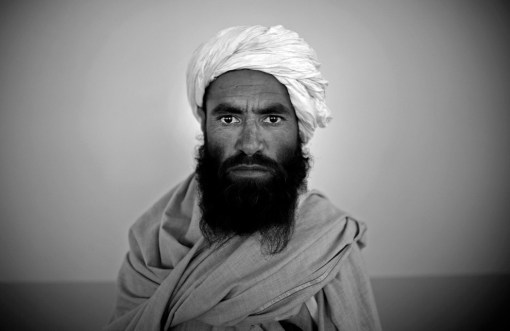
Alleged Taliban Member pic courtsey of Boston Globe

The Taliban are not just simply a bunch of illiterate thugs and bullies for they too often prove to be even worse than animals and barbarians.

Nowhere else in the world has a country experienced a more tragic and callous attack as the one on Christmas day, the birth day of Jesus, the Prince of Peace, than the one Pakistan experienced. In an attack described by President Obama as an “affront on humanity”, the cowards attacked helpless women, children and men while they queued up in food and aid distribution site such as the WFP depot, people who mind you are already suffering from the ongoing war, once in a lifetime floods, and the poverty and radicalism of a generation of desperate, hopeless and increasingly uneducated young men brainwashed by the Taliban and other radical Muslim extremists.

I am still disturbed by the disdain for basic human life that this new attack proves about this radical and extreme enemy. I imagine another one of their brain washed ‘walking zombies’, this time purportedly a woman suicide bomber, a first, even for Pakistan, killed in excess of 43 people in Bajur Pakistan at a World Food Program rations and aid storage and distribution center.

The Pakistani authorities and several domestic and foreign NGO’s who provide food aid at various centers in the area are temporarily closing these centers in order to have increased security. This means that aid distribution will come to a crawl and up to several hundred thousand people will now have to suffer at the hands of the attacker and their backers, the Taliban who have claimed responsibility. The authorities will have to ensure the safety of aid organizations and their personnel for both Pakistani and non Pakistanis relief workers involved in getting food, water and medicine to many people who are either suffering from the war or from the floods.

This catastrophe, although not of near Biblical proportions, does present both a security and humanitarian problem to both the government of Pakistan as well the suffering citizens in the northwest areas of the country where; Taliban fighters take sanctuary from the war in Afghanistan to regroup and return to the fight in warmer weather after the winter months as we have seen in years past. In fact, the reach of the Taliban in Pakistan is now not only reputed to be in the headquartered areas such as in Quetta Pakistan among the restive Baluchi population, now they are so often found to be in major cities like Karachi, Lahore, Rawalpindi, Peshawar and many points in between as they use their religious cover to endear themselves to certain impressionable, weakened or illiterate individuals that are so commonly found in throughout the country. 

Here are the some of the depressing facts. Pakistan, a nation approaching 180 million people at current estimates, perhaps only boasts to having about 60-65% of the male population at a literate level and at best, the females to be only at 40-45% of the total female population. Sadly, what this means is that 4 out of 10 Pakistani males are completely illiterate while up to as many as 6 out of 10 women are not able to read or write. Poverty breeds extremism since there is no support from any government programs or hope for any solution.

Time and time again throughout history and not just of Pakistan’s, we can see that the role of the church, synagogue or mosque in building the community is deeper than that of any government initiatives or other measures. The poverty for these young men along with the lack of jobs like for those individuals who are either very poorly paid construction site workers, household labor or servants, or beggars and sewer workers, a job sadly almost seems to have been reserved for Pakistan’s Christian community members as many can attest in Pakistan of their unfortunate and depressing state. One does not need to remind the reader of the plight of Asia Bibi (also Aasia and Ayesa), the Christian Pakistani woman who is still awaiting her fate in Pakistani courts after more than a year and a half since first being accused of a BS blasphemy charge and being in jail ever since. 

The medieval mentality of these radical extremists is not something that needs to be described as the evidence is here in this latest attack . Certainly anyone alive in any part of the world outside Pakistan and Afghanistan with eyes, TV, radio or newspaper within their reach can see plenty of near daily reminders of the carnage that many natives of these lands see, and to what they have painfully become accustomed.

 The Pakistani and Afghani Talibans have by all the various reports in newspapers and media sources over the last several years have pointed out to the fact that these groups all have too often similar goals. Not only that, these groups all share the same characteristics. The anti-Americanism, the pro-Wahaabi or Orthodox version of Islam, the need for justice for the ‘suffering of the Palestinian people’ , and the anti-colonial and often times anti western sentiment amongst these groups. The radicalization of certain Muslim groups be they Hamas and Hezbollah in the Mideast or Lashkar e taiba, or any other militant outfit operating in this part of the world as mentioned in this quote a few days before he passed, the late Richard Holbrooke of the US State department said that there are a range of militant groups such as the Afghan Taliban, the Pakistani Taliban, the Haqqani Network, Lashkar-e-Taiba, and that “an expert could add another 30.” His exact words are in quotations. 

The radical Muslim groups who take prey of the weaker, cannot think for themselves because they are scions of those abjectly illiterate segments of the society who are only educated in the madrassahs of Pakistan. This is the de facto way of educating Pakistan’s poorer children in little mosque schools which consist of nothing but Qu’ranic surahs and words of ‘wisdom’ or ‘interpretation’ by the local mullah of the said mosque/school. Most probably these children in many Pakistani madrassahs, especially the ones who live near the border areas within the NWFP or North West Frontier Province of Pakistan as this is the part of the country most affected by its close proximity to Afghanistan.

The people in this area of Pakistan, as well as their cousins in Afghanistan have been fighting one enemy or another for the better part of 100 years now. Whether to them the enemy be the British, during the height of the British Raj rule in India, or to the Soviets and the Red army and the Cold War, then in chronological order came the infighting after the Russian withdrawal as various Tajik, Afghani, Uzbek, Pakistani warlords came in to try and consolidate power to now us Americans and the Pakistanis who are our allies in this war.

Granted we do often hear that the Pakistanis can be doing more. By all accounts, the Pakistani government can do more in terms of fighting this war on terror. Numerous western reports and articles in respected dailies have alleged that small elements within both Pakistan’s Army as well as the spy agency, the ISI, have sympathizers to either the Taliban’s cause or they want to be on favorable terms with a powerful entity that most in Pakistan’s establishment believes that Pakistan will be dealing with and not a weakened Karzai once the US begins to draw down troops and end the war by 2014. If this is indeed true, then these ‘officers’ and supposed ‘leaders’ of Pakistan should realize that the colluding with the enemy, which in this case is the Taliban, is tantamount to treason, and the members of the armed forces of Pakistan as well as the intelligence community should not be assisting the enemies of all concerned: Afghanistan, Pakistan and the United States. 

Of course we must not kid ourselves and assume that only alleviating the illiteracy and poverty of the Pakistani youth will and bettering the education system of the Pakistani poor, particularly that of the refugees and residents of the northwest areas near the Afghan border. No there needs to be a study and introspection by the people of these two countries where this hatred breeds. To to get out of this darkness, the population needs be provided not only safety when delivering food aid and or medicine but aldo most importantly give them a book, a pen, and a paper. And teach them how to fish for knowledge with basic comprehension and deductive reasoning skills that can reject a radical and violent view of Islam too often manipulated by the clergy. This is the only way we can come to end this illiteracy of hate.

–Manzer Munir, is a proud and patriotic Pakistani American, an author, who plans to write a book on Pakistan, who is also a blogger and journalist, and as the Founder of Pakistanis for Peace  can be found at www.PakistanisforPeace.com, www.DigitalJournal.com ,www.Open.Salon.com, www.Examiner.com, as well at other websites as a freelance journalist and writer.

China’s Growing Influence on Pakistan Worries U.S.

By Farhan Bokhari for CBS news

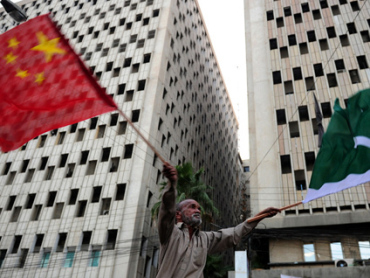
China’s premier Wen Jiabao concluded a high profile visit to Pakistan on Sunday, promising to lay the foundation for a “deeper” relationship to a country which is central to U.S. efforts for stabilizing Afghanistan.

Wen sought to broaden a relationship which has traditionally been driven by Beijing’s role as a key supplier of military hardware to Islamabad. Pakistan’s government officials said that during Wen’s visit, China signed business deals between the governments and private businesses of the two countries worth at least $29 billion, with a possibility of another $6 billion worth of contracts. These contracts were the largest ever signed during a visit by a foreign leader to Pakistan, underlining the growing importance of the country to China.

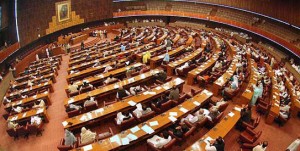
The Chinese premier also used a speech to a joint session of Pakistan’s upper and lower houses of parliament to commend the country for its efforts against terrorism. It was an apparent effort to negate criticism from the western world, including the U.S., which has urged Islamabad to take further steps against Al-Qaeda and the Taliban.

“Pakistan has given great sacrifices and made great efforts in the fight against terrorism. It is a reality and the international community should respect Pakistan’s efforts,” Wen said.

While the U.S. has poured billions of dollars into Pakistan to assist in combating terrorist groups, Pakistan’s military and civilian leaders remain committed to retaining a close alliance with China. “Let’s stand together, with a new confidence, and begin a new era of progress and prosperity, by jointly confronting all challenges,” Wen said in his speech on Sunday. To the applause of Pakistan’s ruling and opposition politicians, the Chinese continued that “China and Pakistan are all-weather strategic partners and share the sorrows and joys of each other as close brothers.”

A senior Pakistani official told CBS News that the deals signed during Wen’s visit included contracts for the development of a road and train network linking the two countries, for mineral resources, for gas and oil fields and for facilities to produce electronics.

“China is beginning to launch an important new phase to help Pakistan transform itself economically,” said the official, who spoke anonymously because he was not authorized to talk to journalists. “Unlike our western friends such as the U.S., China remains a true friend of Pakistan,” he added.

Western diplomats in Islamabad who spoke to CBS News, also on condition of anonymity, said Pakistan’s relations with China remain of concern to Washington in some areas, notably China’s continued support for Pakistan’s nuclear energy program and signs that China is stepping up its supply of conventional military hardware to Pakistan.

In the past decade, the two countries have jointly developed their first fighter plane for the Pakistan Air Force (PAF), known as the JF-17, or “Thunder.” The PAF plans to buy up to 250 of the JF-17s, making it the largest-ever purchase by the PAF of a single type of aircraft. On the other hand, Pakistani leaders frequently speak of the trust factor in their country’s relations with China, an oblique reference to the lack thereof in the country’s ties with the U.S.

In the 1990s, the U.S. sanctioned Pakistan on suspicions that the country was preparing to produce nuclear weapons, which reversed the two sides’ close cooperation when they confronted the occupation of Afghanistan by the former Soviet Union. While those sanctions were lifted after 9/11, which prompted a new partnership against terrorism, many Pakistanis remain skeptical of ties to the U.S. But a Pakistani foreign ministry official who spoke to CBS News said a growing economic relationship with China “will not come at the expense of our relations with the U.S. We want to establish and maintain a close partnership with the U.S. Our relations with China must never be seen as a replacement for our relations with the U.S.”