Posts Tagged ‘ Pakistan ’

Analysis: US Struggles With Image in Pakistan

By Foster Klug  for The Associated Press
U.S. efforts to help Pakistani flood victims will give America’s image there a boost, but not much of one.

The U.S. reputation in a country the Obama administration sees as crucial to defeating the Taliban and al-Qaida already is so tarnished that even millions of dollars from Washington and the work of U.S. soldiers and diplomats probably will do little to change the thinking of most Pakistanis.

After all, U.S. flood aid is only a drop in a bucket already filled with billions of American dollars that have been shipped to Pakistan since the Sept. 11, 2001, terror attacks against the United States.

All that money, apparently, has done little to impress. A recent Pew Foundation poll found nearly six in 10 Pakistanis viewed the United States as an enemy; only one in 10 called it a partner.

Still, the Obama administration does not have the option of doing nothing.

The U.S. interest in helping goes beyond easing the suffering of the more than 17 million people affected by the floods. Washington also wants Pakistan’s weak civilian government to succeed so that it does not lose ground to the aid work of Muslim charity groups associated with militants.

Making sure the pro-U.S. government looks good, or at least competent, is important to the Obama administration as it encourages Pakistan in its fight against militants operating along the border with Afghanistan, where the United States is fighting a 9-year-old war.

Robert Hathaway, director of the Woodrow Wilson Center’s Asia program, warns against expecting U.S. aid to immediately turn around the deep distrust many Pakistanis feel toward America. “This relationship has a lot of baggage, and it will take an incredible amount of hard work over many years really to rebuild,” Hathaway said.

Many in Pakistan see the United States as interested more in killing insurgents than in helping the country’s poor. Past U.S. support for former Gen. Pervez Musharraf and other military rulers has fueled a perception that Washington cares little about Pakistan’s democracy. Then there is the idea in Pakistan that the United States is anti-Muslim, a view that could be strengthened by opposition to a mosque planned near the World Trade Center site that Islamic extremists destroyed in 2001.

Dan Feldman, the Obama administration’s deputy special representative for Afghanistan and Pakistan, recently bristled at the notion that U.S. relief work is an attempt at image improvement. “We’re doing it as a response to a humanitarian crisis,” he said.

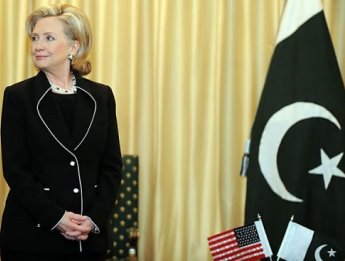
Still, the United States has made sure to spread the word of its response to the floods aggressively, with senior U.S. officials, including Secretary of State Hillary Rodham Clinton, making regular statements.

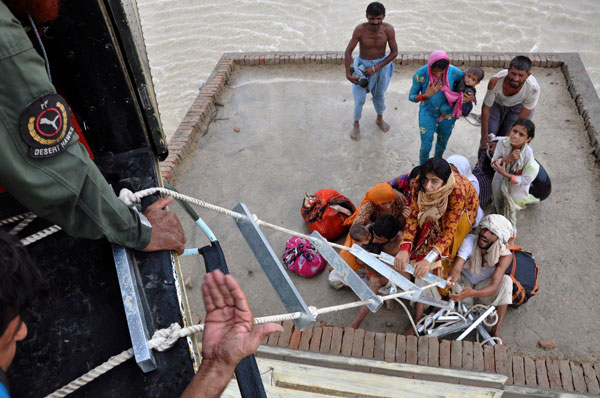
Feldman said in a briefing this week that the United States is providing up to $150 million in aid. U.S. military helicopters have evacuated thousands of people and delivered hundreds of tons of relief supplies. Among those supplies are 700,000 mosquito nets to help families ward off malaria, giant water treatment machines to provide safe drinking water and tens of thousands of blankets and inflatable boats to help isolated villages.

For people saved from rising waters by U.S. helicopters or given lifesaving medicine or food, America’s image will rise. U.S. aid cannot reach every flood victim, however, and not everyone getting the aid will know it is from the United States.

Along with worrying about helping as many people as possible, the Obama administration also must keep an eye on insurgents who know the people and the terrain and can use the flood to build support among its victims.

Jason Campbell, a South Asia analyst at the Rand Corp. think tank, said Washington understands that any “gaps in U.S. assistance will likely be filled by charities that, if not directly tied to militant groups, are at least sympathetic with them.”

The U.S. aid could provide another boost to counterinsurgency efforts. The sooner the Pakistani military can scale down its relief work, the sooner it can return to fighting insurgents.

Teresita Schaffer, a former State Department South Asia specialist, said the United States must do everything it can to help. But, she said, “I don’t think there will be an attack of the warm fuzzies just because we’re providing some helicopters.”
Aid Flooded Pak by Withdrawing Army

By Swaminathan S Anklesaria Aiyar for The Times of India

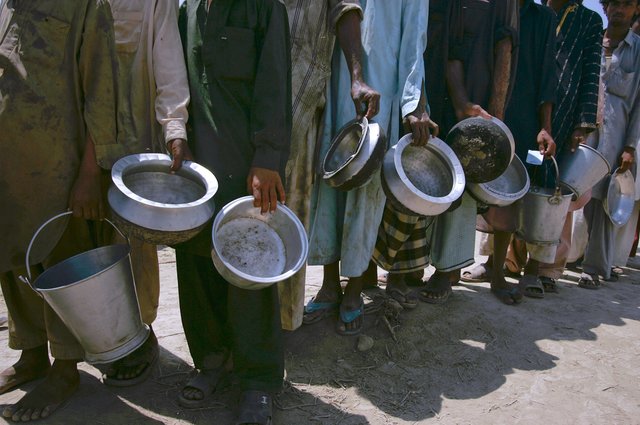
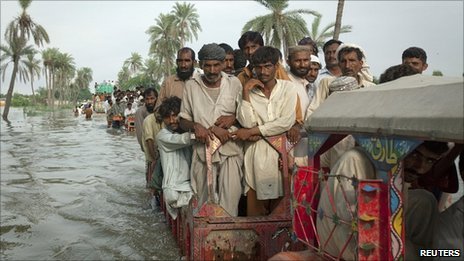
Pakistan is suffering its greatest human tragedy since Partition. The floodwaters of the Indus are an incredible 20 miles wide, sweeping away entire towns, villages and farms. Over 20 million people have been displaced, far more than the nine million displaced by Partition in 1947. The immediate death count of 1,500 will soon increase hugely through disease and deprivation. Rehabilitation could cost $100 billion.

Some Indians might be perverse enough to rejoice that an enemy has been hit by a natural disaster — an act of God, as it were — and will be crippled economically for years. But most Indians will surely want to help their neighbours. In these traumatic times, we need to think of Pakistanis as humans in distress, not foes.

Even those who cannot think beyond realpolitik should see that the floods are potentially a strategic disaster for India too. Flood damage will create a fertile breeding ground for Islamist militancy. Islamist NGOs with links to terrorist groups like the Lashkar-e-Taiba and Jaish-e-Mohammed are at the very forefront of flood relief efforts and hence are gaining popularity. Meanwhile, the civil administration is seen as corrupt and ineffective. President Asif Zardari has further ruined his low reputation by going on foreign junkets.

The Pakistani army has in the last year battled some, though by no means all, militant groups in Swat and FATA (federally administered tribal areas). But much of the infrastructure built to reach the remote tribal areas has been destroyed by the floods. Besides, the Pakistani army is redirecting its efforts in the region, from combating militants to combating flood damage. The militants are re-occupying the resultant political vacuum.

The ISI recently came out with a study suggesting that Islamist militants had become a greater threat to the country than India. Flood damage can only deepen that perception. True, the army wants to back the Afghan Taliban even while battling the Pakistani Taliban, and this results in muddled thinking and sabotage of peace initiatives. The resolution of these contradictions is not in sight.

One day, the Pakistani army and the ISI will have no choice but to confront the reality that Islamist militants are Frankensteins that threaten their own creator. The ISI’s assessment should bring that day somewhat closer.
In the light of both human and strategic considerations, how can India help Pakistan? Individual contributions from Indian citizens must be encouraged, and red tape thwarting contributions in cash and kind must be cut. But the Indian government should not offer more than a modest amount of food and financial aid. Pakistan requires billions of dollars for relief and rehabilitation, so anything India offers will be a drop in the ocean.

Besides, recipients are rarely grateful for alms: they resent being supplicants, and suspect the motives of the donors. The US saved India from mass starvation after the twin droughts of 1965 and 1966 by giving record food aid. But this won the US very few friends and stoked resentment from many who felt India’s independence was being compromised. The US will once again be the chief donor to Pakistan, but will gain virtually no popularity or gratitude.

If food and financial aid will not help much, how can India best help Pakistan? The best way will be for the Indian Army to unilaterally withdraw from the border in Punjab, Rajasthan and Gujarat. This will pose no military risk whatsoever: flood-stricken Pakistan cannot possibly embark on military adventures against India. But the withdrawal of Indian troops will mean that the Pakistan army loses all excuses to avoid diverting manpower and financial resources from the border to flood relief and rehabilitation. This will cost India nothing, yet will release very large resources within Pakistan. Its impact on the Pakistani psyche will be significant. Even analysts who distrust Pakistan agree widely that India has no alternative to diplomatic engagement: cutting off ties will not win any minds and hearts there. Unilateral withdrawal will itself be a form of engagement, and will encourage other forms.

The wrong strategy will be to try to negotiate a mutual withdrawal of troops. Withdrawal must be unilateral and immediate. Defence hawks will express dismay that India is so soft on an enemy that encourages terrorism. But unilateral withdrawal will be a flood relief measure, not a military surrender. In the bargain, it will oblige Pakistan to withdraw its own troops and redeploy them for flood relief: its public opinion will be outraged otherwise.

Dr Manmohan Singh, you say we must be proactive in the peace process with Pakistan. The tragic floods there have given you an opportunity to be proactive in a way that will not come again. Go for it.

Pakistan Faces Economic Hit from Flood

By David Roman for The Wall Street Journal

The flooding in Pakistan will inflict serious damage on its economy, posing another major challenge for a cash-strapped government struggling to keep a recovery on track in the face of high inflation and a relentless Islamist insurgency.

Assistance from the International Monetary Fund and Western countries will likely help Pakistan avoid another brush with bankruptcy as it tries to cope with the damage, which by some estimates may reach $43 billion. But the floods will weigh heavily on economic growth this year and leave a long-term mark on the economy.

“It’s a very serious tragedy,” said Philip Wyatt, a senior economist at UBS. “The hit on the growth rate is going to be very severe … We can see a loss of one or two points of economic growth, depending on the damage.” In the last fiscal year ended June 30, Pakistan’s economy grew 4.1%.

Moody’s Investors Service, which had expected Pakistan’s economic growth to pick up to 4.5% this fiscal year, may lower its estimate to 3% to 3.5%, said analyst Aninda Mitra.

The flood began in July and at one point covered a fifth of the South Asian nation, or land roughly equivalent to the size of Uruguay. According to the United Nations, the disaster has affected close to 20 million people, killing 1,500 and leaving 1.2 million homes damaged or destroyed.

Coping with the social and economic costs of the catastrophe will strain the government’s finances. The budget deficit was already on track to reach 4.5% of gross domestic product in the fiscal year ending June 30 before the crisis but now could widen to as much as 6% to 7% of GDP, said Mr. Mitra. That’s a grim prospect for a country, which had external debt totaling $55.63 billion as of June 30.

President Asif Ali Zardari’s government has been reaching out to other countries for help. A delegation met with IMF officials Monday in Washington. Donors including the U.K. and the European Union have so far pledged almost $500 million in additional help.

Moody’s is unlikely to upgrade Pakistan’s credit rating in coming months due to the devastation from the floods and other challenges, but the country’s current B3 rating “adequately captures the risk” of the likely economic slowdown and is unlikely to be downgraded further, said Mr. Mitra. A B3 rating is just one notch above the C level, which applies to countries in effective sovereign default, and makes it hard for a country to issue bonds in the international market.

The natural disaster is the latest setback for the Pakistan economy, which after several years of strong growth almost ground to a halt in 2008, hurt by budget overruns, a loss in export competitiveness due to high inflation, and an insurgency that continues unabated. On Monday, while emergency workers worked to shore up levees in two southern cities, at least 36 people were killed in three separate bomb attacks across the country, and 12 suspected militants were killed in U.S. drone attacks near the Afghan border.

Concerns about the economic fallout have kept pressure on Pakistan’s financial markets, though the impact has been moderate.

The cost of insuring against a default or restructuring of Pakistan’s bonds remains at very elevated levels, but has been relatively steady in recent weeks, a sign that investors anticipate IMF and U.S. support to prevent any fiscal crisis. The spread on Pakistan five-year credit default swaps was quoted at 1,099 basis points Tuesday, roughly on par with those of other high-risk sovereign bond issuers like Venezuela, but well below early-2009 highs of over 2,100 basis points during the global financial crisis.

Pakistan’s benchmark stock index, KSE-100, has fallen 7% so far in August, but is up 4% so far this year, roughly in line with other emerging market indexes.

The Pakistan rupee, one of Asia’s weakest currencies in recent years, has fallen in recent days, but has found support above its record low against the dollar of 85.84 rupees hit on Aug. 2, helped by expectations that remittances from overseas Pakistanis, which have averaged around 10% of GDP in recent years, may rise to help families at home cope with the floods.

But analysts expect the rupee to remain under pressure in coming months due to Pakistan’s current account deficit and high inflation rate, which ran at 12.3% in July. The floods are likely to push up food prices and transportation costs for other goods, likely eliminating any chance that inflation might fall below 10% this year, said Mr. Wyatt at UBS.

Crisis in Kashmir

By Ashok K Metha for The Wall Street Journal

A few months ago, Pakistan was virtually begging India to restart the dialogue process between the two governments, suspended after the 2008 Mumbai terrorist attack. Now Pakistani spokesman Abdul Basit asserts that Pakistan will not agree to “any preconditions for resuming the dialogue process.” Why did Islamabad’s attitude change?

The answer lies in two cities: Srinagar and Kabul.

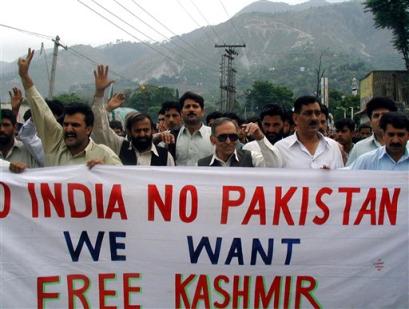
With 62 civilian deaths in the ongoing rioting in the capital city Srinagar and two districts, over the past couple months Kashmir has witnessed a fresh uprising against the symbols of the state. Kashmiris are using every avenue they have—from stones to the Internet—to demand azaadi, or freedom. The mostly spontaneous upheaval involves young men, women and even children. Kashmiris want freedom from corruption, bad governance and the overbearing presence of soldiers.

For decades Pakistan has been trying to wrest Kashmir away from India by sponsoring insurgency. But today, thanks to the ineffective administration in Srinagar, Pakistan doesn’t have to try very hard. After the security forces managed to restore law and order three years ago, India failed to take the political initiative, and frittered away its gains. The result is widespread disillusionment. At a ceremony commemorating India’s Independence Day this month, a local policeman threw a shoe at Omar Abdullah, chief minister of Jammu and Kashmir, whose grandfather Sheikh Abdullah ratified the state’s accession to India.

Up until 2008, the state had a lot going for it: several round-table meetings for self rule and confidence-building measures, periodic release of economic packages, annual visits by Prime Minister Manmohan Singh, conferences connecting the people and quiet dialogue with moderate and hardline separatist leaders. The ceasefire on the Line of Control was holding, and a four-point formula for resolving the Kashmir dispute hammered out with Pakistan through back channels seemed as good as done.

Indian security personnel beat detained Kashmiri Muslim protesters in Srinagar, India.
Mysteriously, the peace process then ground to a halt. The India-Pakistan dialogue began unraveling soon after Gen. Pervez Musharraf left the scene. The new Pakistani Army Chief, Gen. Ashfaq Kayani, a Fort Leavenworth graduate and favorite of the U.S. establishment, reversed the process of reconciliation. The ceasefire has become shaky, and the Pakistani government’s rhetoric on Kashmir has returned to the rights of the people to self determination and “diplomatic and moral support to Kashmir in their legitimate struggle no matter how brutally Indian forces try to suppress it.”

The reason Gen. Kayani feels emboldened to take a harder line is easy to discern. Tensions deepened after the U.S. elevated Pakistan from “major non-NATO ally” to the linchpin of its Afghan exit strategy, and excluded India from a political solution in Afghanistan. Despite the denials of U.S. Af-Pak point man Richard Holbrooke, the Afghanistan-Pakistan free trade agreement has only underscored India’s irrelevance to Kabul.

Civilian strife in the Kashmir Valley will only strengthen Pakistan’s case that resumption of a dialogue on Kashmir alone will enable a more focused fight against the Taliban on the Western frontier. This is not entirely true, as the Pakistan Army has already redeployed to the west 52% of its offensive and 45% of its defensive forces previously devoted to facing down India.

The priority for Delhi is to stop the stone-throwing in Kashmir. Every death—one recent fatality was a child of eight years old—is fresh cause for protests. On an hour’s notice, 10,000 people will come out on the streets to join the funeral procession of someone they don’t know. Further, Kashmir’s moderate Islam is being radicalized by the hardline Jamaat-e-Islami, which has made even separatist leaders irrelevant. No one is willing to talk unconditionally anymore.

Delhi will have to start from scratch in rolling back alienation by reaching out to youth. Yet Rahul Gandhi, India’s prime-minister-in-waiting and supposedly its youth leader, has not reached out to his favorite constituency in Kashmir. Neither has Congress President Sonia Gandhi or Prime Minister Manmohan Singh visited Srinagar since the troubles began in June. Until a few months back, Kashmir was the most violence-free state in India, as security forces had significantly marginalized insurgent and terrorist groups over the last three years.

Islamabad is not about to take over Kashmir—according to a survey by London-based think tank Chatham House last month, just 2% of the population favors joining Pakistan. But as the cry for azaadi grows louder, no one has a clue when this uprising is going to stop. Even as the faithful observe Ramadan, Delhi needs to do something before U.S. President Barack Obama’s scheduled visit in November.

Clinton Invokes Climate Change Debate to Explain Pakistan Floods

As Reported by Fox News

Secretary of State Hillary Clinton and other officials are pointing to the devastating floods in Pakistan and other extreme weather events as signs that climate change is getting worse.

Clinton, in an interview with Pakistan’s Dawn TV, said “there is a linkage” between the recent spate of deadly natural disasters and climate change.

“You can’t point to any particular disaster and say, ‘it was caused by,’ but we are changing the climate of the world,” she said.

Clinton said that on top of the Pakistan floods, which have forced millions out of their homes, the forest fires in Russia stand as another example. She said there’s no “direct link” between the disasters in Pakistan and Russia but that “when you have the changes in climate that affect weather that we’re now seeing, I think the predictions of more natural disasters are unfortunately being played out.”

Climate change skeptics say the planet is going through natural phases — the kind it’s gone through for eons. Pakistan, in particular, is prone to flooding and is routinely drenched by the monsoon rains. Some officials have partially blamed deforestation and inferior levee systems for the historic flooding which has affected one-fifth of the country’s landmass and triggered nearly a half-billion dollars in international aid commitments.

Scientists who study climate change tend to offer more nuance in their explanations of the possible link to a rise in greenhouse gas emissions. They generally say that no one natural disaster can be chalked up to man-caused climate change, but that it can contribute to those disasters happening more frequently and more intensely.

Both the U.N. International Panel on Climate Change and the World Meteorological Organization reiterated that point in light of the Pakistan floods. WMO climate data chief Omar Baddour was quoted saying it’s “too early to point to a human fingerprint” behind the recent disasters but climate change may be “exacerbating the intensity” of them.

But some government officials have shown little equivocation in directly linking the Pakistan disaster with climate change.

Shah Mehmood Qureshi, Pakistan’s foreign minister, said Thursday that his country’s flooding “reconfirms our extreme vulnerability to the adverse impacts of climate change.”

The flooding and Russian forest fires, which were sparked following a severe drought, coincide with record heat elsewhere in addition to downpours and landslides in China.

The renewed concerns over climate change come after international talks on a new treaty to reduce greenhouse gas emissions fell short at a summit last December in Copenhagen. Talks over climate change legislation have also stalled in the U.S. Congress.

India, Pakistan Can’t Break the Ice, Even in Hour of Tragedy

Reported by Sanjeev Miglani for Reuters

Pakistan’s catastrophic flood continues to boggle the mind, both in terms of the human tragedy and the scale of the damage it has wrought, and even more so over the longer term. One official has likened the disaster to the cyclone that devastated what was once East Pakistan, setting off a chain of events that eventually led to its secession and the birth of Bangladesh.

Not even that spectre, raised by Pakistan’s ambassador to Britain, can however dent the steadfast hostility between India and Pakistan. For a full three weeks as the floods worked their way through the spine of Pakistan from the turbulent northwest to Sindh in the south, Islamabad made frantic appeals to the international community not ignore the slow-moving disaster, and help it with emergency aid, funds. But next-door India, best-placed to mount a relief effort probably more because of the geography than any special skill at emergency relief, was kept at arm’s length. An Indian aid offer of $5 million, which itself came after some hesitation and is at best modest,was lying on the table for days before Pakistan accepted it. ”There are a lot of sensitivities between India and Pakistan … but we are considering it very seriously,” a Pakistani embassy spokesman told our reporter in New Delhi earlier this week. Things appeared to have moved faster only after Indian Prime Minister Manmohan Singh called his Pakistani counterpart Yusuf Raza Gilani expressing sympathy and reminding him of the offer of aid. Millions of Pakistans meanwhile continued to struggle for food.

To some extent, Pakistan’s hesitation in accepting aid from India is understandable. India is the traditional enemy. It is also the bigger country of the two. And over the last two decades it has become easily the more prosperous entity, courted by the world’s industrialists while Pakistan is “haunted by the world’s terrorists”, as columnist Vir Sanghvi writes in the Hindustan Times. A Pew poll that we wrote about a few weeks ago showed how deep-seated these Pakistani fears are: a majority of those polled said they considered India to be the bigger threat than al Qaeda or the Taliban, despite the violence they have suffered at the hands of the militant groups over the past few years.

As Sanghvi writes:

But, to be fair to the Pakistanis, let us accept the position that decades of hostility between our two countries have led to a situation where the Pakistanis simply do not trust us. Let us also accept that they are so resentful of India that even in their hour of greatest crisis when thousands of people have died and millions are homeless, they will still spurn India’s hand of friendship. And let us grant them their claim that given our history, they are justified in being suspicious of India.

But then, you have to wonder, if the two nations cannot even keep up basic neighbourly ties such as offering aid and commiseration at times of natural crises, what chances they can ever come to a peace deal that will demand much more from them ?

It was pretty much the same in 2005 when the earthquake struck Pakistani Kashmir and the authorities struggled to provide aid to the affected. And Indian aid offer was initially ignored, later blankets from India were accepted. But even then Pakistan had people cut out the label that read ‘made in India’ on each blanket.

Indeed, some Pakistani writers are already criticising the government of bringing dishonour to the country by accepting Indian assistance. Commentator Shireen M. Mazari in a piece entitled “What Have We Become” says the Pakistani government accepted the Indian offer for help under pressure from the United States and that it was a matter of shame. By taking Indian aid, Pakistan had let the people of Kashmiri down just when they had risen in revolt against Indian forces.

“This money has the blood of Kashmiris on it and one wonders how our Kashmiri brethren must be feeling as they face the bullets of Indian forces every day and see us taking Indian “aid”,” Mazari wrote.

Kashmir, then, can’t be far from any discourse relating to India and Pakistan. It is the core dispute at the heart of 60 years of difficult ties, says Pakistan and must be resolved before any normalcy can take place. India doesn’t even consider the territory to be disputed, so the argument, at least in public, hasn’t changed much in over half a century.

For the 20 million affected by the flooding in Pakistan, and facing a future that would daunt any of us, Kashmir must, at the moment, be a distant thought.

Pakistan Accepts Flood Aid Money From Rival India

By Issam Ahmed for The Christian Science Monitor

Pakistan has accepted an offer of $5 million of flood aid from neighbor and longtime rival India, in a move that could spark a political backlash at home.

In an interview with Indian news channel NDTV, Pakistani Foreign Minister Shah Mehmood Qureshi described the offer of aid, made last week, as a “very welcome initiative” which the government of Pakistan has agreed to accept, after taking some time to decide.

But it would have been better to say “thanks, but no thanks,” according to Liaqat Baloch, secretary general of Pakistan’s second-largest religious party, the Jamaat-e-Islami.

“Pakistan has many disputes with India, with reference to Kashmir, and the Indian Army engaging in brutality in occupied Kashmir,” he says. “In the past, when Pakistan tried to support India after their natural disasters, India never accepted. Therefore it would be better if our government refused the aid with a big thank you.”

Al Khidmet foundation, Jamaat-e-Islami’s charitable wing, has been one of the most visible aid organizations in the flood-affected areas.

The two countries have made efforts in recent months to repair bilateral relations, which took a plunge following the 2008 Mumbai attacks. India blames those attacks on Pakistan-backed militants. The two countries have fought three full-scale wars, most recently in 1999.

The United States had urged Pakistan to accept India’s offer of aid earlier this week. When Indian Prime Minister Manmohan Singh called his Pakistani counterpart to offer his condolences following the worst natural disaster in Pakistan’s history, it was an event widely reported in the Pakistan media.

“In such times of natural disasters, all of South Asia should rise to the occasion and extend every possible help to the people of Pakistan affected by the tragedy,” Mr. Singh said, according to a statement released by his office.

According to Badar Alam, editor of Pakistan’s Herald magazine, the amount of aid pledged is “symbolic, but its effect is immense. It’s a good confidence building measure between the two countries.”

But, he warns, Pakistan’s religious parties will try to spin the move “as a sign of weakness.”

“They will see it as a capitulation to India, that our own government is so weak we have been forced to accept help from the historic enemy,” says Mr. Alam.

Mosharraf Zaidi, a columnist for Pakistan’s The News, termed the decision brave: “It’s a tremendous gesture, very mature. India should be commended for donating it and Pakistan should be commended for accepting it.”

“The whole idea in an emergency is you’ll have the Jamat ud Dawas [the charitable wing of banned militant outfit Lashkar-e-Taiba] and you’ll have competing powers working almost in tandem to support people. It shows that no matter what our value systems, we have to work together right now,” he adds.

Some 20 million people are affected by Pakistan’s worst flooding in recent memory; Pakistan’s government estimates around 1,600 deaths and millions homeless or displaced. The United Nations appealed to the international community to donate $460 million in emergency assistance last week, and has met half of that goal. Yesterday the US increased its flood aid to Pakistan from $80 million to $150 million.

-Pakistanis for Peace Editor’s Note- It is a good decision by the Pakistani government to accept the aid offer from India. Not only will this be a confidence building measure between the two nations, it will save countless lives, and no nation is too proud to save the lives of its citizens.

U.S. Strategy in Pakistan Is Upended by Floods

By Mark Landler for The New York Times

WASHINGTON — The floods in Pakistan have upended the Obama administration’s carefully honed strategy there, confronting the United States with a vast humanitarian crisis and militant groups determined to exploit the misery, in a country that was already one of its thorniest problems.

While the administration has kept its public emphasis on the relief effort, senior officials are busy assessing the longer-term strategic impact. One official said the disaster would affect virtually every aspect of the relationship between the United States and Pakistan, and could have ripple effects on the war in Afghanistan and the broader American battle against Al Qaeda.

With Pakistan’s economy suffering a grievous blow, the administration could be forced to redirect parts of its $7.5 billion economic aid package for Pakistan to urgent needs like rebuilding bridges, rather than more ambitious goals like upgrading the rickety electricity grid.

Beyond that, the United States will be dealing with a crippled Pakistani government and a military that, for now, has switched its focus from rooting out insurgents to plucking people from the floodwaters. The Pakistani authorities, a senior American official said, have been “stretched to the breaking point” by the crisis. Their ragged response has fueled fears that the Taliban will make gains by stepping in to provide emergency meals and shelter.

“It certainly has security implications,” said another official who, like others interviewed for this article, spoke on the condition of anonymity because he was not authorized to discuss internal policy deliberations. “An army that is consumed by flood relief is not conducting counterinsurgency operations.”

On Thursday, the United Nations will convene a special meeting devoted to the floods, hoping to galvanize what has been a lackluster global response. Secretary of State Hillary Rodham Clinton is expected to announce that American public aid has surpassed $100 million, an official said.

“We’re obviously not oblivious to the political and strategic implications of this catastrophe, but right now, we are fully focused on the emergency relief effort and trying to get a good assessment of the needs,” said the administration’s special representative to the region, Richard C. Holbrooke.

Noting that several weeks remain in the monsoon season, Mr. Holbrooke said, “Worse may be yet to come.”

The disaster comes after a period in which the administration seemed to have made strides in repairing the American relationship with Pakistan. Mrs. Clinton visited Islamabad in July with a long list of pledges, including the upgrading of several power plants and a plan to promote Pakistani mangoes. Now, these projects seem almost beside the point.

“Before, there were power plants in need of refurbishment,” said Daniel S. Markey, senior fellow for India, Pakistan and South Asia at the Council on Foreign Relations. “Now there are power plants underwater.”

In recent days, the United States has sent 15 helicopters, rescuing nearly 6,000 people. On Wednesday, military cargo planes delivered 60,000 pounds of food and other relief supplies, bringing total deliveries to 717,000 pounds. The speed and scale of the effort, officials in both countries said, have helped bolster the checkered American image in Pakistan.

In another hopeful sign, officials said Pakistan and India had been in close touch about the floodwaters, some of which are flowing into Pakistan from India. Such communication, between historic archenemies, could augur reduced tension in other areas, one of the officials said.

Against that, however, are the staggering dimensions of the disaster. A senior Pakistani official told the administration on Tuesday that the next flood surge was likely to inundate much of Punjab, the densely populated region that borders India and produces much of Pakistan’s food.

So far, this official said, the greatest damage has been in regions that are also hotbeds for Islamic insurgents, which has set back the army’s fight against extremist groups. Local governments in those places have largely collapsed, leaving the army as the only source of authority.

With 20 million people displaced from their homes, the Pakistani authorities are girding themselves for an immense migration to the major cities, which they fear could sow further instability.

“Americans have not yet registered the enormity of the crisis,” Pakistan’s ambassador to the United States, Husain Haqqani, said in a telephone interview from Islamabad, the capital.

Pakistani and American officials said reports of hard-line Islamic charities providing relief were exaggerated. One pointed out that the floods had hurt the insurgents as well: there was a report of small arms and ammunition belonging to a militant group floating in the water.

Still, people in both countries warned that if rebuilding and rehabilitation efforts bogged down, the Taliban and other militant groups would try to take advantage of it. “The real test is, can their government provide the most fundamental services?” said an administration official.

Parallels to this crisis are hard to find. One official cited the example of the Indonesian province of Aceh, which had been racked by a three-decade insurgency fought by the separatist Free Aceh Movement. After the tsunami swept through in 2004, killing 170,000 people, the separatists and the Indonesian government quickly signed a peace treaty, in August 2005.

There are, however, big differences between a localized separatist group and an international jihadist movement.

“If the flood proves to tilt the balance of power in Pakistan, it’s more likely to tilt toward the militants than toward the government,” said Bruce Riedel, a former intelligence official who helped the administration formulate its initial policy for Pakistan and Afghanistan.

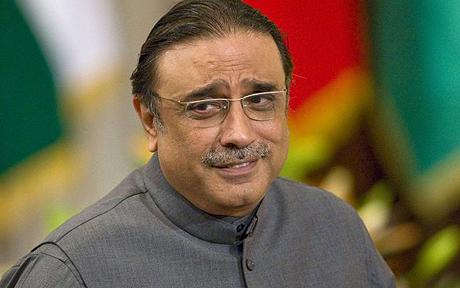
Already, Pakistan’s president, Asif Ali Zardari, has been exposed to withering criticism at home for going on a trip to Europe during the early days of the flood. American officials said they were determined not to get drawn into the dispute, noting that in any event, Mr. Zardari had been stripped of many of his powers in a recent constitutional change.

Decisions on how the flood will affect American economic aid may be influenced by a trip to Pakistan by Senator John Kerry, the Massachusetts Democrat who co-sponsored the five-year nonmilitary assistance package with Senator Richard G. Lugar, Republican of Indiana.

Senator Kerry, accompanied by Dan Feldman, a deputy to Mr. Holbrooke, is scheduled to tour the flooded areas on Thursday. Mr. Kerry has said he is open to redirecting aid money, though some analysts said they were skeptical that Congress would approve additional financing. Military aid may also come under scrutiny, according to administration officials.

“Every dimension of our relationship — politics, economics, security — is going to see major shifts as a result of this historic disaster,” said Lt. Gen. Douglas Lute, the White House coordinator for Afghanistan and Pakistan. “All the tools of diplomacy have to be examined in light of this new reality.”

What They Said: Pakistan Spies Downgrade India Threat

By Vibhuti Agarwal for The Wall Street Journal

The Wall Street Journal reportedTuesday that a report from the Pakistan’s chief spy agency, the Inter-Services Intelligence, said domestic militancy had overtaken the Indian army as the greatest threat to Pakistan’s national security. This is the first time since the ISI was founded in 1948 that the ISI has found a bigger threat than its neighbor. India Real Time presents a roundup of comments from readers and others below:

The Times of India newspaper reported Wednesday that Pakistan’s acknowledgment of its internal problems comes as the country is struggling with an image problem which may be affecting the flow of international aid to help the victims of the devastating floods there. “The unexpected downgrading of the threat perception from New Delhi and waking up to the scourge of home-grown terrorism comes even as foreign aid for the thousands affected in floods in Pakistan is yet to pick up,” wrote Chidanand Rajghatta for the Times of India.

The Hindustan Times newspaper quoted analysts saying the change of mindset makes sense. “I am not surprised that the ISI has changed its strategic thinking,” Talat Masood, a retired general and analyst on defense and security issues told the newspaper. Another analyst, Imtiaz Gul, was also quoted in the article. “The ground realities have changed and have forced allies into becoming enemies,” he said.

“At this point, the Pakistan government will say just about anything the world community wants it to,” wrote H. Jere. “After seeing the response to the aid request has been disappointing, it will agree to almost anything.”

Other readers called Pakistan’s latest admission “hogwash,” adding that it may be a trick to get more funds from the United States.

“It is sheer naiveté to consider Pakistan’s ISI and Islamic terrorists as two separate entities,” said Shri K. “ISI is the quintessence of rabid Islamic fascism and has been mercilessly exporting Islamic terror all over the world.”

Some readers said Pakistan’s admission came as a ray of hope for improving the long-estranged India-Pakistan relationship.

“I hope India take this opportunity to offer real assistance to the victims of the floods,” wrote Phillip Hwee. “It’s time for India and Pakistan to reconcile with one another. A détente is very necessary so that each of the two rivals can reallocate their resources to improve the standard of living of their respective citizens.”

David Almeida agreed, adding that “one can only hope that the military establishment in Pakistan is truly serious about abjuring terrorism, regardless of whether it is targeted at Indian or Pakistani state.”

Pakistan Floods: World Bank to Lend $900m For Recovery

As Reported by the BBC

The World Bank is to loan $900m (£574m) to Pakistan to help it recover from its worst ever flooding. The devastating floods have affected up to 20 million people and left some 2,000 dead, say officials.

But the UN says international aid has been slow and that it has raised only a third of the $460m (£294m) needed for emergency relief.

Pakistan’s High Commissioner to Britain said it could take five years and $15bn (£9.6bn) for the country to recover. The World Bank funds will come through the reprogramming of planned projects and the reallocation of money, a World Bank spokesman said.

“We are reprioritising to make the funds immediately available,” he told Reuters news agency.

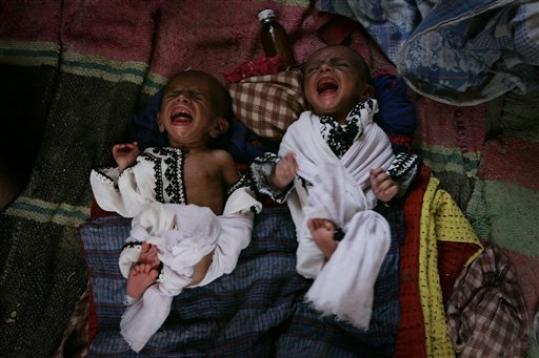
Health officials have warned that disease could spread quickly among the millions of displaced people and that 3.5m children are at risk.

Maurizio Giuliano, of the UN Office for the Coordination of Humanitarian Affairs (OCHA), warned that Pakistan would face “a second wave of deaths” from water-borne diseases and food shortages unless more aid arrived soon.

He estimated the number of people at risk from such diseases was six million.

Meanwhile, rival political groups in Sindh province have been accusing each other of creating breaches in embankments and dykes to save their own towns and property.

Many of the breaches were reportedly made to divert flood waters away from military garrisons in the area.

Jacobabad city, for example, has been saved, but low-lying areas around it, including Dera Allahyar and some other towns in Balochistan province, have been inundated.

In India, Prime Minister Manmohan Singh has promised more funds to help areas affected by the recent devastating floods in Ladakh, a remote mountain region in Indian-administered Kashmir.

During a visit to the heavily damaged town of Leh, he said all the destroyed homes would be rebuilt within the next two-and-a-half months with money from a government relief fund.

The flash floods over 10 days ago killed more than 80 people and caused heavy damage to property. Many people are still missing.

‘Marshall Plan’

Pakistan’s High Commissioner to Britain Wajid Shamsul Hasan told the AFP news agency that 2,000 people had now been killed by the floods – previous estimates have put the number of dead at around 1,500. He said it would take at least five years for the country to recover, and put the reconstruction bill at “more than $10 to $15bn”.

He warned that a failure to provide sufficient relief and rebuilding assistance could lead to an increase in extremism and instability in the wider region.

He called for a new Marshall Plan, referring to the extensive US development programme in Europe after World War II.

Not only have the floods affected around one-fifth of the country, they have also caused considerable damage to roads, bridges and communications, says the BBC’s Mike Wooldridge in Islamabad.

Thousands of homes and other buildings including schools and hospitals have been swept away, and crops for domestic food consumption and for export have been lost.

One of the key questions is whether farmers will be able to use their land to plant their winter wheat crop in September, our correspondent adds.

‘Image deficit’

The UN has so far only received about a third of its appeal amount – the US has made the biggest contribution so far, followed by the UK.

Aid agencies have blamed Pakistan’s “image deficit” for the shortfall, as potential donors fear the funds would be diverted into extremism in the country.

A spokeswoman for Care International told AFP the UN had to do more to convince donors that the money was “not going to go to the hands of the Taliban”.

“The victims are the mothers, the farmers, children. But in the past, information linked to Pakistan has always been linked to Taliban and terrorism,” said Melanie Brooks.

Bill Berger, USAID’s principal regional adviser for South Asia, told the BBC it had been difficult to communicate the scale of the disaster to the rest of the world:

“Remember that this flood has built up over time… I just don’t think the world has realised the magnitude of this now, because this story has just been slowly increasing. It doesn’t have the drama of an earthquake that impacts a huge number of people all at once.”

The floods began more than two weeks ago in the mountainous north-west and has swept south across a quarter of the country, including its agricultural heartland.

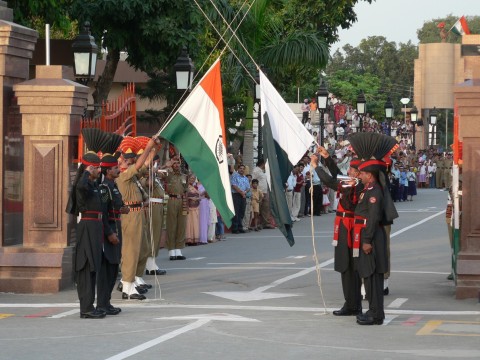
India, Pakistan Peaceniks Hold Candlelight Vigil on Wagah Border

By Sawinder Singh for ANI

Several intellectuals and peace activists from India and Pakistan held a candlelight vigil at Wagah border crossing in on the eve of Independence Day.

The objective of this annual event is to spread the message of peace and brotherhood on the occasion of the Independence Day celebrations of the two neighbouring countries-India and Pakistan.

The midnight vigil on August 14-15 was held on the 63rd Independence Day celebrations of both the countries.

Bollywood Film Producer-Director Mahesh Bhatt, veteran Indian journalist-writer Kuldeep Nayar, Aitzaz Ahsan, former Pakistan Supreme Court Bar Association President and many social activists participated in the midnight vigil.

The participants carrying candlelights and torches marched to the Wagah Border raising slogans of Long Live India-Pakistan Friendship.

“Borders should be open and it should be soft and let people meet from both the countries. Because when people of both the countries will meet then governments will come under pressure and the situation will improve,” said Kuldeep Nayyar.

“Both countries can prosper only if there is a good relationship between them, we have to remove the poverty. Both countries are stricken with acute poverty, unemployment and hunger. Both the countries need to reduce their expenditure on weapons and then only we can reduce poverty and for that it is necessary to have peace, friendship and brotherhood,” added Aitzaz Ahsan, former Pakistan Supreme Court Bar Association President.

On this occasion, a music concert was also held.

India and Pakistan achieved independence from Britain on the midnight of August 14, 1947. While Pakistan celebrates its Independence Day on August 14, India marks its Independence Day on August 15.

This year Pakistan did not celebrate its independence day as a tribut to victims of recent floods in the country.

Flood-Ravaged Pakistan Cancels Independence Day Events

As reported by CNN

Pakistan canceled independence day celebrations Saturday as a second wave of floods continued to put millions in peril, the nation’s prime minister said.

Prime Minister Yousaf Raza Gilani said the devastating floods had affected 20 million people, a figure much larger than officials had given earlier. Gilani said some religious events connected to Ramadan were also canceled.

“In solidarity with the flood victims, all independence day celebrations have been canceled and moreover, all Iftar dinner events and celebration of eid by government ministries have been canceled so that these resources can be utilized in the affected areas,” Gilani said.

A second wave of floodwater is expected to wash through southern Pakistan this weekend, adding hundreds of thousands of people to the number already stranded by a first wave earlier this month, Pakistani officials said.

At least 1,384 people have died and 1,630 more have been injured by flooding that has damaged or destroyed 8,300 Pakistani villages so far, according to Ahmed Kamal, spokesman for the National Disaster Management Authority.

The United Nations said it was racing against time to reach the suffering.

“Relief supplies must reach women, men and children as soon as possible, in order to avoid further death caused by waterborne diseases and food shortages,” said Martin Mogwanja, the United Nations’ humanitarian coordinator for Pakistan.

“The death toll has so far been relatively low compared with other major natural disasters, and we want to keep it that way,” he said.

Pakistan emergency officials predicted the second wave could reach Sukkar on Saturday evening.

Hundreds of thousands of people living along the Indus River in northern Sindh could be stranded, along with the tens of thousands stranded by the first wave, said Lt. Cmdr. Jawad Khawaja of the Pakistani navy.

Many residents have ignored government warnings to evacuate the area, causing a big concern, Khawaja said.

It estimated that 723,950 homes have been damaged or destroyed.

The Scope of Pakistan’s Floods: By the Numbers

By David Knowles for AOL News

Dubbed Pakistan’s “flood of the century,” heavy monsoon rains have washed out upward of one-fourth of the area of the country. The scope of the ongoing devastation is on a scale that is difficult to comprehend, especially to those far away and unfamiliar with the territory. Still it is alarming to consider the estimate given by concerned officials on Wednesday — that up to one-fifth of the entire landmass is now underwater.

The flooding has largely been located in the center of the country and is being caused by overflow from the Indus and Chenab rivers. Surge Desk has been rounding up the figures from the tragedy and has the following context.

Area
Some 150,000 square kilometers, or approximately 93,000 square miles, have been affected by the rising waters, Voice of America reported. That’s a little smaller than the size of the state of Michigan.

Fatalities
So far, at least 1,600 have been killed in the floods.

Agricultural losses
The floods have so far destroyed 2 million bales of cotton, BusinessWeek reported, nearly one-seventh of the country’s yearly target. In addition, 500,000 tons of wheat have been ruined, The New York Times said.

U.S. military response
One thousand U.S. Marines and 24 military helicopters have been deployed to Pakistan to help with relief efforts, The Associated Press reported.

Pakistanis displaced

According to the United Nations, 7 million citizens of Pakistan have been left homeless because of the floodwaters. Furthermore, the U.N. estimates that 14 million Pakistanis, roughly 8 percent of the country’s population, have been adversely affected by the floods. According to UNICEF, 6 million of those are children. All told, approximately 4,700 villages have been wiped out, Voice of America news reported.

Effect on war with the Taliban
Some 60,000 Pakistani troops that had recently been fighting the Taliban have now been put on flood assistance, The Telegraph reports.

Foreign aid
The United Nations is seeking foreign contributions of $460 million to tend to immediate needs, such as food, water and temporary shelters. The United States has pledged $71 million in aid, the biggest amount offered by any country so far, The New York Times reports.

India Hints at Pakistan Role in Kashmir Unrest

By Nigam Prusty for Reuters

India’s interior minister hinted on Friday that Pakistan could be behind weeks of violent anti-India protests in the disputed Kashmir region, a move that could hurt the nuclear-armed rivals’ attempts to improve ties.

This is the first time New Delhi has linked Pakistan to the violence in Kashmir that has killed nearly 50 people since June. Earlier India had said Pakistan-based militants were inciting trouble in Kashmir, a region divided between India and Pakistan and which both claim in full.

“Pakistan appears to have altered its strategy in influencing events in Jammu and Kashmir,” Palaniappan Chidambaram told the Indian parliament during a debate on the protests, among the biggest since a separatist revolt against Indian rule broke out in 1989.

“It is possible that they believe that relying upon civilian unrest will pay them better dividends. But I am confident if we are able to win the hearts and minds of the people … those designs can be foiled.”

There were fresh pro-independence protests in several places in Kashmir on Friday. At least two people were wounded when police opened fire on thousands of protesters in Sopore town in north Kashmir.

The minister’s comments could be seen by Islamabad as a provocation, damaging prospects for improving ties that plummeted after the 2008 Mumbai attacks that killed 166 people and derailed a sluggish four-year-old peace process with Pakistan.

So far, the latest violence in Kashmir has appeared to have little impact on relations.

The two sides last held peace talks in July and those ended in acrimony over the attacks, even though the dialogue itself is seen as a tentative step towards improving ties.

Divided Kashmir remains at the heart of the dispute between India and Pakistan, with both sides claiming the Himalayan region in full. They have fought two of their three wars over it.

India accuses Pakistan of fuelling unrest in Kashmir, but Islamabad says it only lends moral support to what it calls Kashmir’s independence movement which has killed tens of thousands of people.

In June, India blamed Pakistan-based Lashkar-e-Taiba (LeT) militants for the Mumbai attacks, but Kashmiri separatists say protests by crowds of mainly Muslim youths are generally spontaneous.

LeT was founded in 1990 to fight Indian rule in Kashmir and is based in Pakistan’s Punjab province.

Militant violence has fallen dramatically in recent years but popular protests have continued. In 2008, the region witnessed the biggest protests against Indian rule in two decades.

Kashmiri separatists want to carve out an independent homeland or merge with predominantly Muslim Pakistan.

Pakistani British MPs Slam Zardari Visit

As Reported by AFP

British MPs of Pakistani origin hit out at President Asif Ali Zardari on Tuesday, saying he should be back home sorting out the flooding disaster rather than launching his son’s career.

Some ethnic Pakistani politicians have pulled out of a planned meeting with Zardari, insisting he should abandon his visit to Britain to head up Islamabad’s response to the devastating floods.

Zardari starts his five-day visit later Tuesday. Alongside talks with Prime Minister David Cameron, Zardari was to meet with Pakistani-origin MPs, and attend an event Saturday which reports say is primarily to launch the political career of his son Bilawal Bhutto Zardari.

The 21-year-old is the son of Zardari and former prime minister Benazir Bhutto. He is co-chairman of the Pakistan Peoples Party alongside his father and has been studying at Britain’s Oxford University.

“I’m not going to meet with the president because I believe that a head of state needs to be in his country of origin when there’s a state of emergency,” Lord Nazir Ahmed told AFP.

“For him to spend tens of thousands of pounds (dollars, euros) on the launch of his son’s political career at a time when his country needs him shows that he’s out of touch and his advisors are ill-informed.

“Quite frankly, staying in five-star hotels with his huge entourage, tens of big cars that have been hired just to give him this protocol in London, it’s quite outrageous.”

Ahmed, from the opposition Labour Party, has pulled out of Thursday’s lunch event at a London hotel.

“I would rather the money should go to the flood victims than wasting money on a five-star lunch. I could have easily met him at the high commission for a cup of tea,” the Pakistan-born peer said.

Fellow Labour MP Khalid Mahmood has also turned down his invite, insisting Zardari should be in Pakistan rather than visiting Britain for political reasons.

“The issue is the huge environmental catastrophe that’s going on — a lot of people are dying there,” he said.

“No matter what he can do or can’t do, he should be there to try to support the people, not swanning around in the UK and France.”

A spokesman for Baroness Sayeeda Warsi, Britain’s first female Muslim Cabinet minister, told AFP she will be attending the meeting.

Qassim Afzal, a senior Lib Dem politician of Pakistan origin, said he would attend the meeting, even if “British Pakistanis themselves feel that at this moment in time he should have stayed in Pakistan.”